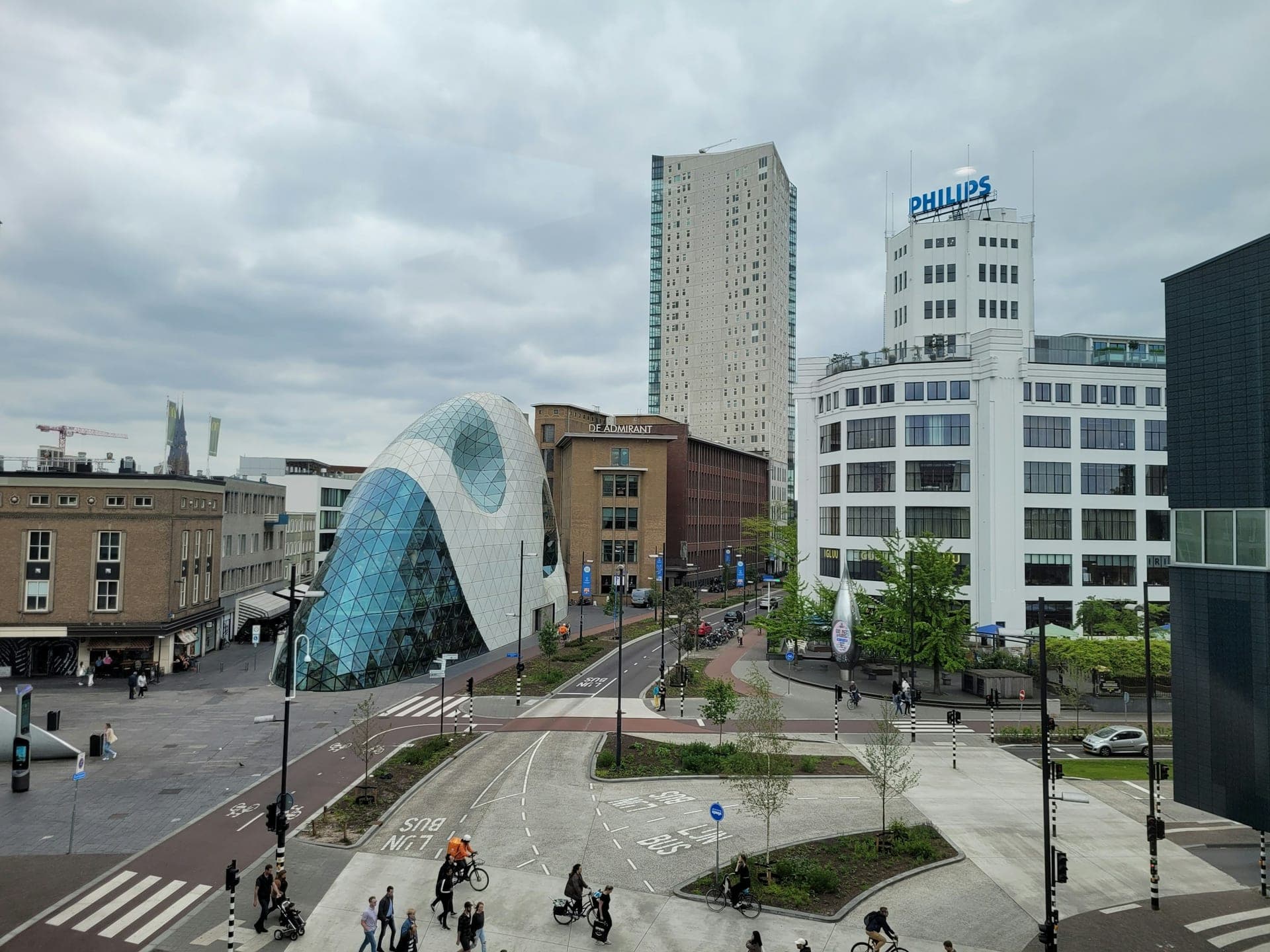
A company town that became a chip capital
Eindhoven has always been built around an employer. Philips began making light bulbs here in 1891, and within a generation the firm was housing its own workers in garden villages such as Philipsdorp. The magnet today is ASML, the maker of the machines that print computer chips, and the web of suppliers that the region calls Brainport. The company wants to take on 20,000 more staff on a new campus near the airport. So a city of 243,730 people is once again building homes for newcomers a company has recruited, and asking who else can still afford to stay.
Renting is the majority tenure. 53% of households rent and 47% own their home. The largest landlords are four woningcorporaties (independent, non-profit housing associations regulated by the state): Woonbedrijf, Trudo, Wooninc. and Woonstichting 'thuis. Together they hold 32% of the stock, about 39,500 homes. None of them is owned by the city. Private landlords let the remaining 21%. Cooperatives do not yet appear in the count: their share is 0%, with 1 organisation registered and no homes of its own.
- Owners
- Owner-occupier47.0%
- Renters
- Public & non-profit rental32.0%
- Cooperative0.00%
- Private rental21.0%
Social housing here is a rulebook rather than a building type. Around 36% of dwellings are let under the regulated social rent regime, a layer that runs across the tenures above instead of forming its own wedge. It is slightly larger than the associations' share because some regulated lets sit outside them. Eligibility is broad: half of households earn little enough to qualify.
What a household pays depends on the door it came through. An association tenancy averages €7.70 per square metre a month. A newly signed private contract costs €17.70, well over twice as much. Flexible serviced flats reach €30.10 gross, and a furnished one-bedroom flat lets for about €1,500 a month. Since July 2024 the Wet betaalbare huur (the Affordable Rent Act) has capped mid-market rents through a national points system, up to €1,157.95 a month for the best-scoring homes.
- Public/non-profit housing
- New contracts
- Serviced (gross)
Monthly rent per square metre by tier: net cold for association and new private contracts, gross all-in for serviced flats. A new private contract costs more than twice an association tenancy.
Very little housing stands empty. Residential vacancy is 1.8% and rental vacancy 2.6%, barely more than homes changing hands. Offices are looser. 6.57% of office floor space is vacant, about 99,980 square metres, and 24 office buildings stand wholly empty. At the top of the market, a one-bedroom flat on a short-stay platform fetches a median €130 a night.
Arrivals keep outrunning completions. Some 21,500 people move to Eindhoven each year, and another 14,000 stay for three to twelve months, many of them students, researchers and engineers on contracts. The council elected in 2022 planned 12,000 new homes for its term. Statistics Netherlands counted a net gain of 6,898 once demolitions were subtracted. Net production in 2024 was just over 2,100 homes, and the city's own pipeline forecast a dip in 2025 and 2026 before any recovery.
The shortage now reaches far beyond the poorest households. In 2025, 62,654 households were actively searching for a social home through Wooniezie, the region's letting platform. Each advertised home drew 656 applicants on average, and a successful applicant had been registered for 8.6 years. A rent-to-income estimate puts 39.1% of households above the overburden line. Worry has spread to the middle. The research agency Newcom surveyed Brainport residents for the regional broadcaster Omroep Brabant. Two thirds were anxious about what ASML's doubling would do to house prices. And 6 in 10 feared there would be no home for them or their children, up from half in the previous year's survey. Rob van der Horst, chair of the Eindhoven food bank, sees the same trend from the other end. "The gap between rich and poor is growing here," he told the broadcaster. In a city with no cooperative homes at all, the question is whether a third way can be built from scratch.
A cooperative instinct the associations absorbed
A Dutch wooncoöperatie (housing cooperative) is an association of residents that manages, and sometimes owns, the building they live in. There are two forms. In a beheerwooncoöperatie (management cooperative) the members run their homes while a housing association remains the owner. In a vastgoedwooncoöperatie (property cooperative) the members develop or buy the building themselves. Eindhoven's first planned project takes the second route. Its future residents will own the building jointly and rent their flats back from their own cooperative, which the developers describe as a form between buying and renting. A 2025 Eindhoven University of Technology study of Dutch cooperative policy compares both forms across every level of government, and a typology of collaborative-housing property regimes shows how many hybrids sit between them.
The city's cooperative instinct was absorbed early by its employers and associations. Philips built Philipsdorp between 1910 and 1923 as a planned workers' village of 771 homes. Civic and church-based housing societies followed. Trudo began as a woningvereniging (a members' housing society) in 1916. In 1994 it merged with the municipal housing company to form the professional association that exists today. Member control gave way to professional management, which is why Eindhoven has large non-profit landlords but no cooperative sector to speak of.
Today's cooperative landscape is therefore a set of beginnings, in three clusters. The first is the associations themselves, whose tenants' councils are the nearest thing to member voice in the existing stock. The second is new-build resident groups such as Salix, a tower planned for Park Meerland whose residents will form the cooperative before they move in. The third is small collective self-build: CPO projects (collectief particulier opdrachtgeverschap, groups commissioning their own homes), woongroepen (shared-living groups) and care clusters. All three meet the same two walls, land and finance, but the newcomers hit them hardest because they have no balance sheet. Demand is not the constraint. A survey-based study of demand for Dutch cooperatives finds appetite far beyond today's supply, and a TU Delft mapping of collaborative housing records hundreds of projects that show the form works.
The municipality now names cooperatives in its housing policy for the first time. The revised housing programme for 2026 to 2030 lists wooncoöperaties among the collective forms it will support, through a website and a named contact point at the city. It also promises to examine whether initiatives aimed at social or mid-market rent can borrow with a municipal loan guarantee. That is support in knowledge rather than land or money so far. A Housing Europe review of collaborative housing argues that the step from pilots to a steady supply of land is what lets such groups scale, and that step is still ahead of Eindhoven.
Eighty-five per cent, or two-thirds?
Housing sits at the centre of Eindhoven's new city government. PRO (the local branch of the merged GreenLeft and Labour party), the CDA (Christian Democrats) and D66 (social liberals) renewed their coalition in June 2026 with 29 of the 45 council seats. Their agreement, Samen vooruit, Samen Thuis (Together forward, together at home), promises 21,500 new homes in four years, 72% of them affordable. People in essential jobs in care, education and public safety get priority. A construction fund set up with banks is meant to restart stalled projects. Mieke Verhees of PRO stays on as alderman for housing.
Beneath the headline sits a harder number. The revised housing programme keeps the city's ambition that 85% of new homes be affordable, with 30% social rent. Commercial partners asked for a lower bar, and the programme now lets towers above 70 metres and some neighbourhood projects fall back to the coalition's lower floor. The scale is set with the region. Eindhoven must deliver or start 23,500 homes and about 1,700 student rooms by 2030, 11,500 of them in two NOVEX areas (sites the national government has designated for large-scale housebuilding). The city's own record is sobering: about 60% of planned homes are completed in the year they were scheduled.
The levers are split between The Hague, the province and the region. On 1 July 2026 the Wet versterking regie volkshuisvesting (the Act to Strengthen Public Direction of Housing) took effect. It requires two-thirds of new homes to be affordable, with a fixed share of social rent in each housing region, and every municipality must publish a housing programme by 1 July 2027. Regionally, the 2024 Beethoven agreement (a national and regional package to keep Brainport's chip industry growing) ties public money to extra homes. The province has warned that 5,100 of the 17,000 Beethoven homes may not be built because the associations cannot invest enough, a risk set out in regional reporting on the Beethoven homes. The housing minister, Elanor Boekholt-O'Sullivan, is a former top military officer, and a Guardian profile describes her push for speed over polish.
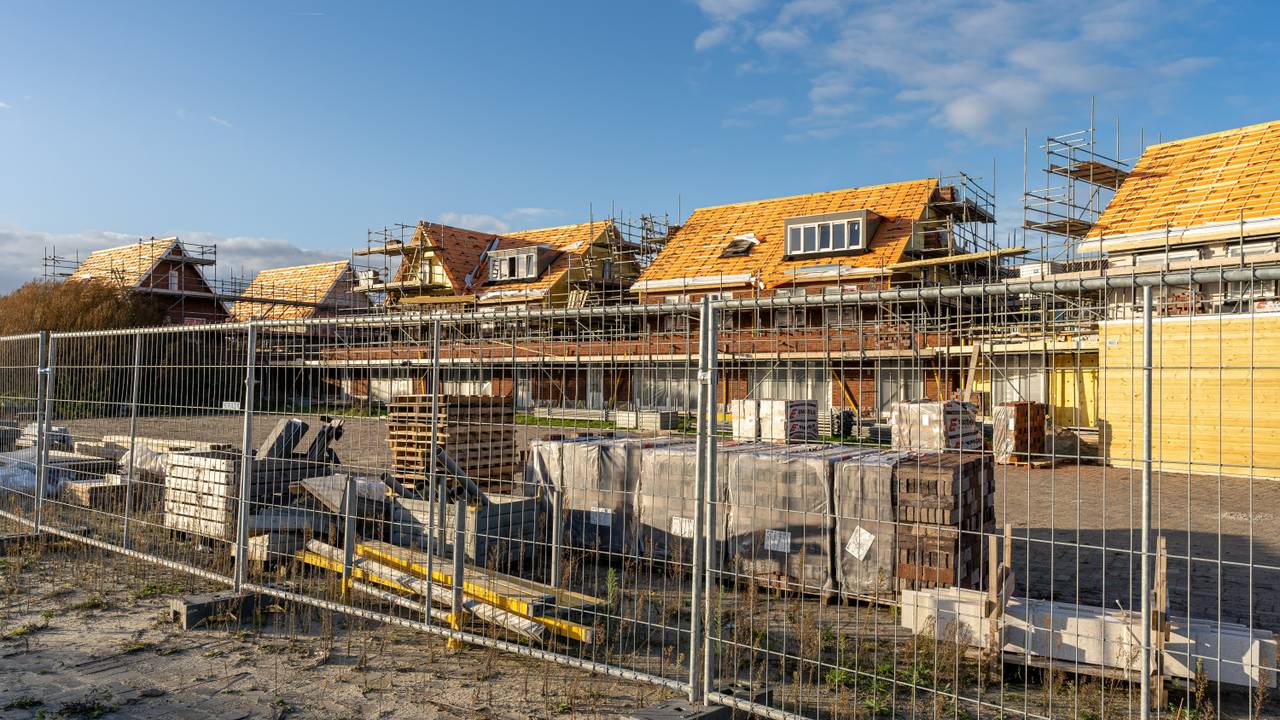
With this law the discussion about affordability agreements is settled: we build two-thirds affordable homes, of which 30% social rented homes.Cooperatives are getting their own legal lane. On 30 June 2026 the Tweede Kamer (the lower house of parliament) passed the Wet bevordering wooncoöperaties (the Housing Cooperatives Promotion Act), a private member's bill by the Socialist Party MP Sandra Beckerman. It writes both cooperative forms into the Housing Act, and municipalities that adopt cooperative policy must record it in their new housing programme. The Eerste Kamer (the senate) has yet to vote. The province of Noord-Brabant already pays for the first steps: since June 2025 collective housing initiatives can receive up to €27,500 for a feasibility study, from a yearly pot of €600,000.
The strongest local lever is land. Eindhoven buys land and keeps it, selling only to housing associations at the low end of its price range, and uses leasehold to keep a say over later sales. Rik Thijs, then a GroenLinks alderman, explained the approach in an interview that also features The Hague. Research on public-cooperative partnerships shows why that land lever matters most for groups without capital.
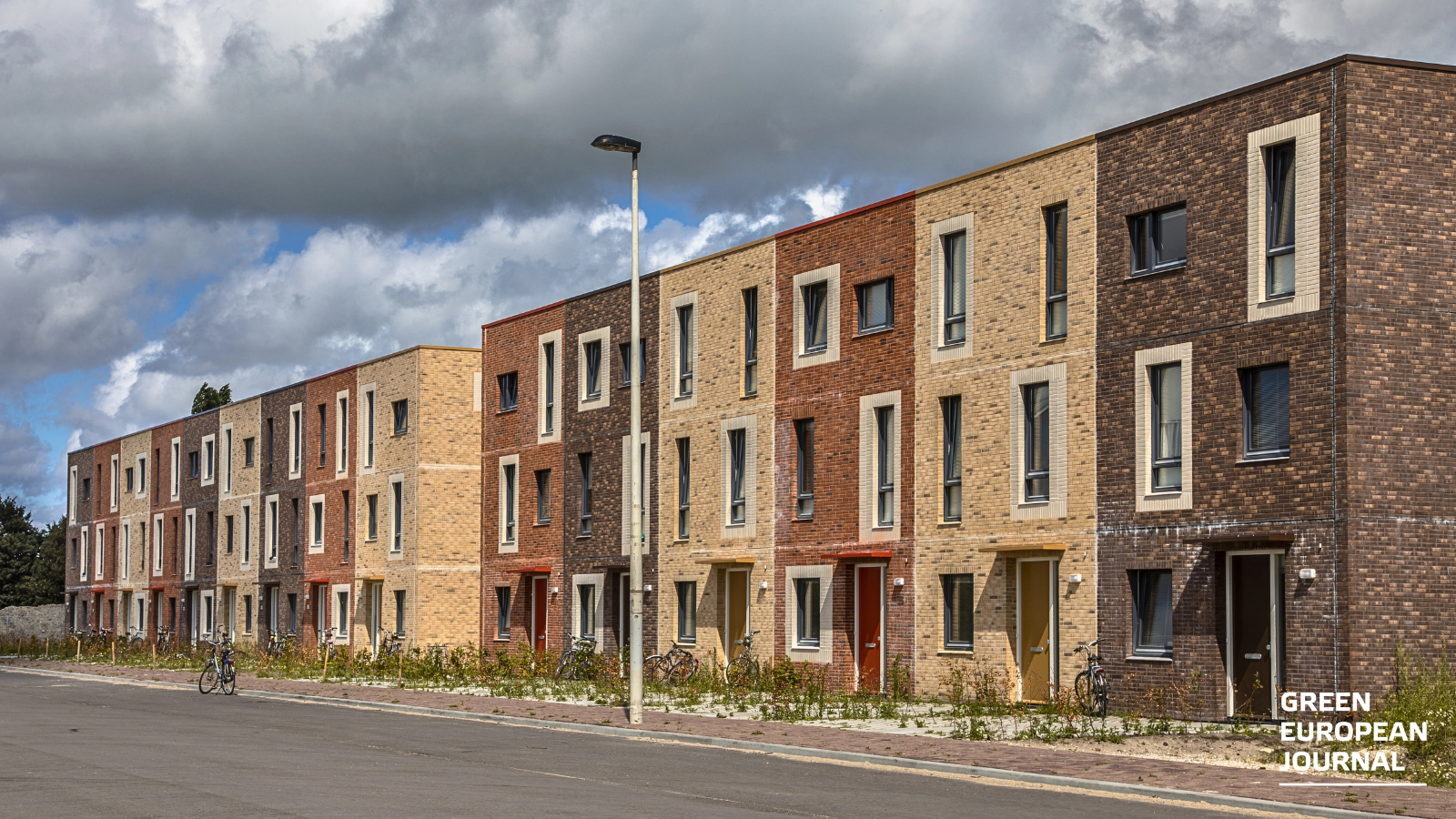
The same goes for the housing crisis: social housing can only be built if it is actively managed with land policy.Empty buildings are part of the answer. Eindhoven created 405 homes by converting existing buildings in 2024, the second-highest total in the country after Rotterdam, according to the national statistics office's conversion survey. The housing programme promises to make adding storeys, extensions and conversions easier. It sets clear rules for splitting large homes, and it commits the city to study a leegstandsverordening (a local vacancy bylaw that lets the city require owners to report long-empty buildings). Splitting echoes a national study of better use of existing homes, and a transformation meter for offices gives a tested way to judge which empty blocks can become homes. Around the station, the city holds a right of first purchase over the 55 hectares of Knoop XL. Under the Wet voorkeursrecht gemeenten (the municipal pre-emption act), owners there must offer land to the municipality before anyone else.
Climate goals ride on the same buildings. The coalition wants a green deal with the 10 largest carbon emitters in the city and will green 10 squares and 50 streets. The city's housing innovation agenda aims to build 10% of new homes with innovative methods up to 2030. The programme also ties the heat transition to the building schedule so that grid congestion, a full electricity network that cannot connect new buildings, does not stall projects. A review of circular and biobased construction by TU/e and 4TU, the federation of Dutch technical universities, maps the materials and material passports that make such targets realistic. Non-profit landlords, and cooperatives that plan for decades, are the natural carriers of that shift.
- 1910[source]
Philipsdorp begins
Philips starts building its garden village for workers in Strijp; it is completed in 1923.
- 1916[source]
Trudo is founded
The housing society Trudo is set up; it is the root of one of the four associations active today.
- 1994[source]
Municipal housing company merges
Trudo merges with the city's own housing company, leaving Eindhoven without a municipal landlord.
- 2002[source]
Strijp-S changes hands
Philips sells the Strijp-S factory site for €140 million to a partnership of the city and VolkerWessels.
- Apr 2021[source]
First 3D-printed home let
Project Milestone hands the keys of its first printed concrete house in Bosrijk to its tenants.
- May 2024[source]
A cooperative tower is chosen
A municipal jury unanimously selects the biobased Salix tower for a cooperative at Park Meerland.
- Jul 2024[source]
Affordable Rent Act
National regulation of mid-market rents takes effect, capped at €1,157.95 a month for the best-scoring homes.
- Jun 2025[source]
Brabant funds collective initiatives
The province opens feasibility grants of up to €27,500 for collective housing initiatives.
- Jun 2026[source]
Together forward, together at home
The renewed coalition promises 21,500 homes in four years, 72% of them affordable.
- Jun 2026[source]
Cooperative law passes the lower house
The Tweede Kamer adopts the Housing Cooperatives Promotion Act; the senate still has to vote.
- Jul 2026[source]
National housing law in force
Two-thirds of new homes must be affordable, with 30% social rent in each region.
- Jul 2027[source]
Housing programme due
Every municipality must have published its statutory housing programme.
- 2030[source]
The Beethoven target
Eindhoven must have delivered or started 23,500 homes and about 1,700 student rooms.
From Philips' company village to the national housing law and the city's 2030 target.
Light-bulb villages, printed houses and a tower of straw
Salix is the project that will show whether a cooperative can take root in Eindhoven. A municipal jury chose it unanimously in 2024 for a site on the edge of Park Meerland, in the west of the city near the airport. The tower stacks four “neighbourhoods” of about 15 homes each, and every one has a shared room and a shared terrace. Most floors and all partition walls are timber and other biobased materials. The insulating facade panels are almost entirely straw and wood, finished with reclaimed timber from Brabant pig barns. The architects calculate that the building stores more carbon than it emits, a net −60 kg of CO₂ per square metre. Residents will choose their own layouts before the cooperative lets the homes back to them.
Philipsdorp was the city's first large answer to a housing shortage caused by an employer's growth. Its blocks of joined houses, laid out by G.J. de Jongh and designed by L. Kooken, Cornelis Smit and K.P.C. de Bazel, still read as one village more than a century on. It has been renovated and is protected as heritage. It proves that an employer, not only a government, can plan an entire neighbourhood around the people it needs.
Strijp-S is the factory complex that Philips left behind. The land was sold in 2002 for €140 million to a partnership between the city and the builder VolkerWessels. The first permanent residents arrived in 2012, and a year later two former television factories reopened as loft buildings named Anton and Sergio after members of the Philips family. Trudo has its head office there, in the Matchbox building. It also sells homes through Slimmer Kopen, a discounted route into ownership that sits in the city's performance agreements with the associations, as their federation Aedes reports.
Project Milestone is the city's laboratory for building faster. In April 2021 a couple moved into the first of five 3D-printed concrete houses in Bosrijk, near Meerhoven. The university's own magazine called it the world's first 3D-printed concrete home ready for occupancy. The house was assembled from 24 concrete elements printed layer by layer in Eindhoven. The partners were Eindhoven University of Technology, the builder Van Wijnen, the landlord Vesteda, Saint-Gobain Weber Beamix, Witteveen+Bos and the municipality. Its lesson feeds the city's goal of building more homes with new methods.
Woonbedrijf is the region's largest landlord, with 34,764 homes across seven municipalities. Its student department, Vestide, lets rooms to students, and describes keeping a large stock of affordable student housing as its main contribution to the city. In a region that recruits talent from all over the world, those rooms are the first Eindhoven address for many newcomers.
Wooninc. and Woonstichting 'thuis complete the group of associations that sign performance agreements with the city and its tenants' councils. Those agreements cover social rent, mid-market rent, ownership products, sustainability and care. They are the practical channel through which the city's social-rent target turns into buildings.
The Lighthouse tower, opened in October 2025, is the counterpoint at the top of the market. It holds 333 private rental apartments and is now the tallest building in Eindhoven. It shows how fast the market can build upwards. Salix, Philipsdorp and the association homes show how the city can also build for people on ordinary incomes, and for the long term.
References
Statistics17Click on any number to see the source
Housing market
Tenure & affordability
Cooperative, social & public
Adaptive reuse & vacancy
Population & migration
From our library14
- Strengthening Cooperative Housing in the Netherlands - A Multi-Level Policy Analysis in Comparative Perspective — Knowledge
- Who owns collaborative housing? A conceptual typology of property regimes — Knowledge
- The demand for housing cooperatives in the Netherlands — Knowledge
- Towards Collaborative Living — Knowledge
- Herziene woonprogramma Eindhoven 2026-2030 - Voor iedereen een thuis — Knowledge
- From pilots to scale: Collaborative housing and the push for long-term affordability — Knowledge
- Bijna een derde van de Beethoven-woningen staat op de tocht — Knowledge
- ‘Luxury takes time. We don’t have time’: The former top military officer on a mission to fix the Dutch housing crisis — Knowledge
- Land Policy in Practice: A Tale of Two Dutch Cities — Knowledge
- Public-cooperative policy mechanisms for housing commons — Knowledge
- Transformaties in de woningvoorraad 2024 - kenmerken van woning- en pandtransformaties — Knowledge
- Beter Benutten Bestaande (Better Use Existing) — Knowledge
- Transformation meter for offices: A tool to assess opportunities and risks of adaptive reuse — Knowledge
- Circularity and Biobased Materials in Architecture and Design: Evaluation of the Status Quo and Defining Future Perspectives — Knowledge
Further sources20
- ASML wil verdubbelen: zorgen in de regio nemen toe — Omroep Brabant / Newcom survey, Dec 2025
- Wet betaalbare huur aangenomen en van kracht vanaf 1 juli — Rijksoverheid, Jun 2024
- Eindhoven groeit door als grootste stad van regio, maar heeft wel groeipijn — Omroep Brabant, Mar 2026 (CBS figures)
- Omgevingsprogramma Herziene woonprogramma Eindhoven 2026-2030 — Gemeente Eindhoven, Herziene woonprogramma 2026-2030
- Wooniezie: 2025 in cijfers — Wooniezie, 2025 in cijfers
- Architecten|en|en en Bygg ontwerpen grotendeels biobased woontoren voor wooncoöperatie in Eindhoven — Architectenweb, May 2024
- Philipsdorp, Eindhoven — World Garden Cities
- Eindhoven presenteert nieuw coalitieakkoord: meer huizen, minder vervuiling — Omroep Brabant, Jun 2026
- Wet Versterking regie volkshuisvesting van kracht vanaf 1 juli — Rijksoverheid, Jun 2026
- Bijna een derde van de Beethoven-woningen staat op de tocht — Omroep Brabant, Oct 2025
- Wet bevordering wooncoöperaties aangenomen door Tweede Kamer — Rijksoverheid, Jun 2026
- Subsidieregeling collectieve wooninitiatieven en sociale ondernemingen Noord-Brabant — Provincie Noord-Brabant, Subsidieregeling collectieve wooninitiatieven
- Transformaties in de woningvoorraad 2024: kenmerken van woning- en pandtransformaties — CBS, Transformaties in de woningvoorraad 2024
- Land Policy in Practice: A Tale of Two Dutch Cities — Green European Journal, Aug 2024
- Strijp-S — Wikipedia, Strijp-S
- Prestatieafspraken Eindhoven: focus op beschikbaarheid — Aedes, Apr 2022
- World's first 3D-printed concrete home ready for occupancy — Cursor (TU/e), Apr 2021
- First tenant of 3D concrete-printed house in Eindhoven receives key — IO+, Apr 2021
- Onze organisatie - Woonbedrijf — Woonbedrijf
- Lighthouse (Eindhoven) — Wikipedia, Lighthouse (Eindhoven)
Funding & land tenure
What a housing cooperative could actually build on hereEindhoven is not in the funding registry yet — the tenure figures above are national.