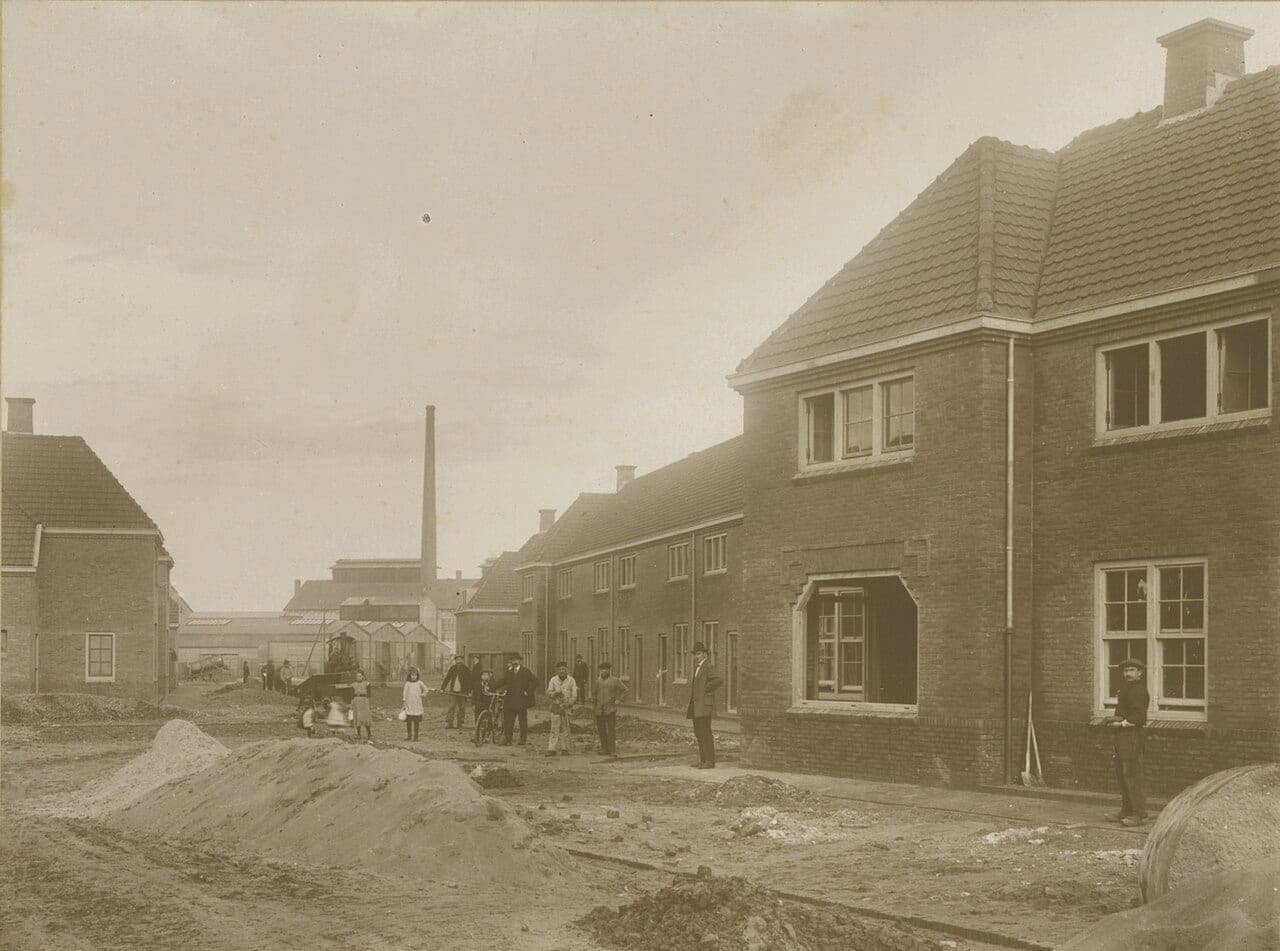
Philipsdorp is a former company town in Eindhoven, the Netherlands, developed by Philips N.V. to house workers as the company and other local manufacturers expanded and demand for housing grew. Construction took place in stages from 1910 to 1923, creating a neighbourhood of 771 homes. 1
The initial phase, known as old Philipsdorp, began with 133 homes in 1910, followed by 128 in 1912 and 80 in 1916. Later sections included the Bazelbuurt, begun in 1917, and the Lijsterbesbuurt and Plantaanbuurt, built in 1919 and 1920. The final streets were completed in 1923. 1 The overall layout was planned by engineer G.J. de Jongh; architects L. Kooken, C. Smit and K.P.C. de Bazel designed houses and other buildings across the development. 1
The neighbourhood developed incrementally rather than as a uniform scheme: its different construction phases produced distinct areas that do not merge seamlessly. Designers sought cohesion through traditional-style building blocks, while varying façades and block lengths. 1 Philipsdorp is listed as having heritage status, and its 771 homes were renovated between 2011 and 2018. 14
The project’s developer and initiator was Philips N.V.; its scope was the construction of worker housing and a planned residential district in Eindhoven. 1 The available sources do not identify a single founding date for Philipsdorp beyond the start of construction in 1910. 1