The first building
We are looking for our first building in Germany: an empty office or commercial building that can become co-op homes, taken on a long lease. Berlin, Hamburg, Munich and Frankfurt first; Cologne, Mannheim, Stuttgart and Leipzig are also in view.
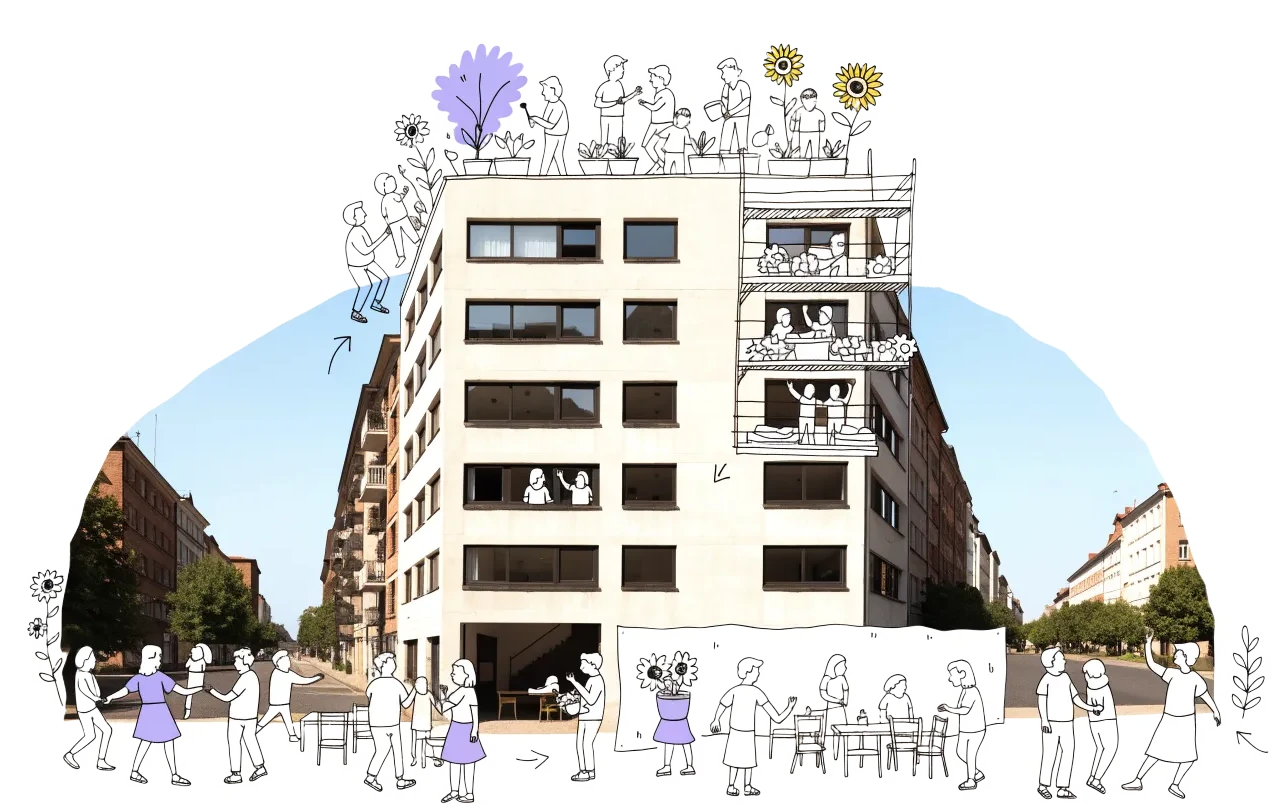
What the first building needs
Co-operatives have housed people well for 150 years. What we are building is a network of them across Europe — and every network starts with one building. Four things have to come together for it:
A building
Empty or emptying offices or commercial space — roughly 2,500 to 20,000 m², near a station, with floors daylight can reach. Taken on a long leasehold: the owner keeps the freehold.
A local partner
A housing co-op or an impact-driven developer who leads the conversion, carries the building risk and runs the homes, for a fee.
Companies
Firms that bid to build, equip, power and run it — and employers whose staff need a home for a few months or a few years.
Where — and who is in so far
The counts start now. An owner, a partner or a bank will ask how many people want to live in a building like this, in this city. These numbers are the answer — each person counts once per city, and no names are shown.
First
Berlin
1,875 empty buildings on record on the reuse radar
Hamburg
524 empty buildings on record on the reuse radar
Munich
316 empty buildings on record on the reuse radar
Frankfurt
208 empty buildings on record on the reuse radar
Also in view
Cologne
374 empty buildings on record on the reuse radar
Mannheim
82 empty buildings on record on the reuse radar
Stuttgart
175 empty buildings on record on the reuse radar
Leipzig
342 empty buildings on record on the reuse radar
Five ways in
Owners of an empty or emptying office or commercial building
Offer a building
Lease it to us long-term and keep the freehold.
Housing co-ops, impact-driven developers, architects and operators
Develop it with us
Lead the conversion locally; we bring the members, the model and the network.
Firms that build, equip, power or run buildings — and employers
Join as a company
Be a founding company and bid to supply the first building.
Impact investors, foundations, family offices and lenders
Register investor interest
Help us shape the vehicle the first building is financed through.
People who would live in, or belong to, a co-op home
Join the founding circle
Tell us your city and your terms — five minutes, no obligation.
What the pilot has to settle
The building
An owner, a public body or a family firm, and terms both sides can live with: the ground rent, the length of the lease, the state the building is in.
The numbers
A feasibility study on the real building, with the same engine as the economic model and the conversion check — then with the partner’s own costs.
The partner
Who develops it and runs it, on what fee, and how control stays with the people who live there.
The terms for members
The co-op share, the yearly fee, who lives where and for how long. The founding circle and the member companies are answering this now.
The money
The vehicle the building is financed through — a European co-operative, a fund, or both — worked out with impact investors and people who have built such structures before.
Built on open data
Every city’s reuse radar is open to anyone working on conversions — owners, councils, co-ops and developers alike, whether or not they ever work with us. The pilot searches the same maps. If you know an empty building we have missed, each radar has a form to report it.
New here? How it works tells the story of one building; the economic model shows the numbers behind it.