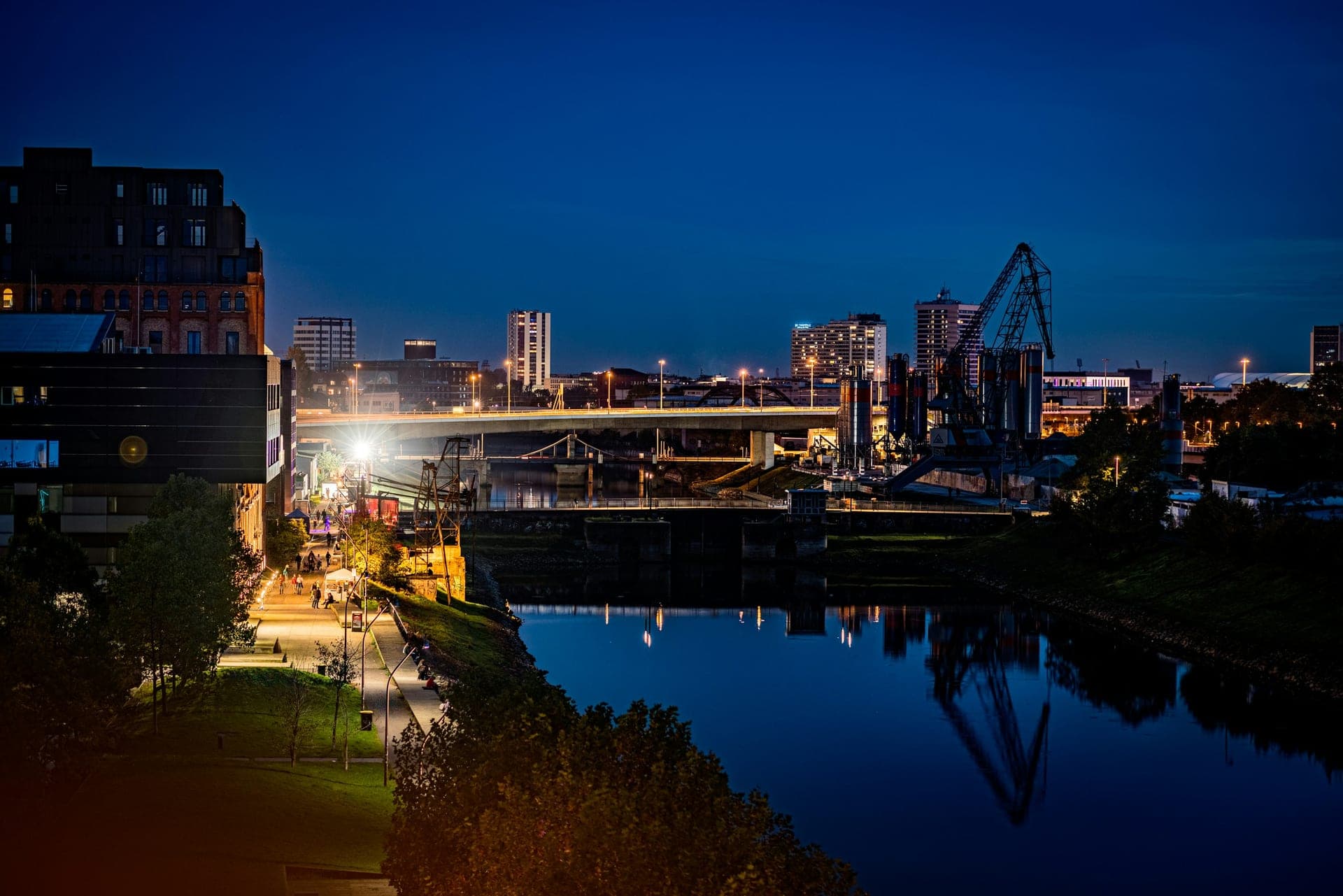
A city built for arrivals, short of homes
Mannheim was drawn with a ruler. Around 1600 an elector laid out the centre as a grid, and it still has no street names, only 144 lettered and numbered blocks called the Quadrate. The city then grew as a worker's town. Its engineers built the first bicycle and the first car, and its factories drew families from across Europe and beyond. Today almost half of residents have roots in 168 nationalities. A city built for arrivals has always had to house them, and that is where its housing story begins.
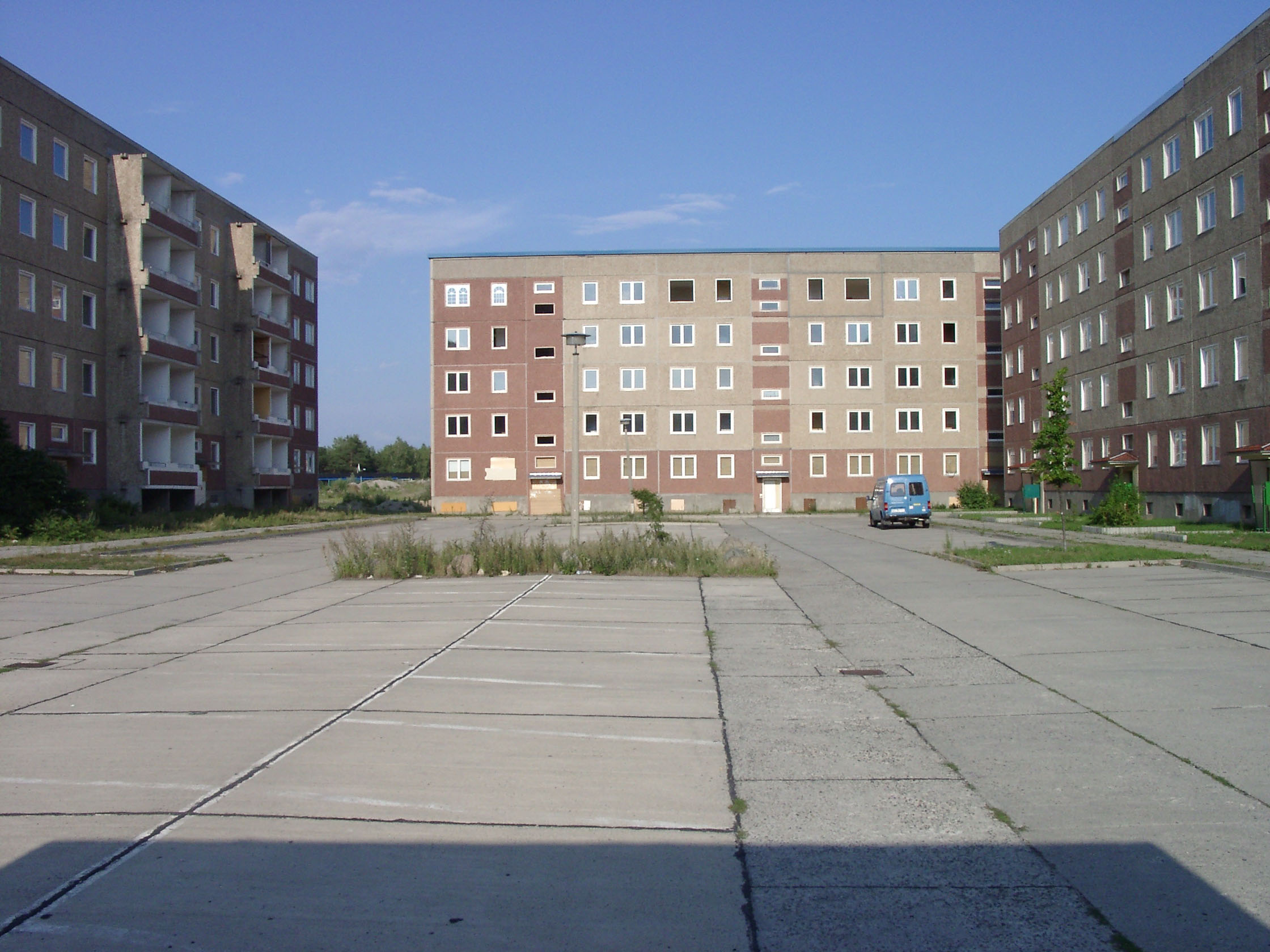
Mannheim is a city of tenants. Only 27.5% of households own their home while 72.5% rent. The largest slice, 57.5%, is private rental, much of it owned by individual landlords. Public housing makes up 11% of the stock, about 19,000 homes, almost all held by the city-owned GBG. Cooperatives hold another 4%, roughly 7,000 homes. Together these two form a non-market tier of 15%, spread over 172,570 dwellings.
- Owners
- Owner-occupier27.5%
- Renters
- Public & non-profit rental11.0%
- Cooperative4.0%
- Private rental57.5%
Social housing is a separate matter. In Germany it is not a tenure but a time-limited rule attached to a subsidy: a capped rent and an income test that lapse when the funding term ends. About 7% of Mannheim's homes carry such a rule, spread across GBG, cooperative and private buildings. The city counted 5,433 subsidised rental flats in 2024. Around 50% of households would qualify for one on income alone.
The rent spread shows what each tenure buys. Public housing lets for about €6.50/m² net cold. GBG's own average was €7.86/m² in 2025, and it lets 95% of its flats below the city's rent index. The all-stock average sits at €9.19/m². A new lease costs €12.98/m², and a furnished flat for a few months runs to €33.80/m² all-in. Buying is no escape: flats sell for about €3,408/m², and new building costs some €2,450/m² before land.
- Cooperative
- Public/municipal housing
- All-stock median
- New contracts
- Furnished / serviced (gross)
Net-cold monthly rent per square metre by tier (furnished is gross, all-in). Cooperative and public rents sit close together near €6.50; a new private lease costs about twice as much.
Empty homes are not the answer they seem. The 2022 census found 4.5% of dwellings unoccupied, and 4,100 empty residential buildings. Yet only 1.7% were empty and ready to let, one of the highest rates in Baden-Württemberg but still a tight market. Offices tell a different story. Some 10.3% of office space stood empty in 2024, about 0 m², and a later count put the rate at 10.1%, the highest in the Rhine-Neckar region.
People keep arriving. About 25,000 people move to Mannheim each year, and some 18,000 residents stay between three months and a year. Building has not kept pace. Completions fell from 1,385 homes in 2023 to 640 in 2024, and the city expects to need 17,000 more homes by 2040. Until the end of 2025 a rent brake capped new leases. Mannheim then fell out of the state's list, so new contracts have been uncapped since January 2026.
The pressure falls unevenly. A study of rent burdens in 77 large German cities found that low-income tenants carry by far the heaviest share of their income in rent. In Mannheim that shows up in the eastern estates. In Vogelstang, a district with many migrant households in poorly insulated blocks, residents told EU researchers they struggle to heat and cool their homes affordably. It reaches the middle too. Asking rents rose to €11.86/m² in 2024, and the rent-index average jumped 8.4% in a single edition. That is a burden well beyond the poorest households. Even GBG, the gentlest landlord in town, filed 125 eviction suits in 2025.
Against that pressure, Mannheim's cooperatives, older than the city's own housing company, hold a modest slice of homes but an outsized share of its affordable ones.
Shares, not deeds: the cooperative way
Cooperative housing in Mannheim works on the classic German model. Members buy a Genossenschaftsanteil, a refundable share that makes them co-owners of the whole cooperative rather than of any one flat. In return they gain a permanent right to live in their home and pay a Nutzungsgebühr, a user charge set to cover costs rather than to earn a return. The flat can never be sold on the open market. That is why the charge stays low: Gartenstadt-Genossenschaft averaged €6.46/m² in 2021, roughly two-thirds of the all-stock rent.
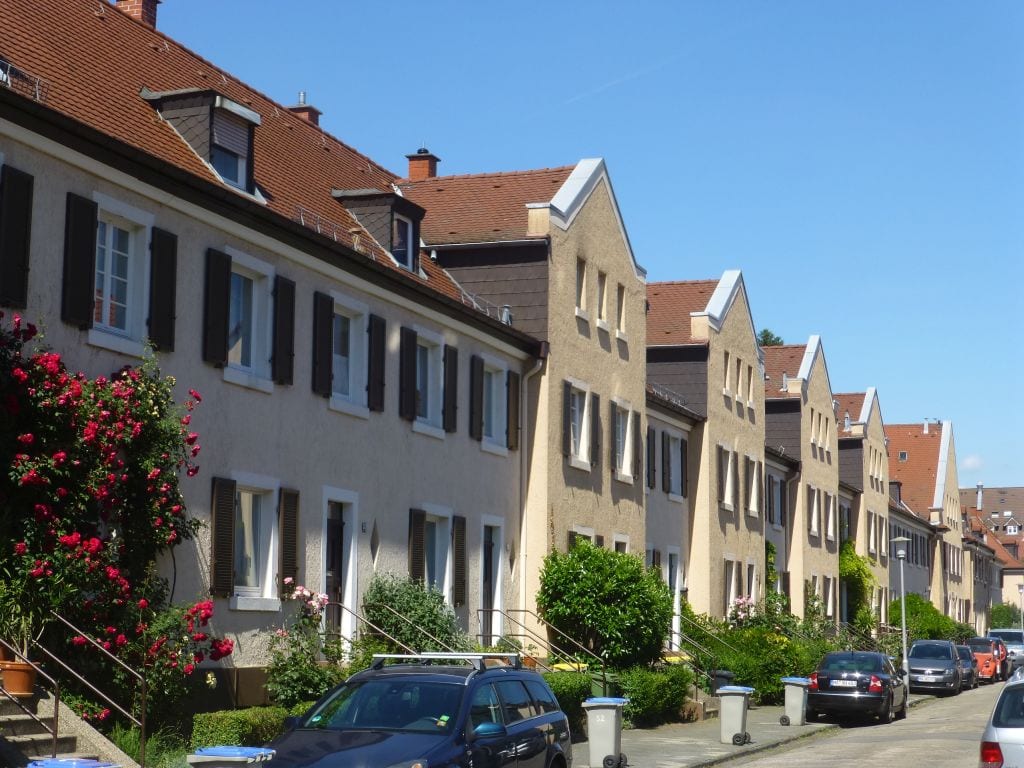
The tradition grew out of the factory age. The Spar- und Bauverein 1895 was founded in 1895 in the middle of Mannheim's industrial boom. In 1910 39 women and men founded what became Gartenstadt-Genossenschaft to build a garden suburb at Waldhof, an answer to industrial living conditions. A second wave followed the war. Familienheim Rhein-Neckar began in 1947 to house refugees, with the stated aim to ease the housing shortage in Mannheim.
Today the sector falls into two clear clusters. The first is the large, century-old cooperatives. Gartenstadt alone has 4,161 homes and 8,800 members, and Familienheim manages 2,423 homes. Their challenge is an ageing stock and rising standards. Gartenstadt's board has warned that climate and quality rules inevitably push up prices, and the risk new building now poses for cooperatives is felt nationwide. The second cluster is small and new. Mannheim counted 17 completed community housing projects in 2023, among them Oikos and three houses on the Mietshäuser Syndikat model, a federation that takes buildings off the market for good. Their problem is not maintenance but getting started: land, and equity. At Oikos, members' shares covered 35% of the building cost.
These newer groups follow a pattern a federal study of shared living in cooperatives traced across Germany, and research on Germany's Baugruppen, self-build groups that commission their own homes, found that building together cuts costs and knits neighbours closer. The city has taken note. A council decision reserves a share of every sale of city land for community housing projects. Federal policy frames cooperatives the same way, as partners of the municipalities in the push for affordable homes. The question is how far Mannheim's politics will carry that support.

Quotas, brakes and a heat plan
Mannheim's answer has been built at the municipal level. In 2017 the council adopted a 12-point programme for housing. In May 2018 it added a quota model, passed by 24 votes to 23 with the mayor's casting vote. Every larger new development must now make at least 30% of its homes affordable rentals. A 2023 update set that rent 33% below the local reference rent and fixed the tie for 30 years. Since 2018 the city has signed contracts for about 1,000 affordable flats under the rule. Christian Specht, the Oberbürgermeister (lord mayor), has praised GBG projects with a high subsidised share as an important offer for citizens.
The other levers sit above the city. The Land (the state of Baden-Württemberg) decides which towns get a Mietpreisbremse, a rent brake that ties new leases to the local reference rent. It dropped Mannheim from the list for 2026. On 22 September 2026 the state announced it would bring Mannheim back from 2027, alongside Konstanz and Kehl. The state also runs the subsidy programme. It approved 3,367 social flats in 2025, its best year in a decade, yet new affordable completions across the state are falling. The federal government sets the frame. It extended the rent brake to 2029, pledged €23.5 billion for social housing to 2029, and passed a Bau-Turbo (a fast-track exemption from planning rules) in 2025. A new Wohngemeinnützigkeit, a tax status for non-profit landlords who let below market, took effect in 2025.
The housing market is overheated. It's only about cashing in.For cooperatives the key tool is the Konzeptvergabe, a tender that awards city land on the quality of a project rather than its price. On FRANKLIN, almost every plot was sold this way, and small groups such as Oikos won sites on Spinelli through the same route. The council's reserve of city land for community projects gives newcomers a foothold. The older cooperatives use it too: Familienheim Rhein-Neckar is among the builders on Franklin.
The empty space is policy too. In 2021 Mannheim passed a Zweckentfremdungsverbot, a ban on misusing homes, that forbids leaving a flat empty for more than six months or letting it to tourists for more than 10 weeks a year. The bylaw lapses after five years, in October 2026. For empty offices, the city has created two advisory posts to help owners convert commercial space into homes. A federal ministry report on empty offices sees the same potential nationwide, and research on post-war inner-city office blocks shows many can become flats.
Climate policy shapes every one of these homes. Mannheim is one of the EU's 100 climate-neutral cities, and its climate action plan aims to cut emissions by at least 80% by 2030; by 2023 it had reached 40%. The municipal heat plan, adopted in 2024, will move most of the city onto district heating. The utility MVV plans to connect 75% of households and retire the gas network, and its foundation, MVV Stiftung Zukunft, funds local energy-transition projects. The cooperatives and GBG own the large blocks where retrofits add up fastest, and serial renovation at a Hagen cooperative shows how that can be done at scale.

Our member companies are investing less because construction costs are what they are.The debate runs between two camps. One, voiced in 2018 by Green councillor Gerhard Fontagnier, blames an overheated market and wants tighter rules. The other, the housing companies' federation VBW, points to construction costs that have made its members build less. Both agree Mannheim needs more affordable homes; they disagree on whether regulation or cost is the brake.
- 1910[source]
A garden-city cooperative
Thirty-nine founders start the cooperative that builds Gartenstadt Waldhof, a garden suburb for industrial Mannheim.
- 1926[source]
The city founds GBG
Mannheim creates its own non-profit building company to counter a glaring shortage of affordable homes.
- 2012[source]
The barracks come back
After the US Army withdraws, about 500 hectares of barracks return to civilian use; MWSP buys Turley, the first site, in 2012.
- 2017[source]
12-point programme
The council adopts a 12-point housing programme, the frame for the city's affordable-housing instruments.
- May 2018[source]
Quota model by one vote
By 24 votes to 23 the council requires at least 30% affordable rental homes in larger new developments.
- Oct 2021[source]
Misuse ban
A bylaw bans leaving homes empty for over six months or letting them short-term for over 10 weeks a year, for five years.
- Apr 2022[source]
EU climate mission
Mannheim is chosen as one of the EU's 100 climate-neutral and smart cities.
- 2023[source]
Quota tightened
The housing strategy confirms the quota, sets affordable rents 33% below the local reference rent and extends the binding to 30 years.
- Mar 2024[source]
Heat plan adopted
The council adopts the municipal heat plan that maps which streets move to district heating.
- Jan 2026[source]
Out of the rent brake
Mannheim drops out of the state's rent-brake list; new leases are uncapped.
- Oct 2026[source]
Misuse ban expires
The five-year empty-homes and short-let bylaw reaches its end date unless the council renews it.
- 2027[source]
Rent brake to return
The state plans to bring Mannheim back under the rent brake from 2027 to the end of 2029, in 133 municipalities.
- 2028[source]
Second river heat pump
MVV's second large heat pump drawing on the Rhine, a €200 million investment, is due in autumn 2028.
- 2030[source]
Climate target
Greenhouse-gas emissions are to fall by at least 80% from 1990 levels; by 2023 they had fallen 40%.
- 2040[source]
Homes still needed
The city's forecast puts the need at 17,000 additional homes by 2040.
From the first garden-city cooperative and the founding of GBG, through the barracks conversion and the quota model, to the rent-brake gap, the climate target and the homes still needed.
Barracks into neighbourhoods
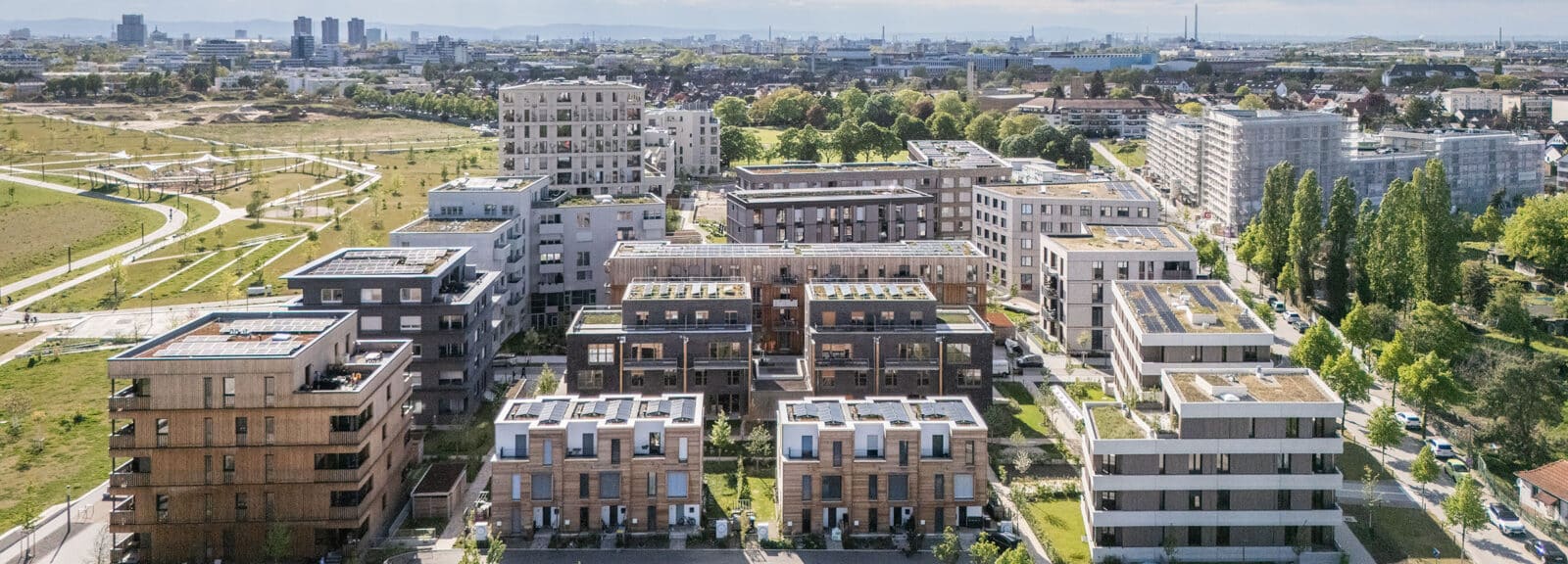
FRANKLIN is the largest test of what Mannheim can build. The former Benjamin Franklin Village, once home to American soldiers and their families, covers 144 hectares. It will hold 5,100 homes, about a third of them in the low-cost segment. 7,773 people already live there, on the way to some 10,700. The site is run by MWSP, a city development company in the GBG group, which chose almost every builder through a concept tender. The mix it produced is unusual: GBG, Familienheim Rhein-Neckar, building groups and a land-trust foundation all work side by side on one estate.
13 ha Freiheit shows the self-organised end of that range. When the US Army left Turley barracks, the first site handed back, a group of residents built a house on the Mietshäuser Syndikat model. Since 2016 it has housed about 65 people in 29 flats at €7.60/m². Next door, umBAU² Turley holds 11 homes, two of them for refugee families from Syria, and the SWK collective houses 23 residents. None of these homes can ever be sold, which is the whole point of the model.
Oikos brought a new cooperative to the Spinelli site, where a former barracks became a large park and a new neighbourhood. Founded in 2019, it won its plot through the city's concept tender and finished 21 homes in early 2023, from 48 to 122 m². The monthly charge is about €13/m², a new-build price, but one that cannot be raised for profit. Across Spinelli, MWSP requires that 30% of homes are let at least 30% below the city average. Oikos is small, yet it proves a group of households can still start a cooperative from scratch in Mannheim.
GBG remains the city's main instrument. Founded by the city in 1926 to fight a housing shortage, it now lets 19,933 homes and added 236 new-build flats in 2025. In Feudenheim it is building 114 flats, 50 of them subsidised. Its managing director, Karl-Heinz Frings, describes the subsidised share there as well over 40%. The company has now returned to its 20,000-home target, with some 600 of those homes new-built.
Gartenstadt-Genossenschaft closes the circle. Its garden suburb at Waldhof began in 1912 with 130 homes, designed as a response to the poor living conditions of industrialisation, and its old core is now a protected monument. More than a century on, the same cooperative still lets its homes for about two-thirds of the city's average rent. Mannheim built its grid for newcomers four centuries ago. Its barracks, its garden city and its small new cooperatives show it still knows how to make room for them; the task now is to do it at the scale its arrivals demand.
References
Statistics17Click on any number to see the source
Housing market
Tenure & affordability
Cooperative, social & public
Adaptive reuse & vacancy
Population & migration
From our library18
- GBG Unternehmensgruppe (GBG Mannheimer Wohnungsbaugesellschaft) — Organisation
- Wie viele (und welche) Wohnungen fehlen in deutschen Großstädten? — Working Paper 217 — Knowledge
- The hidden link between Europe's housing crisis and energy poverty — Knowledge
- Gartenstadt-Genossenschaft Mannheim eG — Organisation
- Familienheim Rhein-Neckar eG — Organisation
- Neubau wird für Wohnungsgenossenschaften zum Risiko — Knowledge
- Neues Wohnen – Gemeinschaftliche Wohnformen bei Genossenschaften — Knowledge
- Self-build communities: the rationale and experiences of group-build (Baugruppen) housing development in Germany — Knowledge
- Bündnis für bezahlbares Wohnen und Bauen – Wohnungsgenossenschaften als Partner der Kommunen — Knowledge
- Wohnungsmarkt-Monitoring Mannheim 2025 — Knowledge
- Beim Bau von preiswerten Wohnungen in Baden-Württemberg droht eine Durststrecke — Knowledge
- Bundestag: Mietpreisbremse verlängert — Knowledge
- German housing crisis: government plans construction boost — Knowledge
- Schriftlicher Bericht des BMWSB zum deutschlandweiten Büroleerstand — Knowledge
- REDEVELOPMENT - Reusing unprofitable and functionally deficient 1950s to 1970s inner-city office buildings for residential purposes – possibilities and chances — Knowledge
- MVV Stiftung Zukunft — Organisation
- Renovating Homes the Cooperative Way in Germany: Serial Renovation at Wohnungsverein Hagen — Knowledge
- MWSP – MWS Projektentwicklungsgesellschaft — Organisation
Further sources32
- www.heidelberg24.de — www.heidelberg24.de
- Wikipedia — en.wikipedia.org
- Stadt Mannheim, Wohnungsmarkt-Monitoring 2025 — www.mannheim.de
- GBG Geschäftsbericht 2025 — berichte.gbg-unternehmensgruppe.de
- Statistisches Landesamt Baden-Württemberg — www.statistik-bw.de
- JLL — www.jll.com
- Mieterverein Mannheim — www.mieterverein-mannheim.de
- Gartenstadt-Genossenschaft member magazine 2022 — gartenstadt-genossenschaft.de
- lei.bloomberg.com — lei.bloomberg.com
- de.wikipedia.org — de.wikipedia.org
- www.fh-rn.de — www.fh-rn.de
- Familienheim Rhein-Neckar — www.fh-rn.de
- Stadt Mannheim, Netzwerktreffen gemeinschaftliches Wohnen 2023 — www.mannheim.de
- Stadt Mannheim, Gemeinschaftliche Wohnprojekte 2018 — www.mannheim.de
- Die Rheinpfalz — www.rheinpfalz.de
- Amtsblatt Mannheim, June 2025 — www.mannheim.de
- Land Baden-Württemberg — www.baden-wuerttemberg.de
- Land Baden-Württemberg — www.baden-wuerttemberg.de
- baulinks.de — www.baulinks.de
- www.forvismazars.com — www.forvismazars.com
- franklin-mannheim.de — franklin-mannheim.de
- Stadt Mannheim — www.mannheim.de
- European Commission — germany.representation.ec.europa.eu
- Amtsblatt Mannheim, June 2026 — www.mannheim.de
- ZDFheute — www.zdfheute.de
- Staatsanzeiger — www.staatsanzeiger.de
- FRANKLIN Mannheim — franklin-mannheim.de
- FRANKLIN Mannheim — www.franklin-mannheim.de
- heinze.de — www.heinze.de
- MWSP — www.mwsp-mannheim.de
- GBG Geschäftsbericht 2025 — berichte.gbg-unternehmensgruppe.de
- Wikipedia — de.wikipedia.org