
The city that emptied, refilled and ran short
Leipzig has a habit of changing course in public. It printed the world's oldest known daily newspaper from 1650, and on 9 October 1989 well over 70,000 people faced armed security forces on its ring road. Then the city emptied. Between 1990 and 1998 its population fell from 511,079 to 437,101, and whole streets of Gründerzeit tenements (the ornate blocks built between about 1870 and 1914) stood dark. The municipal register now counts 632,562 residents. The housing question has flipped from what to do with empty flats to how to find one.
This is a city of tenants. Only 13.5% of homes are lived in by their owners. Cooperatives hold 15% of the stock, about 53,313 homes. Public housing, meaning homes owned by the municipal company LWB (Leipziger Wohnungs- und Baugesellschaft), makes up 10.3%, or 36,700 homes. Private landlords let the largest slice, 56.7%. The small remainder of the 354,898 dwellings counted by the 2022 census is mostly homes that stood empty on census day.
- Owners
- Owner-occupier13.5%
- Renters
- Public & non-profit rental10.3%
- Cooperative15.0%
- Private rental56.7%
- Other4.5%
- Vacant on census day4.5%
Social housing is a rule, not a tenure. In Germany it means a flat built with subsidy that carries a capped rent and an allocation rule for a fixed period, whoever owns it. Leipzig has almost none. Only 0.6% of homes carry that binding, 2,044 flats in August 2025. Demand for them is climbing. The number of WBS certificates (the permit that entitles a household to a subsidised flat) nearly tripled between 2020 and 2024, to 3,424.
Rents follow the tenure. LWB tenants pay around €5.14 per m² net cold, and cooperative members about €5.77. The city's rent index puts the median across all stock at €7.13. New lettings are advertised at €9.10. Furnished flats, priced gross with utilities and furniture, reach €19.10. Between 2020 and 2024 advertised rents rose 29%, while sitting tenants saw 15%.
- Public housing (LWB)
- Cooperative
- All-stock median
- New contracts
- Furnished / serviced (gross)
Monthly rent per m². The first four tiers are net cold; the furnished tier is gross, with utilities and furniture priced in.
Empty homes have not disappeared, but they have changed character. The 2022 census found 5.4% of dwellings empty, 19,308 homes. About 11,000 were ready to let within three months, a normal reserve for people moving. More than 3,000 stood empty for 'other reasons', often whole buildings with no plan behind them. Offices are tighter than in many German cities. About 4.8% of office space, some 0 m², was empty in 2024.
People keep arriving. About 40,455 people moved to Leipzig in 2024, a net gain of 5,887, most of them aged 18 to 34. Builders finished 2,771 homes that year, the second-highest figure since 2001. The pipeline is thinning, though: permits fell from 4,774 in 2020 to 1,772. Rent control has held. Saxony has renewed the Mietpreisbremse (the rent brake) for Leipzig until 30 June 2027. It holds new lets to 10% above the local reference rent.
The burden falls unevenly, and the city's own survey shows where. On average households spend about 30% of income on rent. But 19% spend more than 40%, against 13.2% of tenants nationally. The poorest fifth pay 43% of their income in rent, the richest fifth 20%. The Leipziger Zeitung's reading of the 2024 citizens' survey adds that two-thirds of overburdened households sit in that bottom fifth, and a further quarter in the lower middle class. So the squeeze has reached the middle. It is also the issue people feel most: two-thirds of 18- to 34-year-olds now name housing as one of the city's biggest problems. 14,460 households draw Wohngeld (the state housing allowance). The German Tenants' Association's Mietenreport 2026 tracks the same gap between rents and incomes across the country.
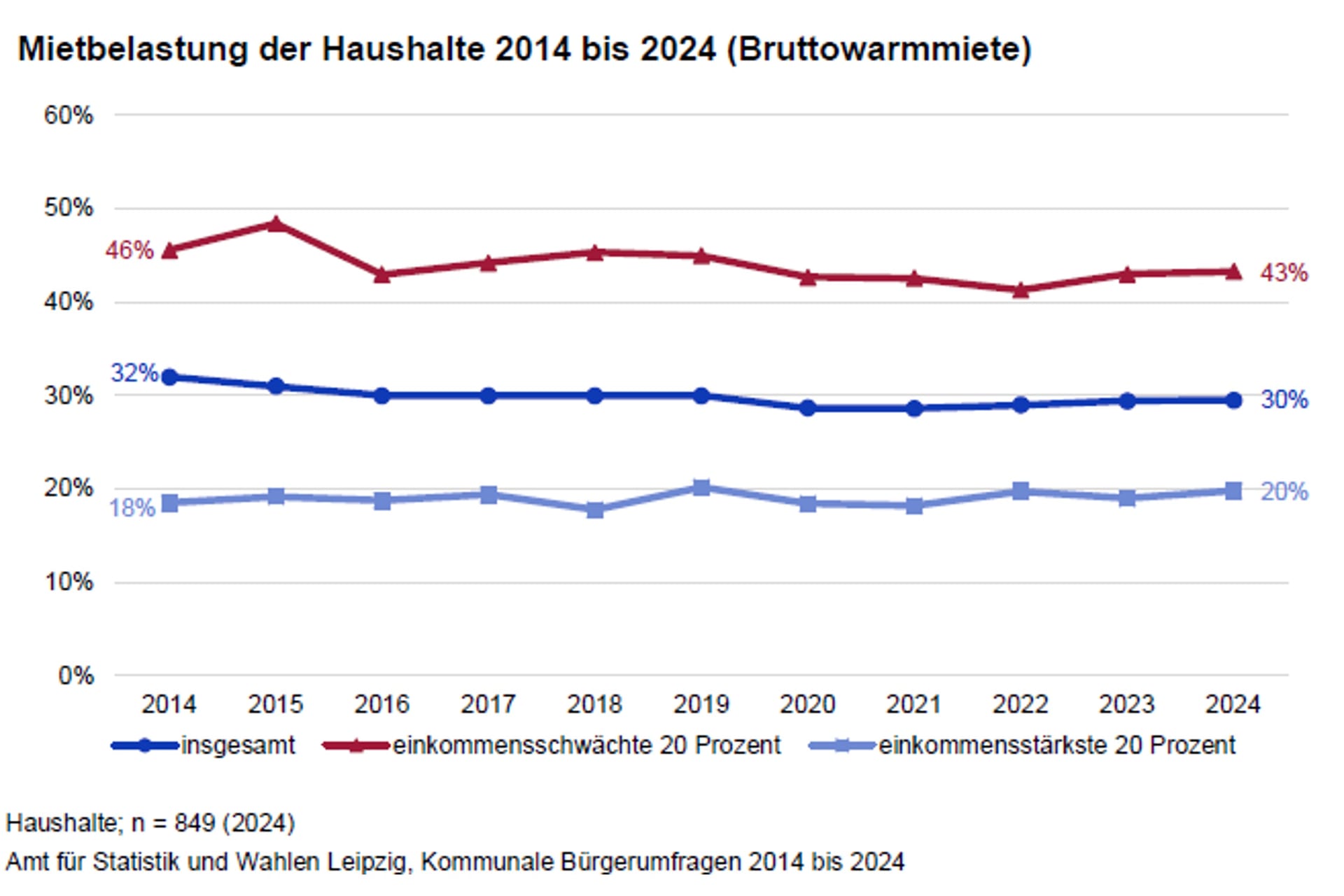
Steadily rising rents make it clear that pressure on the housing market keeps growing and that more and more households depend on support to find a home. Keeping and creating affordable housing that meets people’s needs therefore remains one of the greatest challenges in our city.Against that pressure, Leipzig's largest store of below-market homes belongs neither to the state nor to investors. It belongs to cooperatives, which house one resident in five.
Six old giants and a scatter of house projects
Leipzig's cooperatives are rental cooperatives. A household buys Genossenschaftsanteile (member shares that make it a co-owner of the cooperative, not of its flat) and then pays a monthly usage fee. The flat cannot be sold on, and the shares are repaid when the member leaves. Six large cooperatives dominate: BGL, Kontakt, Lipsia, Unitas, Wogetra and VLW. Together they managed more than 48,000 homes in 2020. Beside them sits a younger form, the self-managed house project. It is usually organised as a single-building cooperative or inside the Mietshäuser Syndikat, a federation that co-owns each house with its residents so it can never be resold.
The tradition predates the GDR. The Bauverein zur Beschaffung preiswerther Wohnungen, founded on 31 January 1898, survives as Baugenossenschaft Leipzig, Saxony's oldest housing cooperative. By 1927 it owned 2,450 flats. The GDR merged it with neighbours into a workers' housing cooperative, which built 3,157 flats by 1989, 2,673 of them in the panel-block estate of Grünau. After 1990 the cooperatives carried that Plattenbau (prefabricated panel-block) stock through mass vacancy, and the city answered with demolition of 15,000 homes. The study of 160 years of German housing co-operatives by Pfatteicher, McCarthy and Power traces how the form survived both states and their reunion.
Today the sector falls into three clusters with different problems. The big traditional cooperatives own most of the stock and have all but stopped building. Across Saxony, cooperatives finished 282 new flats last year, down from more than 500 a decade before, as Die Sachsen reported. New homes would need rents of €15 to €20 per m², so the money goes into existing buildings. The VSWG annual statistics for 2025 put the average cooperative rent across Saxony at €5.75, with 35.5% of the gross warm rent now going on running and heating costs. Energy shocks and retrofit bills are the pressure Theresia Theurl's analysis of cooperatives in challenging times describes. The second cluster is self-organised. The Alternative Wohngenossenschaft Connewitz eG owns 14 mostly once-squatted houses, and Syndikat houses add more. Their problem is land and equity, not ageing members. The third cluster is new building groups on city ground leases, which have stalled on construction costs.
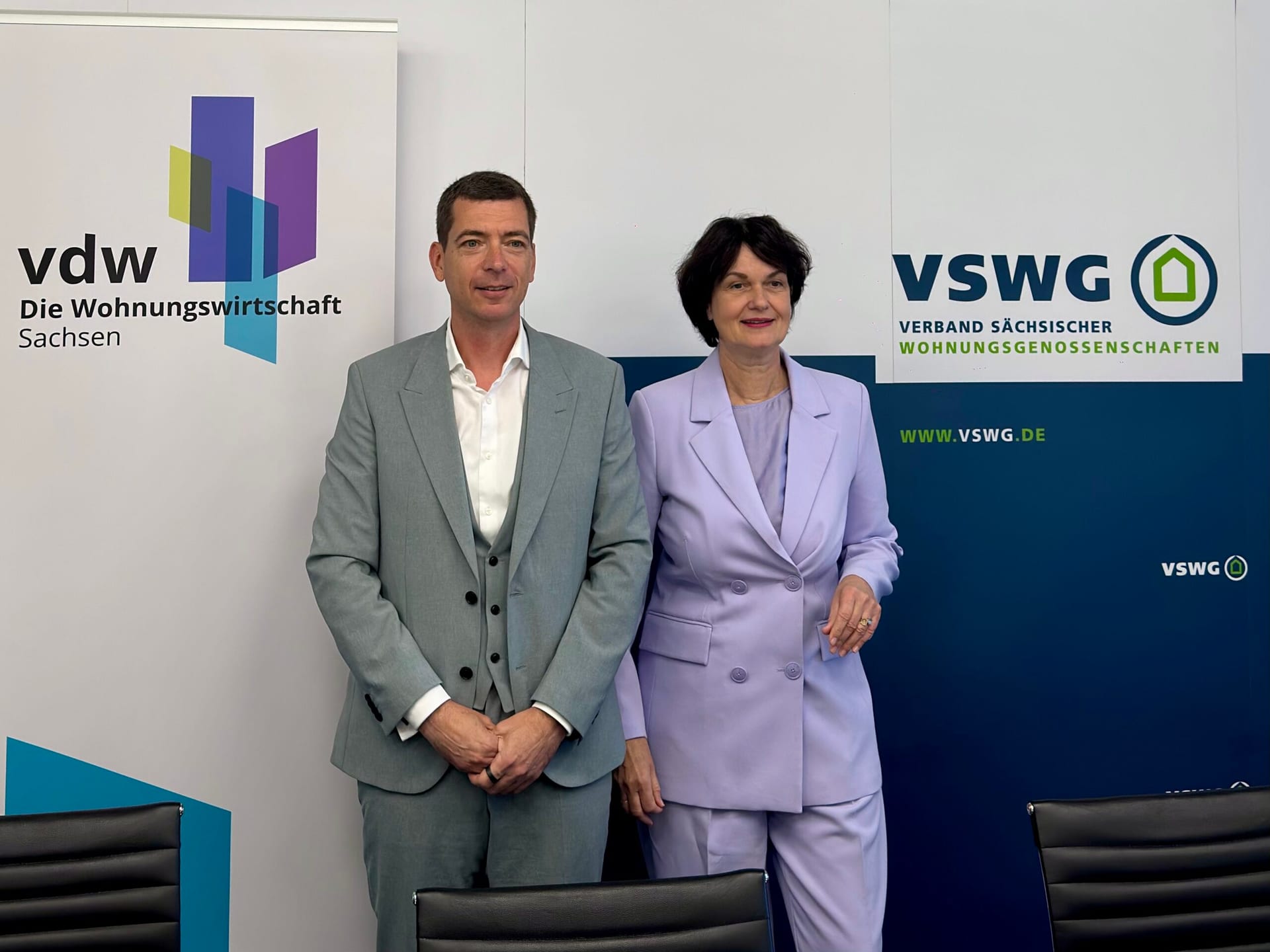
The city courts the small end more than the large one. Its housing concept names cooperative forms as a goal. Since a 2022 council decision it regularly leases city land to them rather than selling it. Yet cooperatives and foundations have built just 59 of the flats contracted under Saxony's social-housing subsidy, against 1,270 by LWB and 1,481 by private owners. The big cooperatives once argued the market was near balance: in 2020 they estimated up to 10,000 flats were available at once. That argument has aged badly, and the policy question is now how to bring their weight into new supply.
Rent brakes, ground leases and a turbo with strings attached
The city's plan starts from its Wohnungspolitisches Konzept (housing policy concept), updated by the council in June 2024. It sets hard numbers. LWB must grow from 36,000 homes to at least 40,000 by 2030, and half its new building should be social housing, about 200 flats a year. New development plans must reserve 50% of residential floor area for subsidised flats. The gap is wide all the same. The city estimates it needs 1,150 rent-capped flats a year but will complete fewer than 500. Leipzig's 2026 subsidy plan spells out the arithmetic behind that shortfall.

The levers are split three ways. The federal level sets tenancy law: the Bundestag has extended the rent brake to 2029 and passed the Bauturbo, a time-limited fast-track for housing permits. The Free State of Saxony holds the subsidy money. Saxony's ministry for infrastructure (SMIL) funds social housing through its FRL gMW guideline and raised the grant to 45% of the asking rent. Its minister, Regina Kraushaar, renewed the rent brake while promising to make it unnecessary through building. The city holds land, permits and LWB. In 2026 it has no money for its own top-up, so subsidised new-build will start at around €7.67 per m² in 2029. That is above what the job centre pays for a claimant's housing, and the Leipziger Zeitung found such flats now miss the households they were meant for.
The sharpest fight in 2026 was over the Bauturbo. In February the council let the city waive development plans for housing schemes. In return developers must build and deliver 30% subsidised flats on schemes above 5,000 m². That is looser than the 2024 rule of 50% above 2,000 m², the Leipziger Zeitung reported. The Left group wanted the stricter rule kept. The cooperative federation wanted the tool used boldly. A Heinrich Böll Foundation debate on the Bauturbo weighed the same trade-off nationally.

With this decision the council has legitimised further speculation with residential property in our city. This resolution is disastrous and opens the city gates to profiteering.The Bauturbo can only work if it is actually applied on the ground. It needs an administration that is able to act and willing to be bold, and clear backing from the municipality. Otherwise this instrument remains a good concept on paper.Even LWB is contested. It plans rent rises on 10,900 flats in 2026, more than a quarter of its stock, using the legal cap of 15% in three years. Left councillor Juliane Nagel argues this pushes up the rent index for the whole city, as the Leipziger Zeitung reported. The city replies that forgoing rises would leave LWB's running costs uncovered.
For cooperatives, the main instrument is land. Under the Konzeptverfahren (concept-led land tenders, scored on quality not price), plots are let on Erbbaurecht (a long ground lease, so the city keeps the land). Deputy mayor Thomas Dienberg says the tenders should make housing 'diverse, affordable and future-proof'. The first round drew 17 bids for 6 plots. Then costs soared, and almost every later winner withdrew. The BBSR (the federal institute for building and urban research) study Wohnungsgenossenschaften als Partner der Kommunen sets out what such land partnerships need to last.
The vacancy reply is enforcement. Under a council resolution against speculative vacancy, the city can issue a Modernisierungs- und Instandsetzungsgebot, a legal order to repair. Around 230 neglected Gründerzeit buildings still stand empty. If owners refuse, the city can fine them or do the work and send the bill. Conversion of offices matters less here than in Frankfurt, given Leipzig's modest office vacancy. The federal BMWSB report on office vacancy (from the federal ministry for housing, urban development and building) treats it as a national, not a Leipzig, lever.
Climate goals run through the same stock. Leipzig aims to be climate-neutral by 2040, cutting emissions to 0.25 tonnes of CO₂ per resident. Cooperative homes start from a decent base: over 90% of Saxon cooperative flats sit in energy classes B to D. Leipzig firm r3leaf sells climate-risk analysis for renovation decisions. The cooperative federation wants a legal basic standard for simpler building to cut costs. The concept-tender winners proposed timber frames, green roofs and rainwater reuse.

- 1898[source]
First building society
The Bauverein zur Beschaffung preiswerther Wohnungen is founded on 31 January; it survives as Baugenossenschaft Leipzig, Saxony’s oldest housing cooperative.
- 1990–1998[source]
The city shrinks
Population falls from 511,079 to 437,101 as residents leave for the west; vacancy reaches 50% in some districts.
- 2002[source]
Stadtumbau Ost
The federal–state urban restructuring programme starts; between 2003 and 2015 Leipzig spends €122 million, 38.1% of it on demolition.
- 2004[source]
The first guardian houses
HausHalten e.V. launches the Wächterhaus model for empty listed buildings; 18 houses follow.
- 2021–2022[source]
First concept-led land tender
17 building groups bid for 6 plots offered on ground leases; the leases are signed in early 2022.
- October 2022[source]
Climate programme adopted
The council adopts the Energie- und Klimaschutzprogramm 2030 on the path to a climate-neutral city by 2040.
- June 2024[source]
Housing concept updated
The council’s updated Wohnungspolitisches Konzept requires 50% subsidised housing in new development plans above 2,000 m² of residential floor area.
- January 2026[source]
Rent brake renewed
Saxony’s ordinance keeps the Mietpreisbremse in force in Leipzig and Dresden until 30 June 2027.
- February 2026[source]
Bauturbo with conditions
The council lets the city apply the federal fast-track, tied to a building obligation and 30% subsidised homes.
- 2027[source]
Saxon rent brake expires
Unless renewed, the state ordinance lapses on 30 June 2027; the federal law allows rent brakes until 2029.
- 2030[source]
LWB target
LWB is to grow from 36,000 to at least 40,000 homes.
- 2040[source]
Climate-neutral city
Emissions are to fall to 0.25 tonnes of CO₂ per resident a year.
From the first building society through shrinkage and regrowth to the targets the city has set itself.
From guardian houses to ground leases
HausHalten e.V. turned Leipzig's emptiness into an invitation. Founded in 2004, it launched the Wächterhaus (guardian house). Owners of empty listed buildings pay for a basic start-up and are spared the running costs. In return the users keep the building dry, safe and alive. 18 guardian houses followed, and many were later bought by their users. The AusBauHaus variant trades cheap rent for tenants' own fit-out work. In 2008 the federal ExWoSt research programme took the model up.
Netzwerk Leipziger Freiheit is the city's answer for the growth years. It gives free first advice to housing-project groups, works with the city's urban renewal office and supports groups bidding in the land tenders. It argues that building groups can save up to 20% of building costs. The Urban Institute's Lessons from Germany's Shared Housing Models singles the network out as the incubator behind Leipzig's small project cooperatives. National advisers work alongside it: the wohnbund e.V. network of community-housing consultants, founded in 1983, and innova eG, a cooperative that has helped found new cooperatives since 2001.
Gothaer Straße 42 in Gohlis shows what the first land tender produced. The Syndikat group WE forever won it with a plan for a neighbourhood café. Ein Haus im Fluss in Zschocher, another Syndikat group, took Breitschuhstraße 31. HolzBrau Süd planned timber housing on Braustraße. A group for people over 50 and a project with residents with disabilities won plots too. It was a showcase of the mix the city wants. LWB put its own buildings into the tenders too, including one in Mockau that went to the Cassida group, so the municipal company and the self-organised scene have already shared a table. Only one project from the next round, at Sternenstraße, survived the cost spike.
SoWo Leipzig eG is the tool for tenants who never planned a house project. Founded in May 2017, it is a Dachgenossenschaft (umbrella cooperative) that can buy a building when a sitting tenant community wants to stay. Its first house, in Lindenau, came with help from the Swiss Stiftung Edith Maryon. The foundation bought the land and leased it to SoWo on a ground lease from 2018. The model borrows from Berlin's Bremer Höhe and Hamburg's Schanze. The Holm and Laimer volume on community-led housing sets it in that wider family.
Klinge10 is the proof that new-build can still happen outside the market. The group worked from 2017 to build a house at Klingenstraße 10 within the Mietshäuser Syndikat. Residents moved in at the end of 2023. A collective's practice rooms opened on the ground floor in January 2024. The group plans solar panels, a heat pump and a lift for older residents. Nobody can ever sell it for profit.
Baugenossenschaft Leipzig closes the circle back to 1898. Its Grünau blocks, built in the GDR and carried through the vacancy years, now sit in a city short of cheap flats. The large cooperatives hold the scale; the house projects hold the new ideas. Neither can close the gap alone. Leipzig's open question is whether the two can meet on the city's leased land, with subsidy that reaches the people the survey says are struggling, before building costs close that door.
References
Statistics12Click on any number to see the source
Housing market
Cooperative, social & public
Adaptive reuse & vacancy
Population & migration
From our library22
- Leipzig – Zahlen und Erzählungen einer wachsenden Stadt — Knowledge
- Monitoringbericht Wohnen 2025 — Knowledge
- Leipziger Wohnungsnot: Statt 1.150 entstehen pro Jahr nur knapp 500 Sozialwohnungen — Knowledge
- Bundestag: Mietpreisbremse verlängert — Knowledge
- Bürgerumfrage 2024: Mietkosten treffen die Ärmsten am härtesten — Knowledge
- Mietenreport 2026 - Deutscher Mieterbund — Knowledge
- Housing co-operatives in Germany: 160 years of evolution and resilience — Knowledge
- Neubau wird für Wohnungsgenossenschaften zum Risiko — Knowledge
- Bezahlbares Wohnen im Freistaat Sachsen unter Druck – VSWG Jahresstatistik 2025 — Knowledge
- Housing Cooperatives in Challenging Times — Knowledge
- Wohnungsbauförderkonzeption 2026 — Knowledge
- Der Stadtrat tagte: Bei der Entscheidung zum Bauturbo geht's im Stadtrat heftig zur Sache — Knowledge
- Einfacher und schneller Bauen: Hilft der Bauturbo zur Lösung der Wohnungskrise? — Knowledge
- Linke-Stadträtin hinterfragt Automatismus: LWB plant 2026 Mieterhöhungen in mehr als 10.000 Wohnungen — Knowledge
- Bündnis für bezahlbares Wohnen und Bauen – Wohnungsgenossenschaften als Partner der Kommunen — Knowledge
- Schriftlicher Bericht des BMWSB zum deutschlandweiten Büroleerstand — Knowledge
- r3leaf — Organisation
- Lessons from Germany's Shared Housing Models: Expanding Ownership Opportunities and Improving the Built Environment — Knowledge
- wohnbund e.V. — Organisation
- innova eG — Organisation
- Gemeinschaftliches Wohnen und selbstorganisiertes Bauen — Knowledge
- Bauen wird immer teurer: Sächsische Wohnungsgenossenschaften blicken auf anspruchsvolles Geschäftsjahr 2025 zurück — Knowledge
Further sources20
- Einkommende Zeitungen — Wikipedia
- Stadt Leipzig — Der 9. Oktober 89 — Stadt Leipzig
- Sächsische Staatsregierung beschließt Mietpreisbegrenzungsverordnung für Dresden und Leipzig — Sächsische Staatsregierung
- Bürgerumfrage 2024: Wenn Armut, Wohnen und Einkommen in Leipzig immer mehr zum Problem werden — Leipziger Zeitung
- Monitoringbericht Wohnen 2025: Nachfrage wächst, Neubau nimmt zu — Stadt Leipzig
- Leipziger Wohnungsgenossenschaften: Leipzigs Wohnungsmarkt dreht in Richtung Überversorgung — LEIPZIGINFO.DE
- Baugenossenschaft Leipzig — Wikipedia
- Bezahlbares Wohnen im Freistaat Sachsen unter Druck — VSWG / vdw Sachsen
- SoWo Leipzig eG — Hintergründe — SoWo Leipzig eG
- Selbst geförderte Mieten sprengen in Leipzig die KdU-Grenzen — Leipziger Zeitung
- „Bauturbo“ soll mehr Wohnungsbau in Leipzig ermöglichen — Stadt Leipzig
- Stadt Leipzig und LWB vergeben Grundstücke in Konzeptverfahren — Stadt Leipzig
- Abgeschlossene Konzeptverfahren zum kooperativen und bezahlbaren Bauen und Wohnen — Stadt Leipzig
- Modernisierungs- und Instandsetzungsgebote in Leipzig — Stadt Leipzig
- Leipzig auf dem Weg zur klimaneutralen Stadt bis zum Jahr 2040 — Stadt Leipzig
- Projekt Wächterhäuser — Stadt Leipzig
- Netzwerk Leipziger Freiheit — Wir — Netzwerk Leipziger Freiheit
- Georg-Schwarz-Strasse / Merseburger Strasse — Stiftung Edith Maryon
- Klinge10 — ein Neubauprojekt mit dem Mietshäuser Syndikat in Leipzig — Klinge10
- Bund-Länder-Programm Stadtumbau Ost in Leipzig — Stadt Leipzig