Context and source
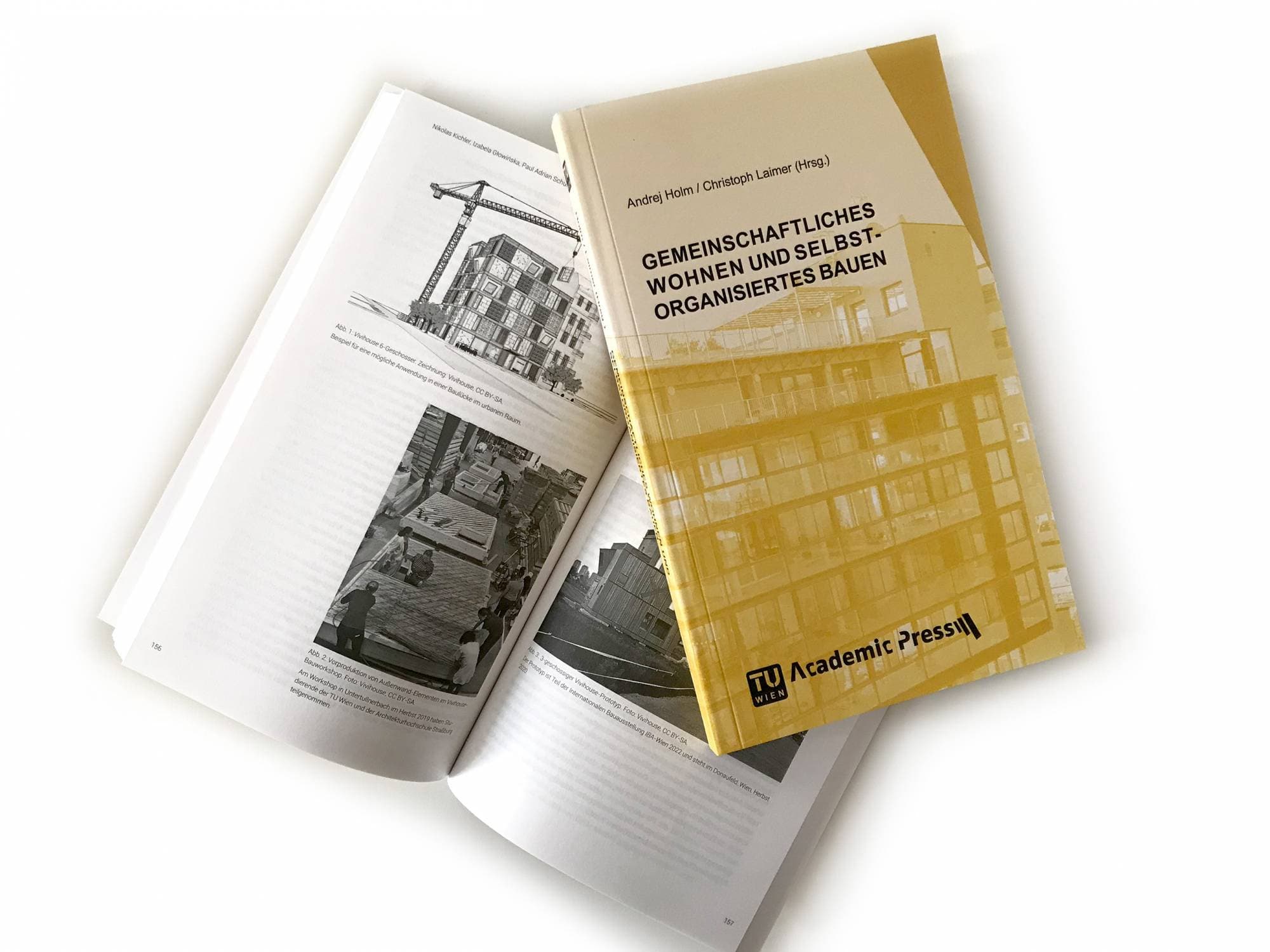
“Gemeinschaftliches Wohnen und selbstorganisiertes Bauen” is a 2021 edited volume published by TU Wien Academic Press and edited by Andrej Holm and Christoph Laimer. The book is released under a Creative Commons Attribution–ShareAlike 4.0 license (CC BY-SA 4.0) and is available online via TU Wien Academic Press and a DOI (978-3-85448-044-0). The publication emerged from a one-year Research Fellowship “Immobilienwirtschaft & Standortentwicklung”, funded by the Immobilien Privatstiftung, in cooperation with the future.lab at TU Wien.
Purpose and framing
The volume positions community-led housing and self-organised building as practical responses to two linked challenges: changing social needs that standardised “modern” family housing often does not meet, and increasing market pressure that treats housing primarily as a financial asset. It highlights projects that rely on self-organised planning, non-profit-oriented management, and collective responsibility, aiming to secure affordable housing while enabling participation and greater control over living environments.
Housing as a social infrastructure
A central argument is that housing policy historically addressed not only physical shelter but broader social conditions. The book contrasts today’s often narrowed understanding of “social” housing (mainly affordability and equipment standards) with earlier traditions that integrated collective facilities and everyday support—such as the “Red Vienna” municipal housing model that combined architecture with shared amenities and services. Against contemporary trends of isolation and rising living costs, the book describes mutual aid and neighbourhood support as increasingly important, especially for groups facing vulnerability such as single parents, people outside the labour market, or those with precarious employment.
Housing as commodity and pathways to decommodification
The book details how commodification and investment logics intensify affordability problems and restrict residents’ influence over their homes. It discusses counter-traditions and instruments of “decommodification”, including cooperative movements, municipal housing, non-profit principles, and newer legal-financial models that aim to remove buildings from speculative markets. Examples referenced include the Mietshäuser Syndikat model and the use of private direct loans to reduce monthly housing costs, alongside long-term structures designed to prevent resale-driven profit.
Structure and thematic scope
The collection combines historical, conceptual, and practice-oriented contributions. Early sections trace histories of utopian communities, cooperative housing initiatives, and self-help traditions, alongside debates on the “housing question” (including Friedrich Engels’ interventions). Conceptual chapters examine commons, property relations, solidarity economy, and collective ownership. A practice-focused block addresses instruments such as long-term leasehold (Erbbaurecht), organisational/legal models, financing strategies, self-build approaches, and typologies like cluster living and collective households.
Cases, interviews, and analytical “building blocks”
The volume includes interviews and discussions with practitioners (including an interview with architect Gabu Heindl) and reflections on projects in Germany, Austria, and Switzerland. It concludes with an investigation that identifies eight recurring “building blocks” of self-organised and community housing: land, carrier/ownership model, financing, planning and construction, management principles, administration, participation mechanisms, and allocation rules. Together, these elements are presented as a toolkit for creating long-term affordable, collectively governed, and sustainability-oriented housing in European urban contexts.