Why is it so hard to find a home in Europe?
Prices have come loose from incomes, empty buildings sit next to housing queues, and the people trying to move are the ones nobody counts. A guided tour of the crisis and its six drivers.

What happens when you open the listings app?
Open a listings app in Lisbon on a Tuesday evening. Set the filter to what a nurse earns, and the map empties. Run the same search in Berlin, Amsterdam or Madrid and it empties in much the same way. This is the housing crisis as most people actually meet it: not a national average, but a screen with nothing on it.
Behind that screen is a gap that opened slowly. Between 2010 and 2025, house prices in the European Union rose by 60.5% and rents by 28.8%, with the two lines pulling apart after 2015. Incomes followed neither. The Commission’s own reading of the crisis puts the consequence plainly: by 2024, 8.2% of EU residents were spending more than two fifths of their disposable income on housing, rising to 31.1% among people already at risk of poverty.
The households caught are not the ones the word “housing crisis” usually conjures. The squeeze now reaches the middle: people earning too much for scarce social housing and too little to buy or rent where they work. On the Commission’s own numbers, about 40% of Europe’s urban population would need a mortgage running beyond twenty years, taking 30% of average income, to buy even a 25 m² flat. Around 30% would cross the same line simply to rent one.
A job in another city, a new baby or a separation puts a household back on the open market, and the open market is where the price is. Sitting tenants and people looking to move are effectively shopping in two different cities. The table below sets seven of them side by side. Watch the new-let factor: what a fresh lease costs, divided by what the average tenant already pays.
In Lisbon, Berlin and Amsterdam a new lease costs more than twice the typical sitting rent. Vienna’s large regulated sector narrows that gap without closing it, at €13.70/m² a month on a new lease against €7.50/m² across the stock. Paris has the opposite problem: almost no gap, and high rents on both sides of it.
The conventional answer to all this is volume. The Commission’s research service reckons the Union needs more than two million new homes a year to 2035, some 650,000 a year beyond current output, and its costing of the investment gap puts the bill near €1.68 trillion. Supply has plainly not kept pace. Yet every city in that table also holds tens of thousands of empty dwellings. Both things are true at once, and the second one is where the next section starts.
Why is the greenest home the one that already exists?
Somewhere in Europe a building comes down about once a minute. That is the campaigners’ framing, and it restates something the European Environment Agency already projects: between 5% and 15% of today’s building stock will not be standing in 2050. Every one of those demolitions throws away serviceable space and the carbon already spent making it.
Buildings account for roughly 40% of the EU’s energy use and 36% of its energy-related greenhouse gas emissions, so no climate plan works without them, and decarbonising buildings is now argued as an affordability measure too. The arithmetic does not stop at the heating bill. Much of a building’s carbon is spent before anyone moves in, locked into concrete, steel and haulage. Whole-life carbon studies find that keeping a structure and adapting it for housing can undercut demolition and rebuild by a wide margin.
At the other end of the cycle, Europe is not renovating what it keeps. Deep energy renovation runs near 1% of the stock a year against the Renovation Wave target of 3%. France manages about 0.7% and Germany 0.9%. Denmark, the best performer on the continent, reaches 1.8%. Ranked against the target, almost nobody is close.
Energy poverty is what the backlog feels like from inside a flat. Between 8% and 20% of households in southern and eastern member states cannot keep their homes warm enough: 17.1% in Spain, 20.7% in Bulgaria. From 2028 the EU extends carbon pricing to heating fuel through a second emissions trading system. Poorer households spend more of their income on energy and are likelier to live in the badly insulated homes they cannot afford to upgrade, which is why modelling of that scheme returns the same warning: without targeted compensation, the cost of greening the stock falls on the people least able to carry it.

Which leaves the strange thing about European cities. They are short of homes and full of empty space at the same time. Plot office vacancy against residential vacancy and a corner appears where the offices are empty and the housing market has no slack at all. Those are the places where turning under-used offices into homes is easiest to argue for: it adds dwellings where they are genuinely missing, and avoids most of the embodied carbon of building new.
The cheapest low-carbon home in Europe is one that has already been built. Some of those are standing empty as homes; a great many more are standing empty as offices, and turning them into housing is its own long story. Who gets to live in any of them is the next question.
Who is left standing outside?
About 1.12 million people in the EU have nowhere to live. In the same union, an estimated 47.5 million dwellings stand empty. Those two figures belong in one sentence, because the organisations that count both read them as one system: tuned for assets, not for residents.
Try a plainer test. A cross-border investigation asked whether a nurse could afford to live where nurses are needed, and found more than one in seven municipalities in Europe out of reach on that salary. Official statistics tend to miss this, because the standard affordability measure tracks people who already have a home. Those trying to move do not appear in it at all.
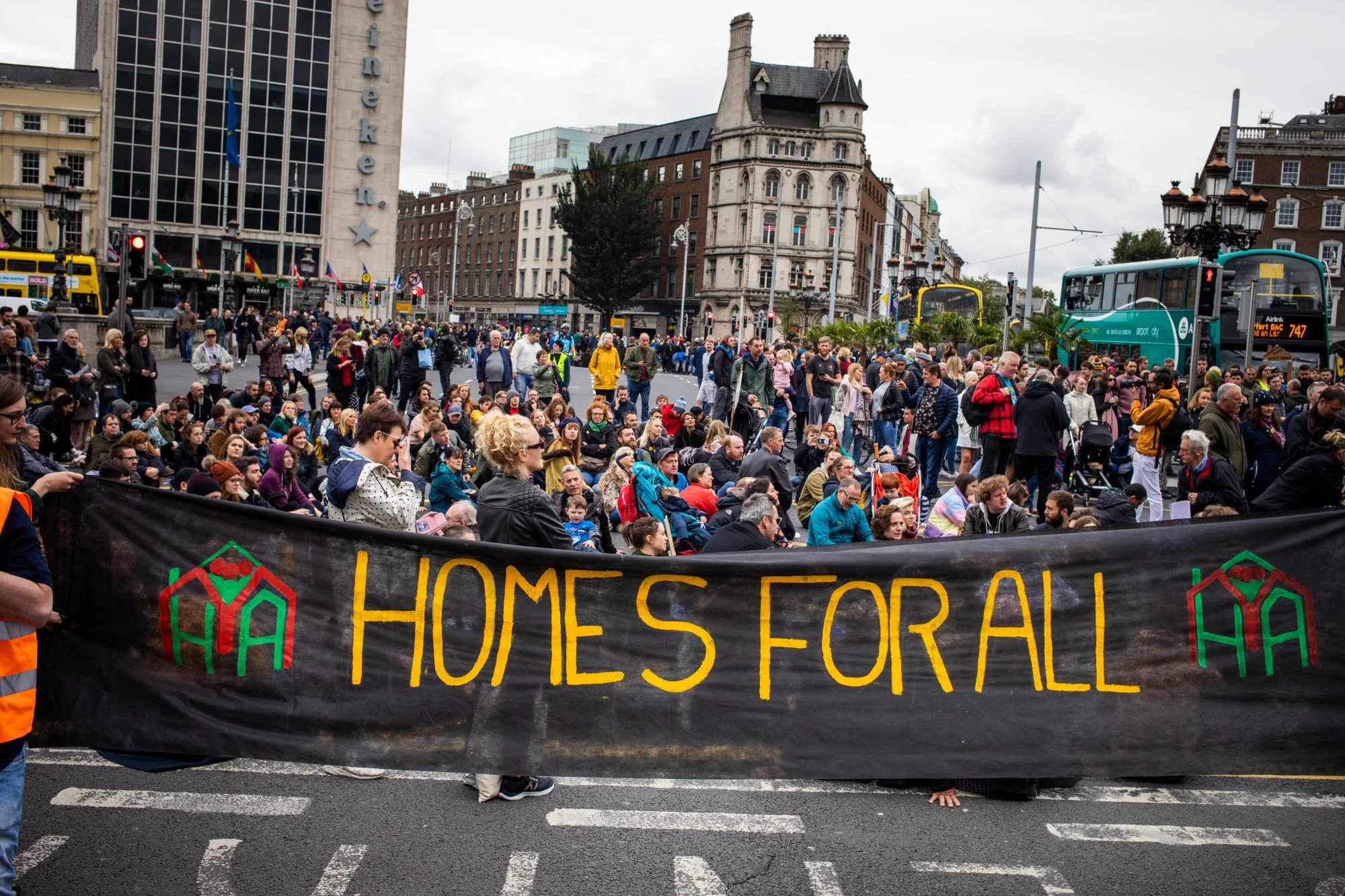
The generational split is sharper. Work for the European Parliament’s housing committee finds young adults, single parents and lower-income renters carrying the fastest-rising costs and the most distant prospect of ownership. They respond the only way they can, by forming households later and staying in the parental home longer. Then there is the question of who gets a reply at all. Large-scale testing across the EU found applicants with a migrant or minority background received roughly 27% to 32% fewer responses to rental enquiries. German courts can fine up to €250,000 for an overtly discriminatory advert, which suggests the practice is neither rare nor subtle.
More room has not brought more company. Europeans occupied around 35 to 36 m² each in 2018, roughly 16% more than in 2000, largely because households got smaller. In the first EU-wide loneliness survey, 13% said they felt lonely most or all of the time, close to 50 million people. Recent arrivals in a municipality reported it at 19.6%, against 14.2% among those settled for over a decade. Moving is how you find work. It is also how you lose your neighbours.
None of this stays private. Research on the politics of housing links unaffordable housing to falling trust in institutions and to parties that fold housing grievance into nativist stories. The same body of work carries a more useful finding on the other side of the ledger: broad-based social housing and participatory densification weaken those stories. The chart below puts housing anxiety next to trust in national parliaments, country by country. Look at which way the cloud leans.
Ability to find and keep a home turns out to shape whether institutions look like they work for ordinary life. So what is producing the pattern?
Six things pushing in the same direction
Expensive homes, empty space and pressure to build still more: it takes several mechanisms working together to produce that combination. Three of them turn a loop that feeds itself. Three more press on it from outside. Tap a driver in the diagram to see what it does.
Financialisation. The deepest driver turns a place to live into an asset class. Tangible assets held by the EU’s listed residential funds grew from €4.8 billion in 2004 to €198.7 billion in 2024, more than forty times over, against nineteen times for the rent collected. Between 2015 and 2024 household credit in the EU fell 18% while house prices rose 61%: the money buying homes is wealth now, not debt. It arrives by a different route in each country, and it can be sent back out again.

Short-term lets. Platforms pull dwellings out of the long-term market, and the damage is local rather than national. In Barcelona’s highest-Airbnb neighbourhoods rents rose 7% and sale prices 17%. In Berlin, each commercial listing displaced 0.2 to 0.4 long-term units. By 2016 a quarter of the housing in Lisbon’s Alfama had become short-term lets, 78% of it acquired by buy-to-let investors. Regulation often moves the pressure instead of removing it: medium-term furnished lets now make up about 20% of Airbnb listings in Paris and 40% in Barcelona, slipping between the short-term rules and ordinary tenancy law.
Costs and interest rates. Building got dearer exactly when more building was needed. EU construction producer prices for new residential buildings rose 52% between 2010 and 2023, and higher policy rates raised the cost of development finance on top. Rents move on a slower clock, which is why tightening money reaches housing costs late and unevenly.
Land. Underneath every building is land, and land rewards waiting. Critical work on supply-led development shows how much of the value created by new building is captured by landowners and investors rather than by the people who move in. Hoarding sharpens the scarcity, and tax breaks written for property funds pull more capital towards the same asset.

Thin non-market supply. Then there is what was never built. Social housing is about 29% of the Dutch stock and 17% of the French, against roughly 2.3% in Germany and 2.5% in Spain. Europe is building barely half the social and affordable homes it needs, with residential permits down around a fifth in many markets. The variation is patterned rather than random: where non-profits compete directly with private landlords instead of serving a residual group, they pull market rents down with them.
Smaller households, bigger homes. The last driver runs against intuition. Europe has never had more floorspace per person and demand still outruns supply, because the single-person household is now the commonest type in the EU. Even a flat population needs more separate dwellings each year. The European Environmental Bureau reckons Europe’s vacant and under-occupied homes could house around 100 million people, while the urban share of Europeans is projected to climb from about 76% to 84% by 2050.
Every driver has its own remedy, and each remedy has its own constituency. That turns out to be the problem.
Can a fix make things worse?
Affordability, carbon and cohesion each have their own experts, their own funding lines and their own favourite instrument. A household meets all three in the same flat. Which is why a policy can succeed on its own terms and still leave that household worse off than before.
Three failure modes show what this looks like. Deregulated supply does lift output, but it tends to produce market-rate units in the most profitable locations: thin help for affordability, and fresh embodied carbon on top. Retrofit first hits the climate target and, without tenant protection, produces renovictions, where a landlord upgrades a building and raises the rent past the people living in it. Evidence gathered for the European Parliament shows how deliberate this can be: corporate landlords in Denmark and Sweden pursued renovation-based rent rises so systematically that Denmark legislated against the practice in 2020. Price control without investment shields sitting tenants, can starve maintenance and new supply, and does nothing at all for the people outside the regulated stock.
Two cities make the interaction concrete. Lisbon has a thin non-market sector, a new-let factor above two, and the churn that follows from both. Vienna’s large cost-based stock does more than moderate prices. Because tenants are shielded from speculative rent rises, the city can run deep retrofits without pushing people out, and the mixed-income neighbourhoods survive the work.
Even Vienna does not solve the entry problem. A strong non-market system protects the people already inside it, while a newcomer still has to find a home in the private market, especially once the non-market stock stops growing. So a durable answer has to be affordable by design, low-carbon by putting reuse and deep renovation first, and cohesive by binding residents into something that lasts. Very few instruments manage all three at once.
What has Europe actually tried?
Europe’s policymakers arrived late and then moved quickly. Housing got its own Commission portfolio in 2025, and in December that year the European Affordable Housing Plan appeared: around €150 billion of public and private investment to mobilise, two million additional homes a year restated as a target rather than an estimate, tighter short-term-rental rules promised, and a pan-European investment platform floated through the European Investment Bank.
National responses diverge instructively. Germany has a Bau-Turbo to speed up permits and a record €23.5 billion of federal money for social housing construction through 2029, betting mostly on volume. Austria leans on the limited-profit sector it never dismantled; Vienna still runs about 20% municipal and 18% cooperative housing. The Netherlands has the EU’s largest social-rental sector and middle-income renters whose position has worsened anyway.
Spain is running an unplanned experiment. Barcelona capped rents, and new contracts came down by 6.4% on average; Madrid went the other way. France pairs rent control in Paris with the SRU law’s social-housing quotas, enforced with fines on municipalities that fall short and studied for two decades. The interesting question is less which instrument wins than what each one leaves untouched.
Two structural constraints sit underneath all of it. The 2026 revision of the state-aid rules for services of general economic interest now exempts affordable-housing subsidies from prior Commission approval, which removes a real barrier. National strategies stay bound by the EU fiscal rules all the same, and deficit limits keep penalising exactly the long-term public borrowing that social housing needs. Meanwhile the new money arrives with few conditions attached, which analysts warn could enrich institutional investors while adding little that stays affordable.
One actor already works at the scale the problem has. HouseEurope’s Power to Renovation citizens’ initiative, which closed at the end of January 2026, put a Right to Reuse on the table: tax incentives for renovation, and formal recognition of the carbon already embodied in a standing building.
So who works at the scale of the problem?
The drivers are continental. Capital crosses borders in an afternoon, platforms operate everywhere at once, the climate obligations are shared, the single market is one market. The response stops at national frontiers, and often at municipal ones.
The mismatch is measurable. Where Denmark, Berlin and Barcelona moved against speculative acquisition, mobile capital largely went somewhere else, which is why the European Parliament’s study on housing speculation closes by recommending an EU-level anti-speculation toolbox alongside expanded cooperative and non-profit provision. Acting alone, a city can only move the problem.
Public borrowing is constrained. Private provision does not reach the middle. That leaves an opening for organisations able to hold buildings for the long term, work across borders, and answer to the people living in them rather than to a yield target. Europe already has a tenure form built for roughly that purpose, with a century and a half of practice behind it and a distinctly uneven record.
Whether it can be rebuilt at continental scale is the next question. The second deep dive takes it up.
References
From our library41
- Understanding the housing crisis: Staff Working Document accompanying the European Affordable Housing Plan — Knowledge
- Housing in the EU: more than 2 million new homes per year needed by 2035 to meet demand — Knowledge
- Housing investment needs in the EU — Knowledge
- Building renovation: Where circular economy and climate meet — Knowledge
- The solution to Europe’s housing affordability crisis must include building decarbonisation — Knowledge
- The Whole Life Carbon of Commercial-to-Residential Conversions — Knowledge
- Adaptive Reuse for Housing — Knowledge
- Heating Up Inequality? Socio-spatial impacts of ETS2 on European housing and cohesion — Knowledge
- Conversion of offices into affordable housing — Knowledge
- Reclaiming Vacant Spaces to Tackle Housing and Homelessness Crises in Europe — Knowledge
- Housing affordability and poverty in Europe: on the deteriorating position of market renters — Knowledge
- Research for HOUS Special Committee - Housing affordability problems across socio-demographic groups — Knowledge
- Housing in the ideology of the radical right — Knowledge
- The politics of housing (PPRNet Policy Brief) — Knowledge
- The Financialization of Housing in Europe - My Home is an Asset Class — Knowledge
- Housing speculation in the EU: Corporate landlords, real estate trusts, abusive speculative behaviour and impacts on prices and transactions — Knowledge
- The variegated financialization of housing — Knowledge
- The de-financialisation of housing: Towards a research agenda — Knowledge
- Do short-term rental platforms affect housing markets? Evidence from Airbnb in Barcelona — Knowledge
- Airbnb and rental markets: Evidence from Berlin — Knowledge
- Airbnb, buy-to-let investment and tourism-driven displacement: A case study in Lisbon — Knowledge
- The regulatory aspects of short-term rentals in the EU — Knowledge
- Housing in Europe – 2024 edition — Knowledge
- Euro area rent developments: insights from the CES — Knowledge
- Centripetal Cities: A critique of supply-side urban development — Knowledge
- Zu den Ursachen der Misere am Wohnungsmarkt — Knowledge
- The State of Housing in Europe 2025: Trends in a Nutshell — Knowledge
- Non-profit Housing Influencing, Leading and Dominating the Unitary Rental — Knowledge
- Key figures on European living conditions – 2025 edition — Knowledge
- European Affordable Housing Plan – Response to Call for Evidence — Knowledge
- Developments and Forecasts on Continuing Urbanisation — Knowledge
- Meeting housing needs within planetary boundaries: A UK case study — Knowledge
- How much state and how much market? Comparing social housing in Berlin and Vienna — Knowledge
- Green Social Housing - Lessons from Vienna — Knowledge
- Decision of the President of the European Commission of 7 January 2025 on the establishment of a Commissioners' Project Group on Affordable Housing — Knowledge
- The European Affordable Housing Plan — Knowledge
- Austria: The state of housing in the EU 2025 — Knowledge
- Brick by brick: Building better housing policies — Knowledge
- Communication from the Commission on the application of the European Union State aid rules to compensation granted for the provision of services of general economic interest — Knowledge
- A coordinated EU approach to housing — Knowledge
- Tackling the Housing Crisis in Europe - Policy Brief — Knowledge
Further sources38
- Eurostat, Housing price statistics — house price index — Eurostat, Housing price statistics — house price index
- European Commission, Understanding the housing crisis — European Commission, Understanding the housing crisis
- EHC Cities dataset — EHC Cities dataset
- Joint Research Centre — Joint Research Centre
- JRC, Housing investment needs in the EU — JRC, Housing investment needs in the EU
- European Environment Agency — European Environment Agency
- Council of the European Union — Council of the European Union
- Eurostat EU-SILC (ilc_mdes01) — Eurostat EU-SILC (ilc_mdes01)
- a second emissions trading system
- turning them into housing
- FEANTSA, Tenth overview of housing exclusion in Europe — FEANTSA, Tenth overview of housing exclusion in Europe
- FEANTSA, Reclaiming vacant spaces — FEANTSA, Reclaiming vacant spaces
- Correctiv, Housing cost investigation — Correctiv, Housing cost investigation
- The Guardian, Double punishment — The Guardian, Double punishment
- Lehner et al., Living smaller — Lehner et al., Living smaller
- Odyssee-Mure, Energy sufficiency indicators — Odyssee-Mure, Energy sufficiency indicators
- Taking stock of loneliness in the European Union — Taking stock of loneliness in the European Union
- Who feels lonely in the European Union? — Who feels lonely in the European Union?
- Eurobarometer surveys — European Commission
- European Parliament, Housing speculation in the EU — European Parliament, Housing speculation in the EU
- García-López et al., Journal of Urban Economics — García-López et al., Journal of Urban Economics
- Duso et al., Regional Science and Urban Economics — Duso et al., Regional Science and Urban Economics
- Cocola-Gant & Gago, Environment and Planning A — Cocola-Gant & Gago, Environment and Planning A
- European Parliament, Regulatory aspects of short-term rentals — European Parliament, Regulatory aspects of short-term rentals
- Eurostat, Housing in Europe 2024 — Eurostat, Housing in Europe 2024
- tax breaks written for property funds
- OECD Affordable Housing Database — OECD Affordable Housing Database
- Housing Europe, State of Housing 2025 — Housing Europe, State of Housing 2025
- European Environmental Bureau — European Environmental Bureau
- European Commission, Knowledge for Policy — European Commission, Knowledge for Policy
- a pan-European investment platform floated
- a Bau-Turbo
- German Federal Ministry for Housing — German Federal Ministry for Housing
- Ajuntament de Barcelona — Ajuntament de Barcelona
- went the other way
- the SRU law’s social-housing quotas
- HouseEurope’s Power to Renovation citizens’ initiative
- The second deep dive takes it up