
Overview of the Report
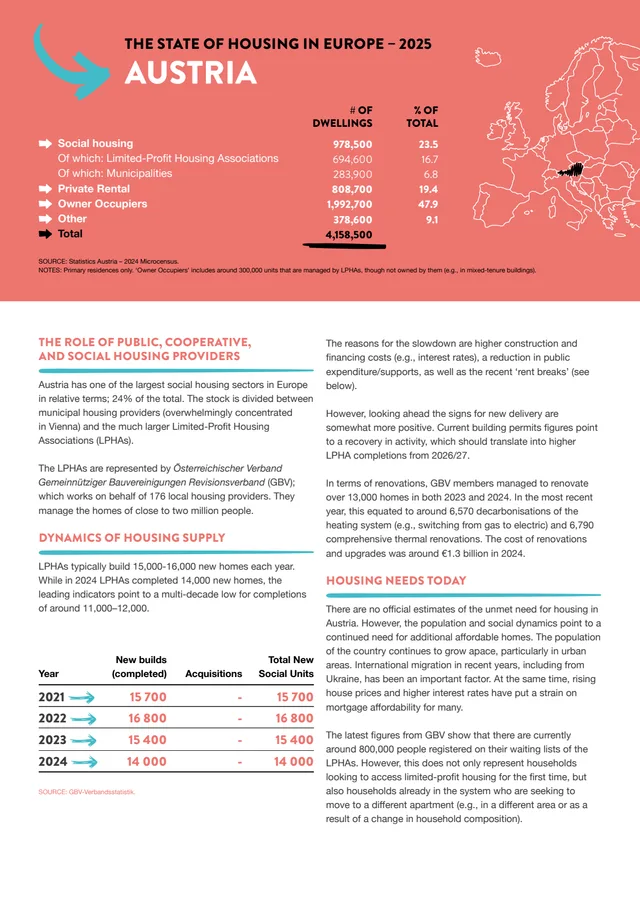
Housing Europe’s 2025 country profile presents a comprehensive analysis of Austria’s housing market within the broader European context. As a leading housing advocacy organisation, Housing Europe provides policy‑focused research aimed at promoting affordable, sustainable and socially inclusive housing across the EU. The report, authored by the organisation’s research team, draws on national statistics, European datasets and recent legislative developments to assess Austria’s performance and challenges.
Housing Stock and Sustainability
Austria maintains a well‑balanced housing stock, with approximately 4.2 million dwellings, of which 68 % are owner‑occupied and 32 % rented. The nation has achieved a high energy‑efficiency rating: over 55 % of residential buildings meet the EU’s Nearly Zero‑Energy Building (NZEB) standards, and retrofitting programmes have upgraded 1.1 million units since 2015. Renewable energy sources account for 38 % of residential heating, driven by extensive district‑heat networks and a strong uptake of heat‑pump installations.
Affordability Indicators
The average home price stands at €3,850 per square metre, translating to roughly 7.5 times the median gross annual household income. Rental markets remain comparatively affordable, with average rents of €9.20 per square metre per month, equating to 25 % of median disposable income. Housing cost‑burden ratios indicate that 12 % of households spend more than 30 % of their income on housing, a figure below the EU average of 18 %.
Policy Measures and Funding
Key national policies include the “Housing Promotion Act” (2021) which expands subsidies for energy‑efficient renovations, and the “Social Housing Expansion Programme” targeting a 10 % increase in social rental units by 2030. Austria leverages EU funding streams such as the European Regional Development Fund (ERDF) and the Cohesion Fund, amounting to €420 million allocated to sustainable housing projects between 2021 and 2025.
Environmental Performance
Carbon emissions from residential buildings have fallen by 22 % since 2010, largely due to the shift towards renewable heating and stricter building codes. The average household’s energy consumption is 85 kWh per square metre annually, well under the EU average of 110 kWh. Austria also leads in circular‑economy initiatives, with 18 % of construction waste being recycled into new building materials.
Social Inclusion and Demographics
The report highlights demographic pressures, noting a steady increase in single‑person households (now 38 % of all dwellings) and an ageing population requiring adaptable housing solutions. Social housing accounts for 16 % of the total stock, providing rent‑controlled units for low‑income families, seniors and migrants. Recent reforms aim to improve allocation transparency and reduce waiting times.
Innovation and Future Outlook
Austria is piloting smart‑home technologies in 250 residential complexes, integrating energy management systems that optimise consumption and enable demand‑response participation in the electricity market. The government’s “Zero‑Carbon Housing 2030” roadmap sets ambitious targets: all new constructions must be NZEB, and retrofitting of existing stock should achieve a 30 % reduction in energy use by 2030.
Conclusion for Pan‑European Readers
Overall, Austria exemplifies a proactive approach to sustainable housing, combining rigorous energy standards, substantial public‑private investment, and socially inclusive policies. The country’s progress offers valuable lessons for other EU members seeking to balance affordability, environmental ambition and social cohesion in their housing strategies.