
The capital that decided to own
Madrid is the capital of a country where buying a home, not renting one, has long been the normal way to live. It is a city of about 3.5 million people, ringed by mountains, built around grand boulevards, the Prado and the Royal Palace. After Spain’s 2008 crash it sold much of its public housing to investment funds. That choice still defines the market: very high ownership, a thin and expensive rental sector, and a public stock so small the city is now trying to rebuild it almost from scratch.
Count Madrid by who holds the keys and the imbalance is stark. About 70% of Madrid households own their home and 26% rent, leaving a small remainder in institutional, employer or family arrangements outside the standard categories. Cooperative housing barely registers as a tenure: around 0.01% of dwellings, perhaps 100 homes across 3 active cooperatives, housing about 0.05% of residents. Municipal and regional landlords hold only 0.6% of the stock, some 9,300 flats, and private landlords let almost all of the rest. The non-market tier, public plus cooperative together, comes to barely more than half a percent — one of the smallest of any European capital.
- Owners
- Owner-occupier70.0%
- Renters
- Public & non-profit rental0.60%
- Cooperative0.01%
- Private rental25.4%
- Other4.0%
- Free use (cesión gratuita)4.0%
A protected, permanently affordable layer is the piece Madrid never really built. Only about 1.2% of Madrid’s dwellings carry a vivienda-protegida rule — an affordability covenant that sits on top of the tenures rather than forming one of its own. Spain mostly built protected housing for sale, not for rent, so very little of it stayed affordable once owners could resell at market prices. A study of housing policy across the European Union traces how that left a means-tested benefit, not a public stock, as the main support. Roughly 30% of Madrid households would qualify for protected housing by income, far more than the system can serve.
Climb the rungs of Madrid rent and the cost of each tenure becomes plain. Tenants in the city’s regulated municipal flats pay around €7.50 per square metre, and members of the cesión-de-uso cooperatives about €10. Across the whole stock the median runs near €14.20; sign a brand-new private lease and the median jumps to €23.30, while furnished, serviced lets reach €26.80 per square metre gross. The distance from the regulated floor to a new market contract is more than three to one. That gap is the whole affordability problem in a single line.
- Public/municipal housing
- Cooperative
- All-stock median
- New contracts
- Furnished / serviced (gross)
Net-cold monthly rent per square metre by tier (furnished is gross, all-in). The regulated municipal floor and the cesión-de-uso cooperative rate sit far below the market median; a newly-let private contract runs more than three times the municipal rate.
Vacancy gets blamed for more of the shortage than it can carry. When the 2021 census counted empty flats it found a residential vacancy of about 6.3%, some 97,000 unoccupied homes, much of it inherited, unmodernised or held for sale rather than withheld from renters. Office floors stand emptier: around 1,380,648 square metres are unlet, roughly 7% of the office stock. The sharper drain on homes is tourism. An estimated 7,687 dwellings operate as full-time entire-home short-term rentals, concentrated in the Centro district and the historic core, where they thin the long-term supply in the very streets visitors fill.
More people keep arriving than the city can house. Net inbound migration runs at roughly 113,964 moves a year, drawn by jobs, universities and the wider region, while the city issues only about 7,500 housing permits a year. A European Parliament study of EU housing needs describes Spanish planning as slow and legally fragile, with general plans taking years and sometimes restarting after court challenges. The pain no longer stops at low incomes. Rents in the region have risen by more than half in five years, pulling middle earners into a market where a new lease can swallow most of an average wage. About 16% of households now face energy poverty, around 2,800 people sleep rough, and the courts log roughly 3,500 evictions a year.
To the people who live in rented homes in Madrid, look at today’s images: we are thousands.The cesión de uso, learned from Catalonia
The cooperative form Madrid is reaching for is the cesión de uso, the grant-of-use model: a cooperative owns the building permanently, and members hold an indefinite right to live in their flat without ever buying it. There is no individual title to sell, so the home cannot be flipped onto the speculative market. This is closer to the rental cooperatives of Vienna or Zurich than to the Spanish norm, where most older housing cooperatives were simply a cheaper route into ownership and dissolved once the flats were built.
The modern model arrived from elsewhere. Spain’s cooperative-housing revival began in Catalonia, where grant-of-use projects such as La Borda in Barcelona showed the form could work, supported by federations and ethical finance. A study of grant-of-use cooperatives and health in Catalonia found the model cut damp and energy poverty for its residents. Madrid had almost none of this tradition. The city’s contemporary cooperative sector is a decade old at most, and tiny.
Today the sector clusters into two groups with the same core problem. Entrepatios is the pioneer: a Madrid cooperative that has built and occupied near-zero-energy buildings in Usera and Vallecas, with a third promotion still searching for land. Around it sit younger collectives such as COOPEROPEN and support bodies like Tangente, which helps social-economy projects organise. Both clusters depend on the same scarce inputs: access to land and patient finance. The Catalan ecosystem they learn from is far deeper, with federations like Sostre Civic, technical support from La Dinamo Fundació and design from LACOL, and ethical lenders such as Coop57 and Fiare Banca Etica. Madrid is importing that toolkit faster than it is building its own.
Where cooperatives sit in the city’s plans leads straight into its politics. Both the municipal and regional administrations now treat the cooperative as a deliberate channel for affordable housing rather than a private leftover. The lever they hold is land: leasing public plots on a long surface right rather than selling them, so the homes stay non-market. Whether that lever is pulled often enough is the question the next section turns over, alongside the office-conversion law and the rent-regulation fight that divides Madrid from the Spanish state.
Build, convert, or cap
Madrid’s housing politics splits cleanly along the build-versus-regulate line, and the city sits at the municipal end of it. Mayor José Luis Martínez-Almeida of the centre-right People’s Party runs the city through its municipal housing company, EMVS Madrid, the Empresa Municipal de la Vivienda y Suelo. In 2026 EMVS began building 2,500 affordable rental homes across 22 sites, including about 800 in industrialised timber, lifting its portfolio toward 10,000 flats. The build-only strategy is the city’s headline answer, and it is slow against a market this tight.
The biggest lever sits one level up, at the region. The Community of Madrid, led by Isabel Díaz Ayuso of the same party, runs Plan VIVE, a public-private programme that leases regional land to developers for 50 or 75 years to build and manage affordable rental housing. The region says it will reach about 13,000 homes this term, with a youth strand for renters under 35 and rents around 30% below the market. The national government sets the legal frame; the region controls most of the land and the planning rules; the city builds its own stock on top. The result is three overlapping programmes that rarely pull in the same direction.
The vacancy story from earlier has a concrete policy reply. Law 3/2024 lets developers convert tertiary office buildings into protected rental homes without a planning amendment, capped at 30% of an area’s office capacity and processed as a direct licence. The region estimates the rule could yield tens of thousands of flats, with licences already requested for several thousand, and in late 2025 it extended the window to 2028 and widened it to hotels. Europe’s wave of office obsolescence makes the timing favourable, and a study of office conversion across the continent maps both the opportunity and its limits, since only a minority of office buildings suit residential use.

Decarbonising the stock and expanding it have become a single task in Madrid. Madrid’s housing stock averages around 50 years old, only about 9% of dwellings are energy-efficient, and the renovation rate crawls at roughly 0.7% a year — far short of the European Union’s deep-retrofit targets. EMVS now builds in industrialised timber, and the office-conversion rule reuses existing structures rather than pouring new concrete, which ties the climate goal to the supply goal. The cooperative and public projects are the main vehicles for cutting the sector’s carbon, because they are where the city can set the standard directly.
- 1985[source]
Regional self-government takes shape
The Community of Madrid gains its own powers over housing and planning, the start of a long divergence between regional and municipal housing policy that still shapes who builds what.
- 2007[source]
Madrid Río begins
The city starts burying the M-30 ring road and reclaiming the Manzanares riverbank as parkland, one of Europe’s largest urban-regeneration projects of the decade.
- 2013[source]
Public homes sold to funds
In the years after the 2008 crash, Madrid’s municipal and regional bodies sell thousands of social flats to investment funds, hollowing out an already thin public stock and drawing later court challenges.
- 2020[source]
Las Carolinas occupied
Entrepatios completes Madrid’s first right-of-use cooperative building in Usera, a near-zero-energy block of 17 homes, financed through ethical banks rather than the mortgage market.
- 2023[source]
National Housing Law
Spain passes its first state housing law, Law 12/2023, letting regions designate tensioned-market zones with rent caps; Madrid’s regional government refuses to declare any and appeals the law.
- Jun 2024[source]
Office-to-housing law
Law 3/2024 lets developers convert tertiary office buildings into protected rental homes without a planning amendment, a fast track the region says could yield tens of thousands of flats.
- 2026[source]
EMVS starts 2,500 homes
The municipal housing company begins building 2,500 affordable rental homes across 22 sites, including roughly 800 in industrialised timber, lifting its portfolio toward 10,000 flats.
- Feb 2026[source]
Constitutional Court upholds the law
The Constitutional Court rejects Madrid’s appeal and confirms that the state may let regions cap rents in tensioned zones; the region maintains it will not declare any.
- Apr 2026[source]
State housing plan 2026–2030
Royal Decree 326/2026 sets up Spain's €7 billion State Housing Plan 2026–2030, and every home bought or built with its funds stays protected for its whole useful life.
- Jun 2026[source]
Regional urgent housing law
The region's Law 2/2026 (Urgent Measures for Protected Housing) allows up to 20% more buildable floor area and 30% more density for protected homes, and permits temporary housing on vacant industrial plots.
- 2028[source]
Conversion window extended
The region extends the office-conversion regime to 2028 and widens it to hotels and other tertiary buildings, betting on adaptive reuse as the main near-term supply channel.
From the regional powers of the 1980s through the post-2008 fire-sale of public stock to the office-conversion law and the national rent-regulation framework upheld in 2026.
The deepest dispute is about rent regulation, and it reaches the courts. Spain’s 2023 housing law, Law 12/2023, lets regions designate tensioned-market zones with capped rents; Madrid’s regional government refused to declare any and appealed the law. In February 2026 the Constitutional Court rejected that appeal and confirmed the state’s power to allow rent caps. Isabel Rodríguez, the national Minister for Housing and Urban Agenda, framed the ruling around the need for decent, affordable homes. Jorge Rodrigo, the regional housing councillor, argues the opposite, that legal certainty for owners and new supply, not caps, are the route out. A comparison of how Madrid and Barcelona diverge on exactly this question lays the two strategies side by side.

One of the biggest problems in housing policy is the legal uncertainty that exists.From Usera to the office tower: where the alternative is taking shape
Madrid’s working examples are few, recent and small, which is itself the point: a city this dominated by ownership is only now learning to build anything else. The examples below run from the grass-roots cooperatives up to the municipal company, and close with the actors trying to make the model repeatable.
Las Carolinas is the clearest proof the form can work here. Built by Entrepatios in the Usera district and occupied since 2020, it houses 17 families in a near-zero-energy block that generates its own solar power and was financed through ethical banks rather than mortgages. Nobody owns a flat; the cooperative owns the building and members hold a permanent right to use. Its caveat is the one every Madrid cooperative names: it took years and scarce, expensive land to assemble, and replication depends on surface rights over public plots the city has been slow to grant.
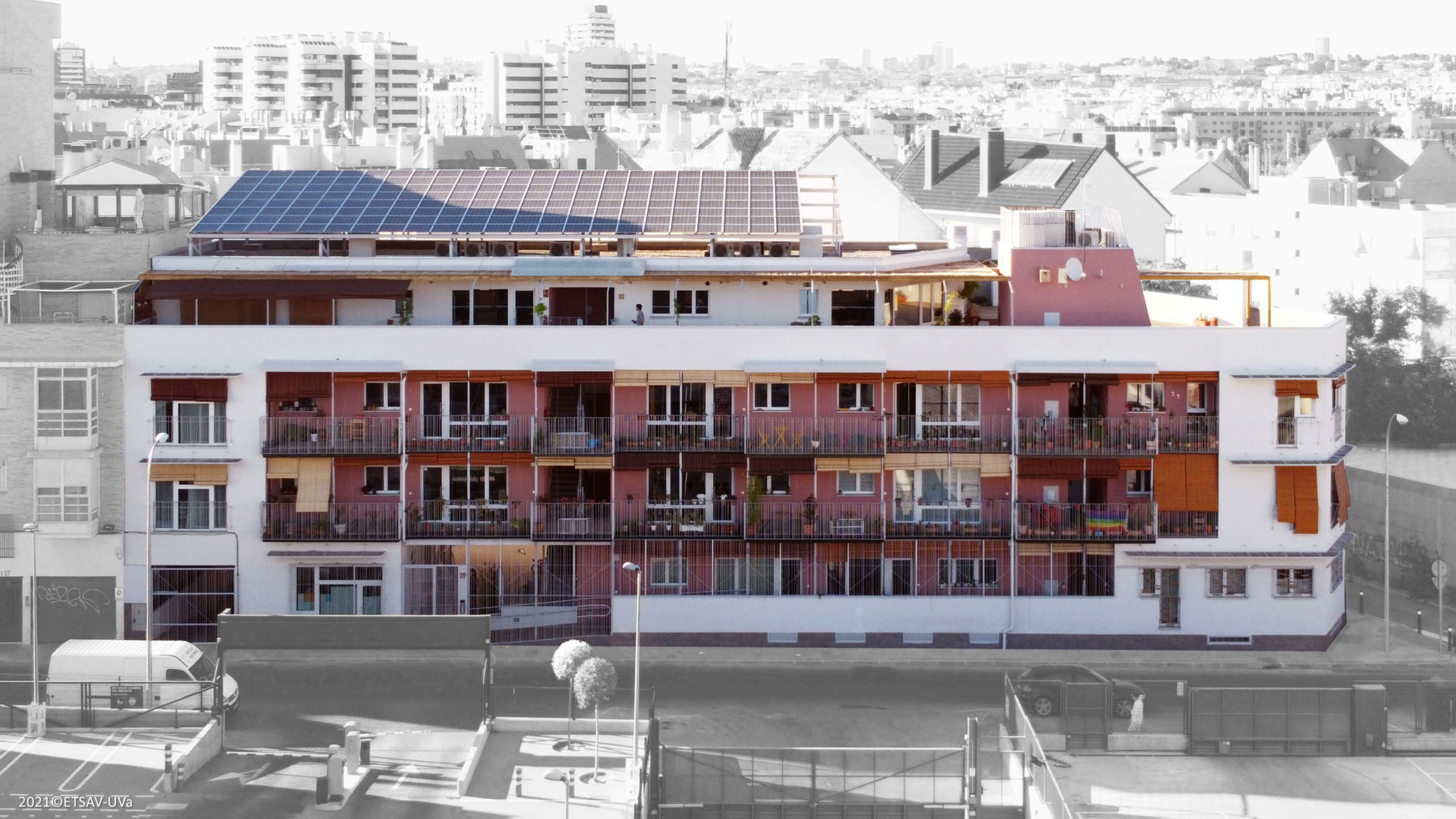
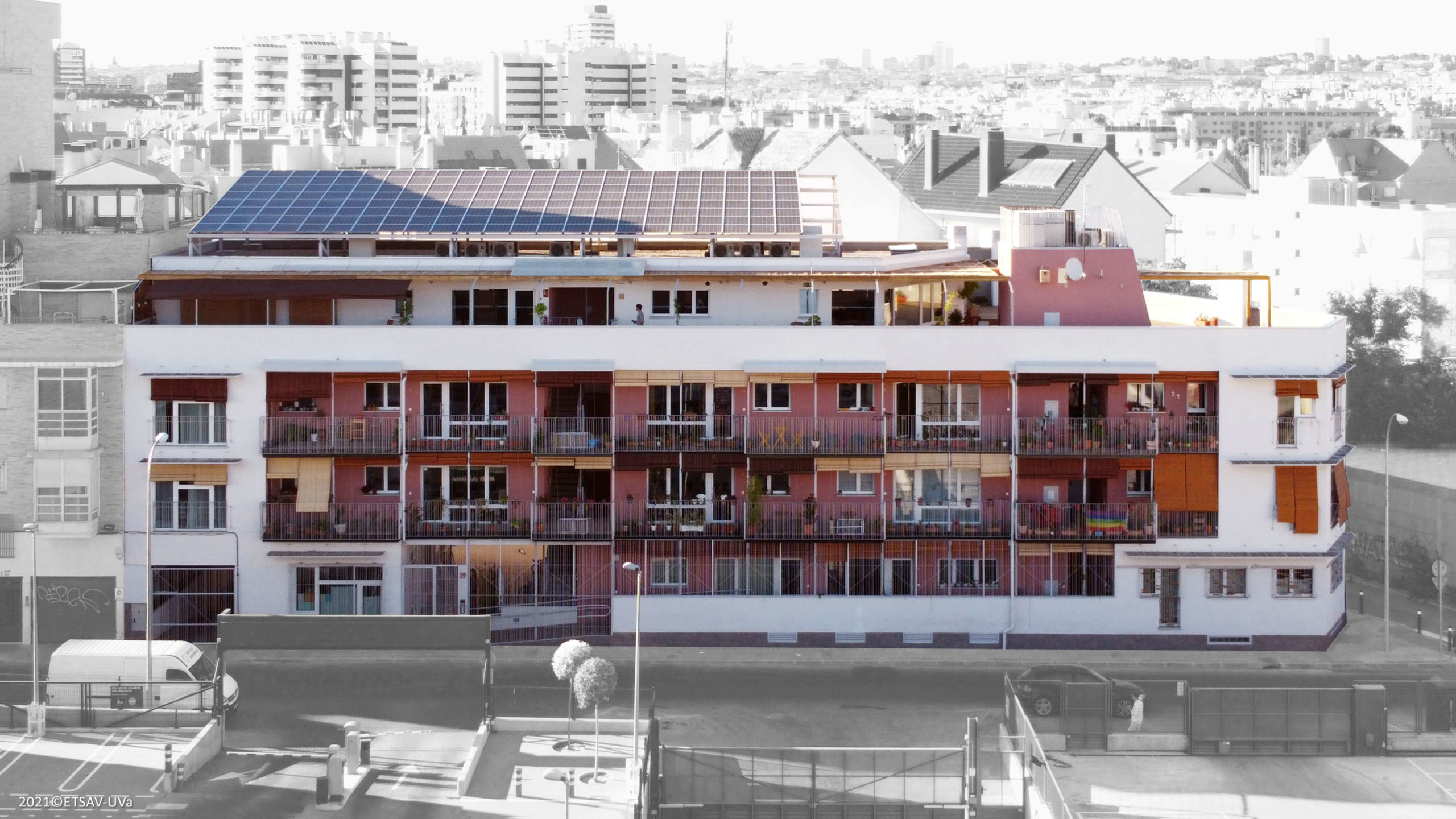
Vallekas extends the same experiment east. Entrepatios’ second building, in the working-class district of Vallecas, holds about ten households in another grant-of-use, near-zero-energy block, this time on land the cooperative had to fight to secure. It demonstrates that the model is not a one-off in a gentrifying inner district, but its slow pace shows the limit: two small buildings and a third still searching for a plot, against a city short tens of thousands of affordable homes.
EMVS Madrid is the municipal counterweight, working at a different scale and with a different problem. Its Plan Suma Vivienda is starting 2,500 affordable rental flats across 22 sites, with roughly 800 built in industrialised timber to cut both cost and carbon. The friction here is delivery speed and politics: municipal rental building is expensive, the pipeline competes with the region’s land-leasing programme, and a thin starting stock means even 10,000 flats barely moves the city-wide tenure mix.
HOGAR SÍ runs the response to the sharpest edge of the crisis. The national foundation pioneers Housing First in Spain, moving rough sleepers directly into stable homes with support rather than through shelters, and advocates for the funded national framework Spain still lacks. Its work is small against the roughly 2,800 people sleeping rough in Madrid, and it depends on a public commitment to permanent housing that the build-versus-regulate fight keeps postponing.

Around these buildings, a small organising and design layer is starting to thicken. Tangente helps social-economy and cooperative projects organise and finance themselves, and architecture practices such as Gutiérrez-delaFuente bring the design experience that Madrid’s public and cooperative housing will need to scale. The deeper institutional weight is still in Catalonia, where grant-of-use housing is knitted together across borders, but the connective work is underway: Funding the Cooperative City: Community Finance and the Economy of Civic Spaces records the early Madrid workshops that seeded this network, and an analysis of the right to stay put in Barcelona shows the tenant-led pressure that has begun to cross to the capital.
References
Statistics20Click on any number to see the source
Housing market
Tenure & affordability
Cooperative, social & public
Adaptive reuse & vacancy
Population & migration
From our library20
- Housing policies in the European Union — Knowledge
- Part 1: Mapping the housing needs in the EU, assessing the impacts of scarcity and providing an overview of relevant EU legislation — Knowledge
- La Borda — Project
- Cooperative housing under a grant-of-use in Catalonia and health: pre-post analysis — Knowledge
- Entrepatios — Organisation
- COOPEROPEN — Organisation
- Tangente — Organisation
- Sostre Civic — Organisation
- La Dinamo Fundació — Organisation
- LACOL — Organisation
- Coop57 — Organisation
- Socially oriented cooperative housing as alternative to housing speculation — Knowledge
- Rethinking European Offices 2030 - Risks and Opportunities from Obsolesence — Knowledge
- Barcelona and Madrid have very different ideas on tackling Spain’s housing crisis. Which will succeed? — Knowledge
- Las Carolinas — Project
- Vallekas — Project
- HOGAR SÍ — Organisation
- Gutiérrez-delaFuente — Organisation
- Funding the Cooperative City: Community Finance and the Economy of Civic Spaces — Knowledge
- Turning Tactics into Strategy: The Right to Stay Put and the Decommodification of Housing in Barcelona — Knowledge
Further sources14
- Plan VIVE — Comunidad de Madrid — Comunidad de Madrid
- Plan VIVE reaches 10,500 affordable rental homes this term — Comunidad de Madrid
- Plan VIVE Solución Joven — 4,472 youth homes tendered — Comunidad de Madrid
- EMVS Madrid — municipal housing company — EMVS Madrid
- Almeida: EMVS to start 2,500 affordable homes in 2026 — Ayuntamiento de Madrid
- Madrid extends office-to-housing conversion law to 2028 — El Economista
- Ley 3/2024 — office-to-protected-housing conversion measures (30% tertiary cap) — KPMG Tendencias
- Region extends office-conversion rule by two more years — Comunidad de Madrid
- Constitutional Court upholds Housing Law, rejects Madrid appeal — Infobae
- Jorge Rodrigo on legal certainty and the Housing Law — Soy de Madrid
- Madrid Tenants’ Union rally — Valeria Racu — El Español
- Entrepatios — Las Carolinas, first right-of-use building in Madrid — Entrepatios
- Royal Palace of Madrid — Wikipedia
- Sobrino de Botín — oldest restaurant — Wikipedia