Overview of the Report
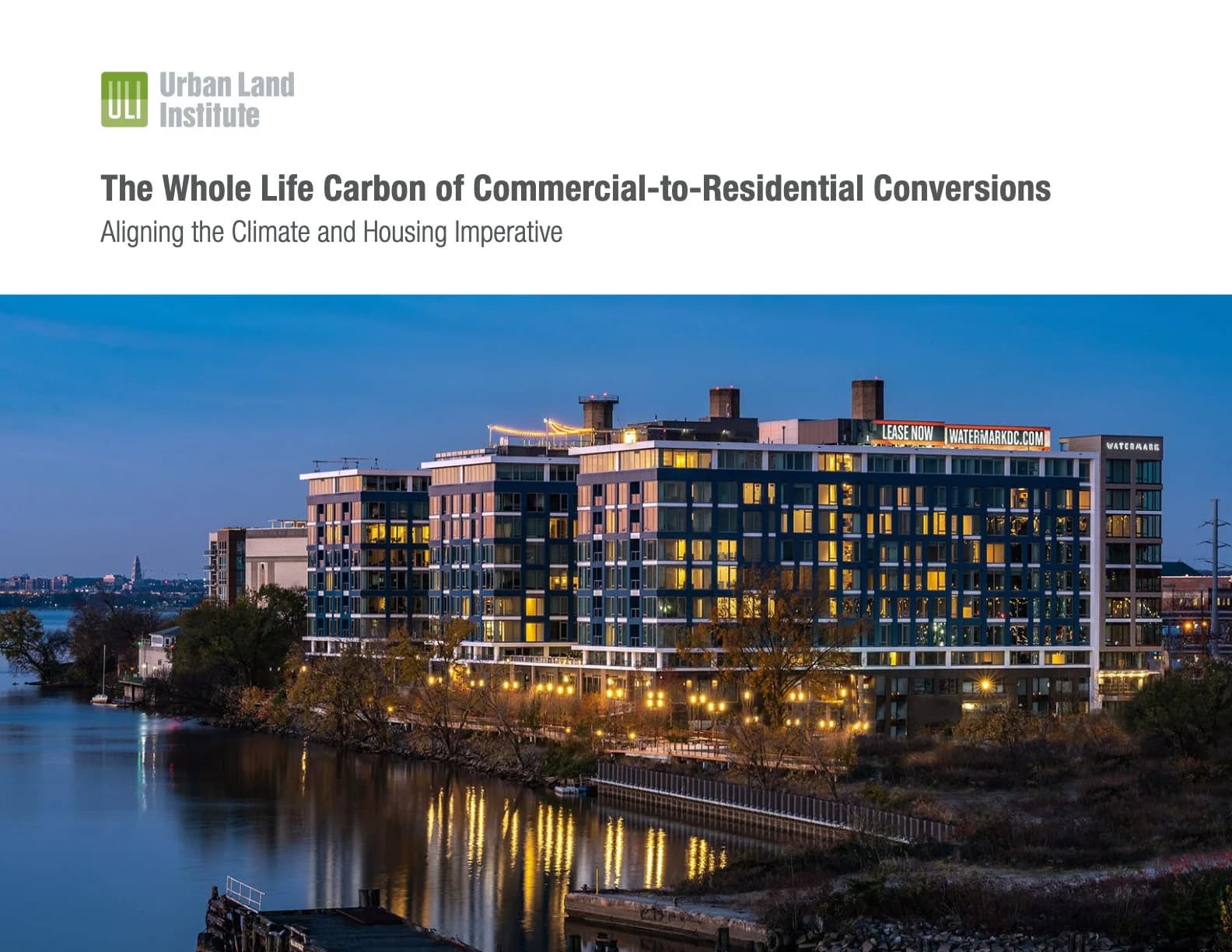
The Urban Land Institute (ULI), a global network of over 48,000 real‑estate and urban‑development professionals, published “The Whole Life Carbon of Commercial‑to‑Residential Conversions: Aligning the Climate and Housing Imperative” in 2025. Authored by Lori Ferriss, Billie Faircloth, Erin McDade, and Kara Kokernak, the study builds on ULI’s Randall Lewis Center for Sustainability in Real Estate, which focuses on net‑zero, resilient, and inclusive built environments. The report provides a data‑driven analysis of carbon implications for converting existing commercial buildings into multifamily housing across the United States, offering guidance for developers, policymakers, and planners seeking low‑carbon redevelopment strategies.
Scope and Methodology
The analysis covers 24 conversion projects originally documented in ULI’s 2023 “Behind the Facade” report. Carbon estimates were generated using Architecture 2030’s CARE (Carbon Avoided Retrofit Estimator) tool, which quantifies embodied, operational, and whole‑life carbon for three scenarios: Do Nothing (pre‑conversion use), New Building (hypothetical new construction), and Completed Conversion. Assumptions include full interior renovation, replacement of mechanical, electrical, and plumbing (MEP) systems, and standard industry carbon intensities for structural, envelope, and addition components. Operational emissions were modeled with EPA and eGRID data, applying local energy‑code reductions and grid‑intensity factors.
Key Findings – Embodied Carbon
Across the 24 cases, conversions achieve an average 62 % reduction in embodied carbon compared with new construction, with individual reductions ranging from 39 % to 72 %. Embodied carbon intensity for conversions falls between 13 kg CO₂e / sq ft and 26 kg CO₂e / sq ft, versus an industry benchmark of roughly 47 kg CO₂e / sq ft for new builds. The largest embodied carbon contributors in conversions are MEP systems (18‑45 % of total) and interiors, while structural systems often contribute less than in new construction.
Operational Carbon Benefits
Post‑conversion operational emissions are 31 % to 88 % lower than the pre‑conversion baseline, averaging a 74 % reduction over a 15‑year horizon (2025‑2040). The reductions stem from lower energy‑use intensity of residential use, code‑compliant efficiency upgrades, and in many cases, electrification of systems. One outlier (Gadsden Place) shows a 57 % increase due to an unusually low‑intensity commercial use before conversion.
Whole‑Life Carbon Outcomes
When both embodied and operational impacts are combined, conversions consistently outperform new construction in whole‑life carbon performance. Minimalist conversions—light‑touch projects with limited structural or envelope work—deliver the greatest total carbon savings, while structurally intensive conversions still achieve net reductions but face higher embodied carbon risk. Decarbonization drivers such as grid greening, stricter energy codes, building performance standards, and full electrification further amplify benefits, often achieving net‑zero operational emissions by 2040.
Policy and Market Implications
The report highlights emerging incentives at state and city levels that support commercial‑to‑residential conversions, including fast‑track permitting, tax abatements, and relaxed zoning. Aligning conversion projects with climate policies, such as net‑zero building standards and renewable‑energy mandates, enhances both environmental outcomes and economic viability. The authors stress that while conversions are not a universal solution, they represent a scalable pathway to address housing shortages and climate goals simultaneously across diverse markets.
Recommendations for Sustainable Housing Stakeholders
- Prioritize buildings with existing structural capacity to minimize embodied carbon.
- Target minimalist or makeover conversion typologies where feasible.
- Incorporate early‑stage carbon analytics to balance embodied and operational trade‑offs.
- Leverage local energy‑code compliance and grid‑decarbonization trajectories to maximize operational reductions.
- Advocate for policy frameworks that streamline conversion approvals and provide financial incentives. In sum, the ULI study provides robust evidence that adaptive reuse of underutilized commercial assets can deliver substantial carbon mitigation while expanding affordable housing stock, offering a compelling model for pan‑European stakeholders seeking climate‑aligned development strategies.