Turning empty offices into homes
Europe does not lack buildings; it lacks buildings in the right use. How much housing sits inside vacant offices, what a conversion costs and saves, which rules help, and the projects that have already done it.
Two kinds of empty
Walk through the business quarter of a large European city on a Tuesday morning and you will pass floor after floor of unlet office space. Walk twenty minutes further out and you will reach people who have been waiting years for a home. Both facts are measured carefully. They are almost never put on the same page.
Stockholm is the sharpest case in our data. Around 10.3% of its central office space sits empty while dwelling vacancy runs at about 1%. Rotterdam pairs 11.5% empty offices with 2.1% empty homes. Frankfurt am Main runs 10.7% against 3.2%. Empty desks upstairs, a queue downstairs, in the same postcode.
The pattern is not universal, and the exceptions are the useful part. Paris holds about 8% office vacancy alongside 9.8% of its dwellings recorded as vacant. Warsaw combines 9.1% office vacancy with a residential vacancy figure near 20%. Where both numbers are high, conversion has to argue on location, quality and carbon rather than on scarcity.
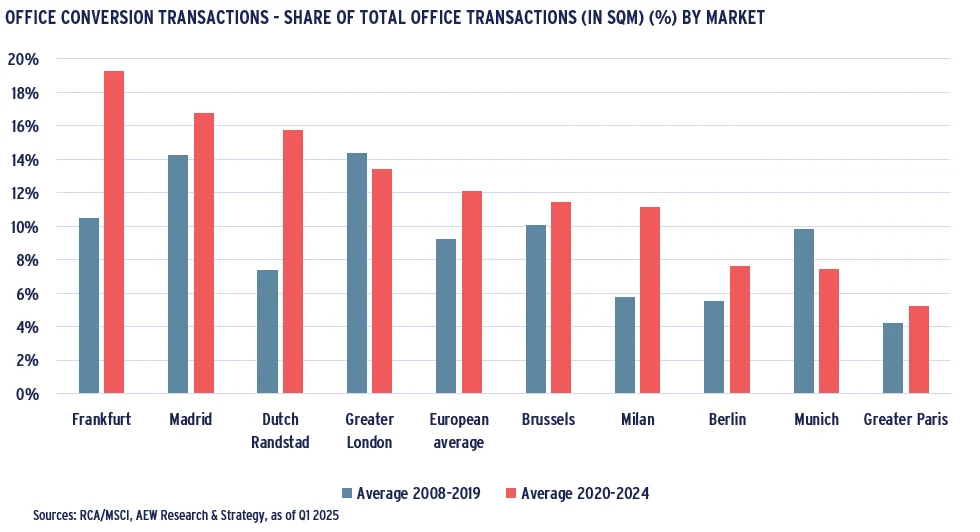
Investors have already noticed the gap. Across nine European markets, buildings bought specifically to be converted made up more than three in every ten office deals by floor area in the first four months of 2025, against 17% across 2024 and a long-run average since the financial crisis of well under half the 2024 share, on AEW's read of the European office market. Conversion is not the speculative part of this argument. What happens to the homes afterwards is.
The chart below puts both vacancies on one pair of axes. Look for the cities in the shaded corner: plenty of empty offices, almost nowhere to live.
That corner tells you where to look. It does not tell you how much is sitting there.
How much housing is hiding in offices?
You can work this out on the back of an envelope, and it matters that you can. Start with the vacant office floor space a city or a country actually reports. Decide what share of it could plausibly become housing. Take off the space that ends up as cores, corridors and risers. Divide by the size of a home.
Our base case converts 30% of the vacant stock, keeps four-fifths of that as liveable floor area, and assumes an average home of 66 m² holding 2.2 people. The convertible fraction is the number worth arguing about, so we bracket it between 15% and 45% instead of defending a single value.
Run it across the thirty focus countries and the base case yields roughly 234,000 homes, inside a band of about 117,000 to 351,000. The pool follows the office economies: Germany leads on around 80,000 homes, then the United Kingdom on 32,000 and France on 20,000.
City by city the figures get smaller and easier to picture. Our thirty-six focus cities hold an indicative 106,000 homes between them, with Paris alone at roughly 23,000. A Delft review of Dutch practice reaches a similar order of magnitude from the other direction, putting adaptive reuse at a tenth to a seventh of new housing supply.
None of this is a pipeline. These are orders of magnitude, and their only job is to show that the pool is large enough to be worth the trouble of screening it properly.
Set that beside the 47.5 million dwellings standing empty across Europe and the office figure looks like a rounding error. It is a different problem, though. An empty dwelling is already housing, and what keeps it empty is ownership, location, condition or law — none of which is fixed by building anything. An empty office is not housing yet, and turning it into housing is something somebody can actually go and do this year, on a site that already has drains, buses and a postcode. The smaller number is the one with a method attached.
Move the convertible fraction in the explorer below and watch the ranking rearrange itself. Switch between the country layer and the city layer to see where the pool concentrates, and where it is thin.
A national total is an argument. A single city is a decision. So take one and follow the chain all the way down.
Frankfurt, link by link
Frankfurt am Main carries about 11.5 million m² of office space, and roughly a tenth of it has no tenant. Push that through the chain and the city yields somewhere between about 2,240 and 6,710 homes, depending on how much of the empty stock you believe is genuinely convertible.
Conversion beats new build on cost only once you have chosen the building. Our model prices a screened conversion at 0.65 to 0.76 of local new-build cost with land excluded. Studies of screened buildings land in a similar range, roughly 0.65 to 0.85. Studies of unscreened stock find no general saving at all, and greater uncertainty on top, because hidden defects and hazardous materials only surface once a building is opened up.
Realised Dutch conversions show how wide that spread really is: from a few hundred euros to around €2,400 per square metre of rentable floor space. So the conversion factor is a question you take to a building, not an answer you bring from a spreadsheet. Two empty offices in the same vacancy register can be entirely different projects, and they should never enter an appraisal at the same price.
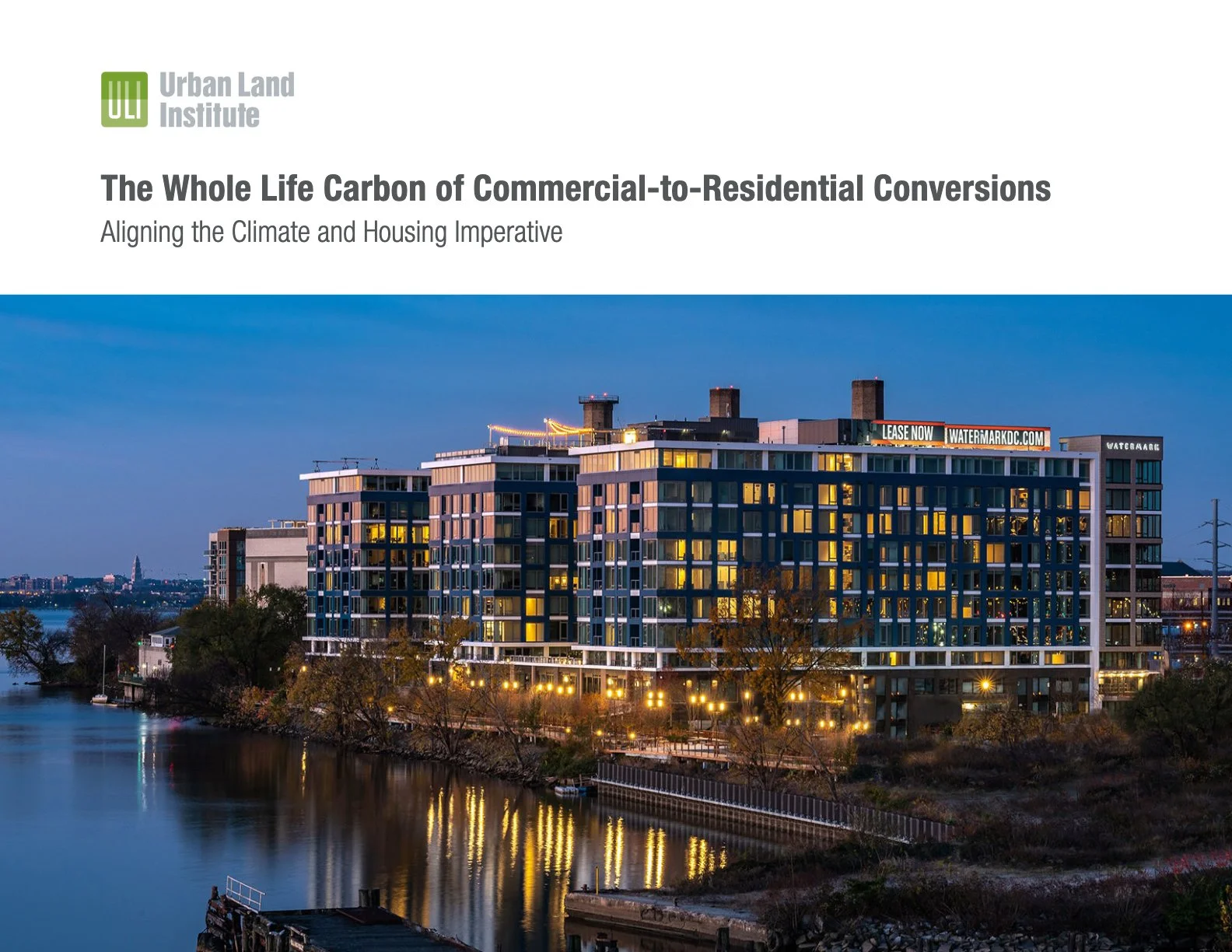
The climate case runs on the same logic. Keeping a structure avoids most of the carbon spent demolishing it and casting a new one. Whole-life studies report embodied-carbon savings of 40% to 80% against demolition and rebuild, with multi-case averages nearer three-fifths. Nearly all of it sits in the frame and the foundations, which is why a building that needs its structure strengthened gives the advantage straight back.
There is a bill beyond the building, too. Brownfield and infill development can cut projected public infrastructure costs by about a fifth against building at the edge, with infrastructure-delivery savings of 10% to 60% where roads, pipes and services already exist. Adaptive reuse should be judged against the full urban cost of adding a home, not only against the cost of erecting a new one.
The chain below is live. Change the city, move the fraction, and every step downstream moves with it: floor space, convertible area, net residential area, homes, people, capital needed and carbon avoided.
Every figure in that chain assumes the buildings pass inspection. Most of them will not.
Eight questions to ask a building
A vacancy register cannot tell a 1970s concrete frame on a generous column grid apart from a deep-plan block whose middle no daylight will ever reach. Both show up as an empty office. Only one of them becomes homes at a sensible price.
So a candidate building faces eight gates before it reaches any financial model, and a failure that cannot be mitigated stops the case there. It does not get averaged away against a flattering score somewhere else. The criteria come from conversion research and practitioner guidance, above all the Dutch transformation-potential method and its 2025 successor, rather than from a set we invented.
Structure comes first, because a frame you can keep is the whole proposition. Then the floorplate: can compliant homes be formed without a dead zone of unusable depth in the middle? Then the façade, which gets a gate of its own for a good reason. Envelope work has come in anywhere between 5% and 48% of conversion cost, against a reliable quarter of the budget in new build. It is the widest swing in the job.
Fire, escape and accessibility follow, because a code-compliant route that guts the building destroys the reuse advantage it was meant to protect. Planning comes next. Then hazardous materials, where asbestos is the classic reason a conversion budget moves after contracts are signed, which is why a phase-one survey with intrusive follow-up is evidence and not a formality.
The seventh gate keeps us honest. Whole-life carbon is assessed against a demolition-and-rebuild counterfactual, and if retention does not win, the project may still go ahead but may not claim to be the greener option. The eighth is the dullest and the most decisive: can a lender lend against it, and is the tenure mortgageable?
Work through the checklist below. Each gate names the evidence it needs, what a pass looks like, what a failure triggers, and where the hard stop sits.
Pass all eight and you still need permission to change what the building is for. That depends entirely on where it stands.
Some countries say yes by default
Two identical empty offices, one in Rotterdam and one in Stockholm, are not the same asset. The difference is the permission regime, and it is worth more to a project than most design decisions.
The Netherlands sits at the permissive end. Its transformatie programme has been turning offices into homes for over a decade, at a scale the national statistics office now tracks as a category in its own right. England has permitted development right Class MA, which lets an office become housing without a full planning application, subject to prior approval on daylight, noise, flood risk and space standards. In both places the route is knowable before you buy.
A middle group is actively easing. Germany has shortened the path through the Baugesetzbuch, including the 2025 Bau-Turbo provision, with Berlin adding its own Umnutzungsverordnung on top. France has pushed office-to-housing conversion through a density bonus in the urbanism code and a dedicated law on change of destination. Ireland exempts qualifying vacant commercial conversions from planning permission outright. Portugal's Mais Habitação removed the licence requirement for switching commercial use to housing in most cases.
Elsewhere the answer arrives one building at a time. Sweden usually needs the detailed plan amended, because that plan names the use as offices. Poland notifies the change but must still match the local plan. Austria and Switzerland require a permit under the Länder or cantonal codes, with no conversion-specific fast track anywhere in sight.
The map below grades every focus country from permissive through improving to discretionary, and names the statute or observatory behind each grade so you can check our reading.
Screen by jurisdiction before you count on any cost advantage. Then go and look at what has already been finished.
Buildings that already did it
Two office blocks at Park West in Dublin stood empty for more than twenty years, never once finding a commercial tenant. In 2022 Tuath Housing finished converting them into 86 apartments, adding a penthouse floor and swapping wall-to-wall office glazing for windows that open. In Cork, Springville House had been empty for a decade and had failed twice to win permission for homes; it reopened in 2021 as 35 apartments for people over sixty moving out of houses that had grown too big.
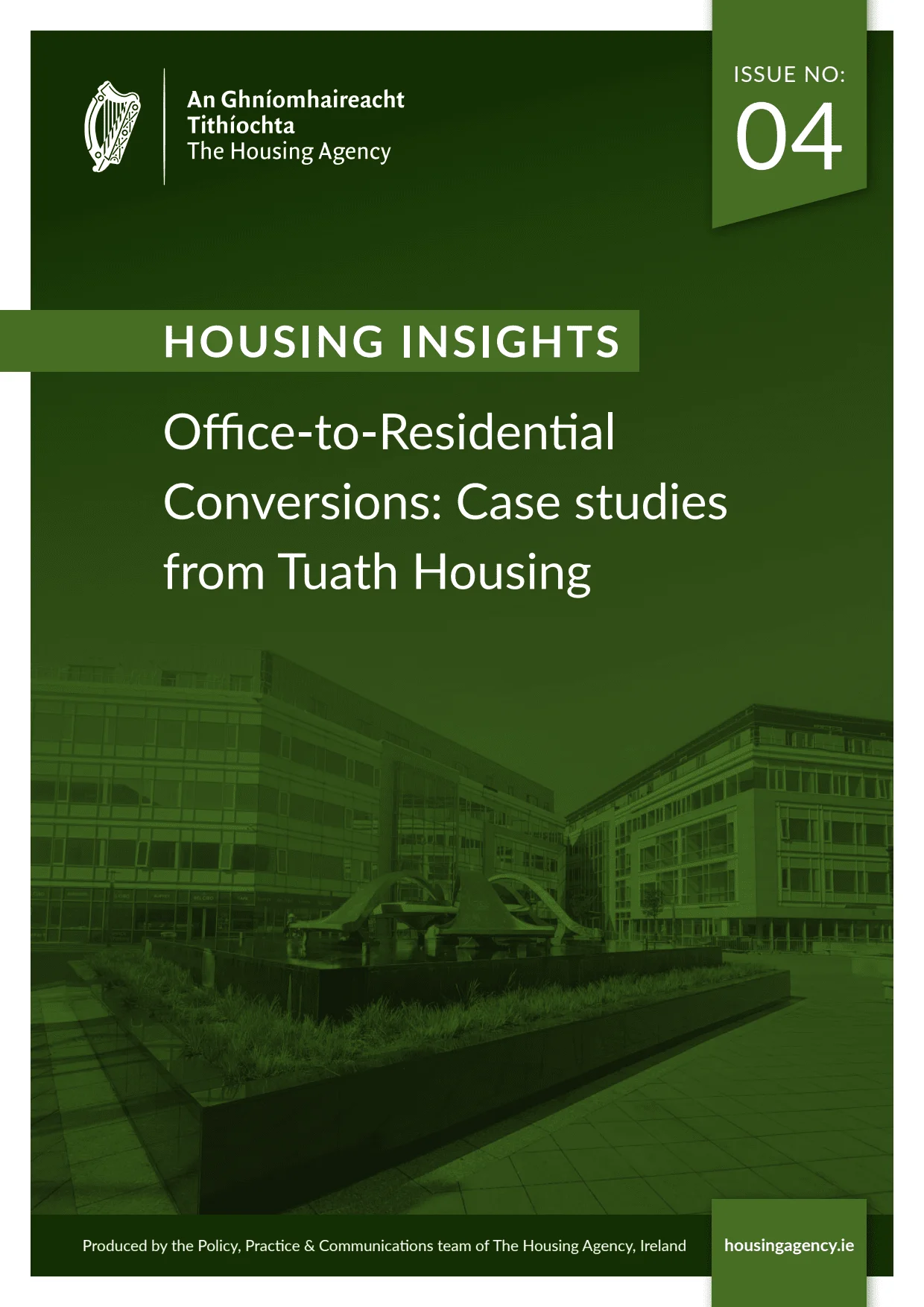
Between them that is 121 homes from two dead buildings, and Park West alone now houses more than 200 people who had been on Dublin City Council's waiting list. The costs are the part worth quoting. Park West came in at an average of €309k per home and Springville at €353k, against a reported €411k to €619k for medium-rise apartments in Dublin and its suburbs. A carbon analysis of Park West put embodied carbon 73% below demolishing and rebuilding, and 62% below an equivalent new build.
From the day I walked over the threshold I knew I was home.Hamburg shows the cooperative version of the same move. Genossenschaft Gröninger Hof eG, founded in 2018, is converting a city-centre multi-storey car park into 90 homes alongside workspace, guest rooms and an open ground floor of culture, teaching, small trade and gastronomy. Every flat is let under Hamburg's funding rules for cooperative building groups, which start the lowest income band at €7.25 a square metre a month. Car storage out, a socially mixed house in, on a site nobody was making any more of.
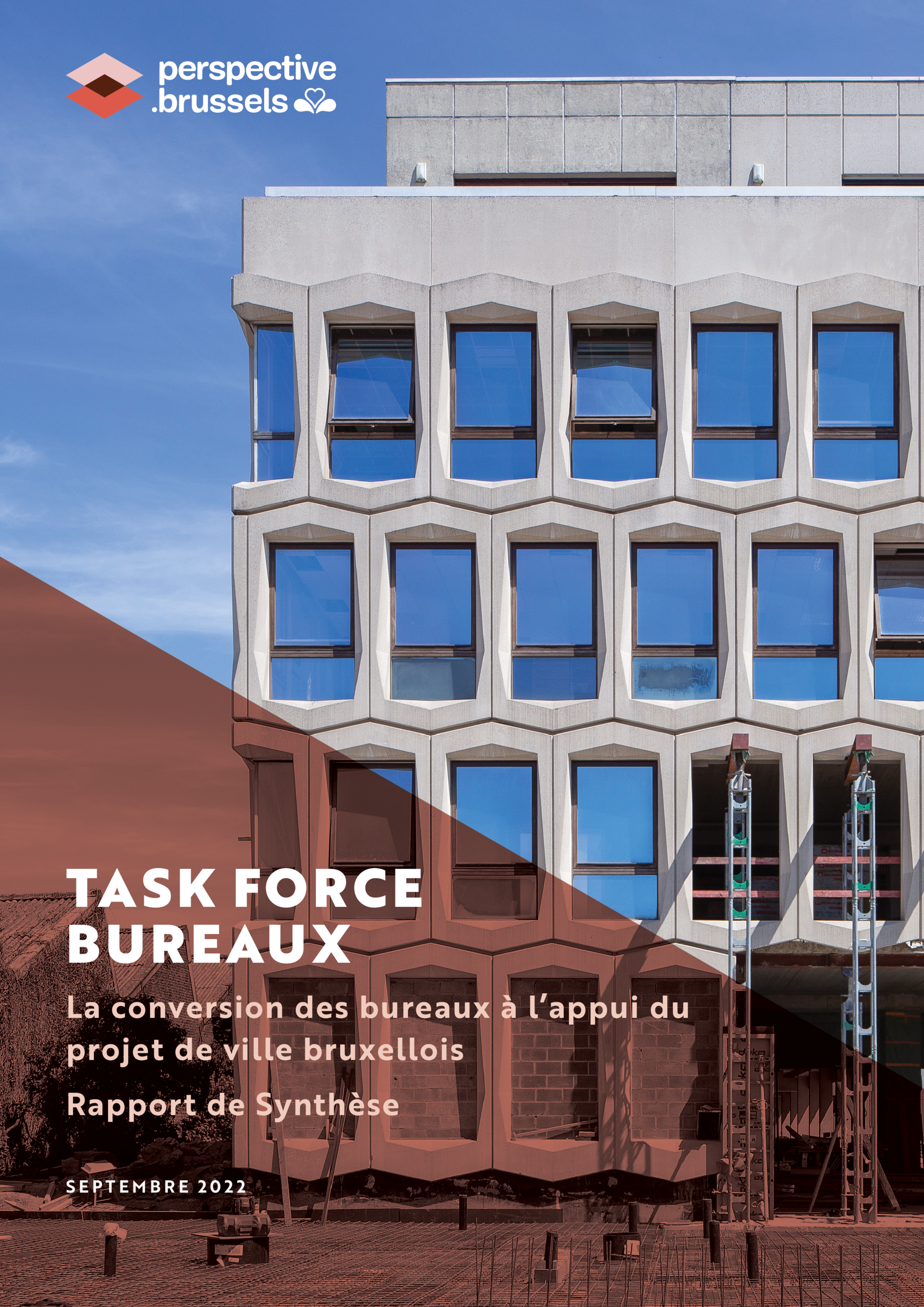
And none of this is exotic. Brussels has permitted 1,674,298 m² of office space to change use since 1997, an average of some 63,000 m² a year, tracked building by building by the region's own office observatory.
The gallery below maps the realised conversions in our library. Open a card to see what the building used to be, and what it is now.
Every one of those buildings changed use. Not all of them changed who the housing is for.
Who owns the building afterwards?
Conversion on its own does not make housing affordable. A developer can buy an empty office, convert it well, and sell the flats at the top of the market. The building changes use and the price changes nothing. Cheaper to build is not the same promise as cheaper to live in.
That is why ownership is the part we care about. A cooperative takes the building out of the resale cycle and holds it for use, at cost, with the people who live in it deciding what happens to it. The cost advantage of a good conversion then shows up where it is useful: in the rent, and in the deposit somebody has to find to move in.
Where to start is where three things overlap. An office glut, a housing market with no slack, and a city willing to say yes to a change of use. On the chart at the top of this page that is the shaded corner. On the regulatory map it is the permissive and improving countries. Rotterdam and Frankfurt am Main sit in both. Stockholm has the widest vacancy gap in our data and one of the harder permission regimes — every conversion there needs the detailed plan amended, so budget for that before you budget for the building.
If you want to see what happens to the numbers once such a building is actually bought, our economic model runs the whole chain: purchase, conversion cost, cost rent, and who pays what in year one and in year thirty. The model itself explains who owns, who controls, who builds and who funds. Start with a city in the corner, then go and find a frame worth keeping.
References
From our library10
- Increase In Conversions Expected To Benefit European Office Market Recovery — Knowledge
- Adaptive Reuse for Housing — Knowledge
- Conversion of offices into affordable housing — Knowledge
- The Whole Life Carbon of Commercial-to-Residential Conversions — Knowledge
- Unlocking Sustainable Urban Regeneration in Europe — Knowledge
- Transformation meter for offices: A tool to assess opportunities and risks of adaptive reuse — Knowledge
- Office to Housing — Knowledge
- Office to housing conversion: estimating life cycle environmental and financial performance — Knowledge
- Housing Insights - Office-to-Residential Conversions: Case studies from Tuath Housing — Knowledge
- Task Force Bureaux – La conversion des bureaux à l'appui du projet de ville bruxellois : enjeux, conditions et potentiel — Knowledge
Further sources34
- CityMarkAnalys / Cushman & Wakefield, autumn 2025 — CityMarkAnalys / Cushman & Wakefield, autumn 2025
- Statistics Sweden, unoccupied dwellings 2024 — Statistics Sweden, unoccupied dwellings 2024
- Cushman & Wakefield, Rotterdam office market 2024 — Cushman & Wakefield, Rotterdam office market 2024
- CBS StatLine, leegstand woningen 2023 — CBS StatLine, leegstand woningen 2023
- Colliers Germany, Frankfurt office market Q4 2024 — Colliers Germany, Frankfurt office market Q4 2024
- Zensus 2022, Frankfurt — Zensus 2022, Frankfurt
- Immostat / CBRE France, Île-de-France offices 2024 — Immostat / CBRE France, Île-de-France offices 2024
- INSEE, census 2022, commune of Paris — INSEE, census 2022, commune of Paris
- JLL Poland, Warsaw office market — JLL Poland, Warsaw office market
- NIK audit of vacant dwellings in Warsaw — NIK audit of vacant dwellings in Warsaw
- AEW, European office market research 2025 — AEW, European office market research 2025
- EHC Countries dataset, base-case assumption — EHC Countries dataset, base-case assumption
- EHC Cities dataset, author's calculation — EHC Cities dataset, author's calculation
- 47.5 million dwellings
- JLL Germany, Big-7 office market 2024 — JLL Germany, Big-7 office market 2024
- Gensler, assessing 1,300+ office-to-residential conversions — Gensler, assessing 1,300+ office-to-residential conversions
- Remøy et al., Adaptive Reuse for Housing (TU Delft, 2025) — Remøy et al., Adaptive Reuse for Housing (TU Delft, 2025)
- Urban Land Institute, whole life carbon of commercial-to-residential conversions (2025) — Urban Land Institute, whole life carbon of commercial-to-residential conversions (2025)
- Arup, C40 Cities and Urban Partners, Unlocking sustainable urban regeneration in Europe (2025) — Arup, C40 Cities and Urban Partners, Unlocking sustainable urban regeneration in Europe (2025)
- BDA Bayern, O2H — Office to housing (2025) — BDA Bayern, O2H — Office to housing (2025)
- Netherlands
- Class MA
- Baugesetzbuch
- density bonus in the urbanism code
- exempts qualifying vacant commercial conversions
- Mais Habitação
- plan amended
- notifies the change
- The Housing Agency, Office-to-Residential Conversions (2024) — The Housing Agency, Office-to-Residential Conversions (2024)
- Society of Chartered Surveyors Ireland, The real cost of new apartment delivery (2021) — Society of Chartered Surveyors Ireland, The real cost of new apartment delivery (2021)
- Genossenschaft Gröninger Hof eG — Genossenschaft Gröninger Hof eG
- perspective.brussels, Task Force Bureaux (2022) — perspective.brussels, Task Force Bureaux (2022)
- economic model
- model itself