Overview of the Study
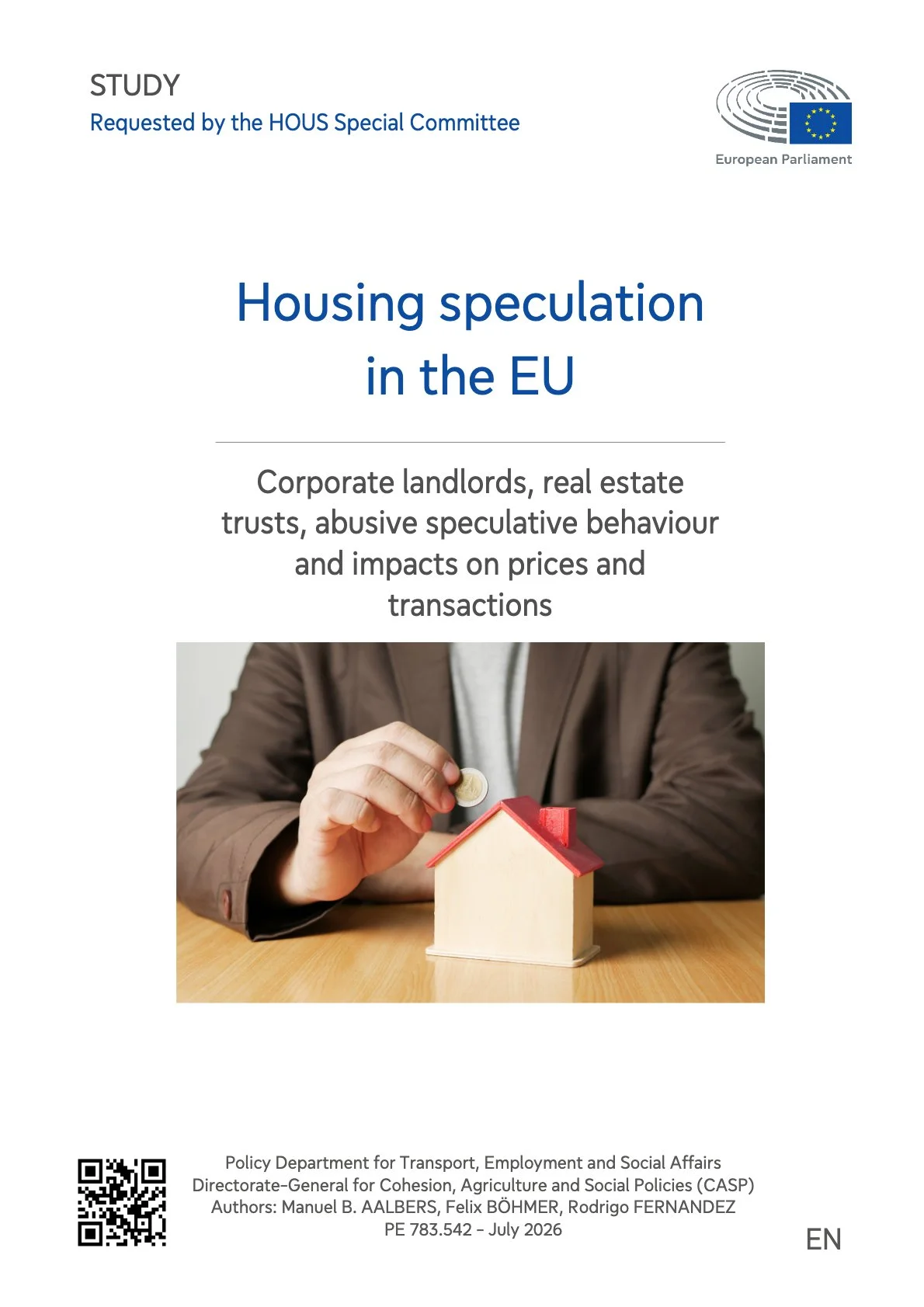
The European Parliament’s Policy Department for Transport, Employment and Social Affairs (CASP) commissioned this study, authored by Manuel B. Aalbers (Professor of Urban and Economic Geography, KU Leuven), Felix Böhmer (PhD candidate, KU Leuven) and Rodrigo Fernández (independent researcher). It examines the growing financialisation of housing across the EU, focusing on corporate landlords, real‑estate investment trusts (REITs) and other institutional investors, and assesses their impact on prices, transactions and affordability.
Scale of Institutional Investment
Between 2004 and 2024, tangible assets held by EU‑27 listed residential funds rose from €4.8 billion to €198.7 billion – a 42‑fold increase. The EU’s share of global listed residential assets grew from 19 % to 27.5 %. Asset‑intensity ratios (assets per € of rental income) more than doubled, reaching 11.1 for listed funds and 17.0 for unlisted funds in 2024, indicating a shift from rent‑based returns to valuation‑driven profits.
Types of Housing Speculation
The authors distinguish four speculative forms. Types 1 and 2 involve buying existing stock or short‑term “flipping”. Types 3 and 4 are empirically measurable: Type 3 relies on valuation gains rather than rental income, while Type 4 comprises abusive landlord practices such as no‑fault evictions, “renovictions” and under‑maintenance that undermine tenant security.
Key Findings on Market Dynamics
- The EU has moved from a debt‑driven to a wealth‑driven housing model; house prices rose 61 % (2015‑2024) while household credit fell 18 %.
- Institutional investors now own a modest share of total housing stock but exert disproportionate influence in cities where they hold large portfolios.
- Valuation‑driven business models dominate: for every €1 of annual rental income, listed funds hold €11 in assets, far above the median €1 across other sectors.
- Renovations are often used to justify rent increases; in Denmark and Sweden, rent‑increase clauses after renovation have been linked to speculative rent hikes.
Policy Context and Responses
The European Affordable Housing Plan (EAHP, 2025) recognises financialisation but focuses on monitoring and transparency rather than curbing asset‑driven investment. National responses include Denmark’s “Blackstone intervention” (tightening renovation‑based rent increases), Berlin’s 2021 referendum to expropriate large private landlords, and Barcelona’s municipal measures limiting short‑term rentals, enforcing vacancy taxes and reserving 30 % of new units for affordable housing.
Recommendations for Sustainable Housing
- Differentiate financing for primary homes from investment purchases, applying stricter loan‑to‑value limits and higher risk weights to the latter.
- Coordinate macro‑prudential tools at EU level to prevent cross‑border arbitrage.
- Re‑introduce credit‑guidance targeting first‑time buyers and affordable‑housing construction.
- Condition public support on capped returns, long‑term affordability clauses and a right of first refusal for public bodies.
- Strengthen transparency of ownership, transactions, rents and valuations to enable monitoring of concentration.
- Close tax‑avoidance structures that allow cross‑border landlords to minimise taxes.
- Enhance rent‑regulation frameworks, curb “renovictions” and improve security of tenure through longer leases and limits on no‑fault evictions.
- Expand social‑housing stock and support non‑profit, cooperative and community‑land‑trust models, especially where public housing has been depleted.
- Use public land strategically, reserving it for affordable and social housing development.
- Develop an EU‑wide anti‑speculation toolbox to harmonise rules and prevent regulatory arbitrage.
Implications for Sustainable Housing
The study highlights that sustainable housing policies must address both the supply side and the financial structures that drive price inflation. By steering capital toward long‑term, non‑speculative housing provision and reinforcing tenant protections, EU members can mitigate the adverse social impacts of financialisation while supporting environmentally sustainable building standards and energy‑efficient retrofits.