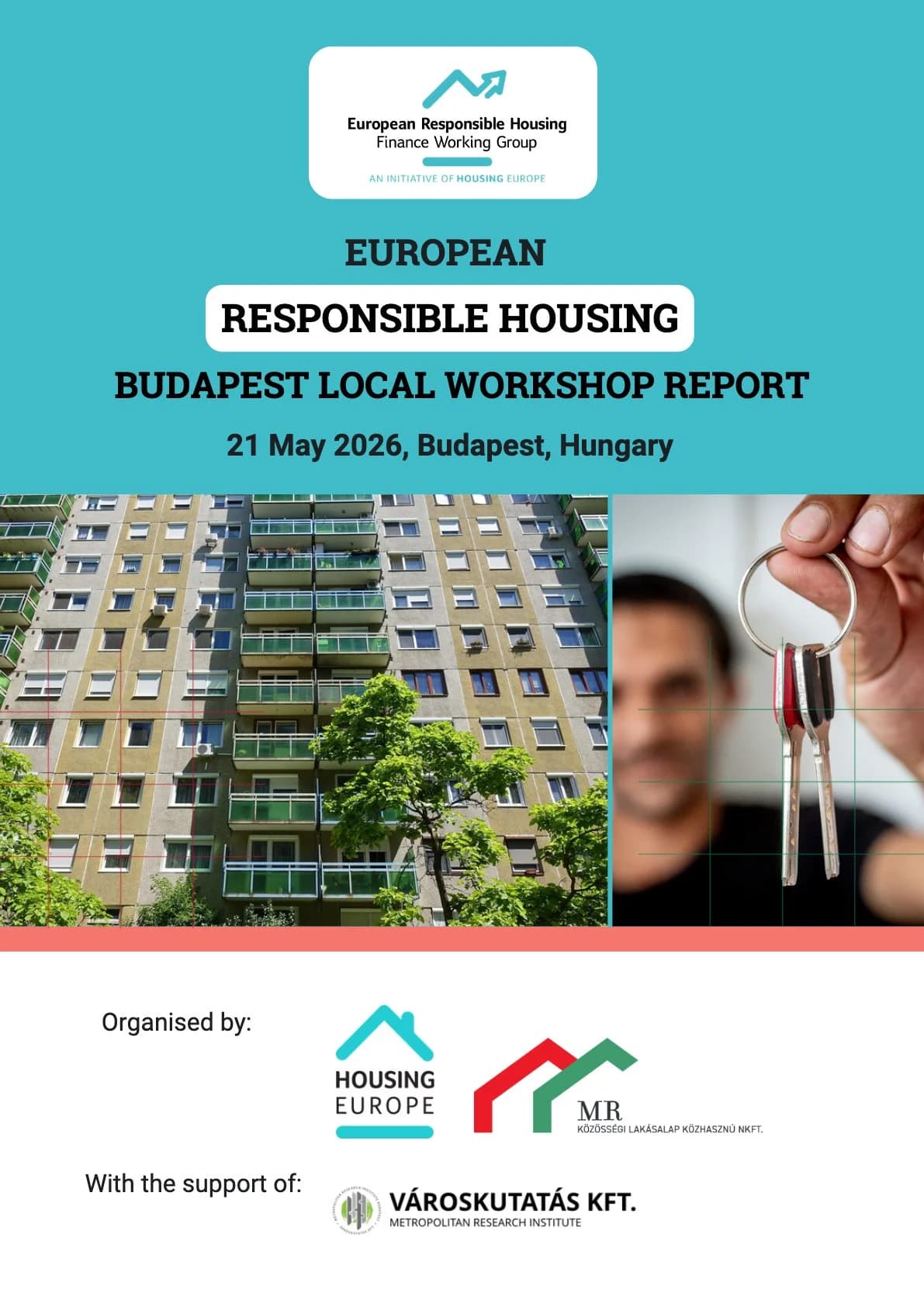
Context and Publisher Overview
The report “European Responsible Housing – Budapest Local Workshop Report (May 2026)” is produced by Housing Europe, a network representing around 43 000 local housing providers across the continent. Housing Europe invests roughly €50 billion annually and delivers approximately 200 000 homes each year. The workshop, organised together with the MR Housing Fund and the Metropolitan Research Institute, convened housing providers, financial institutions, public authorities and academics in Budapest on 21 May 2026 to discuss financing and governance challenges for social and affordable housing in Europe, with a focus on Hungary.
Workshop Objectives and Themes
The two‑day event aimed to identify practical pathways for improving housing affordability, to explore new EU financing instruments under the European Affordable Housing Plan, and to strengthen capacity for accessing European funds. Key themes included the need for long‑term governance structures, blended finance, technical assistance, and mechanisms that preserve permanent affordability.
Funding Landscape and EU Instruments
Participants highlighted that the Council of Europe Development Bank, the European Investment Bank and the European Union have created funding opportunities, complemented by Structural Funds and national schemes. Emerging instruments such as the Pan‑European Investment Platform for Affordable and Sustainable Housing, digital portals, expert groups and national hubs were presented as potential levers for the next Multiannual Financial Framework (2028‑2034). The workshop stressed that successful mobilisation of EU money depends on credible local actors, stable policy frameworks and investment‑ready project pipelines.
Lessons from European Case Studies
Examples from Flanders, Ireland, France and Estonia illustrated how long‑term public guarantees, clear regulatory environments and strong intermediary organisations enable large‑scale financing. In Flanders, a €1.7 billion EIB loan was secured through stable governance and public guarantees. Ireland’s delivery of around 7 000 social homes annually was attributed to early regulatory clarity and institutional capacity before capital was attracted. Estonia’s blend of EIB, CEB and ERDF funds demonstrated the value of coordinated financing mechanisms.
Hungarian Context and Recommendations
The report noted that Hungary’s ownership‑oriented housing system has driven price increases and limited supply over the past decade. Preferential home‑ownership schemes have provided short‑term access but have also intensified market pressures. Recommendations for Hungarian stakeholders include developing long‑term financing horizons, establishing technical assistance structures, and creating aggregation mechanisms to prepare projects for upcoming EU funding cycles.
Session Highlights and Outcomes
Session 1 examined practical lessons for housing affordability, identifying transferable principles such as long‑term financing, technical support, and the need for stable governance. Session 2 focused on new EU financing under the Affordable Housing Plan, outlining concrete steps for municipalities and providers to ready themselves for the 2028‑2034 MFF. Break‑out discussions produced a list of actions for the next 2‑3 years, including project preparation, capacity building and alignment with EU instruments.
Collaboration and Future Directions
The workshop underscored the importance of cross‑border peer learning and the role of intermediary organisations in aggregating projects and providing due diligence. Participants agreed that public funding alone is insufficient; a combination of public guarantees, blended finance, and robust institutional frameworks is essential to achieve sustainable, affordable housing at scale across Europe.