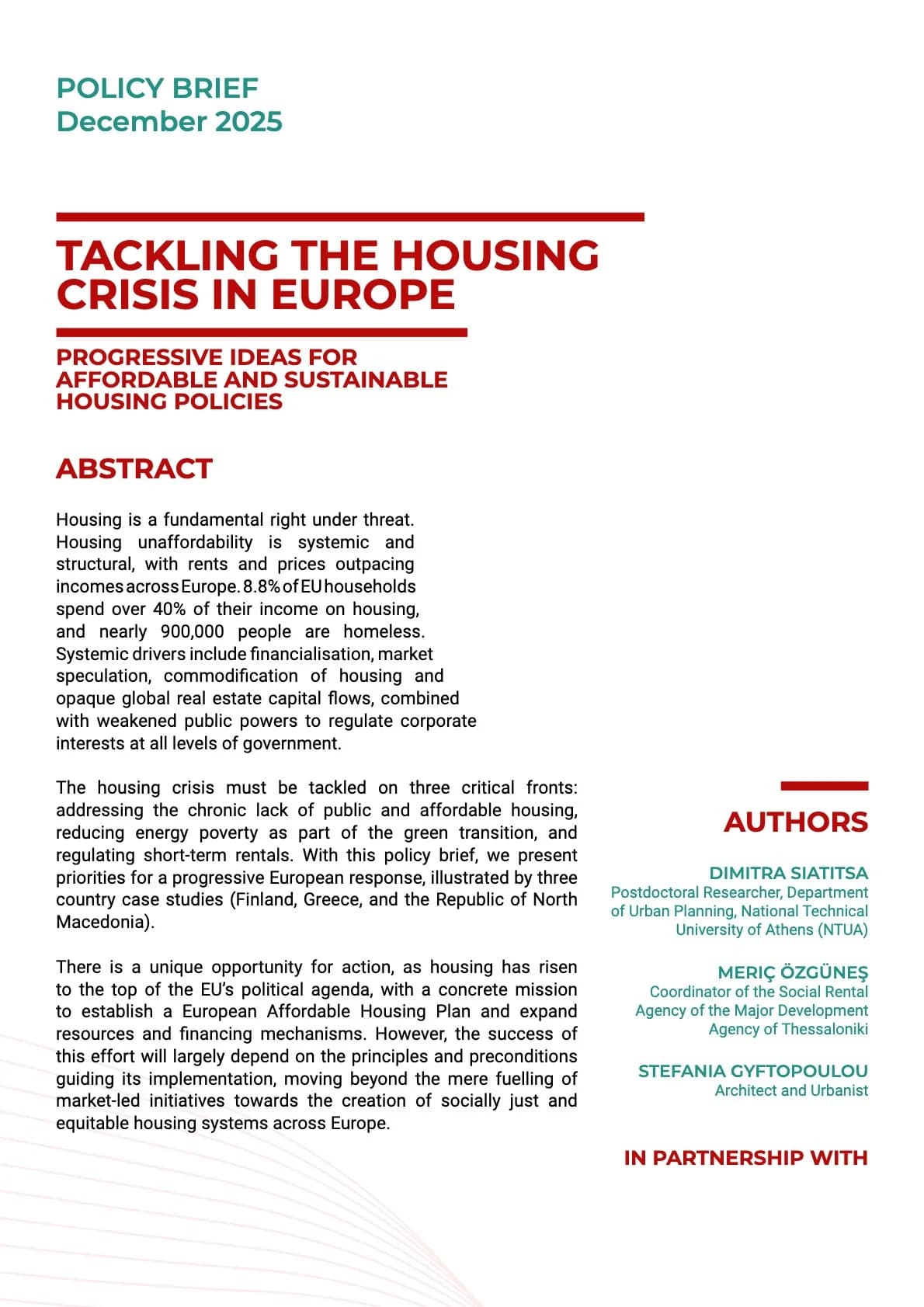
Overview of the Policy Brief
The brief “Tackling the Housing Crisis in Europe – Progressive Ideas for Affordable and Sustainable Housing Policies” is published by the Foundation for European Progressive Studies (FEPS) with co‑publication support from Eteron, the Kalevi Sorsa Foundation and Progres. Authors Dimitra Siatitsa (post‑doctoral researcher at NTUA, Athens), Meriç Özgüneş (coordinator of the Social Rental Agency, Thessaloniki) and Stefania Gyftopoulou (architect and urbanist) combine academic, policy‑making and design expertise to analyse Europe’s housing challenges.
Scope of the Housing Crisis
Housing unaffordability affects 8.8 % of EU households, who spend over 40 % of income on shelter, and nearly 900 000 people are homeless. Between 2010 and 2025, EU house prices rose by 57.9 % and rents by 27.8 %, while 93.3 million Europeans (21 % of the population) were at risk of poverty or social exclusion in 2024. The brief highlights three critical fronts: lack of public and affordable housing, energy poverty linked to the green transition, and the impact of short‑term rentals (STRs).
Key Data on Housing Supply
Public investment in housing fell from 0.17 % of GDP (2001) to 0.06 % (2018) across OECD nations. Social‑rental stock varies widely: the Netherlands holds 34 % of its housing stock as social rental, Austria 23.6 %, France 14 %, while Greece has virtually none. Overall, socially regulated housing averages 7.8 % of total stock in OECD countries. EU‑wide, non‑listed funds own about 30 % of €2.7 trillion of real‑estate assets, underscoring the financialisation of housing.
European Policy Context
Housing has been assigned to the EU Commissioner for Energy and Housing, with a mandate to deliver a European Affordable Housing Plan by end‑2025. The European Council addressed housing for the first time in October 2025. Funding streams include €7.5 billion in cohesion policy programmes (2021‑2027) and a €10 billion commitment from the European Investment Bank over the next two years. The Recovery and Resilience Facility aims to create roughly 147 000 new or renovated dwellings.
Recommended Interventions
The brief proposes three pillars:
- Supply Expansion – Socialise existing stock, boost public and cooperative housing construction, and repurpose vacant buildings.
- Regulation of Markets – Implement EU‑wide rent caps, taxes on vacant homes, and limits on corporate ownership and STR platforms.
- Common Affordability Framework – Adopt shared definitions and mandatory social‑impact assessments to ensure funding targets genuine housing outcomes.
Sustainable and Social Equity Focus
Energy poverty is highlighted as a barrier to the green transition; retrofitting existing homes without raising costs for low‑income occupants is essential. Policies must align climate goals with affordability to avoid deepening social inequality. The brief stresses that without coordinated, multi‑level action, national and local efforts alone cannot resolve the systemic drivers of unaffordability and speculation.
Outlook for a Pan‑European Audience
For stakeholders interested in sustainable housing, the brief provides a data‑rich foundation for policy design, emphasizing that affordable, energy‑efficient housing requires both increased public investment and robust regulation of financial actors. The suggested pan‑European investment platform and revised state‑aid rules aim to channel capital toward socially beneficial projects, while empowering local authorities to monitor and implement solutions tailored to regional needs.