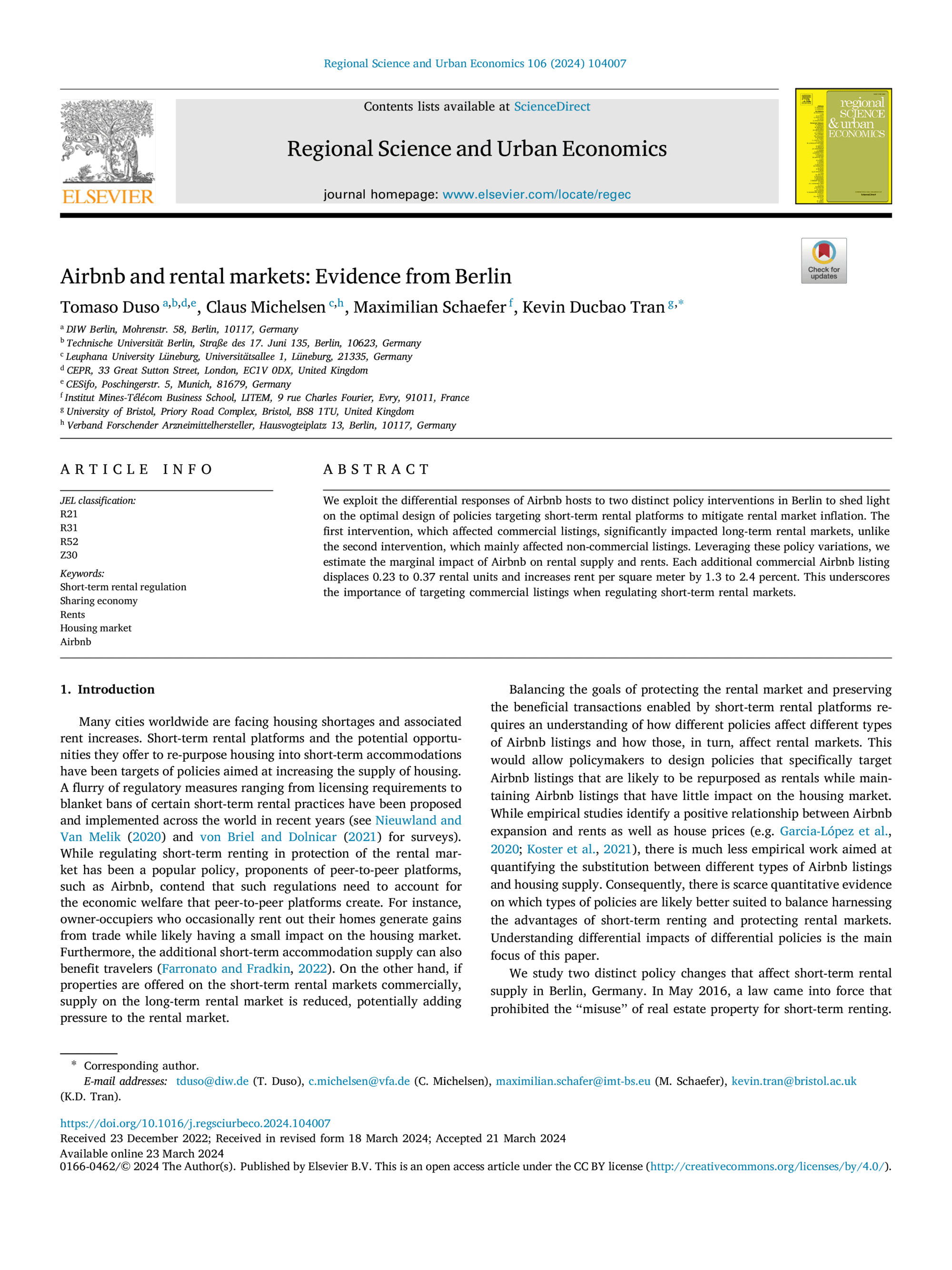
Overview of the Study and Its Authors
The paper “Airbnb and rental markets: Evidence from Berlin” is published in Regional Science and Urban Economics, a leading journal for urban and regional economic research. It is authored by Tomaso Duso (DIW Berlin), Claus Michelsen (Verband Forschender Arzneimittelhersteller), Maximilian Schaefer (Institut Mines‑Télécom Business School), and Kevin Ducbao Tran (University of Bristol). The authors combine expertise from economic research institutes, a university, and a public‑policy think‑tank, providing a multidisciplinary perspective on housing market dynamics.
Policy Context and Interventions
Berlin introduced two key regulatory interventions affecting short‑term rentals. The first, effective May 2016, prohibited the “misuse” of housing for short‑term rentals without explicit city‑council permission, targeting especially commercial listings. The second, enacted August 2018, required hosts to display a registration number, a measure mainly affecting non‑commercial hosts. Both policies aimed to curb the growth of Airbnb listings and alleviate pressure on long‑term rental supply and rents.
Research Design and Data
The authors exploit the staggered timing of these policies as quasi‑experimental shocks. They use a rich, monthly dataset covering November 2014 to July 2019, sourced from AirDNA for Airbnb listings and from Empirica for long‑term rental advertisements. The data include information on listing type (entire home, private room), availability (days listed), and estimated monthly revenue, allowing the authors to differentiate “commercial” listings (high availability or high revenue) from occasional, non‑commercial ones. The analysis is conducted at the city‑block level (approximately 0.03 km²) and at the postal‑code level for rent outcomes, controlling for a comprehensive set of neighbourhood characteristics (e.g., points of interest, pollution measures) and fixed effects.
Impact on Airbnb Supply
The 2016 reform led to a 30 % reduction in total Airbnb listings, with a pronounced drop in commercial listings (0.45 → 0.20 listings per block). The 2018 reform caused an 18 % overall reduction but primarily affected non‑commercial listings, leaving commercial supply largely unchanged. Overall, each additional commercial Airbnb listing displaced 0.23 to 0.37 long‑term rental units, whereas the effect of all listings combined was smaller (≈ 0.08 units).
Effects on Rental Supply and Prices
Using a difference‑in‑differences framework, the authors find that blocks with pre‑policy Airbnb exposure experienced an increase of about 0.1 additional long‑term rentals per month after the 2016 reform, signalling a modest rebound in supply. No comparable effect is observed after the 2018 reform. Instrumental‑variable estimates confirm that each extra commercial Airbnb listing reduces long‑term rental supply by 0.23–0.37 units and raises rent per square metre by 1.3–2.4 %, equivalent to an increase of €0.13–€0.24 per m². By contrast, all listings together raise rent by only €0.08 per m² (≈ 0.8 %). The authors note that Berlin’s average asked rent rose by €0.65 per m² per year between 2012 and 2018, highlighting that a single commercial Airbnb can generate a rent increase comparable to 20–35 % of the annual growth rate.
Implications for Sustainable Housing Policy
The findings suggest that targeting commercial short‑term rentals is crucial for mitigating negative externalities on the long‑term housing market. Policies that primarily affect occasional hosts, such as the registration‑number requirement, have limited impact on rental supply and rent levels. By contrast, stricter regulation of commercial listings can modestly increase housing availability and curb rent inflation, supporting more sustainable and affordable urban housing. The study underscores the importance of nuanced, data‑driven policy design that distinguishes between different types of Airbnb activity.