Skip to content
Reuse radar

Paris

Paris has little office vacancy by regional standards, but it is rising fastest in the city itself, and more than 100,000 private homes stand empty. The City already converts offices, garages and a ministry into housing, reserves 819 plots for social and bail réel solidaire homes in its local plan, and keeps the land of its bail réel solidaire homes in a community land trust — the route closest to a cooperative.
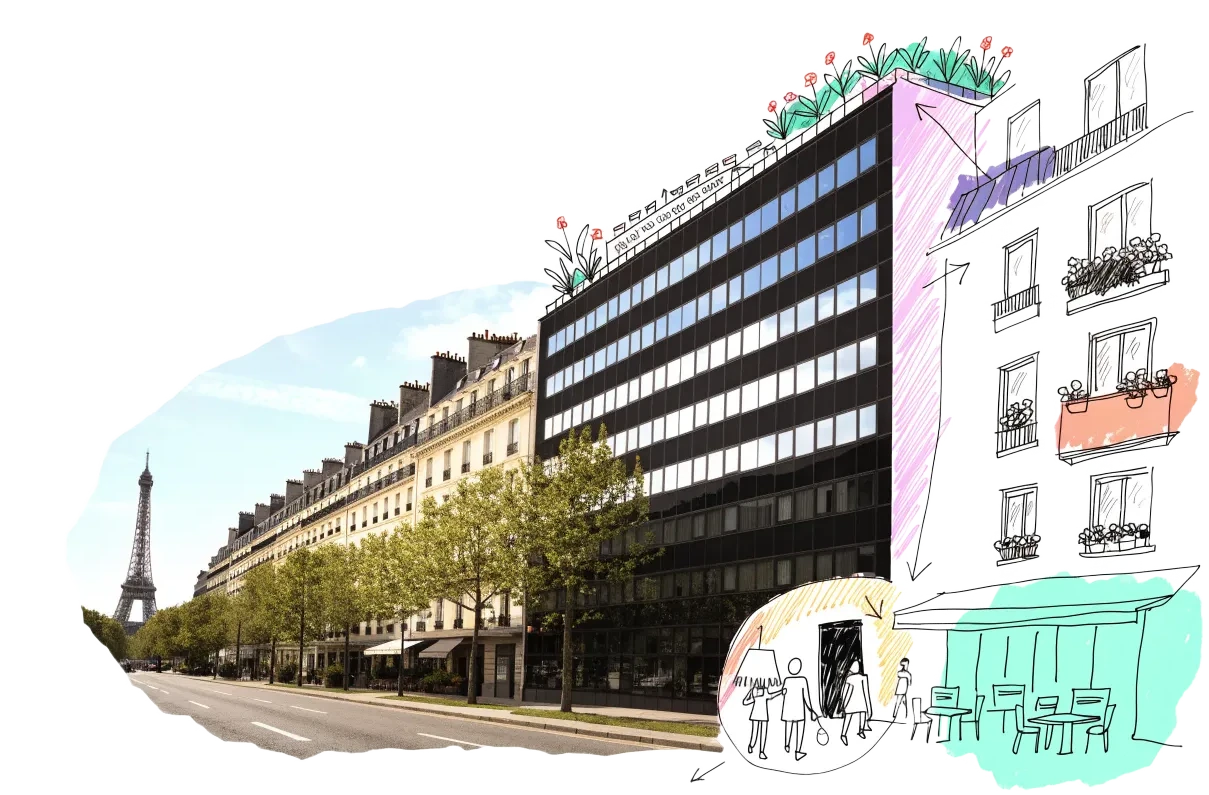
An empty building in Paris with homes, balconies and neighbours drawn onto it in ink
Vacant office space1.41 million m²
On the map6,022buildings and sites from 11 open sources
Homes potential≈ 5,607if 30% of empty offices converted

Office figures: Paris held 22% of Île-de-France's 6.4 million m² of immediately available offices at end-2025 (DRIEAT/ORIE) — about 1.4 million m², derived. CBRE/Immostat put vacancy at 6.5% in Paris Centre Ouest and 9.6% in the rest of Paris in Q1 2026; there is no single published rate for the city.. Homes: our economic model’s conversion engine. Map built 2026-10-06.

The map

Switch layers on by the question you are asking. Every point comes from a public record, an open dataset or a cited report; open one to see where it comes from and what the data cannot tell us.

The City's own open-data portal (opendata.paris.fr) disallows automated access to its API and downloads in robots.txt, so planning permits with change of use, City property and financed social housing are not on the map; the regional Sitadel layer stands in for permits but ends in 2024.

Loading map…

0 points · click a cluster to zoom, a point for its sources

Districts where conversion makes sense

Where empty offices, the right zoning and a working neighbourhood come together — and what could go wrong.

A hand outlining a neighbourhood on a city map, with small houses drawn inside

Paris Nord-Est (18th, 19th, 20th)

The most housing reservations for bail réel solidaire, the largest rail-land quarters and three of the City's conversion sites sit here.

  • 68 of the 113 bail réel solidaire reservations in the PLU are in the 18th, 19th and 20th
  • Hébert (1,160 homes), Gare des Mines (880) and Chapelle Charbon (375) are in progress
  • 970 empty ground-floor units in the 18th alone — the most of any arrondissement (Apur, 2023)

Risk: Much of the land is in long rail and ZAC operations already allocated to developers and social landlords.
3 sources

Paris Centre Ouest (8th, 16th, 17th and the QCA)

Offices are emptying fastest here as new buildings deliver into a weak market, and the 8th and 16th carry the most housing reservations in the PLU.

  • Immediate office supply in Paris Centre Ouest up 44% in a year (CBRE, Q2 2026)
  • Vacancy 6.5% in Q1 2026, up 1.7 points in a year
  • 157 PLU housing reservations in the 8th and 16th

Risk: The highest office rents and values in France; owners refurbish rather than convert, so a cooperative needs a public partner to compete.

3 sources

Paris Sud (12th, 13th, 14th)

The most public land without a facility on it, former hospital and rail sites, and the most housing already created by conversion.

  • 126 public-owned plots of 500 m² or more with no listed facility (Apur parcels)
  • About 109,000 m² of housing created by conversion permits of 300 m² or more since 2013 (Sitadel)
  • ZAC Saint-Vincent-de-Paul: 618 homes on a former hospital

Risk: The big sites (Saint-Vincent-de-Paul, Paris Rive Gauche, Bercy) are run by public developers with allocated programmes.

3 sources

Paris Centre (1st–4th)

Public headquarters and ministries are being turned into homes here, so the owners to approach are the State, AP-HP and the City.

  • Former AP-HP headquarters: 30,000 m², 48 social homes, completion end-2028
  • Morland: 16,280 m² of housing created from former public offices (Sitadel, completed)
  • About 53,000 m² of housing created by conversion permits of 300 m² or more since 2013

Risk: Small plots, listed buildings and very high values; most large public buildings have already been allocated.

2 sources

Owners and routes in

Who controls the space, and what a housing cooperative can actually do with them.

A door key on a doorstep with a drawn path leading to an open door
Allocation rule

Foncière de la Ville de Paris (community land trust, OFS)

The City's land trust keeps the land and sells homes under bail réel solidaire at about €5,000/m². A cooperative can ask to be the operator of a BRS lot or partner on a BRS-reserved plot rather than compete for market land.

1 source
Allocation rule

Ville de Paris — PLU housing reservations

819 plots carry a reservation for social, intermediate or BRS housing (113 of them BRS). When one of these buildings changes hands or is redeveloped, the programme must follow the reservation — a cooperative with a BRS or social partner fits it by design.

1 source
City agency

Ville de Paris — calls to convert vacant offices (Réinventer Paris)

The City runs calls for innovative urban projects on offices, garages and stores it or its partners control; ten sites have been offered so far, including a bail réel solidaire scheme of six homes. Watch for the next series and bid with a social-landlord or OFS partner.

1 source
Public owner

The State (Direction de l'immobilier de l'État) — discounted public land

State land can be sold below value for social housing (the 'Duflot' discount): the former ministry at 10 rue Saint-Dominique went for €56.72 million less. Apur's parcels show 47 large State plots in Paris with no listed facility — a list to raise with the City and the prefecture.

2 sources
Public owner

AP-HP, SNCF and RATP — operational land

Hospital, rail and transport bodies release sites through calls for projects (La Rochefoucauld, Fer à Moulin) and joint operations (Hébert, Les Messageries, Ateliers Vaugirard). Their next disposals appear first in Apur's project database.

1 source
Church property

Diocèse de Paris

The diocese is redeveloping some of its property with social housing (Maison de la Visitation, 92 homes). Diocesan associations own further plots in Paris — ask about convents and parish buildings, not only churches.

1 source

Signals to watch

Decisions, auctions and closures that change what becomes available, and when.

  1. 2026-09-03
    122 more bail réel solidaire homes

    The Foncière de la Ville de Paris put 122 new BRS homes on sale at about €5,000/m² in the 14th, 18th and 19th.

    1 source
  2. 2026-07
    Office supply jumps in central Paris

    Immediate office supply in Paris Centre Ouest rose 44% in a year as new buildings delivered into a weak market; Île-de-France reached 6.57 million m².

    1 source
  3. 2026-06-16
    New version of the Paris PLU in force

    The modified local plan published on the Géoportail de l'Urbanisme carries 819 housing reservations, 113 of them for bail réel solidaire.

    1 source
  4. 2026-06
    Long-term office vacancy doubles

    More than 1.9 million m² of Île-de-France offices have been empty for over three years — more than twice the 2024 level.

    1 source
  5. 2026-05-05
    Office-to-housing call picks 61 projects

    The State's Île-de-France call selected 61 of 101 projects, with potential for 8,200 homes, 55% of them social.

    1 source
  6. 2025-06-16
    Office-to-housing law

    Law 2025-541 lets mayors waive local plan rules to turn offices and other buildings into homes and creates a 20-year permit for successive uses.

    1 source

Sources and freshness

13 sources connected, 1 waiting for access. We only use data we may lawfully reuse; where a publisher blocks automated access we do not work around it — a person downloads it, or we ask for permission.

Show every source, its licence and when we last read it
SourceAccessRecordsStatusLicence
OpenStreetMap disused/abandoned tags and brownfields
OpenStreetMap contributors
Open API77Live
2026-10-06
ODbL 1.0 (© OpenStreetMap contributors)
Rail, S-Bahn and U-Bahn stations (OpenStreetMap)
OpenStreetMap contributors
Open APIscoringLive
2026-10-06
ODbL 1.0 (© OpenStreetMap contributors)
Road noise (EU Environmental Noise Directive, Lden)
European Environment Agency
Open APIscoringLive
2026-10-06
EEA standard re-use policy (attribution)
Leerstandsmelder.de — public reports of empty buildings
Leerstandsmelder (Gängeviertel e.V., Hamburg)
Shown while we ask Leerstandsmelder for permission. Reports since 2016 only, with the address, the month reported and a link to each entry; not checked by EHC. From a one-time copy of 4 October 2026 — the API is not fetched, as it disallows automated agents.
Asking for permission0Pending
2026-10-06
Credited to Leerstandsmelder.de; asking for permission
Named buildings and sites from EHC research (each with its own source)
European Housing Coop research
EHC research18Live
2026-10-06
Facts cited to their publishers
Empty ground-floor premises of 300 m² or more (BDCOM 2023)
Apur – Atelier parisien d'urbanisme
Open API273Live
2026-10-06
ODbL
Plots reserved for housing in the Paris PLU (incl. bail réel solidaire)
Ville de Paris, via the Géoportail de l'Urbanisme (IGN)
Open API819Live
2026-10-06
Licence Ouverte Etalab 2.0
Urban development operations and calls for projects (Apur BD Projets)
Apur – Atelier parisien d'urbanisme
Open API68Live
2026-10-06
ODbL
Public-owned land of 500 m² or more with no listed public facility
Apur – Atelier parisien d'urbanisme (urban parcels, owner nomenclature)
Open API517Live
2026-10-06
ODbL
Permits creating homes by converting other floor space (Sitadel, 2013–2024)
DRIEAT Île-de-France (Sitadel, geocoded)
Open API314Live
2026-10-06
Licence Ouverte Etalab 2.0
Service buildings of six storeys or more with no homes (IGN BD TOPO)
IGN – BD TOPO, via the Géoplateforme
Open API1,436Live
2026-10-06
Licence Ouverte Etalab 2.0
Existing buildings to be rehabilitated as housing inside development operations
Apur – Atelier parisien d'urbanisme
Open API15Live
2026-10-06
ODbL
Permits turning offices, shops or hotels into housing (building scale, 1997–2026)
Ville de Paris — Autorisations d'urbanisme (historique)
Manual download820Snapshot
2026
ODbL
Existing buildings bought and rehabilitated into social homes
Ville de Paris — Logements sociaux financés à Paris
Manual download1,665Snapshot
2025
ODbL

What this radar cannot see yet

  • The City's own open-data portal (opendata.paris.fr) disallows automated access to its API and downloads in robots.txt, so planning permits with change of use, City property and financed social housing are not on the map; the regional Sitadel layer stands in for permits but ends in 2024.
  • France's register of vacant homes (LOVAC) is restricted to authorised public bodies; only totals are open — 105,785 private homes empty in Paris on 1 January 2025, 26,264 of them for more than two years — so no empty block of flats can be shown.
  • There is no public register of empty offices; brokers publish vacancy by sector only, so office points are a building-type proxy, not a vacancy record.
  • Brownfield records (Cartofriches, 32 Paris sites) could not be loaded: the Cerema site disallows robots, its API was down on 6 October 2026 and the open CSV has no latitude/longitude columns.
  • Empty shop units are drawn only from 300 m²; the 2023 census counts 9,060 empty ground-floor units in all.

Know an empty building we have missed?

Open data cannot see everything. Tell us about a building in Paris that stands empty or barely used; once we have checked it, it joins the map under “Reported by visitors (checked)”.

A phone held up to photograph an empty shopfront, with a map pin drawn above it

We publish the address, the kind of building and your description once we have checked it — never your email. Please do not name the people who own or live in a building.

Other radars