
Skip to content
Reuse radar

Vienna

Vienna has one of the lowest office vacancy rates of any European capital and no official count of empty homes — the city does not record vacancy, while the 2021 register count found about 104,000 flats with no main residence. The way in for a cooperative is less a stock of stranded offices than a city that still owns and allocates land: wohnfonds_wien competitions with Baugruppen lots, rezoning that caps land prices for subsidised housing, and emptied public buildings now in interim use.
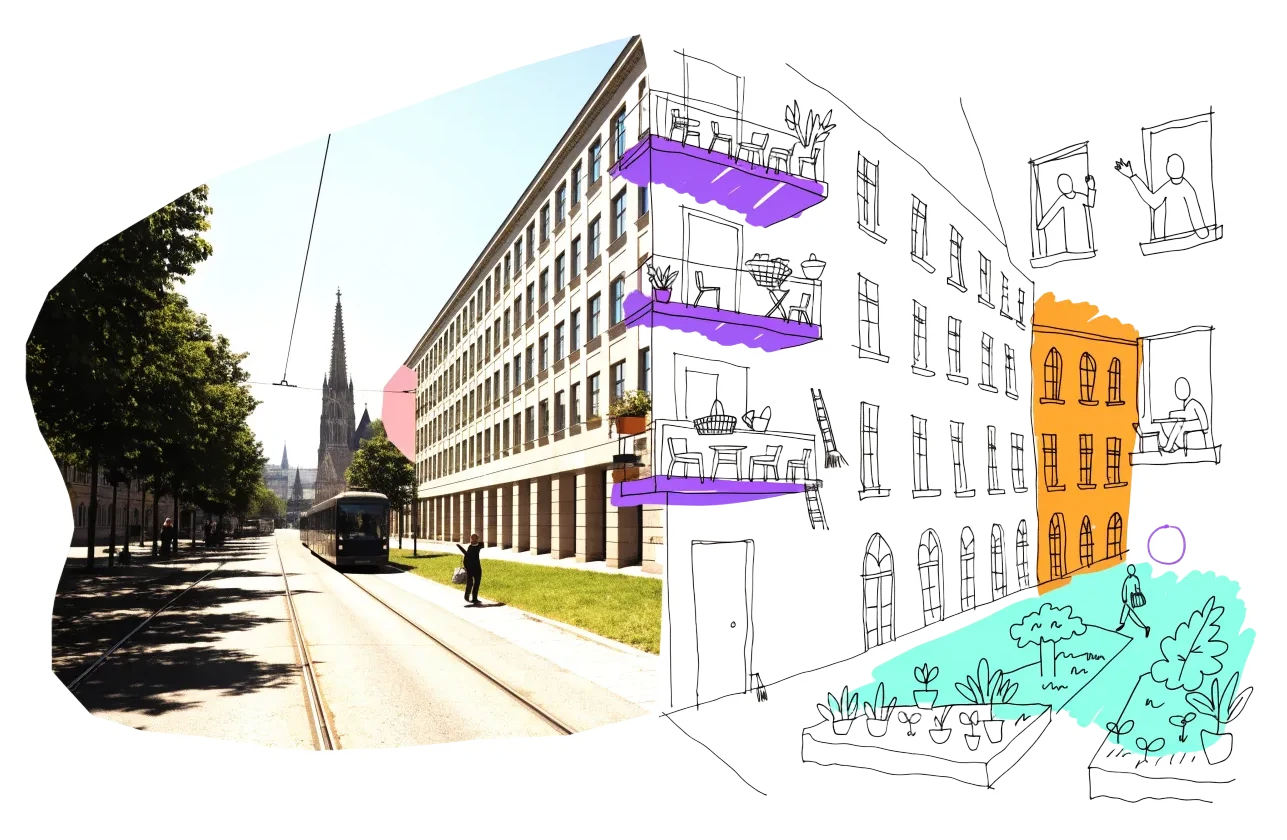
An empty building in Vienna with homes, balconies and neighbours drawn onto it in ink
Vacant office space454,000 m²3.9% of the stock stands empty
On the map1,351buildings and sites from 8 open sources
Homes potential≈ 1,627if 30% of empty offices converted

Office figures: CBRE Office Figures Q2 2026 — total stock 11.64 million m², occupied 11.19 million m², 3.9% vacant (4.4% in the modern stock). Homes: our economic model’s conversion engine. Map built 2026-10-06.

The map

Switch layers on by the question you are asking. Every point comes from a public record, an open dataset or a cited report; open one to see where it comes from and what the data cannot tell us.

Vienna keeps no register of empty buildings or flats, and there is no vacancy levy, so there is no official 'empty now' layer as in Berlin; the register count of flats without a main residence exists only as district and grid statistics.

Loading map…

0 points · click a cluster to zoom, a point for its sources

Where to look first

Buildings with evidence that they stand empty — a second source agrees, a public record names them, or we have checked them — ranked by a score you can read: co-op scale, daylight depth, a station nearby, a zone that allows homes, affordable land and an open route in. Checked buildings carry their result; nobody has visited them on site yet.

ScoreBuildingFloor areaStationActions
58Obere DonaustraßeConfirmed empty
Office or work building · 6.-Bauten der öffentlichen und privaten Wirtschaft · 14 storeys
—200 m
48Former Globus-Verlag (KPÖ) printing works and Schütte-Lihotzky wing, Höchstädtplatz 3
Distressed or stranded (named) · 1 other source nearby
—388 m

Districts where conversion makes sense

Where empty offices, the right zoning and a working neighbourhood come together — and what could go wrong.

A hand outlining a neighbourhood on a city map, with small houses drawn inside

Donaustadt (Eibengasse, Seestadt, Am Heidjöchl)

Half of all land the city mapped as 'in transformation' in 2024 lies here, much of it owned by wohnfonds_wien and allocated by competition.

  • 91 transformation areas covering 132 ha — half of Vienna's 266 ha (land-use mapping 2024)
  • Developer competition running now at Stadtquartier Eibengasse; Aspern Nord announced
  • Eibengasse and Am Heidjöchl are two of the five new quarters on wohnfonds_wien land

Risk: This is new building on former fields and railway land, not reuse, and far from the centre.
3 sources

Leopoldstadt and Brigittenau (Nordwestbahnhof, Nordbahnhof)

Two former railway yards close to the centre are being turned into quarters, with a subsidised-housing competition open now.

  • Bauträgerwettbewerb Nordwestbahnhof Phase A.2 running now
  • Two zoning procedures at Nordbahnhof-Innstraße and Lößlweg went to public exhibition in August 2026
  • 24 office and administration blocks (28.6 ha) in Leopoldstadt (land-use mapping 2024)

Risk: Plots go to the best project in competition; cooperatives compete with large non-profit developers.

3 sources

Landstraße (3rd district)

More land is mapped as offices and administration here than in any other district, much of it beside dense housing.

  • 48 office and administration blocks covering 50.9 ha, the most of any district (land-use mapping 2024)
  • 92 of the 569 inventoried office, administration and store buildings with 4+ storeys
  • 13 transformation areas covering 18.6 ha

Risk: Vienna's office vacancy is low (3.9%), so owners usually re-let or refurbish rather than convert.

3 sources

Penzing (Steinhof and the Wien valley)

The city-owned Otto-Wagner-Areal has a named future user for 15 of its 35 pavilions; an empty five-storey store stands on Hadikgasse.

  • 15 of 35 pavilions earmarked for the MUK by 2030/31; student housing planned
  • About 4,000 m² opened to creative interim uses from September 2025
  • Former Leiner store on Hadikgasse empty with no plans (August 2025)

Risk: Heritage protection and a city plan aimed at education, culture and health on Steinhof; no housing call has been made.

3 sources

Owners and routes in

Who controls the space, and what a housing cooperative can actually do with them.

A door key on a doorstep with a drawn path leading to an open door
Allocation rule

wohnfonds_wien (city land and housing fund)

Holds over 3 million m² of land for subsidised housing and allocates it through developer competitions (Bauträgerwettbewerbe), some reserved for Baugruppen — self-organised building groups. A cooperative can bid with a non-profit developer or for a Baugruppen lot; Eibengasse and Nordwestbahnhof A.2 are running now.

2 sources
Public owner

Otto Wagner Areal Revitalisierung GmbH (Wien Holding / WSE)

Manages the city-owned Steinhof pavilions. The university takes 15 of 35; student housing and other uses are still being shaped — the moment to propose a cooperative or supported-housing use for a pavilion.

1 source
Public owner

Wiener Wohnen (municipal housing)

Lets the shops, offices and storerooms in its estates; 55 were free on 6 October 2026, searchable by district and size. Ground-floor space for a cooperative's common rooms or workshop can be rented directly.

1 source
Subsidy

wohnfonds_wien — subsidised refurbishment

Vienna's refurbishment subsidy covers the conversion of buildings ('Umbau von Objekten') as well as renovation, from three homes upwards; the free Hauskunft advice service helps with the application, which must come before work starts.

1 source

Signals to watch

Decisions, auctions and closures that change what becomes available, and when.

  1. 2026-07-13
    Office vacancy edges up to 3.9%

    Only 20,559 m² let in Q2 2026, the weakest quarter since 2021; vacancy rose from 3.8% to 3.9%.

    1 source
  2. 2026-05-19
    Vacancy levy debated in the city council

    The Greens put the yield of a vacancy levy at about €1.1 billion per term; the governing SPÖ wants to see how other Länder fare first. No decision was taken.

    1 source
  3. 2026-03-29
    Lamarr shell becomes flats

    Permit granted on 24 February 2026 for about 200 flats above shops in the stalled Signa department store on Mariahilfer Straße; completion expected in Q1 2028.

    1 source
  4. 2026-01-29
    Two former kika/Leiner stores still without a future

    A year after the last stores closed, the Laxenburger Straße site is being converted to shops and offices while the Penzing and Donaustadt buildings remain under negotiation.

    1 source
  5. 2025-09-02
    Steinhof pavilions open for interim use

    About 4,000 m² in the Otto-Wagner-Areal's administration building and Pavilion 21 let to creative collectives until the university moves in.

    1 source
  6. 2025-04-09
    Architects and cultural bodies call for a vacancy count

    Seven institutions point out that Vienna does not record vacancy at all; the 2021 register count shows about 104,000 flats (9.7%) with no main residence.

    1 source

Sources and freshness

13 sources connected. We only use data we may lawfully reuse; where a publisher blocks automated access we do not work around it — a person downloads it, or we ask for permission.

Show every source, its licence and when we last read it
SourceAccessRecordsStatusLicence
OpenStreetMap disused/abandoned tags and brownfields
OpenStreetMap contributors
Open API332Live
2026-10-06
ODbL 1.0 (© OpenStreetMap contributors)
Rail, S-Bahn and U-Bahn stations (OpenStreetMap)
OpenStreetMap contributors
Open APIscoringLive
2026-10-06
ODbL 1.0 (© OpenStreetMap contributors)
Road noise (EU Environmental Noise Directive, Lden)
European Environment Agency
Open APIscoringLive
2026-10-06
EEA standard re-use policy (attribution)
Leerstandsmelder.de — public reports of empty buildings
Leerstandsmelder (Gängeviertel e.V., Hamburg)
Shown while we ask Leerstandsmelder for permission. Reports since 2016 only, with the address, the month reported and a link to each entry; not checked by EHC. From a one-time copy of 4 October 2026 — the API is not fetched, as it disallows automated agents.
Asking for permission166Used, not shown
2026-10-06
Credited to Leerstandsmelder.de; asking for permission
Named buildings and sites from EHC research (each with its own source)
European Housing Coop research
EHC research15Live
2026-10-06
Facts cited to their publishers
Office, administration and department-store buildings with 4+ storeys (city building inventory)
Stadt Wien – MA 19 Architektur und Stadtgestaltung (data.wien.gv.at)
Open API569Live
2026-10-06
CC BY 4.0 (Datenquelle: Stadt Wien – data.wien.gv.at)
Commercial yards and factory buildings with 3+ storeys (city building inventory)
Stadt Wien – MA 19 Architektur und Stadtgestaltung (data.wien.gv.at)
Open API175Live
2026-10-06
CC BY 4.0 (Datenquelle: Stadt Wien – data.wien.gv.at)
Transformation areas, building sites and extraction land (land-use mapping 2024)
Stadt Wien – MA 18 Stadtentwicklung und Stadtplanung (data.wien.gv.at)
Open API215Live
2026-10-06
CC BY 4.0 (Datenquelle: Stadt Wien – data.wien.gv.at)
Blocks mapped as offices and administration (land-use mapping 2024)
Stadt Wien – MA 18 Stadtentwicklung und Stadtplanung (data.wien.gv.at)
Open API294Used, not shown
2026-10-06
CC BY 4.0 (Datenquelle: Stadt Wien – data.wien.gv.at)
Zoning and building plans in procedure (from public exhibition on)
Stadt Wien – MA 21 Stadtteilplanung und Flächenwidmung (data.wien.gv.at)
Open API20Live
2026-10-06
CC BY 4.0 (Datenquelle: Stadt Wien – data.wien.gv.at)
Municipal housing estates (Gemeindebauten) owned by the City of Vienna
Stadt Wien – Wiener Wohnen (data.wien.gv.at)
Open API1,776Used, not shown
2026-10-06
CC BY 4.0 (Datenquelle: Stadt Wien – data.wien.gv.at)
Building freezes while a new zoning plan is prepared (§ 8(2) BO)
Stadt Wien — MA 21 (Stadtteilplanung und Flächenwidmung)
Open API10Live
2026-10-06
CC BY 4.0 (Datenquelle: Stadt Wien – data.wien.gv.at)
Building freezes for sites to be re-zoned (§ 8(6) BO)
Stadt Wien — MA 21 (Stadtteilplanung und Flächenwidmung)
Open API15Live
2026-10-06
CC BY 4.0 (Datenquelle: Stadt Wien – data.wien.gv.at)

What this radar cannot see yet

  • Vienna keeps no register of empty buildings or flats, and there is no vacancy levy, so there is no official 'empty now' layer as in Berlin; the register count of flats without a main residence exists only as district and grid statistics.
  • The city's building inventory gives building type and storeys for about 58,000 buildings in the dense city, not occupancy, floor area or owner — the office and factory points are candidates by type, not known vacancies.
  • Office vacancy is published only as a city-wide rate by brokers; no building- or district-level figures are open.
  • Wiener Wohnen's list of free commercial units has addresses but no coordinates, and court auction notices (Ediktsdatei) are not used — neither is drawn on the map yet.
  • There is no open orthophoto WMS for Vienna (only tile services), so building cards have no aerial close-up.

Know an empty building we have missed?

Open data cannot see everything. Tell us about a building in Vienna that stands empty or barely used; once we have checked it, it joins the map under “Reported by visitors (checked)”.

A phone held up to photograph an empty shopfront, with a map pin drawn above it

We publish the address, the kind of building and your description once we have checked it — never your email. Please do not name the people who own or live in a building.

Other radars