
Visitors, students and a shrinking rental market
Verona has always lived off the people who come to it. Roman legions, Venetian merchants and Habsburg garrisons each left a layer of walls, forts and barracks. Today the visitors are opera-goers, wine buyers and students, and they compete with residents for the same old rooms. That tension now shapes the housing question more than any other.
Most Veronese own their home. The 2021 census counted 121,250 homes occupied by residents, and 80,017 of them, about 66%, are owner-occupied. Another 39,655 are rented. The public share is small. AGEC (Azienda Gestione Edifici Comunali, the city's own housing company) manages 4,068 municipal homes, roughly 3.4% of the occupied stock. ATER (the Veneto region's public-housing body) owns more in the city, but no current count is published. No rental cooperative stock is recorded, so private landlords hold nearly all the rest.
- Owners0.00%
- Owner-occupier0.00%
- Renters0.00%
- Public & non-profit rental0.00%
- Cooperative0.00%
- Private rental0.00%
- Unclassified100.0%
- Unknown / Other100.0%
Social housing in Italy is a set of rules, not a landlord. Of AGEC's homes, 60% are let at canone convenzionato (a below-market rent set by the city) and the remainder under the regional ERP law (edilizia residenziale pubblica, public housing allocated by income). The same regulatory layer reaches into private stock. The regional Fondo Veneto Casa (an ethical property fund) built 77 new homes in Verona for households too well off for ERP but priced out of the market. Private owners can also sign leases at canone concordato (an agreed rent set by local landlord and tenant associations) in return for tax relief. The rule therefore cuts across the tenures rather than forming a slice of its own.
Rents have climbed fast from a low base. Immobiliare.it's asking rent rose from €7.6 per m² a month in 2015 to €11.7 in 2023, while the average number of flats on offer each quarter fell from 777 to 266. By mid-2026 the figure stood at €12.3 per m², against an asking price of €2,898 per m² to buy. Furnished lets sit higher: a furnished studio averages €723 a month, and furnished mid-stay flats are estimated at about €19.6 per m² including bills.
- Asking rent, 2015
- New contracts
- Asking rent, H1 2026
- Furnished / serviced (gross)
Monthly rent per m² for advertised homes, from 2015 asking rents to furnished lets. No cooperative or public-housing rent per m² is published for the city.
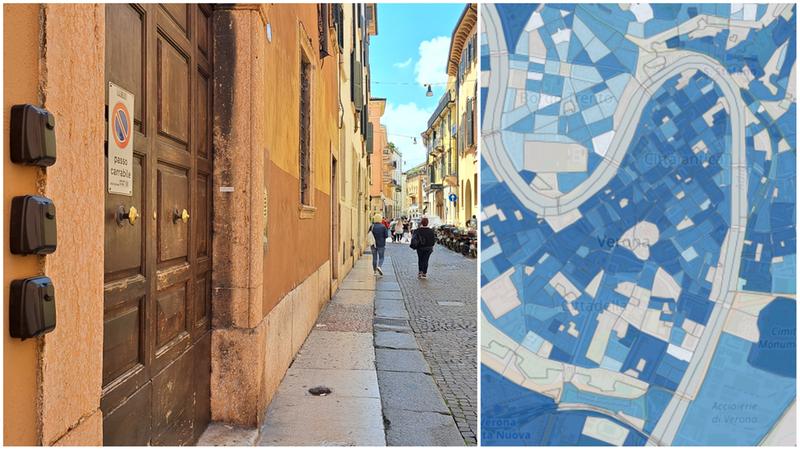
Homes stand empty all the same. The latest census reading found 18,685 dwellings, or 13.3%, either vacant or used only by non-residents at the end of 2023. The share peaks in the historic centre and Veronetta, where it reaches 37.7% in some blocks. Office space is harder to read. The land registry lists 1 m² of private offices and studios, but no measured vacancy rate exists for the city. Tourist lets are the sharper pressure. The city's tourist-tax register counted 56 of them in 2014 and 4,366 at the end of June 2026.
Demand is growing where supply is not. Enrolment at the University of Verona rose from 25,771 students in 2019/20 to 29,875, while subsidised student beds reached only 540. Registered rental contracts meanwhile fell from 10,968 in 2019 to 9,365 in 2023. The city's structure plan (PAT) estimates that 5,559 homes must come onto the market by 2033. Italy has no rent cap, so the agreed-rent lease is the main affordability tool.
The pressure no longer stops at the poorest. A CNA (craft and small-business association) analysis of tax-agency data found rents up 39% between 2019 and 2025, with the average rent now above 50% of a typical salary. Immobiliare.it ranks Verona 16th of 17 large cities on rental affordability, with rent taking 67.5% of a two-income household's budget in its model. Evictions tell the same story: in 2022 the province recorded 542 eviction orders, the most in Veneto. The waiting list for public homes grew to 1,371 applications, up from about 800. An Altreconomia investigation found that migrant workers, who hold many of the city's jobs, are pushed furthest to the margins. Salaried families are now joining them in the queue.
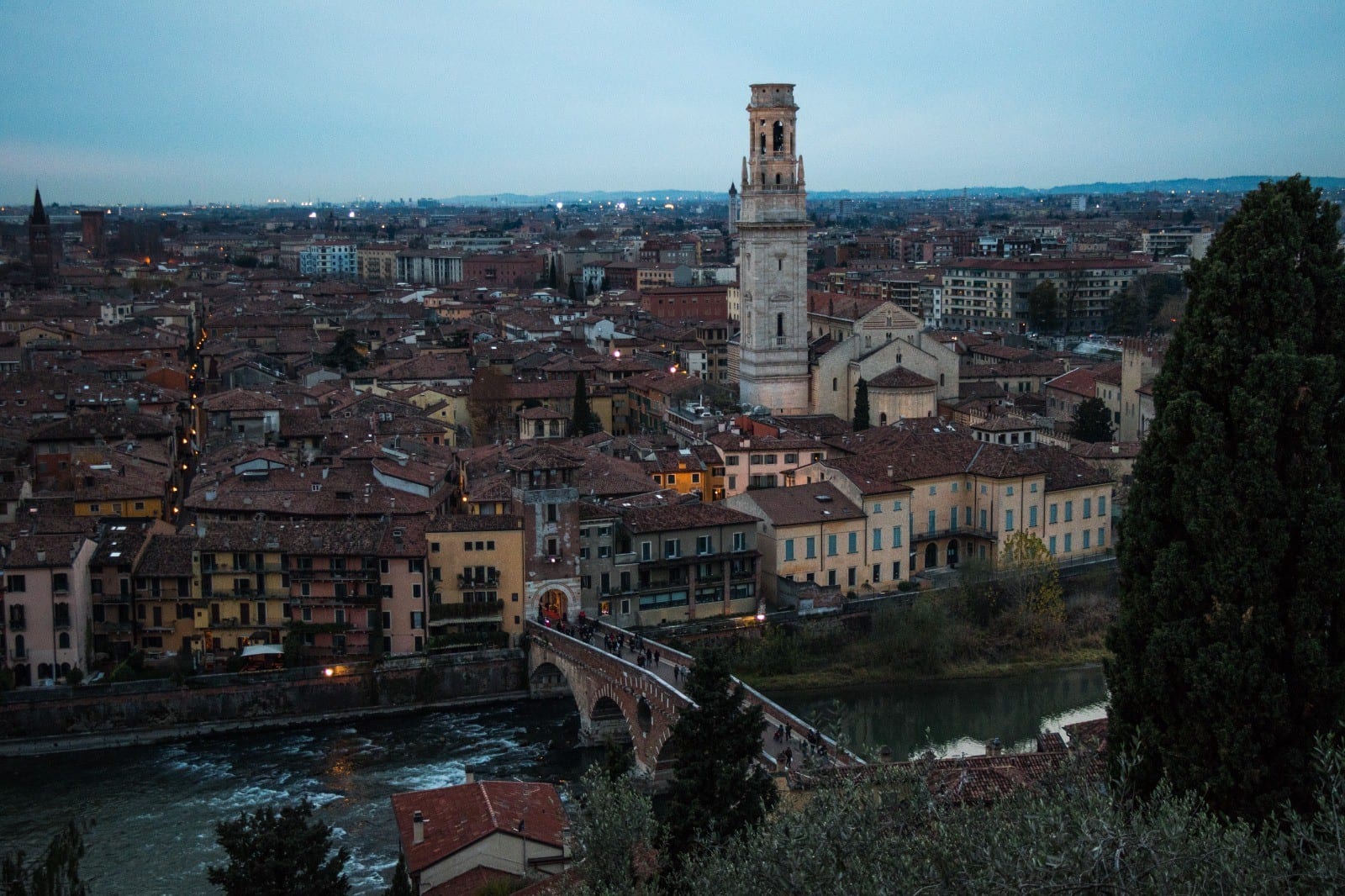
In recent years, citizens with a permanent job and families with some financial means are also turning to AGEC, and foreign residents make up half of those on the waiting list.Missing from that picture is a cooperative rental sector of the kind that steadies prices in Bologna or Zurich. Verona built one of Italy's first workers' cooperatives for housing, and then let the model fade.
A cooperative city that sold its homes
Italian housing cooperatives come in two forms. In a cooperativa a proprietà divisa (divided-ownership cooperative), members pool money to build and each buys their flat at cost, after which it becomes ordinary private property. In a cooperativa a proprietà indivisa (undivided-ownership cooperative), the society keeps the buildings and assigns each member a home for use without time limit, in return for a cost-based fee. Members join by paying a quota sociale (a share in the society's capital), which is returned when they leave. Across Italy, according to Legacoop Abitanti's 2025 evidence to Parliament, cooperatives have built more than 330,000 homes, but only about 40,000 remain in undivided ownership.
Verona's tradition began early. In 1888 the Società Anonima Cooperativa Edificatrice di Case Operaie (the workers' housing building cooperative) put up the Quartiere XVI Ottobre, today Alto San Nazaro, eight blocks with 46 flats for workers hit by the housing shortage of the time. After the war the national INA-Casa plan shaped whole districts such as Santa Croce, built between 1949 and 1963. Like most Italian cooperatives of the post-war decades, Verona's built mainly to sell to their members at cost. Almost none kept homes to let, which is why the census records no rental cooperative stock in the city.
The sector that exists today looks very different, and it clusters in three groups. The classic building cooperatives are nearly invisible: a 2017 Legacoop census counted just 2 active Legacoop housing cooperatives in all of Veneto, out of 691 nationally. The second group is social cooperatives that house people rather than build. La Casa per gli Immigrati has spent more than 30 years finding homes for migrants and now manages dozens of flats. The Cooperativa Il Samaritano runs Caritas Verona's Housing First project for young people. The third group is investment vehicles, such as the Fondo Veneto Casa, which let agreed-rent homes without member ownership.
Their problems differ. Building cooperatives lack cheap land and the public loans that once financed them. Social cooperatives have the tenants and the know-how but no capital, so they depend on buildings they can borrow. Funds have capital but no members. Verona's administration has begun to treat the second group as a partner. In September 2024 AGEC changed its rules so that associations can repair vacant public flats in return for a below-market lease. That exchange of labour for tenure sits at the centre of the city's housing policy.
Rome promises, Venice funds, Verona borrows
Rome's answer to the crisis is the Piano Casa Italia. Decree-law 66 of May 2026, converted into law in July, aims to make about 100,000 homes available over ten years, mostly as edilizia convenzionata (homes sold or let at a regulated discount to market). It also adds an urgent eviction procedure in which a judge can order a tenant out within 15 days. How much money stands behind it is disputed. L'Indipendente's tally finds about €970 million actually budgeted for 2026–2030, far below the figures announced. The plan follows the 2023 decision to cut the national rent-support fund from €230 million to zero.
The levers are split between three levels. Rome writes tenancy law and funds big programmes. The Veneto region sets the rules for public housing through regional law 39 of 2017, and owns ATER. Its new president, Alberto Stefani, launched Generazione Casa in January 2026 with €50 million of reprogrammed EU funds for working households who fall between public housing and the market. The comune controls land use, AGEC and its own welfare budget. Mayor Damiano Tommasi's council has used them in small, targeted steps. A social housing agency, meant to broker safe leases between owners and tenants, was formally set up in February 2026. Its first budget line is €178,000. In June 2026 the council added Verona Abita Giovane, a rent top-up of up to €200 a month for under-35s on agreed-rent leases.
Cooperatives enter this policy through vacant buildings rather than new land. AGEC's 2024 rule change lets social cooperatives and associations repair empty public flats in return for a lease. Tenant unions, owners' associations and social cooperatives jointly asked the mayor in June 2026 to make the social housing agency fully operational and back it with a public-private guarantee fund. The city has not yet announced a concept-led land tender or ground-lease programme reserved for cooperatives.
The vacancy numbers have produced the sharpest measure. In July 2026 the council adopted Variante 70 to its planning rules by 20 votes to 5. It bans new tourist-let use of homes in the UNESCO historic centre, where 2,028 of the city's 3,404 tourist lets were concentrated in 2024. Existing lets keep their status. Public empties are the other target. AGEC's stock of vacant homes awaiting repair fell to 497 by the end of 2024. The former Passalacqua and Santa Marta barracks, under a 2024 agreement with the state property agency, are to host a university residence.
Climate goals increasingly run through the same buildings. Veneto's regional law 14 of 2017 commits it to reduce the consumption of undeveloped land to zero by 2050, which pushes growth into existing stock. Italy missed the May 2026 deadline to transpose the EU's recast buildings directive, with no national renovation plan yet presented. The Superbonus retrofit tax credit, once the main financing tool, fell to 65% for condominiums in 2025.
- 1998
Law 431 creates the agreed-rent lease
The national tenancy law introduces canone concordato leases, with rents set by local landlord and tenant associations.
- 2017[source]
Veneto's twin laws
Regional law 14 sets out to reduce soil consumption towards zero by 2050; law 39 recasts public housing around the ISEE means test and renewable fixed-term leases.
- Jun 2022[source]
Damiano Tommasi elected mayor
A centre-left coalition takes the city in the run-off.
- 2023[source]
National rent-support fund cut to zero
The budget law ends the Fondo per il sostegno alla locazione, which had held €230 million.
- Sep 2024[source]
AGEC opens vacant flats to associations
Associations may repair empty public homes in exchange for a below-market lease.
- Nov 2025[source]
Alberto Stefani elected president of Veneto
The new regional government launches "Generazione Casa" for workers priced out of the market.
- May 2026[source]
Piano Casa Italia decree
Decree-law 66 targets about 100,000 homes over ten years and a fast-track eviction procedure.
- Jul 2026[source]
Variante 70 adopted
The city council bars new tourist lets in the UNESCO historic centre, pending final approval.
- 2030[source]
First EU building-energy milestone
The recast Energy Performance of Buildings Directive requires a 16% cut in residential energy use against 2020.
- 2033[source]
Structure-plan horizon
The PAT's estimate of 5,559 homes needed falls due.
- 2050[source]
Zero net soil consumption
Veneto's land-take target, aligned with the EU's.
National, regional and municipal milestones, with the targets set for the years ahead.
The argument over tourist lets divides the city clearly. Deputy mayor Barbara Bissoli argues that the historic centre is at a limit. Edoardo Nestori, president of the short-let owners' association Locatur, answered the council's vote directly. Nationally, Confedilizia's president Giorgio Spaziani Testa argues that owners will only rent long-term if they can be sure of recovering their property.
There are more than 3,000 tourist lets in the city, around 2,000 of them concentrated in the historic centre. We have clearly reached a limit beyond which the centre risks becoming a stage set without a soul.This is not the way to meet the challenges of tourism or of housing.Edoardo Nestori, President of Locatur, the association of tourist-let owners
Between the national promises and the local vote, the working answers are small: a fort, a few dozen borrowed flats and a student residence.
Forts, empty flats and borrowed keys
Verona's most concrete housing experiments reuse what the city already has: military land, empty council flats and the goodwill of its foundations. None is large. Together they show which tools the city can already use.
Spazio Forte is the flagship. The Comune is regenerating Forte Santa Caterina, a 19th-century Austrian fort, and the neighbouring military land on via del Pestrino. The plan includes a social housing hub of 20 homes in four buildings on a lot of about 11,000 m². The project mobilises €19 million, of which €15 million comes from PINQuA, the national quality-of-living programme funded by the EU recovery plan (PNRR).
La Casa per gli Immigrati shows the other route, the one that starts from empty flats. Under AGEC's 2024 rule, the social cooperative took over five vacant public homes and invested €120,000 to house 20 migrant workers. Its Abitare Verona project extends the same deal to around 50 more flats awaiting repair. Renzo Fior, its president, has described how much harder it has become for migrants to rent in the city. The cooperative has turned that difficulty into a working model.
AGEC itself has been learning the same lesson in its own stock. In 2020 it spent €1.3 million to bring 18 long-unusable flats back into use, about €50,000–60,000 per home. It now re-lets about 250 homes a year. The model is slow and expensive, but it adds homes without taking new land.
ESU Verona, the regional body for student welfare, is the answer to the university's growth. Its subsidised beds rose from 430 in 2021 to 540, with 670 planned, including a new residence in via Don Mazza. Residences still house only about 5% of out-of-town students, according to local reporting.
Caritas Verona's Casa Solidale Giovani, run since 2014 with the social cooperative Il Samaritano, applies Housing First to homeless young people. Participants move straight into a shared flat with up to three peers and receive support there, rather than earning a home through shelters. It is small, but it is one of the few projects in the city built around tenure as a starting point.
Fondazione Cariverona, the banking foundation that once owned social housing of its own, has returned to the field through grants. Its 2026 call Facciamo Spazio puts €7.5 million into accessible homes and study spaces for young people across its territory. Its president, Bruno Giordano, frames staying in one's home region as something territories must build, not something individuals must endure.
A thin layer of research ties these projects together. A 2026 study of social housing in Verona, written from inside the city's social services, maps who manages what and notes that neither AGEC nor ATER yet runs its homes with a social-management model. Altreconomia's investigation documents the human cost of the gap. Between them they describe a city with the buildings, the partners and the rules to do more, but not yet the finance or the vehicle.
References
Statistics5Click on any number to see the source
Housing market
Population & migration
From our library5
- Censimento 2023: in centro case vuote, abitanti e auto (L'Arena) — Knowledge
- L'emergenza abitativa a Verona costringe le persone migranti ai margini — Knowledge
- Audizione Legacoop Abitanti — Commissione VIII Camera dei Deputati (luglio 2025) — Knowledge
- Le cooperative di abitazione aderenti a Legacoop Abitanti (Centro Studi Legacoop, 2017) — Knowledge
- Abitare Sociale a Verona: dall'emergenza abitativa al welfare abitativo — Knowledge
Further sources32
- Fondo immobiliare etico Veneto Casa — Regione del Veneto
- Boom di affitti brevi a Verona: i dati — il NordEst · 2026-08-20
- Università di Verona: il rettore Nocini inaugura il 42° anno accademico — MilanoFinanza · 2025-02-07
- Affitti a Verona: aumenti e stipendi — VeronaSera · 2026-06-06
- Prezzo delle case a Verona: vendita e affitto 2026 — VeronaSera · 2026-09-15
- Verona prima provincia in Veneto per sfratti — L'Arena · 2023-10-06
- Case Agec: calano gli alloggi sfitti ma tante richieste — L'Arena · 2025-04-24
- Cooperative edilizie di abitazione: proprietà divisa e indivisa — Informazione Fiscale · 2021-12-27
- La Veronetta del Tocatì — AGILE Aps / COCAI Aps · 2024-09
- Circoscrizione 6 — profilo storico — Comune di Verona
- L'Housing First del Progetto Casa Solidale Giovani di Caritas Verona — EDA Forum / Università di Verona · 2015-12
- Nuovo Piano Casa 2026: 100mila nuovi alloggi e sfratti lampo — LentePubblica · 2026-05-04
- Prima sottofinanziato, poi rinviato: il Piano casa del governo Meloni — L'Indipendente · 2026-04-02
- Emergenza casa: il governo azzera i fondi per l'affitto — Il Fatto Quotidiano · 2022-12-13
- Legge regionale 39 del 2017 — Regione del Veneto
- Generazione Casa, piano da 50 milioni — Italpress · 2026-01-09
- Delibera di Giunta 563/2026 — Fondo Abitare Giovane under 35 — Comune di Verona · 2026-06-05
- Bando Verona Abita Giovane 2026 — Comune di Verona · 2026
- Sfratti: appello per l'Agenzia Sociale per l'Abitare — VeronaSera · 2026-06-12
- Locazioni turistiche in centro storico: approvato il freno ai B&B — L'Arena · 2026-07-30
- Accordo Agenzia del Demanio – Comune di Verona — Agenzia del Demanio · 2024-05-09
- Contenimento del consumo di suolo — Regione del Veneto
- Recepimento direttiva case green: Italia, Germania, Austria e Spagna a confronto — Ingenio
- Superbonus 2024: novità e scadenze — Informazione Fiscale · 2024-09-23
- Ballottaggio elezioni Verona 2022: risultati — Money.it · 2022-06-26
- Casa per gli Immigrati e Agec: la replica di Ceni — VeronaSera · 2025-06-18
- Elezioni regionali, Alberto Stefani nuovo presidente — Gente Veneta · 2025-11-24
- Spaziani Testa: la certezza dei tempi negli sfratti è anch'essa una politica per la casa — Italia Oggi · 2026-09-09
- Stop a nuove locazioni turistiche in centro storico — L'Arena · 2025-09-09
- AGEC: recupero di 18 appartamenti — Comune di Verona · 2020-11-25
- Emergenza alloggi per gli studenti universitari fuori sede — L'Arena · 2024-10-10
- Bando Facciamo Spazio — Fondazione Cariverona · 2026-05-28