Overview of the Audition and Its Context
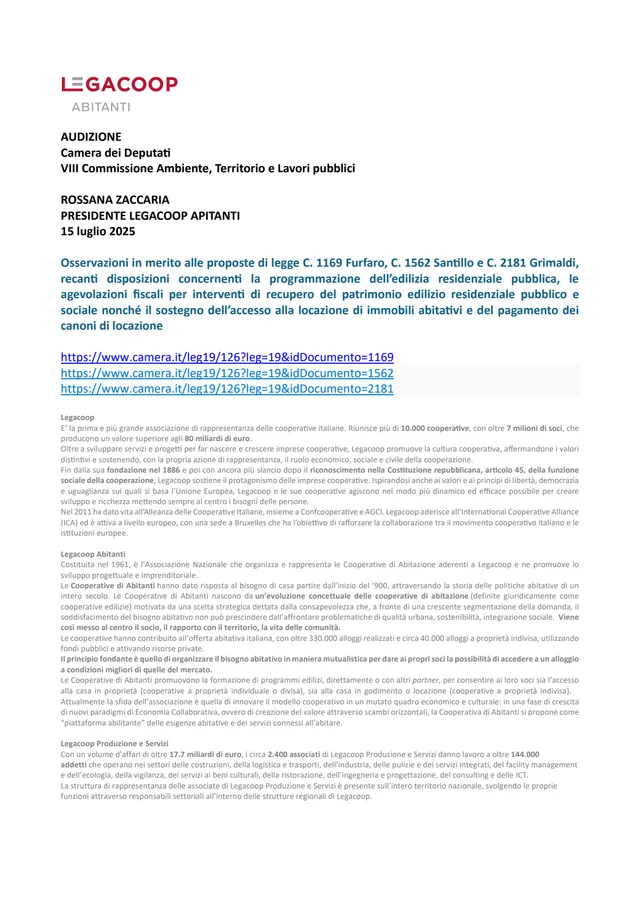
The document records the audizione of Legacoop Abitanti before the VIII Commission of the Italian Chamber of Deputies in July 2025. It was authored by Rossana Zaccaria, President of Legacoop Abitanti, and published by the Camera dei Deputati. The hearing addresses legislative proposals (C. 1169, C. 1562, C. 2181) concerning public residential building programmes, fiscal incentives for the refurbishment of public housing stock, and measures to facilitate affordable renting.
Legislative Proposals Discussed
Three bills are examined:
- C. 1169 (Furfaro) – proposes a multi‑year public residential building plan with mixed financing, but past measures such as “incremento alloggi Erp/Ers” have shown limited effectiveness.
- C. 1562 (San4llo) – focuses on European‑funded projects, energy‑efficient retrofitting, and the creation of renewable‑energy community hubs within social housing.
- C. 2181 (Grimaldi) – targets the recovery of unused public assets, mandating that at least 25 % of gross floor area in urban regeneration plans be allocated to social housing or subsidised rentals.
Key Quantitative Data
- Legacoop represents >10,000 cooperatives, >7 million members, and generates >€80 billion in economic activity.
- Nationwide, cooperatives have built ≈330,000 housing units, including ≈40,000 units under indivisible ownership.
- Proposed decennial plan: 20,000 new homes (≈70‑80 m² each) with a total investment of €4.9 billion (net of VAT).
- Financing split: €1.496 billion public (areas, urbanisation, design) and €3.315 billion private debt (BEI, CEB).
- Public contribution: €600 million over ten years (€60 million per year).
- Cost per housing unit: €190,000 private equity, €80,000 public funding.
Financial Instruments and Partnerships
The proposal recommends a public‑private partnership (PPP) model anchored by:
- Grants (EU Cohesion Funds, BEI “grant‑plus‑debt” schemes).
- Long‑term fixed‑rate mortgages (30‑40 years) from the European Investment Bank (EIB) and the Central European Bank (CEB).
- Impact‑finance vehicles for equity.
- State guarantees on long‑term loans, use of public land, and issuance of long‑term bonds.
Sustainable Building and Energy Goals
The plan integrates energy‑efficiency upgrades and renewable‑energy community projects, aligning with EU climate objectives. It seeks to reduce carbon footprints of new and refurbished dwellings and to promote circular‑economy principles within cooperative construction.
Governance and Implementation Structure
Two‑tier governance is outlined:
- Government Function – Ministries, national and regional authorities set objectives, approve budgets, and monitor compliance with the S.I.E.G. (Service of General Economic Interest).
- Technical Management Function – an operational body appointed by the Government oversees project execution, debt syndication, and coordination with cooperatives.
European Context and Funding Opportunities
The EU’s mid‑term Cohesion Policy revision (2021‑2027) earmarks increased resources for affordable housing, including a 30 % pre‑financing boost for 2026 and a 100 % co‑financing rate. The European Commission’s “Housing” portfolio and the special parliamentary committee chaired by Irene Tinagli provide policy backing for the proposed PPP model.
Expected Impact on Housing Market
If fully implemented, the 20,000‑unit programme would add roughly 0.1 % to Italy’s housing stock annually over ten years, lower rental costs to €60‑75 per m² per year, and create a replicable template for other EU Member States facing similar housing affordability challenges.