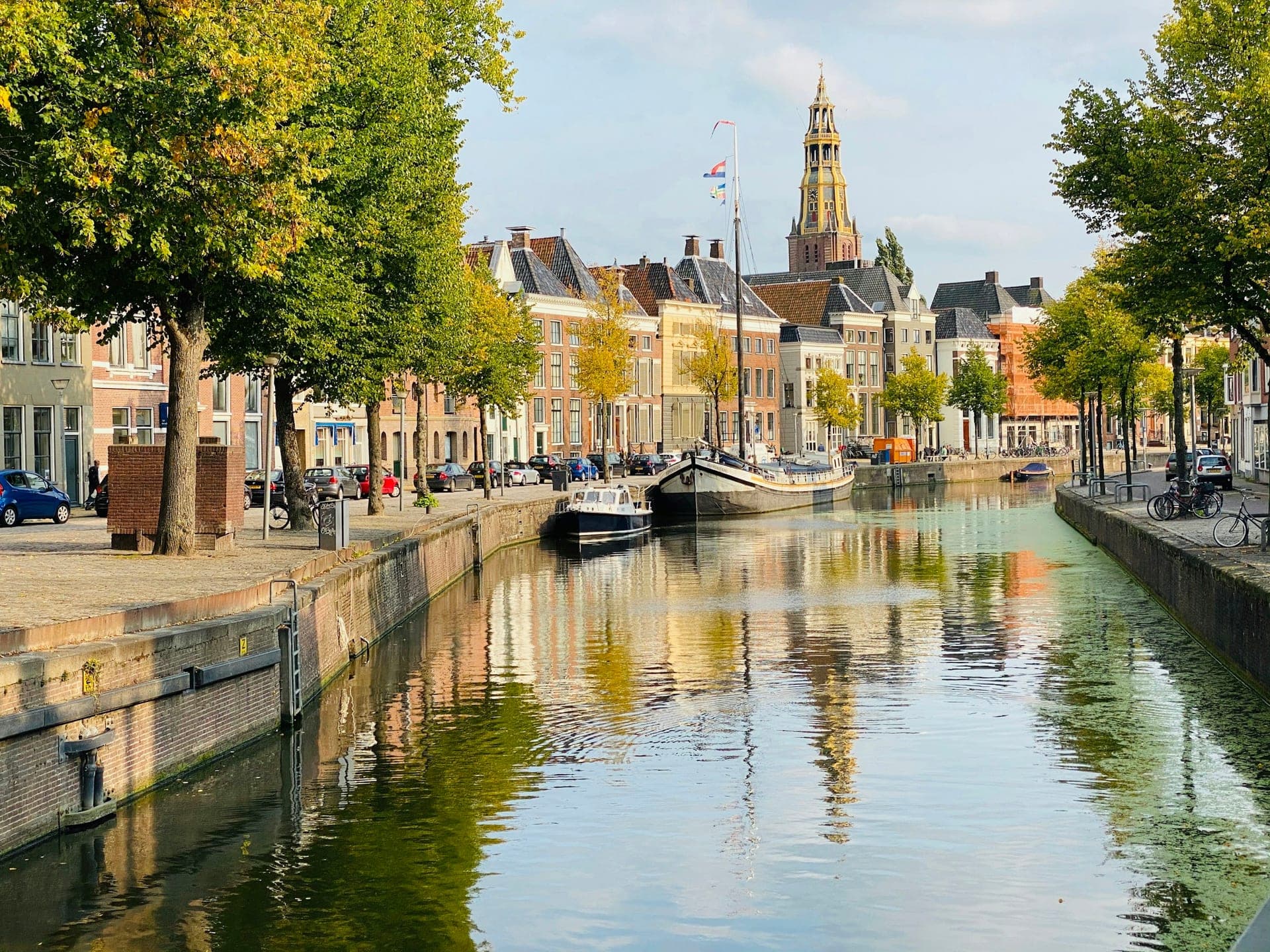
A young city that refills every September
Groningen has been the capital of the Dutch north since the Middle Ages, and a university town since 1614. It is also a city that decided early to put people before cars. On 19 September 1977 a traffic plan cut the centre into four sectors that cars could not cross, and today more than 60% of all trips are made by bicycle. The other constant is youth. Around 60,000 students live here, a quarter of the population, and the average resident is 36 years old, the youngest of any Dutch city. A place that refills every September is a place where the scarce thing is a room.
The municipality counts 244,427 residents, a figure that includes Haren and Ten Boer since the 2019 merger. Most of them rent: 61% of households are tenants and 39% own their home. The largest landlords are four housing associations, the woningcorporaties (non-profit landlords regulated by the state): Nijestee, Lefier, Patrimonium and De Huismeesters. Together they own about 31% of all dwellings, some 39,300 homes. Private landlords let the other about 28%. Cooperatives hardly appear in the statistics. The catalogue records 0% of dwellings and 1 cooperative organisation, although a handful of resident-run projects exist below that threshold.
- Owners
- Owner-occupier39.0%
- Renters
- Public & non-profit rental30.0%
- Cooperative0.00%
- Private rental31.0%
Social housing in the Netherlands is a set of rules, not a kind of owner. Most homes let under the regulated social-rent ceiling belong to the associations, but some private homes are let below the line too. Eligibility is broad: 55% of households earn little enough to qualify.
What a tenant pays depends on which door they came through. An association home costs €7.45 per square metre a month on average. A new private contract costs €18, well over twice as much. Flexible, serviced flats reach €30.60 gross, and a furnished one-bedroom flat lets for about €1,250 a month. Students feel the steepest climb. A room cost €580 a month in early 2026, 12.6% more than a year before.
- Public/association housing
- New contracts
- Serviced (gross)
Monthly rent per square metre by tier: net cold for association and new private lets, gross all-in for serviced flats. A new private contract costs about 2.4 times an association home.
Very few homes stand empty. Residential vacancy is 2.4%, about 2,850 dwellings. The city's own housing plan counts a little more, 3%, or roughly 4,100 homes, of which the plan treats about 2% as healthy turnover between tenants. Offices are almost as full: 3.02% of office space is vacant, only 31,950 square metres. Groningen has already used much of that slack. In 2021 it created 485 homes by converting other buildings, second only to Amsterdam. Short-term letting sits at the top of the market, where a one-bedroom flat fetches a median €110 a night.
Newcomers keep arriving faster than homes are finished. Some 18,500 people move to Groningen each year, and about 22,000 stay for three to twelve months. The population grew by more than 13,000 in six years, driven mainly by arrivals from abroad. Building has not kept pace. In 2024 the city aimed for 1,400 new homes and delivered 629. The social stock was meant to grow and instead shrank by 240 homes. The Wet betaalbare huur (the Affordable Rent Act of 2024, which caps mid-market rents through a points system) has also pushed private landlords to sell. Across the province, homes let by private landlords fell from 51,225 to 50,699 in a year, the first fall in six years.
The squeeze reaches well past the poorest households. A newcomer without priority waits more than 8 years to qualify for a social home, and the active search time rose to 3.1 years against a goal of 2. Private tenants carry the heaviest load. Households in Groningen spend 24.4% of their income on housing, against 23% nationally, and private renters spend the most. More than half of residents under 35 rent privately, and students spend 45% of their income on housing. A rough rent-to-income estimate puts 39.8% of renters above the overburden line. Middle earners now say they are caught too. René Staijen of the local party Groep Staijen made the point in the council in 2025, as OOG (the city's local broadcaster) reported. Middle incomes, he said, "earn too much for a social rental and too little for a home to buy". With the average home at €410,000, the city reports a shortage of 10,000 homes.
Voters rank it first. Before the March 2026 municipal elections, 51% of voters said housing would decide their vote, up from 36% four years earlier. An investigation by Follow the Money found that making housing affordable topped the party programmes in the 2025 national election. In a city where renters are the majority, the missing tenure is the one residents would own together: the cooperative.
From member societies to a desk for new ones
Dutch law has recognised the wooncoöperatie (housing cooperative) as a form of its own since 2015. It comes in two main kinds, although the 2015 Housing Act listed three variants, including a buying cooperative. In a management cooperative, tenants take over some or all management of homes that a third party, usually a housing association, still owns. In an ownership cooperative, residents develop or take over a building together and rent the homes to themselves as members. Members usually put in a modest stake rather than a full deposit. The national Fonds Coöperatief Wonen (the Cooperative Housing Fund) asks groups for at least 5% of the cost and finances the planning and development phase, plus construction for rental projects. It holds €60.6 million, enough for about 1,000 rental homes, and was awarded in October 2025 to SVn (the municipalities' own housing-finance fund).
Groningen's non-profit landlords began as local initiatives. The Woningwet (the Housing Act of 1901) came into force in 1902 and lent public money to recognised housing societies. Patrimonium, a Reformed Protestant society, was founded in 1914 and in 1937 built 103 homes in the Grunobuurt. Railway workers founded Gruno in 1919, and socialists founded Woningstichting Groningen a day later. The two merged in 1998 to form Nijestee, which now owns about 13,000 homes. Over the century many housing societies turned into professional foundations, and tenants turned from members into customers. A 2025 Eindhoven study of Dutch cooperative policy traces that same drift at national level.

The new cooperative sector is small and falls into three clusters. The first is housing for older residents. Ebbingehof on the Langestraat, 40 flats for people over 50, was developed by its future residents and finished in 2021. Its problem is success, with a long waiting list and few flats falling vacant. The second cluster is new-build groups, often younger, such as De Zuidertuinen, where seven people had spent three years forming a cooperative by 2024. Their obstacles are land and finance. The third is village groups in the merged districts, such as the plan for an old school site in Ten Boer. There the question is timing, since the site depends on demolition. Karin Kruijer of the Startpunt Wooncoöperatie (the city's cooperative support desk) names what all three share: "It all starts with land. Without land you can't start anything," she told OOG.
The city has started to supply that land. It opened the Startpunt in October 2024. Rik van Niejenhuis, then the Labour (PvdA) alderman for housing, said Groningen has "a very fine tradition of cooperative building", with many projects "developed by people themselves" (RTV Noord). In April 2026 the municipality reserved two plots, one in Meerstad and one in De Suikerzijde, and 135 people signed up for the information evenings. A survey of demand for Dutch cooperatives suggests that interest is broad, especially among younger renters. The political question is how fast the city will scale it.
Six thousand homes, a vacancy rule and a first cooperative plot
A new city government took office on 24 June 2026, backed by 39 of the 43 council members present (the full council has 45 seats). It joins PRO (the merged green and Labour party), the Partij voor de Dieren (Party for the Animals), the CDA (Christian Democrats), the SP (Socialist Party) and the ChristenUnie (a small Christian social party). Its agreement, Samen voor Groningen (Together for Groningen), promises 6,000 homes between 2026 and 2030, mainly within the large development areas, such as De Suikerzijde, Meerstad and Stadshavens. New building is to be 30% social, 30% affordable and 40% free-market, with at least 10% for older residents. The coalition also plans 11,000 homes in the west of the city by 2040 and a new pact with the associations. Rik van Niejenhuis, now sitting for PRO, keeps the housing portfolio.
The long view is the city's Volkshuisvestingsplan (public housing plan), Bouwen aan Gronings Woongeluk (Building Groningen's housing happiness). It adds 16,000 homes between 2026 and 2035: 14,000 new and 2,000 by making better use of existing buildings. Two-thirds are to be social or affordable. The plan is also candid about the recent record, and so was the alderman.
We did not deliver what we wrote down.The levers are split between three tiers of government. In The Hague, the minister for housing, Elanor Boekholt-O'Sullivan of D66 (the social-liberal party), is charged with 100,000 homes a year, two-thirds affordable and 30% social rent. A Guardian profile describes a former general who puts speed before polish. Her Wet versterking regie volkshuisvesting (the Act to strengthen public direction of housing) took effect on 1 July 2026. Every municipality must adopt a housing programme by 1 July 2027 and new allocation rules by 1 January 2028. The Wet betaalbare huur already caps rents up to 186 points on the national scoring system. Regional and national bodies also run the reinforcement of earthquake-damaged homes above the gas field, which in the municipality covers 5,144 addresses. The city holds the local tools: land, permits and letting rules.

Groningen uses those tools hard. Turning a house into rooms needs a conversion permit that is now granted only in very rare cases. Since March 2022, buy-to-let protection has stopped investors renting out existing owner-occupied homes worth up to €430,000 (by official WOZ value) for four years after purchase without a permit. New homes on municipal land carry a two-year duty to live in them. Landlords and agents see the other side.
Investors used to call to ask: will you let my house? Now they ask whether we can sell it.Cooperatives now have their own place in this system. The coalition aims for 1 cooperative project every 2 years from 2027, with land set aside in each new district. Nationally, the Tweede Kamer (the lower house of parliament) passed the Wet bevordering wooncoöperaties (the Housing Cooperatives Promotion Act) on 30 June 2026. The bill, tabled by the SP member Sandra Beckerman, writes both cooperative forms into the Housing Act. Research on public-cooperative partnerships shows that reserved public land is one key factor, alongside municipal partnerships and financing, and a comparison of land policy in two Dutch cities argues for keeping land in public hands rather than selling it.
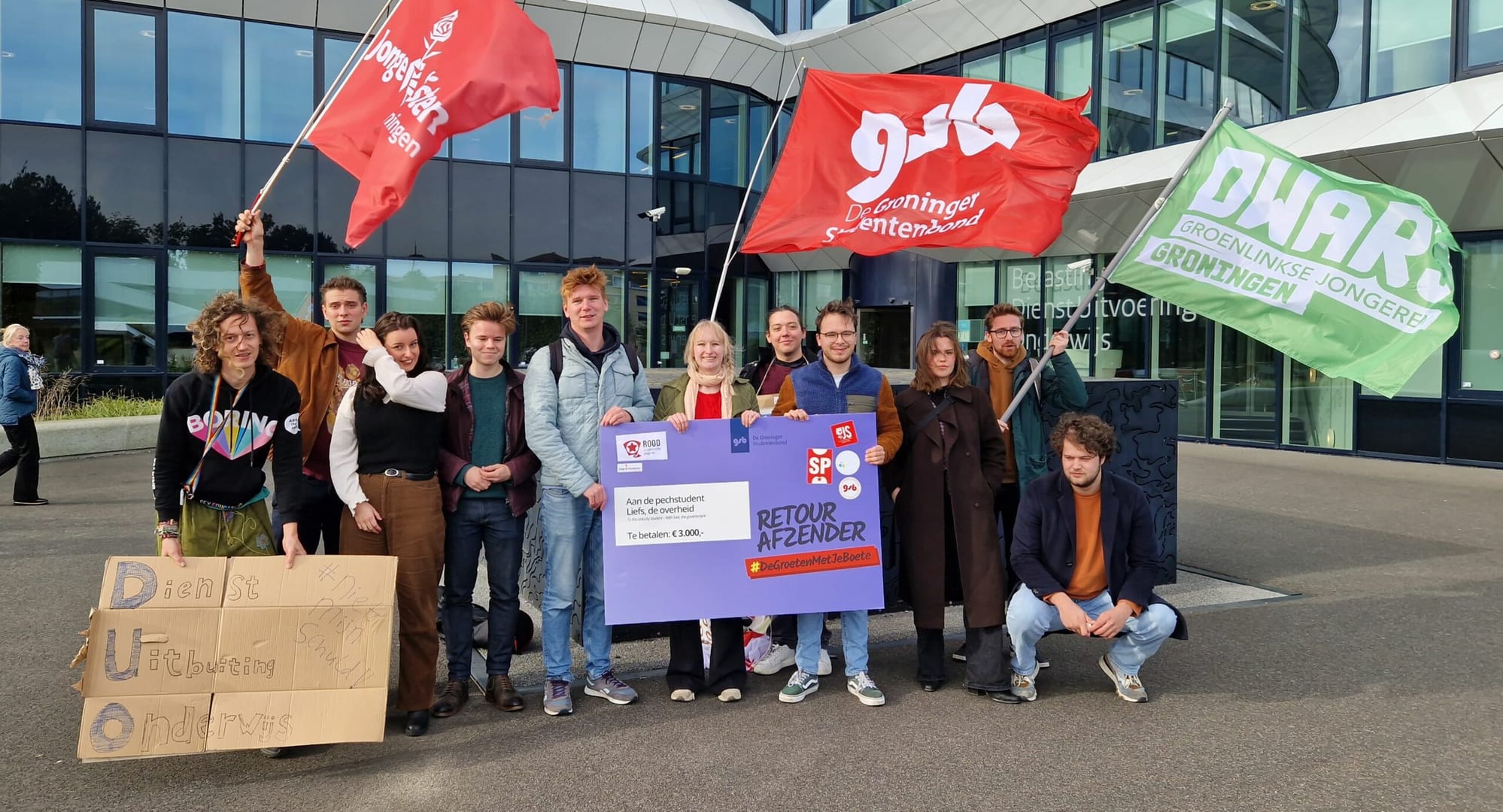
The answer to empty space is a vacancy bylaw. The city will put a leegstandsverordening (a rule letting it act against long-term empty homes) to the council in late 2026. The minister has also allowed municipalities to fine owners of empty homes, the Guardian reports. With vacancy this low, the bigger reserve lies inside occupied homes, which is why a national study of better use of existing homes matters here. The coalition also wants to limit landlords turning student rooms into dearer studios, a demand the Groninger Studentenbond (the city's student union) has pressed since 2021. It plans to build the first 500 of 1,500 homes on the Zernike campus.
Climate targets are carried by the same stock. The city aims to be CO2-neutral by 2035. The public heat company WarmteStad already serves almost 10,000 homes, and taking neighbourhoods such as Paddepoel, Selwerd, Vinkhuizen, Tuinwijk, Kostverloren and the Zernike Campus off gas could cut emissions 43% by 2030. Nationally, rented homes with an E, F or G label must reach at least label D by 1 January 2029, with exceptions such as monuments and small detached homes. Associations and cooperatives are the natural vehicle, since they plan over decades. A European study of renovictions warns that such retrofits must not push tenants out.
- 1902[source]
The Housing Act takes effect
Public loans open to recognised housing societies.
- 1914[source]
Patrimonium is founded
A Reformed housing society; in 1937 it builds 103 homes in the Grunobuurt.
- 1919[source]
Gruno and Woningstichting Groningen
Railway staff and socialists found two societies within a day of each other.
- 1998[source]
Nijestee is formed
The two 1919 societies merge into the city's largest landlord.
- 2019[source]
Haren and Ten Boer join
The municipality merges with two neighbours.
- Mar 2022[source]
Buy-to-let protection
Existing owner-occupied homes with a WOZ value up to €430,000 may not be let for 4 years after purchase without a permit.
- Jul 2024[source]
Affordable Rent Act
Rent caps extend to mid-market homes up to 186 points.
- Oct 2024[source]
Cooperative desk opens
The Startpunt Wooncoöperatie starts advising resident groups.
- 2024[source]
Targets missed
629 new homes against an aim of 1,400; the social stock shrinks by 240.
- Apr 2026[source]
First cooperative plots
Two plots reserved in Meerstad and De Suikerzijde, for about 25 and 26 homes.
- Jul 2026[source]
National housing act in force
Regionally, two-thirds of new homes must be affordable and 30% social rent.
- 2027[source]
A cooperative every two years
The coalition's goal of 1 cooperative project per 2 years begins.
- Jan 2029[source]
Label D for rented homes
Owners of rented homes with label E, F or G must upgrade them to at least label D; there is no letting ban, and some categories are exempt.
- 2030[source]
6,000 homes
The coalition's building goal for 2026-2030.
- 2035[source]
16,000 homes and CO2-neutral
The housing plan's 10-year total and the city's climate goal.
- 2040[source]
11,000 homes in the west
The long-range target for the western part of the city.
From the first Housing Act loans to the city's 2035 climate and building goals.
Sugar land, courtyards and a tower raised a floor a week
De Suikerzijde is one of the city's large development zones. The CSM sugar factory west of the centre closed and was demolished in 2008. The site is being turned into a district of about 5,000 homes. Binnenlands Bestuur quoted the municipal director saying that the city's building over the next ten years or more would add a town the size of Drachten. Building of the first homes began in October 2025. Beside the Hoendiep, one plot is kept for a cooperative of about 26 mid-rent flats, so the new district has room for cooperative housing from the start.
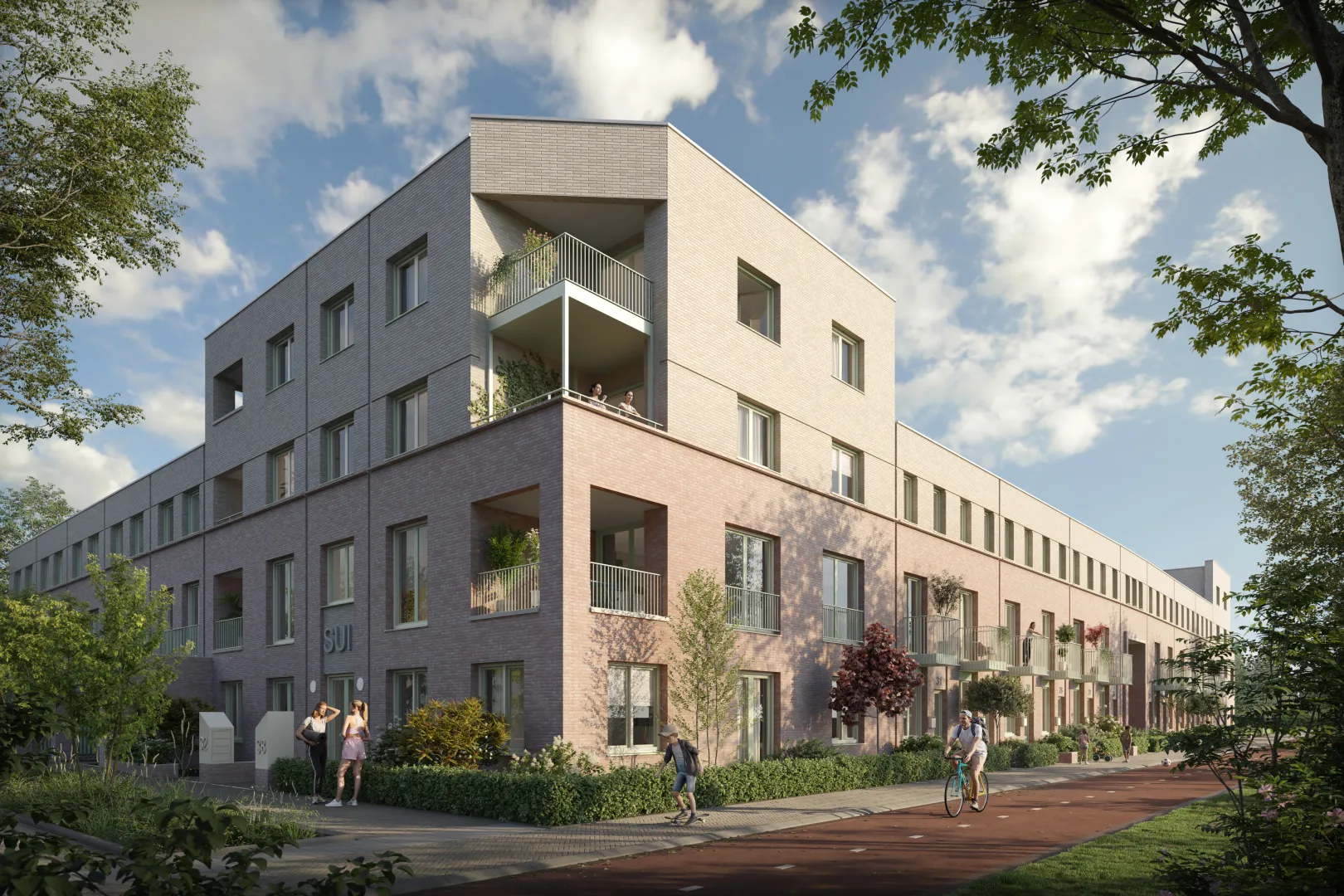
Meerstad shows how a plan can be rescued. The lake-side extension east of the city was drawn for 9,100 homes, then cut back after losses of €60 million by 2011, and the whole area passed to the municipality in 2017. A 2022 plan now counts on 8,000 homes, with floating houses and self-build plots around the Woldmeer lake. Its cooperative plot at De Eems allows about 25 homes in up to 5 storeys.
Stadshavens, the old harbour land along the Eemskanaal, is the third big site, planned for about 2,400 homes. The bigger share falls elsewhere. Meerstad, De Suikerzijde and De Nieuwe Held in the north-west can hold about 75% of the city's building task, Van Niejenhuis has said. The rest must fit inside the existing city.
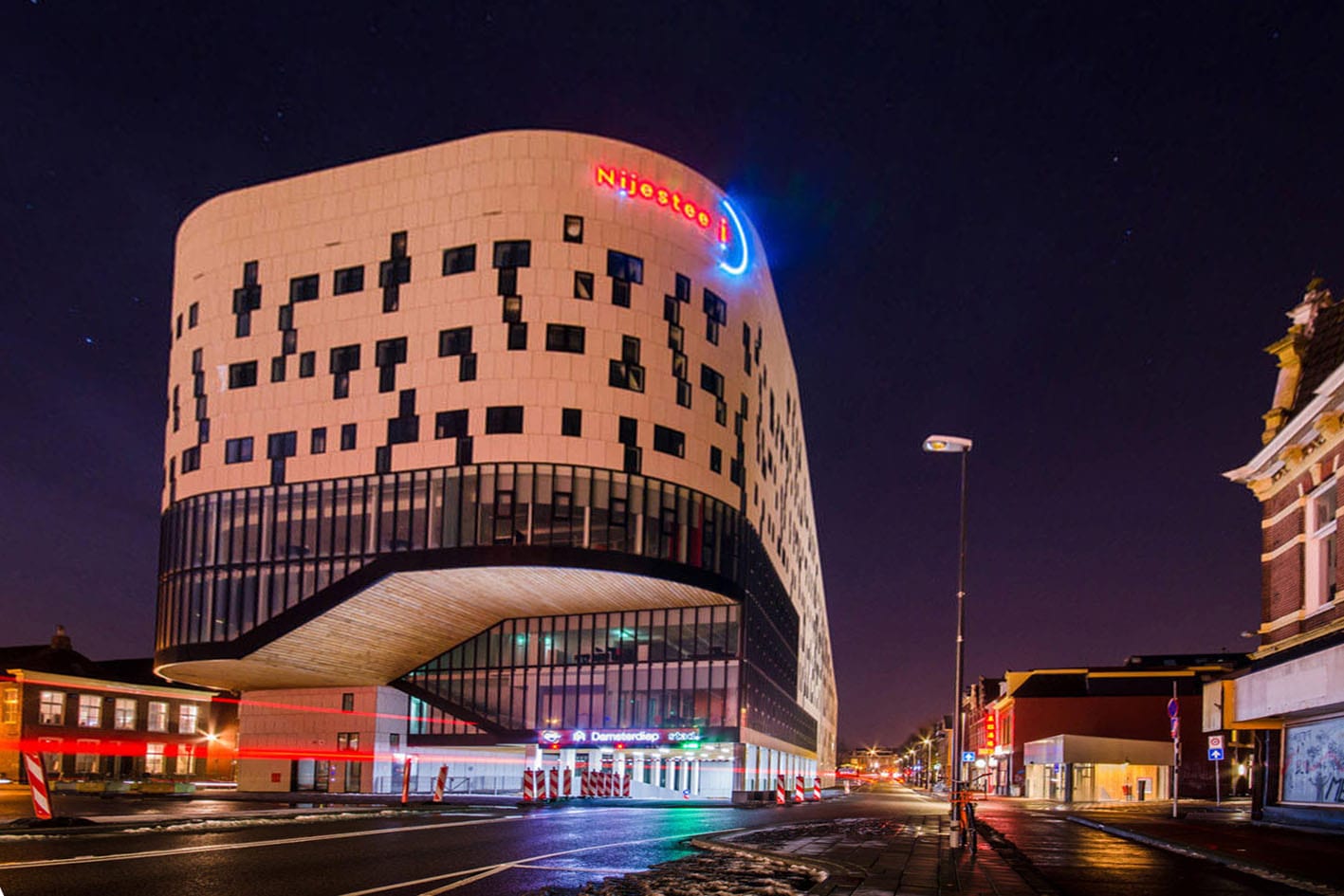
The Regulateur in the Grunobuurt is what an association can do on a smaller scale. Nijestee commissioned De Zwarte Hond, a practice founded in Groningen in 1985, to design 79 social and 26 mid-market flats around a green courtyard. The design borrows from the hofjes, Groningen's historic almshouse courtyards, so a new block reads like a neighbourhood.
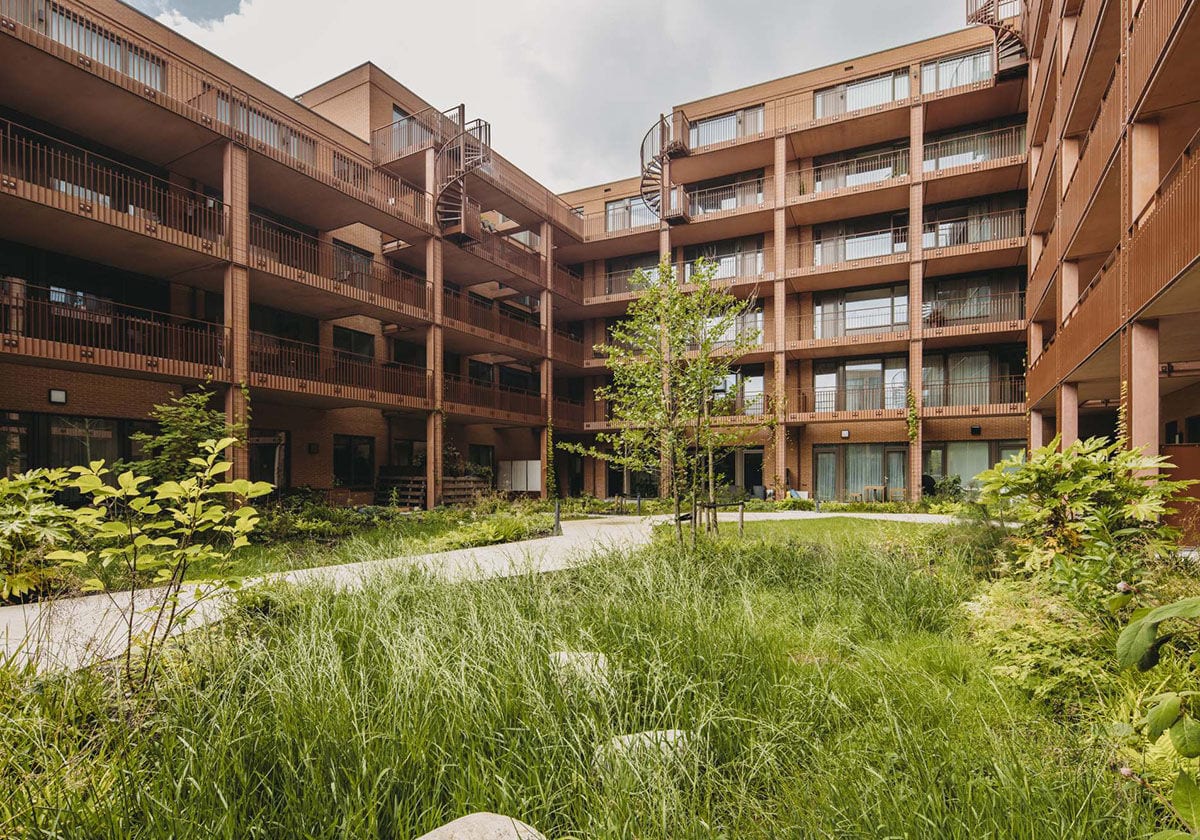

Agaathhof is the same idea in the old centre. De Zwarte Hond placed 17 homes around a shared garden and gave the medieval hof a modern form. Together with Ebbingehof, the resident-built courtyard nearby, it shows how naturally the courtyard suits shared living in this city.
Libertas answers the student squeeze with speed. The tower beside the UMCG hospital, built for Nijestee, holds 270 rooms on 18 floors, and its concrete floors went up at one a week. Such towers are one reason the pressure is easing. A 2026 national evaluation now sees Groningen's student market shrinking, with a risk of local overproduction.

The Paddepoel retrofit shows the other half of the task, the homes already standing. Lefier and the builder Dura Vermeer are upgrading 120 flats in the post-war district towards net-zero energy use, part of a 323-home programme, with insulation, new ventilation and solar roofs planned, if 70% of residents agree. Paddepoel is now on the list of districts coming off gas.
Put together, these projects answer the question the city asks every September. Groningen can build fast, as Libertas shows, and it can build at district scale, as De Suikerzijde will. With Ebbingehof and the two reserved plots, it is also learning to support homes that resident cooperatives develop and run, with members renting from their cooperative, around the courtyards it has always known.
References
Statistics16Click on any number to see the source
Housing market
Tenure & affordability
Cooperative, social & public
Adaptive reuse & vacancy
Population & migration
From our library23
- Nijestee — Organisation
- Lefier — Organisation
- Woonstichting Patrimonium Groningen — Organisation
- De Huismeesters — Organisation
- Unaffordable housing is the main election issue, but no party is tackling the cause — Knowledge
- Strengthening Cooperative Housing in the Netherlands - A Multi-Level Policy Analysis in Comparative Perspective — Knowledge
- Ebbingehof — Project
- Startpunt Wooncoöperatie Groningen — Organisation
- The demand for housing cooperatives in the Netherlands — Knowledge
- ‘Luxury takes time. We don’t have time’: The former top military officer on a mission to fix the Dutch housing crisis — Knowledge
- Public-cooperative policy mechanisms for housing commons — Knowledge
- Land Policy in Practice: A Tale of Two Dutch Cities — Knowledge
- Beter Benutten Bestaande (Better Use Existing) — Knowledge
- Groninger Studentenbond — Organisation
- WarmteStad — Organisation
- Avoiding Renovictions in European Cities — Knowledge
- De Suikerzijde — Project
- Meerstad — Project
- Regulateur, Grunobuurt — Project
- De zwarte Hond — Organisation
- Agaathhof — Project
- Libertas student tower — Project
- Paddepoel Nul-op-de-Meter retrofit — Project
Further sources46
- Verkeerscirculatieplan Groningen — Wikipedia
- Why Groningen? — University College Groningen — University of Groningen
- Stad en studentenleven — University of Groningen · 2026
- Groningen (gemeente) — Wikipedia · 2026
- Huurprijzen studentenkamers in Stad met 12,6 procent gestegen — OOG · 2026-05-27
- Volkshuisvestingsplan Gemeente Groningen 2026: Bouwen aan Gronings Woongeluk — Gemeente Groningen (via Omgevingsweb) · 2026
- 10,5 duizend woningen door transformaties in 2021 — CBS · 2022
- Groningen mist woningbouwdoelen: "We hebben niet geleverd wat we opgeschreven hebben" — OOG · 2025-06-25
- Afgelopen twee jaar in Groningen honderden particuliere huurwoningen verdwenen — RTV Noord · 2026-08
- 10,6 procent van de Groningse sociale huurwoningen gaat naar statushouders — OOG · 2026-02-01
- Druk op studentenhuisvesting in Groningen blijft hoog — OOG · 2025-09-03
- De woningnood: de kijk van de partijen — OOG · 2026-03-12
- Kiezersonderzoek Ipsos I&O: wonen was in heel Nederland belangrijkste thema — NOS · 2026-03-18
- Financiering van wooncoöperaties — Volkshuisvesting Nederland · 2026
- Fonds Coöperatief Wonen gaat financiering wooncoöperaties mogelijk maken — Rijksoverheid · 2026-01-19
- Woningwet — Wikipedia
- Grunobuurt — gebiedsbeschrijving — Gemeente Groningen, Erfgoed
- Nijestee — Wikipedia
- Startpunt Wooncoöperatie enthousiast over initiatiefwet — OOG · 2026-06-14
- Kijkje achter de schermen bij Ebbingehof: "Wooncoöperaties zitten enorm in de lift" — OOG · 2026-05-17
- Als groep je eigen buurt bouwen — RTV Noord · 2024-11-13
- Dorpscoöperatie Ten Boer organiseert informatieavond voor coöperatief wonen — OOG · 2025-01-09
- Startpunt Wooncoöperatie geopend — Groningen.nieuws.nl · 2024-10-10
- De Eems en Suikerzijde houden kavels vrij voor wooncoöperaties — OOG · 2026-04-24
- Nieuw college kan aan de slag — OOG · 2026-06-24
- Samen voor Groningen – Eigenzinnig & Verbonden: Coalitieakkoord 2026-2030 — Gemeente Groningen coalition parties · 2026
- Vanaf 24 juni zijn dit de wethouders en hun portefeuilles in Groningen — Haren de Krant · 2026-06
- Elanor Boekholt-O'Sullivan — Rijksoverheid · 2026
- Wet versterking regie volkshuisvesting — Volkshuisvesting Nederland · 2026
- Wet versterking regie volkshuisvesting van kracht vanaf 1 juli — Volkshuisvesting Nederland · 2026-06-24
- Wet betaalbare huur — Volkshuisvesting Nederland · 2024
- Lokaal plan van aanpak versterking gemeente Groningen 2025 — Gemeente Groningen · 2025
- Wet bevordering wooncoöperaties aangenomen door Tweede Kamer — Rijksoverheid · 2026-06-30
- Uitwerking eisen energieprestatie huurwoningen — Volkshuisvesting Nederland · 2025-03-07
- De Suikerzijde — Gemeente Groningen · 2026
- Suikerzoete nieuwbouw — Binnenlands Bestuur · 2022-12-23
- Meerstad (Groningen) — Wikipedia
- Persbericht: nieuw toekomstplan plangebied Meerstad — Meerstad · 2022-09-08
- Stadshavens — gemeenteblad 2024-24494 — Gemeente Groningen · 2024-01-11
- Nijestee en gemeente (NoordZ) — Nijestee · 2026-06-19
- Bezahlbares Wohnen in Groningen von De Zwarte Hond — BauNetz · 2025-04-15
- Agaathhof Groningen — Dutch Architects
- Libertas student housing tower — Stedenbouw · 2022-07-29
- Studentenhuisvesting daalt licht, maar druk blijft hoog in grote steden — Omgevingsweb · 2026-09-03
- Lefier en Dura Vermeer verbeteren 323 woningen naar Nul-op-de-Meter — Solar Magazine · 2017-07-04
- Verordening doelgroepen woningbouw Groningen 2020 — Gemeente Groningen · 2020
Funding & land tenure
What a housing cooperative could actually build on hereGroningen is not in the funding registry yet — the tenure figures above are national.