Overview of the Report
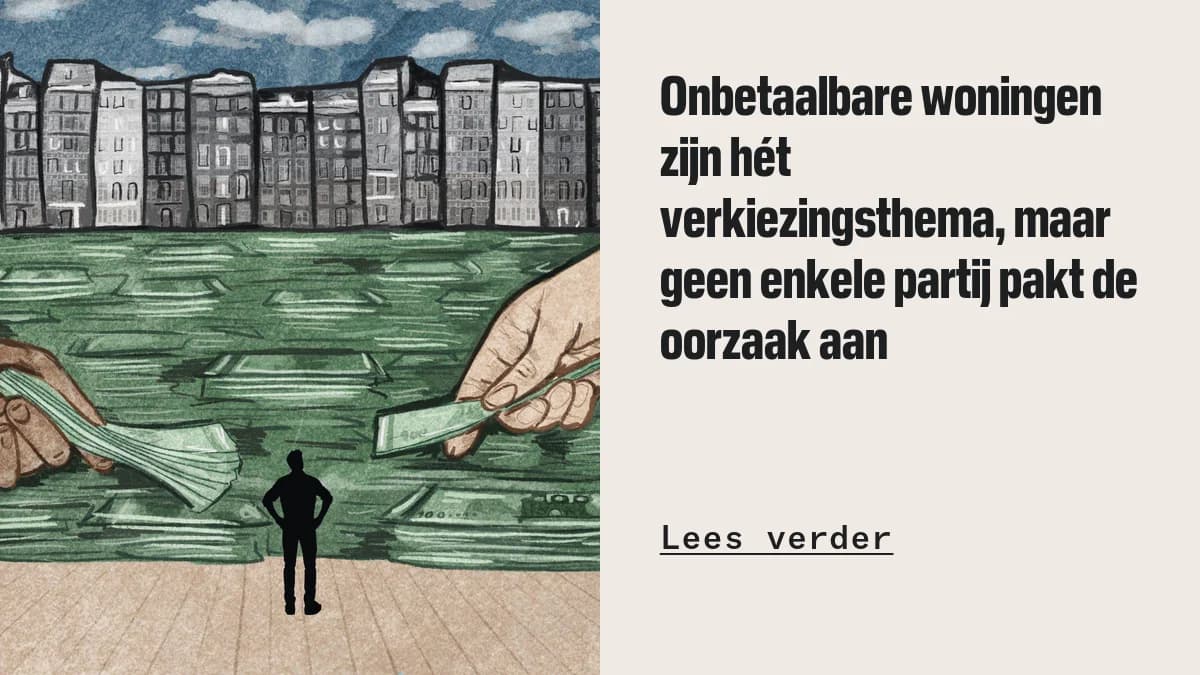
The article “Unaffordable housing is the main election issue, but no party is tackling the cause” is published by Follow the Money (FTM), a Dutch investigative journalism outlet known for in‑depth financial and political analysis. The piece is authored by Thomas Bollen, an experienced reporter specializing in economic and housing market topics. It examines why Dutch political parties, despite promising more affordable homes, fail to address the fundamental driver of soaring house prices: the massive inflow of new money into the housing market.
Rising Prices vs. Income Growth
Between 1995 and 2025 the average Dutch household income roughly doubled from €22,235 to €46,500, while the average house price increased almost fivefold from €93,750 to €473,000. Consequently, buying a home now requires more than ten times a gross annual salary, compared with roughly four times a salary three decades earlier.
Money Supply as the Core Driver
The article highlights that the surge in mortgage credit – from €93 billion in 1990 to €860 billion in 2025 – has injected unprecedented amounts of liquidity into the housing market. Banks create this money through mortgage lending, not by using savers’ deposits. The resulting “financing space” is identified by the Dutch Central Bank (DNB) as a primary catalyst for price growth, outweighing the effect of new housing supply.
Supply‑Side Policies Miss the Mark
All major parties endorse large‑scale construction targets (e.g., 100,000 new homes per year, 900,000 additional homes by 2030, two‑thirds labeled “affordable”). However, DNB studies from 2020 and 2023 show that expanding supply has little statistically significant impact on prices. Historical data confirm that even when the housing shortage fell to 1.5 % of the stock, prices still rose by 130 % over a decade.
The Vicious Housing‑Finance Cycle
Higher mortgage availability fuels bidding wars, pushing prices up, which in turn encourages even larger loans—a self‑reinforcing loop. The article references the “housing finance cycle” where banks profit from mortgage creation while borrowers and society bear rising costs. Institutional investors have also amplified demand, with European banks tripling their real‑estate fund lending from €20 billion to €60 billion since 2015.
Fiscal Instruments Amplify the Problem
Mortgage interest deduction remains a major subsidy, allowing households to deduct a portion of interest from taxes, thereby increasing borrowing capacity. The deduction costs the Dutch treasury roughly €11 billion annually (2024). While some parties propose reducing or abolishing the deduction, most retain it, perpetuating the financing pressure on prices.
Demographic Shifts and Mismatch of Housing Types
The share of single‑person households grew from 32.2 % in 1995 to 40.1 % in 2025, creating demand for smaller homes. Yet new construction focuses on larger family houses, leading to a mismatch between supply and the needs of singles, seniors, and low‑income families.
European Relevance and Sustainability Implications
The Dutch case illustrates a broader European challenge: sustainable housing cannot be achieved solely by building more units. Without curbing excessive credit expansion and aligning fiscal policies, new homes remain unaffordable and resource‑intensive. Policies that target the root cause—excessive mortgage financing and speculative investment—are essential for creating genuinely affordable, sustainable housing across Europe.