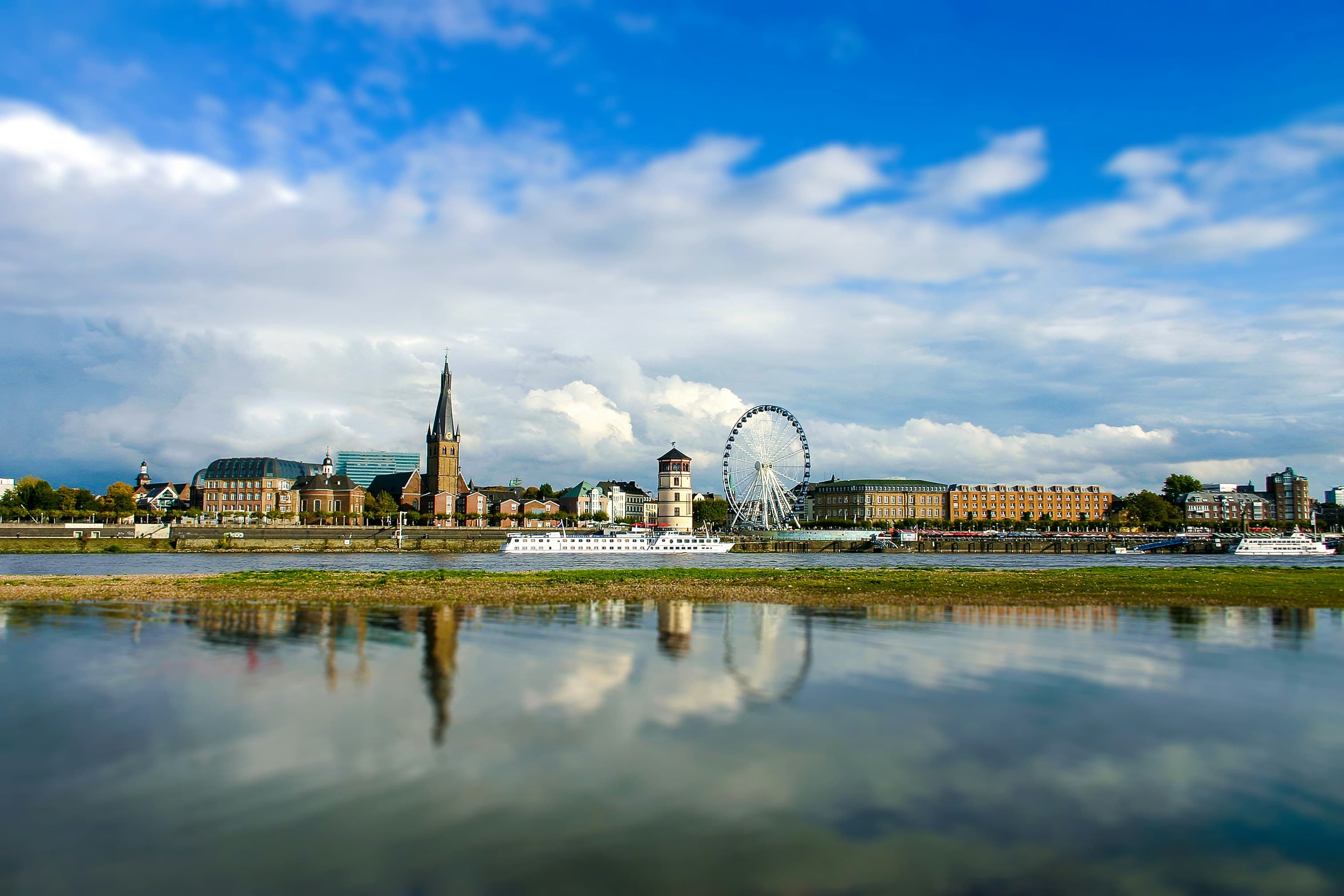
A tenant city behind the boulevard
Düsseldorf earns its living at the desk. It is the capital of North Rhine-Westphalia, a trade-fair host and a favourite address for corporate headquarters, and it draws staff from across the world. That pull keeps newcomers arriving: 43,726 people moved into the city in 2023. Most of them will rent, because in Düsseldorf renting is the normal way to live.
The census counted 349,605 homes. Only 22.1% are lived in by their owners, while 75.9% are rented. Private landlords own the largest slice by far, roughly 69% of the stock. Member-owned cooperatives hold 4%, about 14,000 homes spread across 12 societies. Public housing, meaning homes owned by the city itself, is smaller still at 2.9%, or around 10,000 flats. Nearly all of them belong to the SWD (Städtische Wohnungsgesellschaft Düsseldorf, the municipal housing company).
- Owners
- Owner-occupier22.1%
- Renters
- Public & non-profit rental2.9%
- Cooperative4.0%
- Private rental69.0%
- Unclassified2.0%
- Unknown / Other2.0%
Social housing is a separate matter. In Germany it is not a landlord but a time-limited covenant, the Mietpreis- und Belegungsbindung (a rent cap and tenant-allocation rule attached to public subsidy). It lapses once the subsidised loan is repaid. 4.3% of Düsseldorf's homes carry one, spread across the municipal, cooperative and private slices above. The layer is thinning. The NRW.BANK, the state development bank of North Rhine-Westphalia, projects that 47% of the city's social flats will leave their binding by 2030. The tenant coalition cites that projection in its warning of a sharpening housing crisis.
Rents rise steeply with each step away from non-market ownership. Cooperative members pay around €6.45 per m² net cold (before heating and service charges), a statewide average from the regional cooperative federation. SWD tenants pay about €7.50. The median across all existing leases is €10.30, and new contracts are advertised at €15.45. Furnished and serviced flats, with utilities and furniture priced in, reach €25.45 gross.
- Cooperative
- Public/municipal housing
- All-stock median
- New contracts
- Furnished / serviced (gross)
Monthly rent per m² by segment. Cooperative, public, all-stock and new-let tiers are net cold; the furnished/serviced tier is gross, with utilities and furniture included.
Listings tell a similar story. The tenant association's Mietenmonitor study analysed 5,500 rental offers in 2026. It found a median of €13.71 per m² for unfurnished flats and €19.09 for furnished ones. That furnished premium mirrors what a 2025 study of Berlin's grey market in fixed-term furnished lets found in the capital.
Empty homes are scarce. The 2022 census recorded a dwelling vacancy rate of 3%, but the tenant coalition puts the share actually on offer at just 1.59%. The city counts about 1,800 empty residential buildings. Offices show the reverse. Around 11.6% of office space stands empty, some 1 m² of floor space waiting for tenants.
Construction has not kept pace with arrivals. An estimated 11,000 newcomers a year stay only 3 to 12 months: trainees, posted staff and project workers. In 2025 the city completed 24.8 homes per 10,000 residents. That beats the North Rhine-Westphalia average of 19.8 but trails neighbouring Cologne at 42.6. Since March 2025 the city has also fallen under the state's Mieterschutzverordnung (tenant-protection ordinance). It holds new-let rents to 10% above the local reference rent and caps rises on existing leases at 15% over three years.
Who carries the strain? Low earners first. 45% of residents would qualify for a subsidised flat, and an estimated 38.9% of households are overburdened by housing costs on a rent-to-income measure. The squeeze has also reached middle incomes. Advertised rents have risen 24% since 2021. According to local reporting on the 2026 Mietenmonitor, 51% of unfurnished listings appear to breach the Mietpreisbremse (the legal cap on new-let rents). Most affected tenants overpay by at least €50 to well over €100 a month. Residents feel it. In the city's last published survey, from 2019, 73% named excessive rents as the main housing problem. The housing market scored lowest of every field, with 60% dissatisfied. The national tenants' federation's Mietenreport 2026 traces the same strain across Germany.
Because of high housing costs, employees struggle to find an affordable flat near their workplace. That leads to more traffic, and companies have difficulty recruiting skilled workers.Against that backdrop, the 4% of homes owned by their residents' cooperatives are Düsseldorf's quietest affordability tool.
Savings clubs, civil servants and railwaymen
Almost every Düsseldorf cooperative is a rental cooperative. Members do not own their flat. They buy a Genossenschaftsanteil (the share a member buys to join, repaid on leaving) and in return hold a lifelong right to rent at cost. At the Düsseldorfer Bau- und Spargenossenschaft (DüBS) the entry share is at least €1,400. Rents follow costs rather than the market, and surpluses stay in the buildings. It is the same model the national cooperative federation's facts and figures on German cooperatives describe for the country as a whole.
The tradition was born of an industrial boom. Düsseldorf grew from 70,000 inhabitants in 1872 to 100,000 by 1882, and working families could not find rooms. On 6 May 1898 citizens founded the Düsseldorfer Spar- und Bauverein (savings and building association), today's Düsseldorfer Wohnungsgenossenschaft (DWG). The same year civil servants set up the Beamten-Wohnungs-Baugenossenschaft (BWB), now open to every profession. Railway workers built their own through the Eisenbahner-Bauverein (EBV), and WOGEDO (Wohnungsgenossenschaft Düsseldorf-Ost) has housed the eastern districts since 1919. Several grew out of a trade or an employer rather than a political movement.
Today the sector falls into two clusters with different problems. The first consists of the five large, century-old societies. Their obstacle is cost. Across the VdW Rheinland Westfalen (the federation of housing companies and cooperatives in the Rhineland and Westphalia), members completed 3,607 homes in 2025, down more than 30%. Rising building costs keep stalling new construction, and the federation's director, Alexander Rychter, wants planning and permits standardised so that serial and modular building can bring them down. So the big societies increasingly grow by buying finished buildings and sites. The second cluster is small and self-organised: Baugemeinschaften (building groups of future residents) and resident-led projects that the city's housing office tracks and advises. A recent example is a subsidised mixed-generation house of 14 flats on Talstraße in Friedrichstadt, finished in 2025. Their obstacle is land, not management, as a handbook on collective, self-organised building argues for German cities generally.

The city has courted both clusters. In April 2017 it signed the Düsseldorfer Bündnis für genossenschaftliches Wohnen (Düsseldorf alliance for cooperative housing) with the five societies and the VdW. The cooperatives pledged rents at least 15% below the local comparative rent. The city promised to look for building land for them. It was a local version of the partnerships a federal study of cooperatives as partners of local government had recommended a year earlier. Whether land actually follows is now a question for the city's housing politics.
Half for the common good: the quota city
Düsseldorf's answer to the crisis is written into two documents. In mid-2023 Mayor Stephan Keller of the CDU (the Christian Democrats) proclaimed the Wohnungsbauoffensive Düsseldorf 2030 (housing construction offensive). Its target is at least 8,000 homes by 2030. Keller won a second term in a run-off on 28 September 2025 with 60.45% of the vote against the Green candidate, Clara Gerlach. In December 2025 the CDU and the Greens signed a coalition agreement that tightens the rules.

On private land, developers must now meet a Gemeinwohlquote (public-benefit quota) of 50%. They can still build half the scheme as subsidised flats, or swap up to 20 percentage points for other public-benefit uses such as bought-in allocation rights or staff housing. On city land, concept tenders are decided entirely on housing criteria. At least 80% of the homes must meet the quota, and 40% to 60% must be subsidised. The city's own Impulsprogramm (a municipal top-up loan) lends €2,000 per m² interest-free for 15 years if the starting rent stays at or below €12 per m². The coalition also promises three new soziale Erhaltungssatzungen (social-preservation statutes that restrict luxury refurbishment) and more Housing First places.
Each tier of government pulls a different lever. The federal government sets tenancy law. The Bundestag extended the Mietpreisbremse to the end of 2029, and the 2025 Bauturbo (a fast-track amendment to the federal building code) lets councils approve housing without a new zoning plan. A Heinrich-Böll-Stiftung debate on the Bauturbo asked whether speed alone can solve the shortage. The state pays and enforces. North Rhine-Westphalia's housing ministry, the MHKBD (Ministry for Home Affairs, Local Government, Construction and Digitalisation), approved €2.4 billion for 13,356 subsidised homes statewide in its 2025 funding round. Yet its minister, Ina Scharrenbach, has said plainly that "the rent brake in its current form does not work" and wants tougher criminal-law tools. The city holds land, permits and enforcement. Its coalition wants the power to prosecute rent gouging under the WiStG (the Economic Offences Act) and a portal where tenants can report excessive rents directly.
The figures speak for themselves: our housing offensive is moving forward steadily. This brings us closer to keeping our promise of creating 8,000 homes by 2030.For cooperatives the decisive tools concern land. The coalition promises to target "alternative housing forms, cooperatives and other public-benefit actors" in every Konzeptvergabe (concept-led land tender, scored on quality rather than price). It will also adjust Erbpacht (ground-lease) terms for affordability, and tenders may be won on the lowest starting rent. These are the instruments a federal study of public-benefit housing policy identified as the ones that keep land affordable for good.
Empty offices are the obvious reserve. The coalition commits to tackling vacancy "systematically" and to extending municipal subsidy to office conversions. It will also cap short-term letting at 56 days a year under a revised state housing-protection law. Federal help comes through KfW (the German state development bank), whose programme 266, Gewerbe zu Wohnen (commercial to housing), opens in summer 2026. The BMWSB's report on office vacancy (from the federal ministry for housing, urban development and building) sets out the case. The ministry reckons about 1.8 million m² of office space could become flats across seven cities, Düsseldorf among them. An ifo study of home working and office demand cautions that only part of any surplus is physically convertible. The Seestern in Lörick, a 520,000 m² office district, has had planning guidelines since 2019 steering it towards mixed use.

Climate goals set the frame. Düsseldorf aims for climate neutrality by 2035, and the coalition adds net-zero soil sealing and "Umbau statt Abriss" (conversion before demolition). A planned deck over the Münchener Straße would add homes without sealing new ground. The long-held estates of the cooperatives and the SWD are where retrofit targets bite hardest. Serial renovation at Wohnungsverein Hagen, a case study from nearby Hagen, shows one cooperative route. Plattform-E collects the leaner Gebäudetyp E (simplified building standard) methods that could cut the cost of both.
In last year's election campaign this was the number one issue for the Lord Mayor and almost all leading politicians. Today they seem to want to stay out of it again. That is why the commitment to affordable housing must become a citizens' movement.- 1898[source]
First housing cooperatives
The Düsseldorfer Spar- und Bauverein, today's DWG, is founded on 6 May amid an acute housing shortage.
- 1987[source]
Kiefernstraße legalised
After years of occupations, raids and demolition plans, the city signs tenancy contracts with the squatters of Kiefernstraße in Flingern.
- April 2017[source]
Alliance for cooperative housing
The city, five cooperatives and the VdW sign the Düsseldorfer Bündnis; cooperatives pledge rents at least 15% below the comparative rent.
- Mid-2023[source]
Wohnungsbauoffensive 2030
Mayor Keller proclaims the housing offensive with the Baulandmodell: at least 8,000 homes by 2030.
- 1 March 2025[source]
State tenant protection widened
North Rhine-Westphalia's Mieterschutzverordnung extends the rent brake and a 15% cap on rises to 57 municipalities, Düsseldorf included, until February 2030.
- 26 June 2025[source]
Rent brake extended federally
The Bundestag extends the Mietpreisbremse to the end of 2029.
- 28 September 2025[source]
Keller re-elected
Stephan Keller (CDU) wins the mayoral run-off with 60.45% against Clara Gerlach (Greens).
- December 2025[source]
CDU–Green coalition agreement
A 50% public-benefit quota on private land, housing-led concept tenders on city land and a systematic push against vacancy.
- June 2026[source]
Second Mietenmonitor
The tenant association finds 51% of unfurnished listings suspected of breaching the rent brake.
- Summer 2026[source]
Federal conversion programme opens
KfW programme 266, Gewerbe zu Wohnen, starts funding office-to-housing conversions.
- 2028[source]
Kennedydamm-Center due
Target completion of the conversion of the 1972 office block into about 240 flats.
- 2029[source]
Federal rent brake expires
The extended Mietpreisbremse runs to the end of the year unless renewed again.
- 2030[source]
Housing target year
Deadline for the 8,000 homes of the Wohnungsbauoffensive; the state tenant-protection ordinance lapses in February.
- 2035[source]
Climate neutrality
The city's target for climate neutrality, reaffirmed by the coalition, with net-zero soil sealing as a companion goal.
From the first cooperatives to the targets the current coalition has set.
From Kiefernstraße to the Kennedydamm
Kiefernstraße in Flingern is where self-organised housing in Düsseldorf began. In 1981 the first residents moved into empty flats built for workers of the Klöckner steelworks. When the council announced demolition plans, newcomers occupied the rest. The city finally signed tenancy contracts in 1987. In 2008 those contracts were extended indefinitely. Around 800 residents of up to 45 nationalities have lived on the street, which is now better known for its murals than its barricades. It proved that a threatened block could be kept by the people living in it.
The Düsseldorfer Wohnungsgenossenschaft shows the traditional form at its largest. It has more than 11,000 members and nearly 8,000 homes. In 2013 it took over 800 flats from Rheinbahn, the city's transport company. In autumn 2025 it bought 117 flats in Grafental and a building site on the Hansaallee. When new construction is too expensive to start, buying finished stock is how a cooperative keeps growing.
WOGEDO, the eastern districts' cooperative, adds around 4,500 homes and more than 10,000 members in Gerresheim, Wersten and Garath. Garath, a post-war satellite town, is one of the districts the coalition has kept in the city's urban-renewal programme, so the cooperative's estates there sit inside a wider neighbourhood repair.
Wohnen mit Kindern – wmk3 is the building-group version. On a former industrial site in eastern Düsseldorf, future residents planned 30 rental and owner-occupied homes together. They added a shared garden, a public playground and a ground-floor community room, heated by a combined heat and power plant with solar panels. Projects like it are the proof that residents can commission their own housing when they can get hold of a plot.
The Glasmacherviertel in Gerresheim is the cautionary tale. Glass production on the 35-hectare site ended in 2005. A 2017 plan promised about 1,400 homes, 500 of them affordable. Then the land passed from Patrizia to the Adler group and on to LEG, and nothing was built. In April 2025 the Greens asked the city to consider buying it. By September the mayor was listing it among the private sites finally moving forward. Twenty years of stalled speculation explain why the coalition now names urban development measures and pre-emption rights as tools.
The Kennedydamm-Center is the adaptive-reuse test. The 1972 office block will be stripped back to its frame and rebuilt as about 240 flats of around 60 m² each, with a kindergarten and a primary school. A Dutch investor is putting in more than €100 million, with completion planned for 2028. Whether conversions like it can also be affordable is the question the city's extended Impulsprogramm now has to answer.
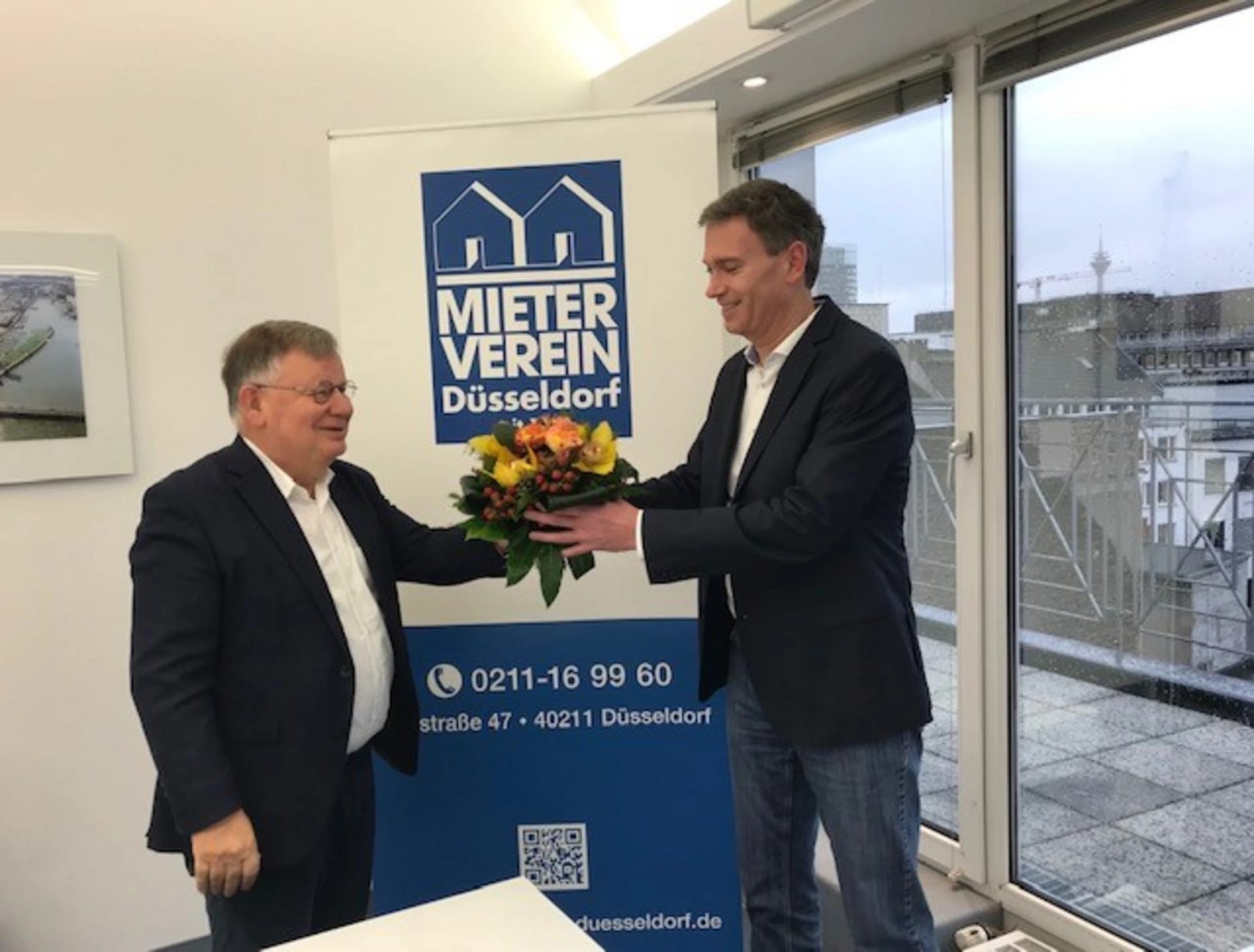
The Mieterverein Düsseldorf completes the picture from the tenants' side. With around 34,000 members, it co-publishes the city's Mietspiegel (the official local rent index) with Haus und Grund Düsseldorf, the landlords' association, and commissions the Mietenmonitor. Its data turned the rent brake from a statute into a measurable promise, and the coalition has pledged to work with it on rent monitoring.
References
Statistics18Click on any number to see the source
Housing market
Tenure & affordability
Cooperative, social & public
Adaptive reuse & vacancy
Population & migration
From our library20
- Wohnungskrise in Düsseldorf spitzt sich zu — Knowledge
- Überhöhte Mieten am Düsseldorfer Wohnungsmarkt (Mietenmonitor 2026) — Knowledge
- Befristet, möbliert und teuer - Geschäftsmodelle am ‚Grauen Wohnungsmarkt‘ — Knowledge
- Aus 18 werden 57 – Nordrhein-Westfalen weitet Mieterschutzverordnung aus — Knowledge
- Mieterverein Düsseldorf präsentiert erschreckende Zahlen – Vermieter verlangen vielfach zu hohe Mieten — Knowledge
- Mietenreport 2026 - Deutscher Mieterbund — Knowledge
- Facts and Figures of the Cooperatives (Focus on Germany) — Knowledge
- In Nordrhein-Westfalen: Baukosten bremsen Wohnungsneubau weiter aus — Knowledge
- Gemeinschaftliches Wohnen und selbstorganisiertes Bauen — Knowledge
- Bündnis für bezahlbares Wohnen und Bauen – Wohnungsgenossenschaften als Partner der Kommunen — Knowledge
- Gemeinsam für Düsseldorf – Koalitionsvertrag CDU und Bündnis 90/Die Grünen Düsseldorf 2025 — Knowledge
- Bundestag: Mietpreisbremse verlängert — Knowledge
- Einfacher und schneller Bauen: Hilft der Bauturbo zur Lösung der Wohnungskrise? — Knowledge
- Der Förder-Boom für bezahlbare Mieten und Eigentum geht weiter – Rund 2,4 Milliarden Euro für 13.356 Wohnungen bewilligt — Knowledge
- Gemeinwohlorientierte Wohnungspolitik - eine Studie — Knowledge
- Schriftlicher Bericht des BMWSB zum deutschlandweiten Büroleerstand — Knowledge
- Homeoffice und die Zukunft der Büros: Flexibilisierung, Reduzierung und Umnutzungspotenzial — Knowledge
- Renovating Homes the Cooperative Way in Germany: Serial Renovation at Wohnungsverein Hagen — Knowledge
- Plattform-E | Wissensplattform für einfaches & nachhaltiges Bauen — Knowledge
- Wohnungsbau geht kontinuierlich voran: Seit 2024 Baugenehmigungen für 6000 Wohnungen erteilt — Knowledge
Further sources24
- Mieterverein Düsseldorf präsentiert erschreckende Zahlen — ddorf-aktuell · 2026-06-19
- Wohnungskrise in Düsseldorf spitzt sich zu — Mieterverein Düsseldorf · 2025-08-28
- NRW: Erneut weniger Wohnungen im Jahr 2025 fertiggestellt — IT.NRW · 2026-05-29
- Düsseldorfer leben gern in ihrer Stadt (Bürgerumfrage 2019) — Stadt Düsseldorf · 2019
- Aus 18 werden 57 – Mieterschutzverordnung — Land NRW · 2025-01-29
- Düsseldorfs Genossenschaften (housing associations overview) — newinthecity.de
- Düsseldorfer Wohnungsgenossenschaft — Wikipedia
- In Nordrhein-Westfalen: Baukosten bremsen Wohnungsneubau weiter aus — Allgemeine Bauzeitung · 2026-07
- Wohnprojekte in Düsseldorf — Stadt Düsseldorf
- Bezahlbarer Wohnraum durch das Düsseldorfer Bündnis für genossenschaftliches Wohnen — WIG Düsseldorf · 2017
- Wohnungsbau geht kontinuierlich voran — Stadt Düsseldorf · 2025-09-08
- Endgültiges Ergebnis der Oberbürgermeister-Stichwahl — Stadt Düsseldorf · 2025-10-02
- Koalitionsvertrag CDU / Bündnis 90/Die Grünen Düsseldorf — CDU and Greens Düsseldorf · 2025-12
- Impulsprogramm Neubau Mietwohnungen — Stadt Düsseldorf
- Ministerin Scharrenbach: Der Förder-Boom … 13.356 Wohnungen bewilligt — Land NRW · 2026-02-02
- Wohnraum statt Büroleerstand: Neue Förderung startet im Sommer 2026 — immowelt · 2026
- Quartier Seestern — Stadt Düsseldorf
- Bundestag verlängert Mietpreisbremse — Deutscher Bundestag · 2025-06-26
- Kiefernstraße (Düsseldorf) — Wikipedia
- DWG Aktuelles — Düsseldorfer Wohnungsgenossenschaft · 2025-10
- Die WOGEDO — WOGEDO
- Baugemeinschaft Wohnen mit Kindern – wmk3 — polis Award · 2020
- Glasmacherviertel in Gerresheim: Stadt prüft Ankauf — Neue Düsseldorfer Online Zeitung · 2025-04-11
- Kennedydamm-Center soll zum Wohnhaus werden — Düsseldorf Wirtschaftsförderung · 2025-05-22