Why can't young Europeans leave home?
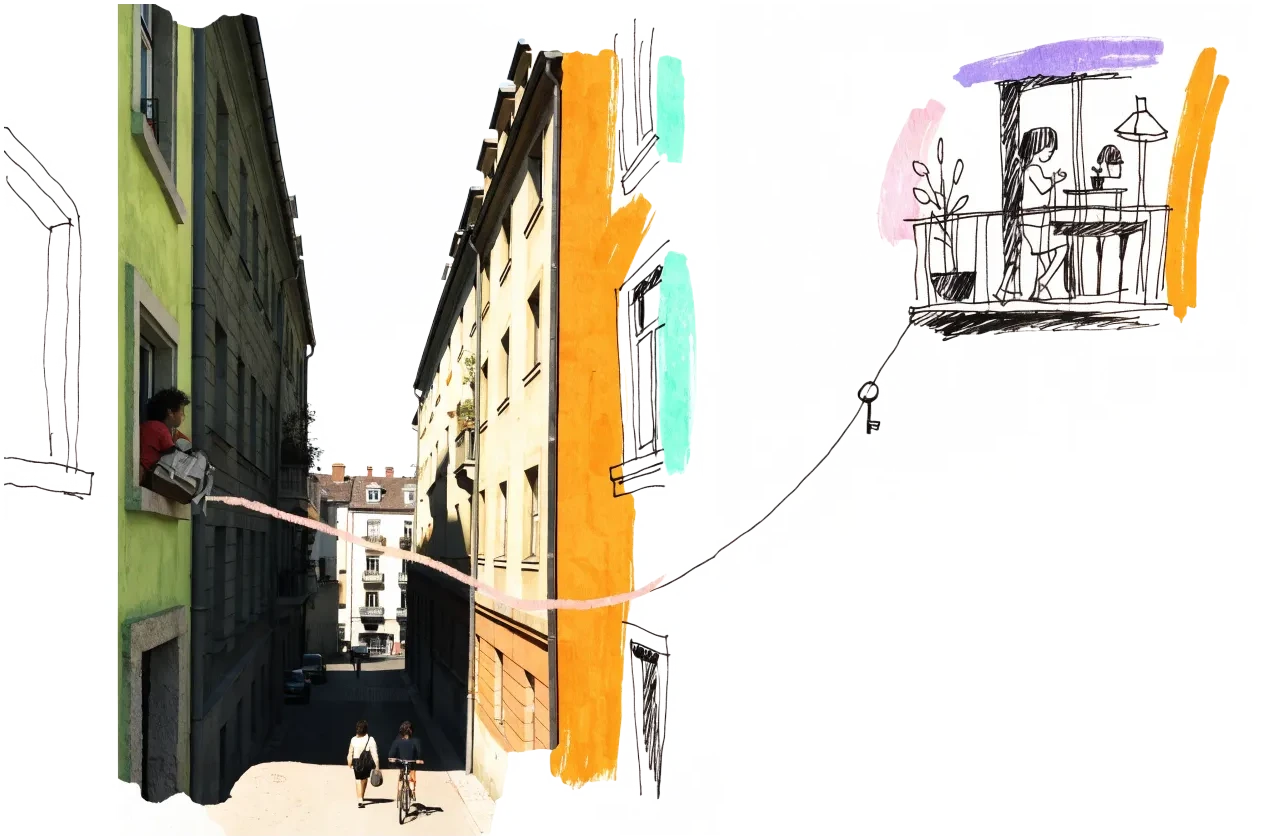
Thirty, and still in your childhood bedroom
She wanted to study art history in Granada. The rent near the faculty settled it. She enrolled in Jaén, a smaller city, and lives in a house her family owns in a village a bus ride away. Her story, told to ARTE, is ordinary arithmetic in Spain, where a room in a shared flat averages €550 a month, more than 70% of what a typical student has to live on.
Multiply that choice across a continent and it shows up in the statistics. In 2024 young people in the EU left their parents’ home at 26.2 years on average. The average hides a gap of ten years between the north and the south-east of the Union.
Nordic young people leave in their early twenties; in Croatia, Slovakia, Greece, Italy and Spain the average is thirty or older. Selected EU countries; Eurostat figures as published by the Council of the EU. Source: Eurostat, via Council of the EU, One roof, many realities (2025); EU average from the European Parliament
Culture explains part of that spread, and Eurofound says so. The direction of travel is harder to put down to habit. The age by which half of Europeans live away from their parents rose from 26 to 28 between 2007 and 2019. Over the decade to 2019 the share of 25- to 34-year-olds still at home grew by six percentage points or more in Belgium, Croatia, Cyprus, Greece, Ireland, Italy and Spain.
Widen the age band and the picture sharpens. In 2024, 49.1% of EU adults aged 18 to 34 lived with at least one parent, according to the European Parliament’s housing report. Close to half of them were students or otherwise outside the labour force. The rest were working or looking for work, and still at home.
We wanted to leave home as early as possible. And we did. We could. There really were shared flats.Asked why they stay, young people mostly name the rent. In a Finnish survey, 48% of 18- to 29-year-olds living with their parents said they could not afford to leave, 12 points more than in 2014. In Croatia almost 80% blamed housing costs. The reporting has a name for it: a generation forced to put life on hold. Who gets held longest is not random.

Who waits longest?
Start with the headline figure. Eurofound counts 75% of 15- to 29-year-olds in the EU living with their parents: 86% of those aged 15 to 24 and 42% of those aged 25 to 29. The share is higher in less populated areas, 82%, than in cities, 67%. The cities are where young people go for study and work, and where the shortage bites hardest.

Moving out does not end the squeeze. Young people who live independently spend notably more of their income on housing than other age groups, and most of them rent. Between 2010 and 2019 tenants’ housing costs rose from 28% to 31% of income while owners’ fell from 18% to 16%. Among private renters, 46% feel at risk of having to leave their home within three months because they can no longer afford it. Buying has moved further off too: home ownership among 30- to 49-year-olds fell by seven points, to 68%, between 2010 and 2024.
Renters' share rose while owners' fell, so the gap between them widened by five points in a decade. Source: Eurofound, Unaffordable and inadequate housing in Europe
A job no longer settles it either. The share of employed 25- to 34-year-olds living with their parents rose from 24% to 27% between 2017 and 2022, and the country gap is enormous: 2% in Finland and Sweden, 65% in Croatia, 57% in Greece. Eurofound links part of the southern pattern to temporary contracts, which young workers are far more likely to hold.
The map below shows how many people in each country spend more than 40% of their disposable income on housing. It covers every age, so read it as the market young people walk into rather than their own bill.
Greece is the extreme: 29% of Greeks in cities pay more than two fifths of their income for housing, against 9.8% of households in EU cities as a whole. Further east the squeeze often shows as crowding rather than rent. Romania, Latvia and Bulgaria had the highest overcrowding rates in 2024, at 41%, 39% and 34%.
Ask young people what they want and the answer is plain. When the TUI Foundation’s youth study asked 16- to 26-year-olds in seven countries what the EU should do first, the most chosen answer, at 38%, was to make living costs and prices affordable for everyone. The next question is what the waiting does to the rest of a life.

What does the wait cost?
The Commission’s own reading of the crisis is blunt about it: young people of limited means drop out of higher education and start work earlier than planned, put off starting a family, and live with their parents or in overcrowded flats. The European Investment Bank adds the choices that never show up in a statistic: students who turn down the best universities, teachers and nurses who refuse jobs in major cities.
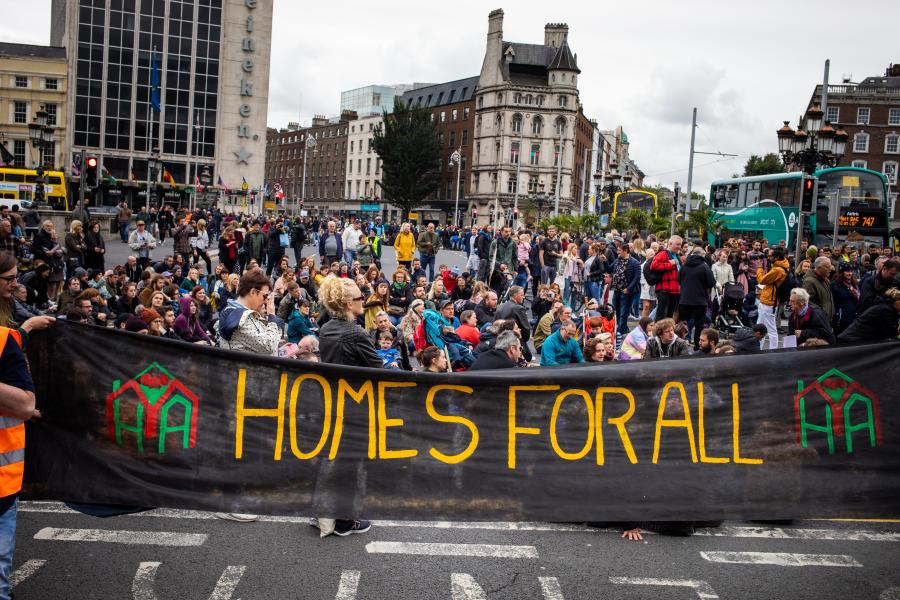
You get into the best university in your country, which is generally in the capital city, and you can’t go if your parents aren’t well-off.That is a cost to employers as much as to young people. High housing costs discourage moves to the cities and regions where the jobs are, which makes hiring harder and slows productivity. In Ireland, 62% of companies surveyed in 2024 said the housing crisis had hurt their ability to attract or keep staff, and 30% were providing accommodation support themselves.
Families come later too. In Britain in 2016, 22% of 18- to 44-year-olds without children said they had delayed starting one because housing was unaffordable. The wait also darkens the outlook. During the pandemic 52% of 18- to 35-year-olds living independently said they were optimistic about the future, against 44% of those living with their parents. Eurofound finds that a third of young people living at home feel excluded from society, and almost half would move out within a year if they could.
During the pandemic, those who had moved out were the more hopeful group. Source: Eurofound, Unaffordable and inadequate housing in Europe
It sorts young people by their parents, too. Eurofound notes that many of today’s retirees own their homes outright while younger generations watch ownership drift out of reach, which may leave a future generation of pensioners still paying rent. Help from parents and grandparents increasingly decides who gets a foot in the door at all, and Drea reads that as a widening gap between the haves and the have-nots.
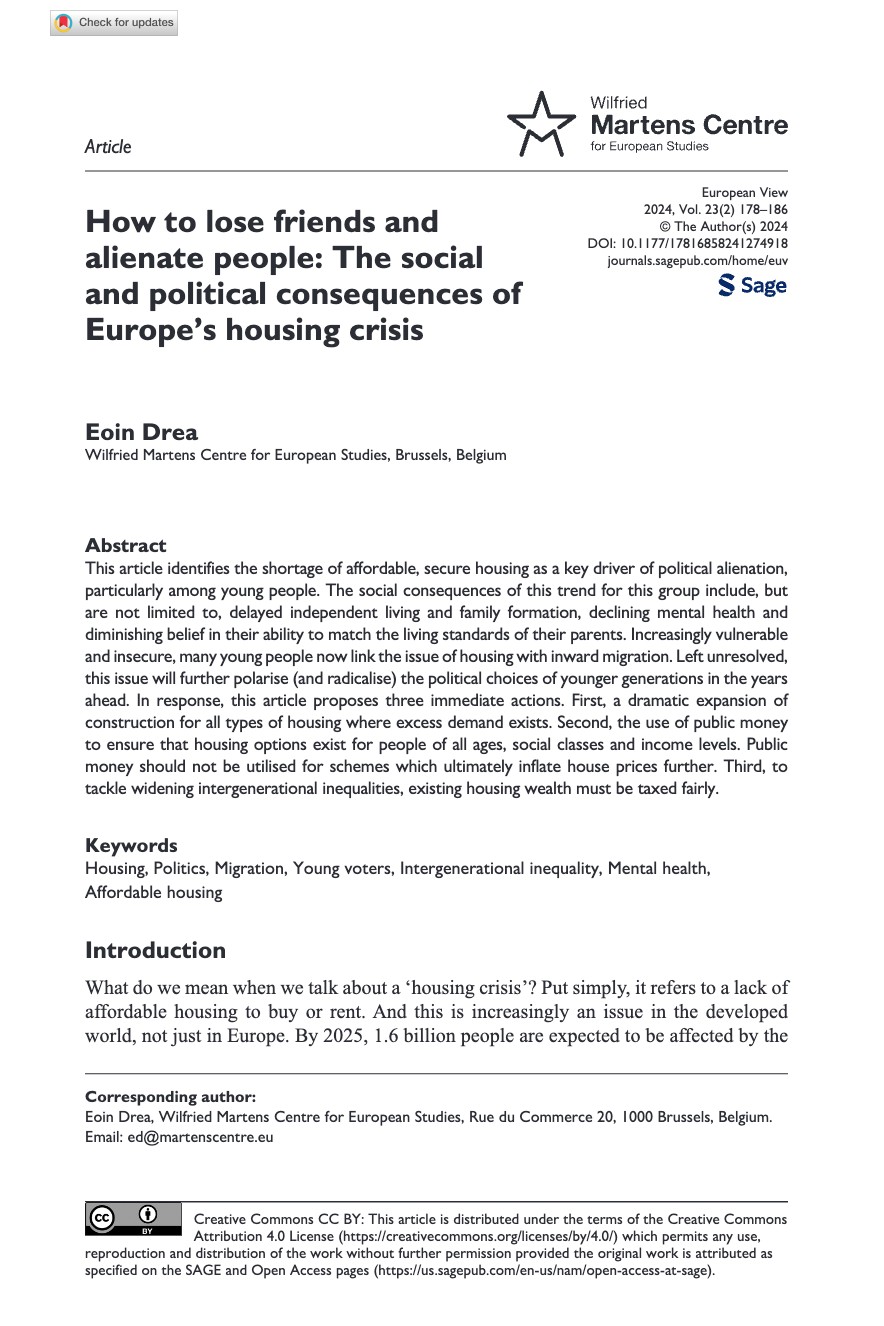
Then there is politics. In an essay for European View, Eoin Drea of the Wilfried Martens Centre calls the shortage of affordable, secure housing a key driver of political alienation among the young, and warns that, left unresolved, it will “further polarise (and radicalise)” their choices. The housing-crisis read maps where housing anxiety meets low trust in parliament. Here the question is narrower: what stands between a young person and a front door of their own?
Deposits, guarantors and closed waiting lists
Suppose you find a flat you can afford. The letting agent wants a deposit, proof of steady income and, often, someone to vouch for you. None of those comes easily at 25. In 2023, 34.4% of young workers in the EU were on temporary contracts, more than twice the rate of the workforce as a whole, and 43% of those contracts ran for twelve months or less. A contract that ends within the year is a weak card against applicants with a permanent one.
Young workers are more than twice as likely to hold a temporary contract, the weakest card in a rental application. Source: Eurofound, Living and working in Europe 2024
The public route has its own queue. Social housing is more or less absent in many member states, and where it exists it comes with long waiting lists, even in the countries that have the most of it. The Netherlands reports waiting lists of more than 330,000 households, with waits in major cities often longer than ten years. Strict income rules leave many people who earn just above the threshold with no way in at all.
Cooperatives look like the obvious way round, and in the places with the most of them the door is often shut. The old cooperatives’ low rents rest on buildings paid off long ago, and their rolls favour whoever joined first. In Berlin and Amsterdam, some have stopped taking members at all; the cooperative read has the numbers. A 25-year-old who arrives from another city starts at the back.
The cooperative movement knows this. The International Cooperative Alliance’s own study of young people and cooperatives found them “almost invisible” in the movement, held back by minimum share capital before they join and by older members who see them as competition, or as lacking commitment, once they do.

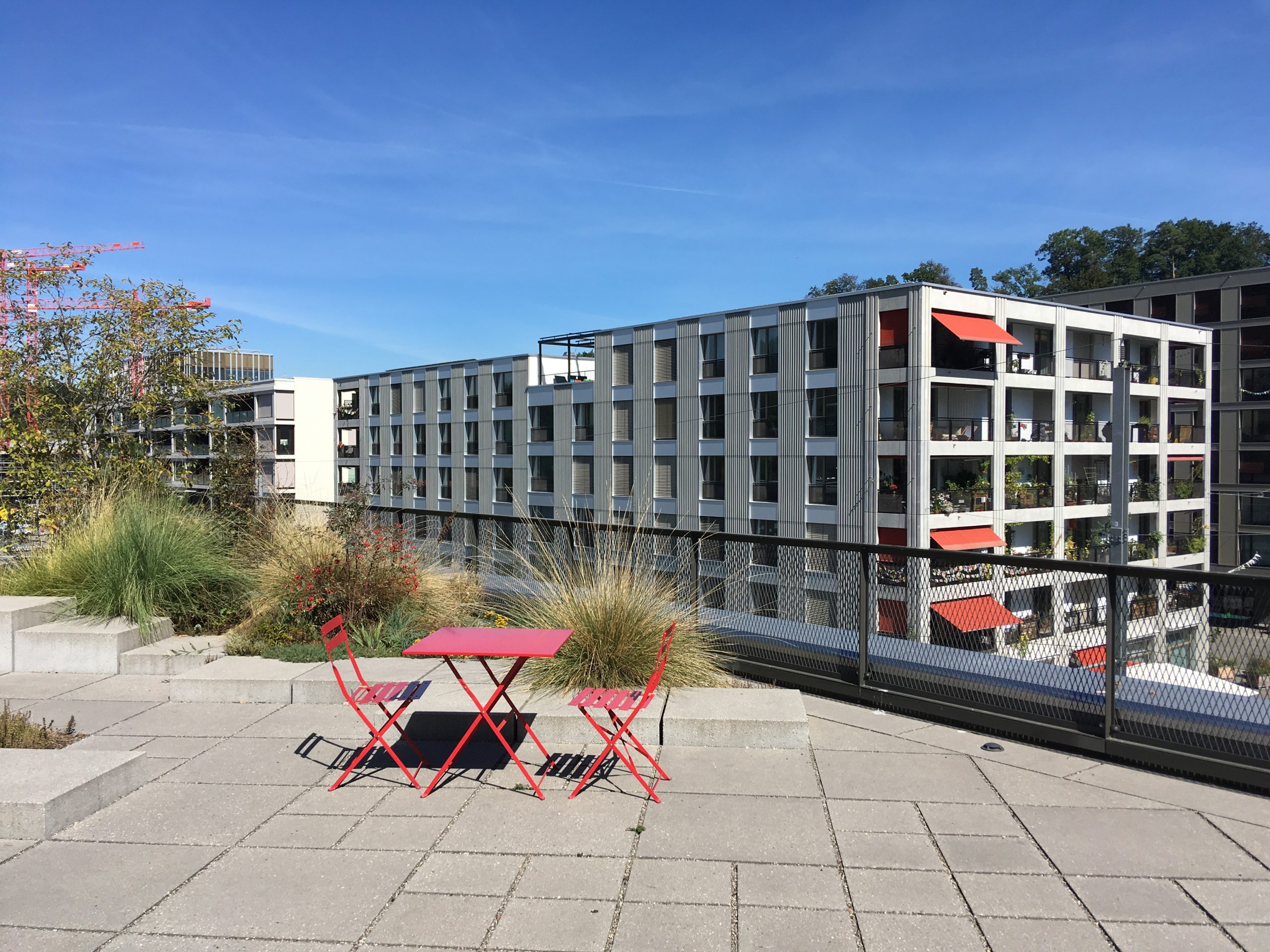
Some cooperatives have designed their way around it. In Zurich, larger cooperatives match flat size to household size, so a growing family moves to a bigger flat and a shrinking one to a smaller flat inside the same cooperative. Kalkbreite keeps rooms with their own kitchenette and bathroom that a family can rent, for a while, for a child who wants to leave home without leaving the neighbourhood. Only a cooperative with a lot of homes can do the first. Some young people have stopped waiting for one.
The ones building their own
In Ljubljana, Zadrugator was founded in 2016 by students and young employees looking for housing that avoided both the traps of ownership and renting for profit. Their first project, a rental cooperative at Rakova Jelša, is being developed as a pilot with the city’s public housing fund. Zadrugator belongs to MOBA, a European cooperative of housing initiatives in five countries that pools know-how and a shared loan fund.
Two Zagreb cooperatives, Open Architecture and the Cooperative for Ethical Financing, are working with MOBA and the town of Križevci on a housing cooperative there, which plans to turn a former army dormitory into 36 flats for young people, first-time buyers and older residents, with the town planning to grant use of the site for 50 to 75 years. It was set up to test whether housing cooperatives can work in Croatia at all.
Bologna tried a public version. Porto 15 restored 18 flats in a publicly owned building and let them to people under 35 chosen through a public call in 2016. Before moving in, the future residents worked out together how they would live, drafting a charter of values and house rules, and they have been expected to take part in the life of the community since the first of them arrived in 2017.
In Heidelberg, a volunteer group has been building Collegium Academicum since 2013, housing for students, trainees and doctoral candidates that is self-managed, part of the Mietshäuser Syndikat, and financed partly by direct loans from supporters. The first 176 residents moved into its timber building in February 2023.
Berlin shows the same impulse at city scale. The Bündnis junger Genossenschaften, founded in 2017, is an alliance of young cooperatives: “young” describes the cooperatives rather than their members. That matters here, because a new cooperative has no decades-old queue in front of its door. The alliance lists more than 40 member cooperatives, aims to build at least 20,000 homes over fifteen years and says it needs the city’s help above all to get land. The catch is the one the cooperative read describes: a young cooperative builds at today’s prices.
Back in 2020 two Flemish cooperative advocates wrote that what housing cooperatives really needed were “daredevils”: councils that dare to lease them land, banks willing to take the plunge, citizens ready to put in the time to start one. The founders above are that kind of daredevil. None of them can yet follow a member who moves.
A cooperative you can take with you
Every project in this read is rooted in one city, which is why cooperatives last. It is also why they struggle with the people this read is about. A young engineer who moves from Zagreb to Munich for a job, or a student who leaves Porto for a master’s in Amsterdam, leaves their place in the queue behind.
The European Housing Coop is testing whether membership can travel. The bet is that a member who moves city can stay inside the same cooperative, and that the furnished flats they land in help pay for the long-term homes around them. It is the Zurich idea of moving between flats inside one cooperative, stretched across borders, and it only works with enough buildings in enough cities. The model’s network view shows what that takes.
The people in this read are short of exactly what the old routes ask for: savings for a deposit, someone to vouch for them, years on a local list. Staying inside one cooperative when you move would at least mean not starting at the back of a new queue in every city. Whether the numbers hold is still being tested.
If you have moved for study or work, or expect to, the most useful thing you can tell us is what would make you join. Tell us on the participate page.
References
From our library22
- Why is Europe's housing crisis hitting young people the hardest? | ARTE Europe Weekly — Knowledge
- The housing crisis in Europe: key facts and EU action — Knowledge
- Unaffordable and inadequate housing in Europe — Knowledge
- REPORT on the housing crisis in the European Union with the aim of proposing solutions for decent, sustainable and affordable housing — Knowledge
- Europe’s Housing Crisis is forcing a generation to put life on hold — Knowledge
- Living and working in Europe - 2024 edition — Knowledge
- Who's most affected by Europe's housing crisis? — Knowledge
- Just the Facts - Under One Roof? Europe’s Housing Crisis — Knowledge
- Part 1: Mapping the housing needs in the EU, assessing the impacts of scarcity and providing an overview of relevant EU legislation — Knowledge
- Young Europe 2025 - Youth Study — Knowledge
- Understanding the housing crisis: Staff Working Document accompanying the European Affordable Housing Plan — Knowledge
- Why is there a housing crisis and how do we fix it? — Knowledge
- How to lose friends and alienate people: The social and political consequences of Europe’s housing crisis — Knowledge
- Young people and cooperatives: a perfect match? — Knowledge
- Wanted: Daredevils for housing cooperatives — Knowledge
- ZADRUGATOR — Organisation
- MOBA Housing SCE — Organisation
- Stambena zadruga Križevci — Project
- Co-operative housing project in Croatia: the case of the city of Križevci — Project
- Porto 15 — Project
- Collegium Academicum — Project
- Bündnis junger Genossenschaften (BjG) — Organisation
Further sources4
- Heinz Egger, 70, remembering his move from Klagenfurt to Vienna, speaking to Euranet Plus — Heinz Egger, 70, remembering his move from Klagenfurt to Vienna, speaking to Euranet Plus
- Emily Sinnott, head of the Policy and Strategy Division, EIB Economics Department — Emily Sinnott, head of the Policy and Strategy Division, EIB Economics Department
- Eoin Drea, European View (2024) — Eoin Drea, European View (2024)
- Bündnis junger Genossenschaften, member list — Bündnis junger Genossenschaften, member list