A city of newcomers, still waiting for keys
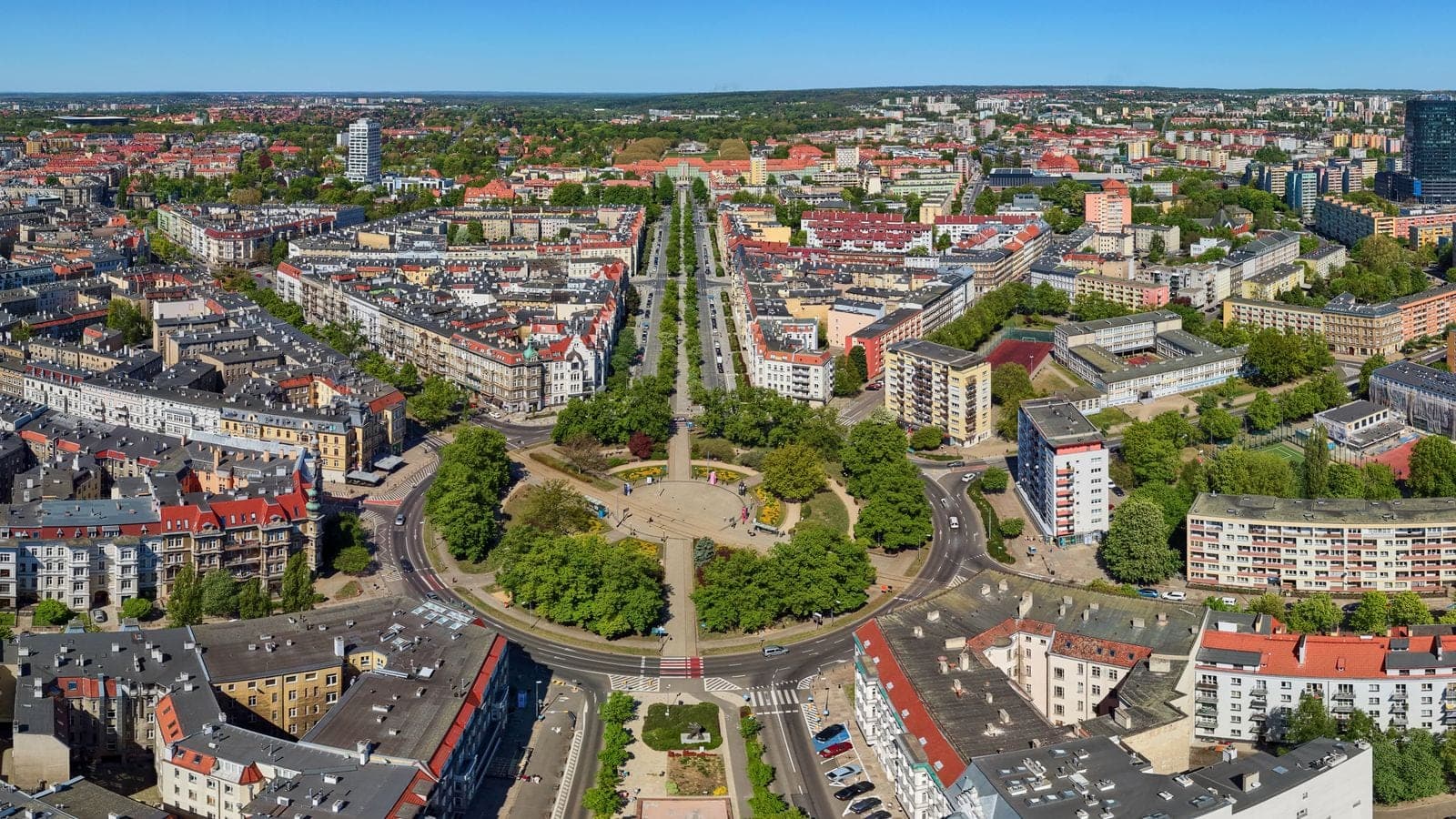
Szczecin became Polish in 1945 as a port almost emptied of its own people. When the Polish administration took over that July, there were only about 200 Poles for every 6,000 Germans in the city, and settlers from central Poland soon made up about 70% of the new population. Nearly every family therefore moved into a flat built for someone else, or into one the new state and its cooperatives built next. That inheritance still decides who holds which keys in a city of 387,700.
Polish statistics treat a cooperative ownership right as a way of owning, which blurs the tenure picture. On that basis about 58.1% of households own their home and 41.9% rent, shares taken from census figures for Polish cities as a whole because no Szczecin split has been published. Cooperatives hold about 13.2% of homes on the national measure, spread across some 52 cooperatives in the city. The municipality owns roughly 14,000 flats, about 7.1% of the 196,941 dwellings. Private renting is left with 34.8% on paper. Read that figure with care: it is a residual, and it absorbs whatever the borrowed national shares miss.
- Owners
- Owner-occupier44.9%
- Cooperative13.2%
- Renters
- Public & non-profit rental7.1%
- Private rental34.8%
Social housing in Szczecin is a set of rules rather than a separate tenure. The city's figure of about 8.5% adds the regulated-rent homes of Szczecińskie TBS (the municipal social-rental company) to the council stock, so it cuts across the tenure slices instead of sitting beside them. ZBiLK, the city's municipal-buildings agency, manages a little over 80% of the council flats. The deepest tier is the lokal socjalny, a social flat for households a court has protected from eviction onto the street. It is also the scarcest: the city still owes 1,821 court-ordered social tenancies, and moving an unlawful occupant out can take 13 to 25 years.
What a square metre costs depends almost entirely on who owns the building. A council tenant pays about €1.40 a month and a cooperative member about €1.65 in basic running charges. The National Bank of Poland's survey of agreed rents put the all-stock median near €11.78, while asking rents on new listings sat around €10.77 in early 2026. The two series come from different sources and do not agree on which is higher. Furnished and serviced lets, priced gross with utilities and furniture included, reach about €12.89.
- Public/municipal housing
- Cooperative
- New contracts
- All-stock median
- Furnished / serviced (gross)
Monthly cost per square metre by tier. The municipal and cooperative figures are controlled charges rather than market rents; the furnished tier is gross and all-in.
Empty homes exist, though mostly in small pockets. A proxy from the 2021 census counts about 8,200 unoccupied dwellings, a vacancy of 4.2%. The city's own stock of empty council flats has shrunk, from 997 in 2021 to 675 by September 2024. Offices are tighter than in Poland's other regional cities: vacancy stood at 7.7% in the smallest of those markets, or about 22,330 m² of unlet floor.
Newcomers keep arriving, if slowly. About 3,246 people registered as new residents in 2024, alongside an estimated 10,000 students, seafarers and cross-border workers who stay for months rather than years. Prices outran pay. The average asking price for a new flat rose from 7,222 to 13,094 złoty per m² between 2020 and 2025, and an average monthly wage now buys 0.68 m², down from 0.73.
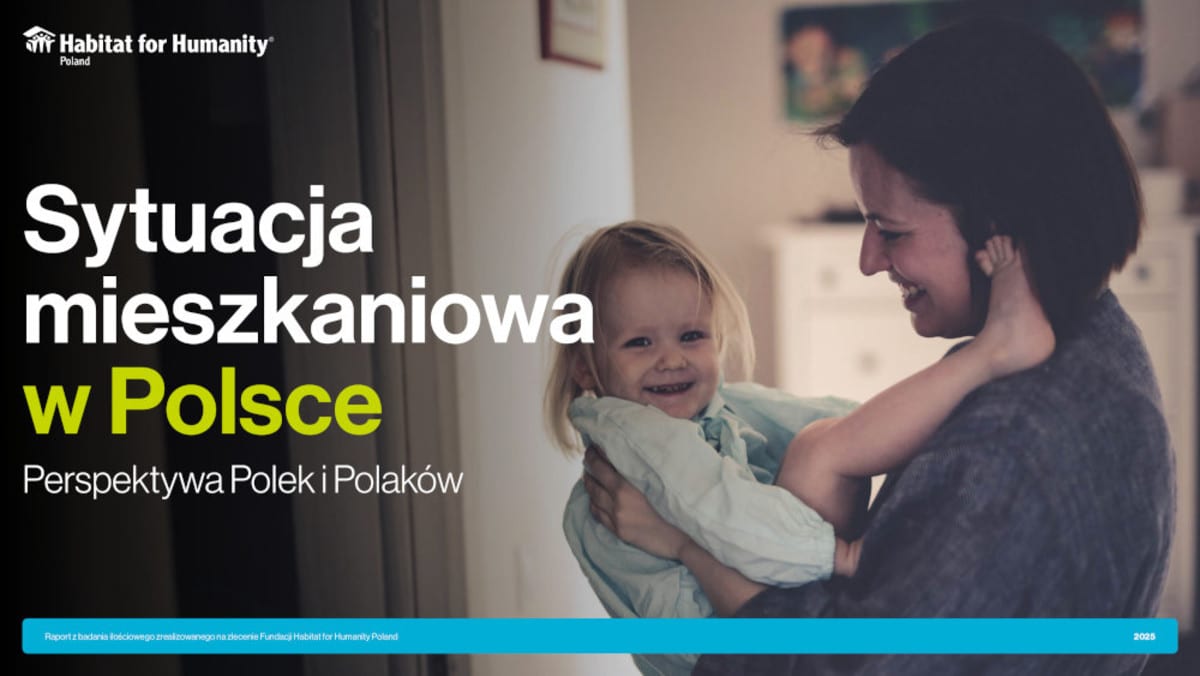
Who carries the cost? A Habitat for Humanity Poland report on the national housing situation found that 14% of Poles spend more than half their income on housing. One in three earn too little to rent or buy a suitable home, yet too much for public help. The government's own strategy puts that rent gap at up to 4 million families, about 35% of society, which places it firmly in the middle of the income ladder. The young feel it first: over half of Poles aged 25 to 34 still live with their parents. In Szczecin the issue reached the 2024 mayoral race, where the challengers tied it directly to young people leaving the city.
If there were [such an offer], young people wouldn't be leaving Szczecin. They don't stay because they have nowhere to live.For most families, the affordable home they already know is not a council flat but a cooperative one, and cooperatives still run a large part of the post-war city.
Dąb, Wspólny Dom and the cooperative city
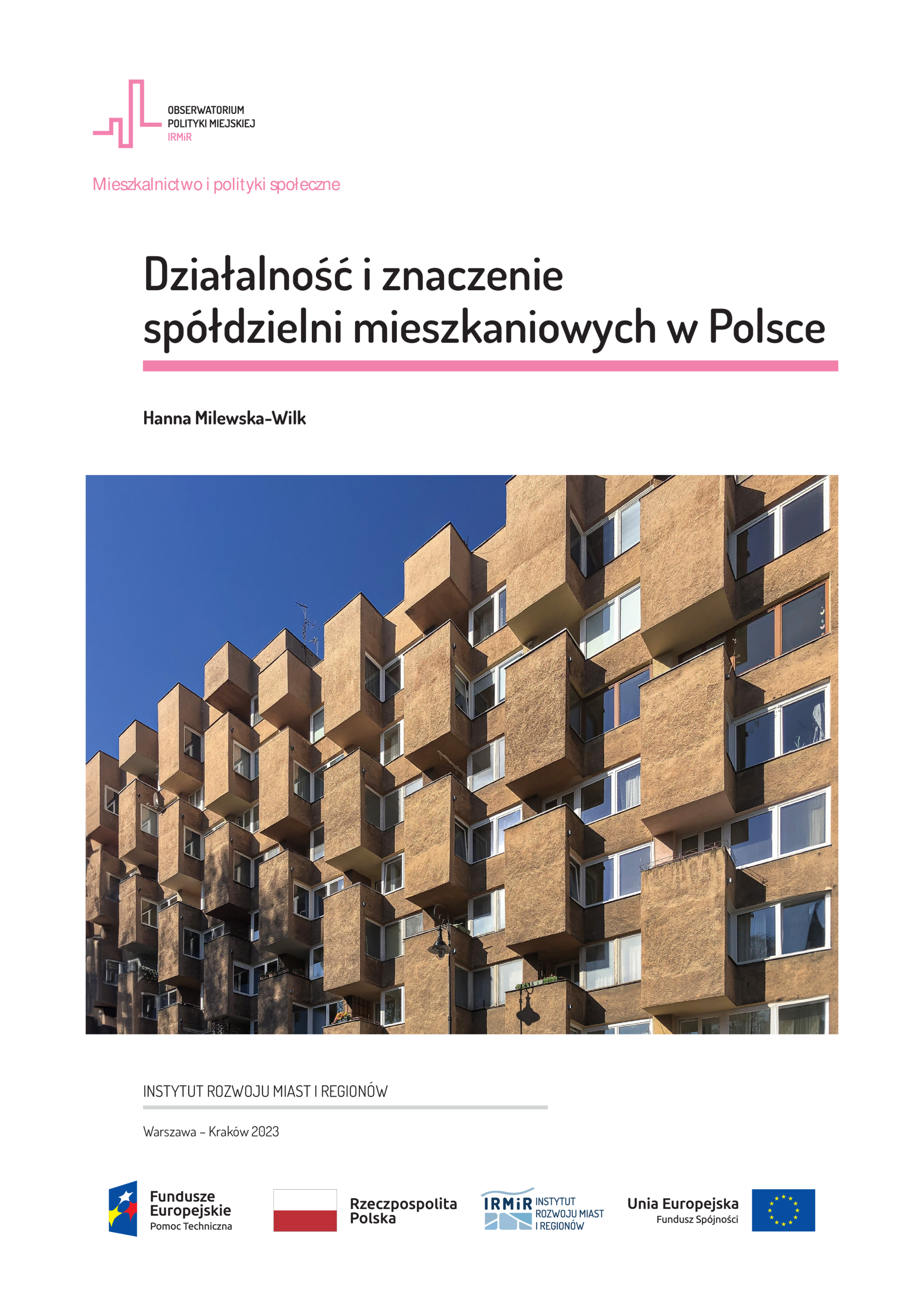
The Polish housing cooperative is the spółdzielnia mieszkaniowa, a member-owned body that builds and manages blocks. Members held one of two rights. The spółdzielcze lokatorskie prawo was a tenant-style right of occupancy that could not be sold. The spółdzielcze własnościowe prawo, a cooperative ownership right, could be sold and inherited much like a flat. Most members have since converted to full separate ownership, so the sector now looks like owner-occupation with a shared manager. The national survey of what Polish housing cooperatives do and how much they manage documents that drift.
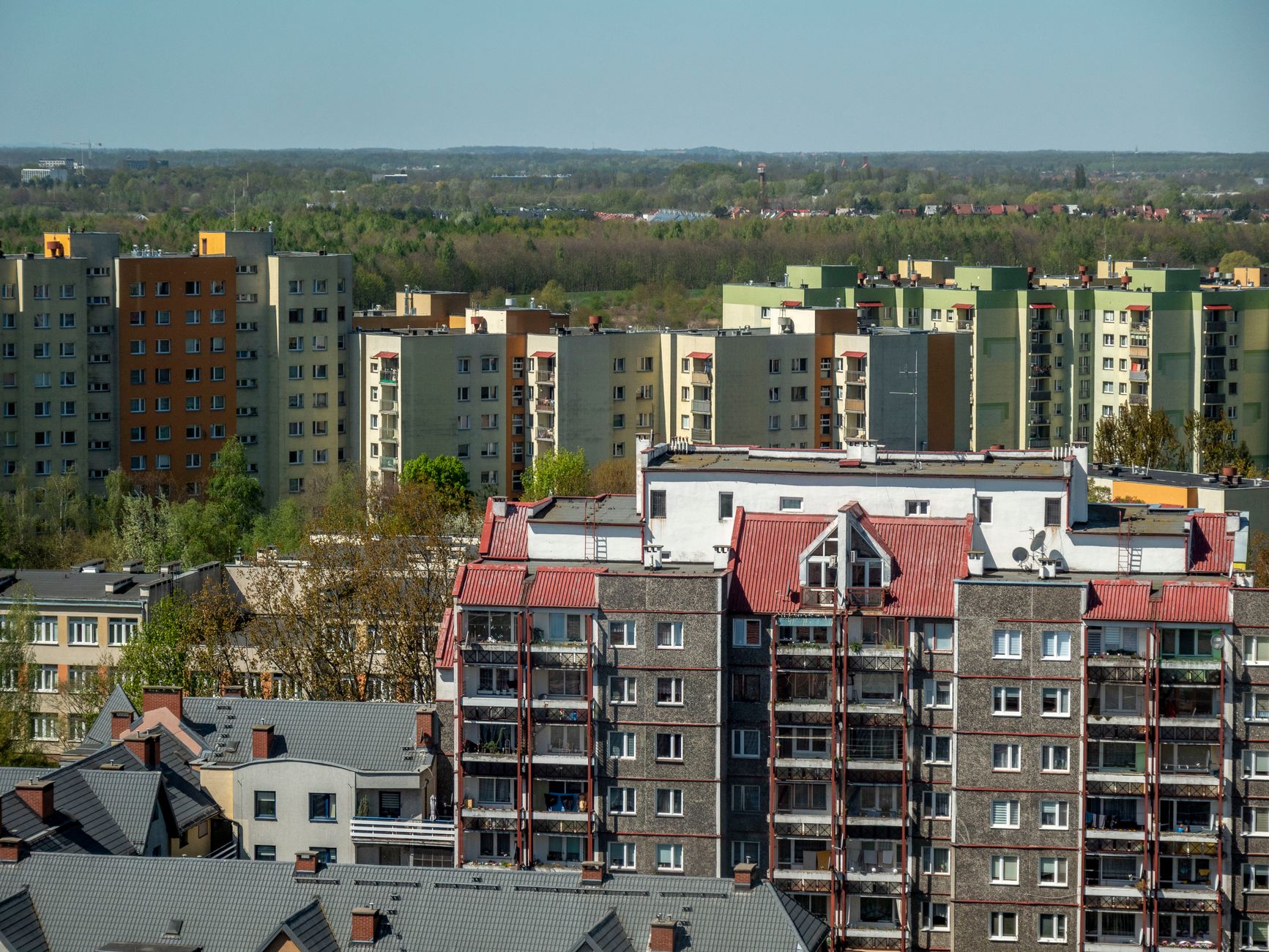
The tradition arrived with the settlers and grew with the panel block. Spółdzielnia Mieszkaniowa „Wspólny Dom” was set up in 1958 by a group of trading enterprises and, after a 1968 merger, became the largest cooperative in the Szczecin region. Spółdzielnia Mieszkaniowa „Dąb” followed in 1966 in the eastern district of Dąbie and went on to build most of the right-bank estates. Its biggest investment boom ran from 1978 to 1987, when estates such as Słoneczne and Bukowe rose from prefabricated concrete panels. In the 1990s Wspólny Dom dropped panel technology and returned to traditional building.
Today the sector splits into a large legacy camp and a new one that barely exists. The legacy cooperatives still house a big slice of the city. Dąb alone manages more than 16,000 flats with over 50,000 residents, which it reckons is one Szczecin resident in eight, and Wspólny Dom over 12,000 flats for about 22,000 people. Their worries are ageing blocks and energy bills. In 2022 Dąb's president, Józef Karbowniczyn, told Twoje Radio it would defer lesser repairs but still replace fourteen lifts, because new ones use far less electricity. Dąb still builds, yet its new blocks on Swojska Street sell from 11,000 złoty per m², close to market prices. The other camp is the kooperatywa mieszkaniowa, a small group of future neighbours commissioning its own building. Szczecin has none so far. Urban Lab Szczecin, the city's urban-innovation lab, ran workshops on the idea in late 2025, and its Monika Żelichowska told Radio Szczecin that the subject is also about young people leaving the city. Both camps meet the same barriers of finance, planning and management identified in a study of cooperatives on the Polish property market.
The state has begun to court the form again. Its 2026 strategy offers cooperative flats cheap credit from BGK, the state development bank, at a fixed 2% a year over up to 50 years. A draft reform adopted by a government committee in September 2026 would also bring back tenant-right cooperative flats that can no longer be bought out, according to Ilezametr.pl. That would turn cooperatives from a legacy manager into a lasting rental channel, which is exactly where the national programme wants new homes to come from.
Council flats: sell them, fix them or build more?
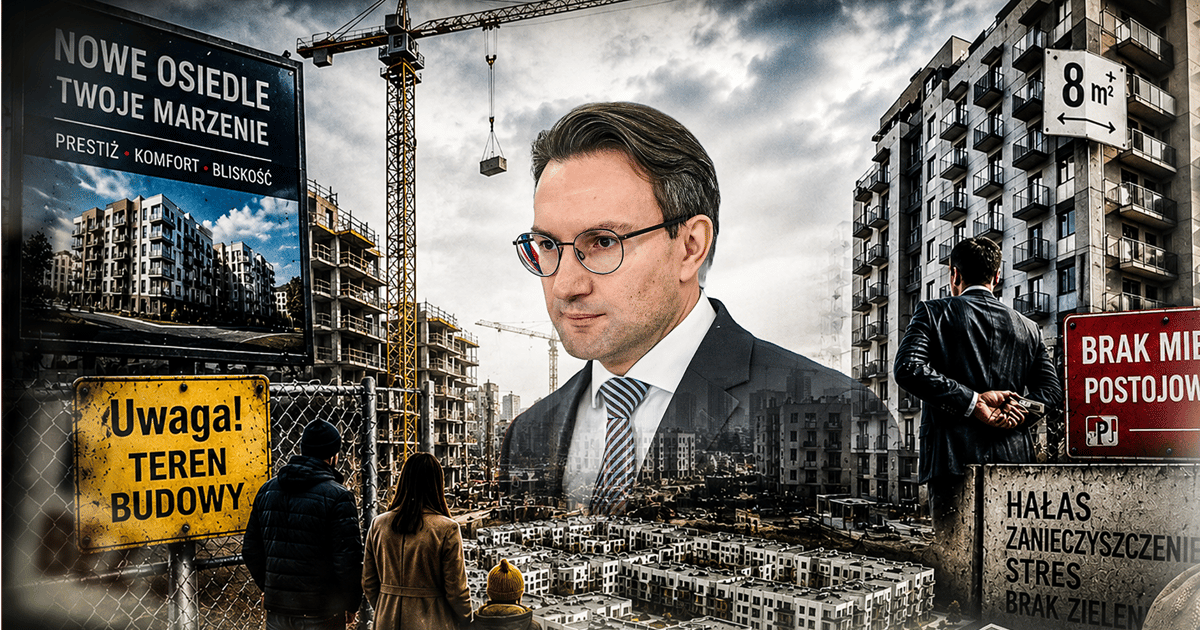
Poland's current answer to the crisis is money for rental building rather than mortgage subsidies. A 2025 package set aside up to 45 billion złoty for social and municipal housing between 2025 and 2030, with a yearly ceiling of 10 billion. For 2026 the state budget carries a record 6.7 billion złoty for housing. Of that, 4.02 billion goes to municipalities as grants, enough for about 18,000 municipal and social flats. The man in charge of the file is Tomasz Lewandowski of the New Left, deputy minister for housing at the MRiT (the Ministry of Development and Technology). In a July 2026 interview with zero.pl he argued that the state should strengthen renting rather than push everyone towards a mortgage. The OECD's review of housing reforms in Czechia and Poland makes a similar case for a stronger not-for-profit rental sector.
Warsaw holds the money and the tenancy law; Szczecin holds land, council flats and a builder of its own. Mayor Piotr Krzystek, in office since 2006, has relied on Szczecińskie TBS rather than joining the state's regional social-rental company, SIM KZN-Zachodniopomorskie, whose members are smaller West Pomeranian towns. In the 2024 campaign he said the company had built 830 flats in his previous term, each sought by four families. The sharpest local argument is about selling what the city owns. Tenants can buy their council flat at a discount of up to 95% after 20 years, and about 5,000 flats are excluded from sale. When the city proposed cutting those discounts in autumn 2025, councillor Przemysław Słowik called it changing the rules mid-game, and colleagues across the chamber objected.
Cooperatives and resident groups still enter this programme mainly through credit. The same strategy offers BGK loans at a fixed 1% for social rental homes, alongside the cooperative rate. Szczecin runs no concept-led land tender for cooperatives, and a kooperatywa has no legal form of its own. As the architect Małgorzata Mader explained on Radio Szczecin, the group shares the investment, then splits into separately owned flats once the building is finished.
On empty homes, the city prefers repair to conversion. A 2026 analysis by the Institute of Regional Studies credits Szczecin with cutting empty council flats by more than 700 units, through heavy renovation and Mieszkanie za remont. That scheme lets a vacant council flat at low rent to a household that renovates it at its own cost. Grants from BGK cover part of the rest, worth nearly 20 million złoty in estimated support. The city has no office-to-housing programme and no tax on empty homes. A national tax, floated by the Left in 2024 against an estimated 1.9 million unoccupied dwellings, would only let municipalities opt in, and has not been enacted.
Climate goals reach the housing stock through heat and the EU buildings directive. In 2024 the city signed a district-heating pact with PGE Energia Ciepła, the network operator SEC and other firms, and PGE aims for 100% low- and zero-emission heat by 2030. Poland missed the May 2026 deadline to transpose the EPBD (the EU Energy Performance of Buildings Directive) and still has no A-to-G energy classes, according to Rzeczpospolita. The public and cooperative landlords own the blocks where that work will land first, from panel estates to TBS new builds.
The national quarrel is over ownership itself. The deputy minister argues that renting deserves equal standing; developers counter that state help should also reach new flats, which are cheaper to heat. When the government limited its Klucz do mieszkania scheme (the key-to-a-home loan) to second-hand flats, Rzeczpospolita quoted then-minister Krzysztof Paszyk saying not a single złoty would go to developers.
Not everyone has to own a home. It's worth fighting the idea that owning your flat is some measure of success in life. It isn't, and it's time to say so out loud.It is hard to understand why the legislator chose not to let these people buy new flats from the primary market, which are cheaper to run.- 1945[source]
Poland takes over the city
The Polish administration takes over from the Soviet command in July, when only about 200 Poles live among some 6,000 Germans.
- 1958[source]
Wspólny Dom founded
Trading enterprises found the cooperative that becomes the largest in the Szczecin region after a 1968 merger.
- 1966[source]
SM „Dąb” founded
The cooperative behind most right-bank panel estates is founded in Dąbie; its building boom runs from 1978 to 1987.
- 2020[source]
Housing package creates SIM
Parliament passes the package creating Społeczne Inicjatywy Mieszkaniowe, social-rental companies run by municipalities with the state land agency.
- 2024[source]
Empty council flats fall
The city's stock of empty municipal flats falls to 675 by September, from 997 in 2021.
- 2025[source]
Social housing package to 2030
The government commits up to 45 billion złoty for social and municipal housing between 2025 and 2030.
- 2026[source]
Record housing budget
The state budget carries 6.7 billion złoty for housing, including 4.02 billion in grants to municipalities.
- 2028[source]
Wrzosowe Wzgórze III due
Handover of 283 Szczecińskie TBS rental flats is planned for January 2028.
- 2029[source]
SIM target
The national SIM network aims for almost 30,000 flats in total by 2029.
- 2030[source]
Buildings directive milestone
Under the EU buildings directive, 16% of existing buildings should meet minimum energy standards from 2030, rising to 26% from 2033.
From the post-war resettlement and the cooperative boom to the social-rental programme and the EU buildings directive.
In Szczecin the argument is decided less by rhetoric than by what the TBS, the old cooperatives and the waterfront developers actually put up.
From Łucznicza to Łasztownia: who builds the next homes
Szczecińskie TBS is the city's strongest case that non-market rental can work at scale. Its chief executive for three decades, Grażyna Szotkowska, stepped down in 2026 and told Szczeciner.pl the company manages close to 14,800 dwellings, more than 8,500 of them its own. No other TBS or SIM in Poland holds as many. Its estates include Łucznicza on Krasińskiego Street, 308 flats that drew coverage in the architectural press at home and abroad. The limit is money and time: rents must repay public loans, and every flat still draws several families.
Wrzosowe Wzgórze is where the company's next phase is under way. Its third stage adds 283 rental flats in 11 buildings for almost 96 million złoty, plus supported flats and a care facility, with handover set for January 2028. The contractor needs 660 days to build it. Further out, in Podjuchy on the right bank, an architectural competition drew 23 entries for an estate of about 560 rental flats. Its first stage is not due before 2027–2029, a long wait in a city where the queue is already measured in court judgments.
Kwartał 36 and Kwartał 40, two inner-city blocks the TBS finished renewing in 2025, show its other trade. Kwartał 36, beside Plac Zgody, gained a building with 30 flats whose design was picked in an architectural competition. Szotkowska has said the aim is a functional change, not only an aesthetic one, with shared courtyards meant for neighbours of all ages. Block-by-block renewal is slow and costly, which is why so few Polish cities attempt it.
Spółdzielnia Mieszkaniowa „Dąb” remains the monument of the cooperative city. Słoneczne, begun in 1974 on the northern edge of Klęskowo, held 4,041 flats and 10,784 residents in 2007, and Bukowe followed from 1983. These estates house tens of thousands of people at running charges far below the market. Their friction is the retrofit bill for lifts, heating and façades, which members pay through their monthly charges.
Spółdzielnia Mieszkaniowa „Wspólny Dom” shows how a legacy cooperative can keep building after the panel era. Since 2001 it has added traditionally built blocks on Duńska, Kostrzewskiego and Złotowska streets in the Warszewo-Stoki area, on the northern edge of the city. Whether it and Dąb can offer members new rental homes, rather than flats for sale, depends on the reform now before the government.
Łasztownia, the old port island facing the Wały Chrobrego terraces, is the test of whether the waterfront becomes a neighbourhood. A draft zoning plan for more than 174 hectares replaces a planned large shopping centre with mixed inner-city building. On neighbouring Kępa Parnicka, four developer schemes, including Sedina on the site of the former Odra river shipyard, could house more than 1,500 people. These are market flats, and a single bridge still serves the island, though the city promises more crossings.
Urban Lab Szczecin is where the smallest and newest idea is being tried out. Its kooperatywa workshops have no building yet. They are, however, the first local attempt to let residents commission homes together instead of waiting for a TBS allocation or buying from a developer.
References
Statistics14Click on any number to see the source
Housing market
Cooperative, social & public
Adaptive reuse & vacancy
Population & migration
From our library6
- Co trzeci Polak zbyt biedny na najem lub kupno mieszkania, a za bogaty na wsparcie — Knowledge
- Over half of Poles aged 25-34 live with parents — Knowledge
- Działalność i znaczenie spółdzielni mieszkaniowych w Polsce — Knowledge
- Spółdzielnie mieszkaniowe na rynku nieruchomości w Polsce w XXI w.: Bariery i szanse rozwoju — Knowledge
- Wiceminister Lewandowski: Nie każdy musi być właścicielem mieszkania — Knowledge
- Housing Reforms in Czechia and Poland — Knowledge
Further sources33
- dzieje.pl / PAP, 5 July 2015 — dzieje.pl / PAP
- Wikipedia: Szczecin — Wikipedia: Szczecin
- wSzczecinie.pl, 3 October 2025 — wSzczecinie.pl
- wSzczecinie.pl, 23 May 2024 — wSzczecinie.pl
- Kurier Szczeciński, 30 December 2024 — Kurier Szczeciński
- Infoludek.pl / RynekPierwotny.pl, July 2025 — Infoludek.pl / RynekPierwotny.pl
- Architektura.info on Habitat for Humanity Poland, July 2025 — Architektura.info on Habitat for Humanity Poland
- Ministry of Development and Technology, the government's housing strategy — Ministry of Development and Technology
- wSzczecinie.pl mayoral debate, 5 April 2024 — wSzczecinie.pl mayoral debate
- SM „Dąb”, history of the cooperative — SM „Dąb”
- SM „Wspólny Dom”, history of the cooperative — SM „Wspólny Dom”
- Twoje Radio, 14 January 2022 — Twoje Radio
- SM „Dąb”, Swojska estate offer — SM „Dąb”
- Radio Szczecin, 27 November 2025 — Radio Szczecin
- Ilezametr.pl, 19 September 2026 — Ilezametr.pl
- PropertyNews.pl, 18 March 2025 — PropertyNews.pl
- KZN (National Property Resource), list of SIM companies — KZN (National Property Resource)
- Instytut Studiów Regionalnych, March 2026 — Instytut Studiów Regionalnych
- OKO.press, 7 September 2024 — OKO.press
- Metropolie.pl, August 2024 — Metropolie.pl
- Rzeczpospolita, 10 April 2026 — Rzeczpospolita
- Rzeczpospolita, 13 February 2025 — Rzeczpospolita
- zero.pl, July 2026 — zero.pl
- Infor.pl, August 2021 — Infor.pl
- Szczeciner.pl, 28 February 2026 — Szczeciner.pl
- KPO (Recovery Plan) news, 30 December 2025 — KPO (Recovery Plan) news
- Szczeciner.pl, 31 March 2026 — Szczeciner.pl
- Szczecińskie TBS, what we build — Szczecińskie TBS
- PropertyDesign.pl, 25 March 2026 — PropertyDesign.pl
- Strefa Gospodarki, 28 April 2025 — Strefa Gospodarki
- Encyklopedia Pomorza Zachodniego: Słoneczne — Encyklopedia Pomorza Zachodniego: Słoneczne
- City of Szczecin news: plan for Łasztownia — City of Szczecin news: plan for Łasztownia
- wSzczecinie.pl, 4 January 2025 — wSzczecinie.pl