A harbour city that already owns its flats
Constanța began as Tomis, a Greek trading post on the Black Sea around 600 BC, and it has lived off its harbour ever since. The Roman poet Ovid was exiled here and wrote of it as the edge of the world. Today the port, the Mamaia resort strip and a university share one long, narrow shoreline between the sea and Lake Siutghiol. That geography shapes how the city's 263,707 residents are housed: tightly, in ageing blocks, with the best land given over to summer.
Of the city's 135,000 dwellings, 94% are lived in by their owners. That share goes back to the early 1990s, when the state sold its flats to the families already living in them for a small sum. Only 6% of households rent, and practically all of them rent privately. Constanța has no housing cooperatives to count at all. Public housing is a thin municipal layer: the national housing agency built 554 rental flats for young people in the city by 2018, and the municipal Henri Coandă district adds 906 container-built flats and studios.
- Owners
- Owner-occupier94.0%
- Renters
- Public & non-profit rental0.00%
- Cooperative0.00%
- Private rental6.0%
Social housing here is a rent rule, not a separate slice of the stock. It covers 0.4% of dwellings, spread through the municipal blocks, yet 38% of households would meet the income test. The national picture is just as stark. Social dwellings make up 0.17% of Romania's housing, and applications outnumber them 2.5 times.
Rents are modest by Western standards but steep against local pay. In December 2025 a studio asked about €350 a month, a two-room flat €500 and a three-room flat €650. Those prices did not move over the year, one of only two big Romanian cities where that happened. New lets average €9.1 per m², while furnished flats let for a few months cost €15.5 per m². A furnished one-bedroom goes for about €360 a month, and a family-sized furnished flat for €620.
- Studio (Storia)
- Furnished 1-bed
- 1-bed outside centre (Numbeo)
- 2-room flat (Storia)
- 1-bed in the centre (Numbeo)
- Furnished family flat
- 3-room flat (Storia)
- 3-bed in the centre (Numbeo)
Asking rents by flat size and letting type, in euros per month. The spread is set by size and furnishing more than by location.
Empty homes are a large part of the story. The 2021 census found 18% of dwellings unoccupied, and much of that is seasonal. Developers delivered more than 8,000 flats in the Mamaia–Năvodari strip in the five years to 2020, many bought to let by the night in summer. A one-bedroom holiday flat earns about €70 a night. Commercial vacancy is small by comparison, with about 0 m² of shop and commercial floor space standing empty.
Demand keeps coming. Around 5,200 people move to the city each year, and some 6,000 stay for three to twelve months, from students to port and seasonal workers. Building is not cheap either: construction runs to about €950 per m² and residential land to €250 per m². New flats in the city ask roughly €2,000–2,100 per m². Since August 2025 buyers of new homes also pay 21% VAT instead of the old reduced rate. Romania has no rent cap, so new lets follow the market.
The crisis in Constanța is one of space and quality more than of price. Romania has the EU's highest overcrowding rate, with 40.7% of people living in homes too small for their household. FEANTSA (the European federation of homelessness organisations) shows in its overview of housing exclusion in Europe that housing costs weigh hardest on the lowest-income fifth of Europeans. People here also have little room each: in 2012 the city counted 0.0 m² of living space per person. The political scientists behind a Social Europe essay, Housing Crisis Threatens to Fracture Central and Eastern Europe, call it a paradox of high ownership and low access. Homes are plentiful where jobs are scarce and dear where work is. They tie that squeeze to the cost-of-living anger that lifted Călin Georgescu's populist campaign in 2024. The middle class feels it most at the first step: a young couple on starting salaries meets a two-room rent that takes a large share of one income.

For the families we support, time does not pass the same way. Every day spent in unfit conditions means real risks to health, to children and to their future. The later we act, the harder it becomes to change this reality.That leaves the cooperative form, so ordinary in Vienna or Zürich, without any foothold in this city.
A cooperative idea still waiting for its law
Romania has no working cooperative housing tenure today. There is no Romanian equivalent of the German Genossenschaftsanteil (the share a member buys to join), and no limited-equity model like Denmark's andelsbolig. What every block does have is an asociație de proprietari (the homeowners' association that each apartment building must form to run its stairs, roof and heating). It manages shared parts collectively, but each flat is owned and sold on its own. A cooperative law of 2005 exists, yet it was never given the rules needed for housing. A draft national strategy of 2016 sketched the missing model: members as occupant-owners who could sell only at what they had paid in, on land provided by the council.
The history explains the gap. Romania's cooperative tradition grew in savings banks and farming, never in housing. Under socialism the state built the blocks that still house most of Constanța, from Tomis Nord to the Km 4–5 estates. After 1990 those flats were sold to their tenants almost overnight. The country went from state landlord to a nation of individual owners without any intermediate form, and the cooperative idea was left with nothing to organise.
The live sector is therefore made of pioneers rather than institutions. Across the region, the network documented in Cooperative Housing Pioneers in Central and South-Eastern Europe links young groups in Zagreb, Budapest, Belgrade and Ljubljana through MOBA, a cross-border cooperative that pools finance. Its members describe the region as a system of "super-homeownership" in a conversation on financing affordable rental and cooperative housing. In Constanța the nearest thing to self-organised building is the volunteer self-build of Habitat for Humanity Romania in Cumpăna, on the city's edge. The clusters differ in form but share the same obstacles. They lack a legal vehicle, land and patient finance, since banks lend to individual buyers, not to groups.
That may be changing at national level. In May 2026 the World Bank and the European Commission ran a Bucharest workshop on housing cooperatives as a tool for social and affordable housing in Romania. The ministries for development and for labour co-organised it. It was part of a project to rewrite the rules for social housing. For the first time the state is treating cooperatives as a possible delivery vehicle rather than a historical curiosity.
From Mamaia's concrete to a social-housing law
Constanța's mayor, Vergil Chițac of the centre-right National Liberal Party (PNL), won a second term in June 2024 with 34.36% of the vote. His housing agenda is mostly about repairing what the boom years left behind. The national programme that pays for new rented homes runs through ANL (the Agenția Națională pentru Locuințe, Romania's national housing agency). Its 2026 budget, approved in June, commits 2.1 billion lei to three lines: rented homes for young people, social housing for Roma communities, and service flats for doctors and teachers.
The levers are split between tiers of government. Bucharest writes the housing law and funds ANL through the Ministry of Development, Public Works and Administration (MDLPA). Councils supply the land, and once ANL has built the blocks they hand the flats over to be let to people under 35. The prefect (the government's representative in each county) polices the legality of council decisions. The city itself controls zoning through the PUZ (planul urbanistic zonal, the local zoning plan) and allocates its own social flats. That split has left Constanța with little stock of its own. The Henri Coandă district, built in the Radu Mazăre years from steel containers, was a cheap and fast answer to need. In April 2026 a fire there forced the evacuation of 157 people, and the city had to find 41 free flats to rehouse them.
Dedicated support for cooperatives does not yet exist. There are no concept-led land tenders, ground leases or federation pacts to name. What exists is the social-housing reform project behind the May 2026 cooperative workshop, and a national housing strategy to 2050 adopted in 2022. That strategy promises to simplify how social homes are allocated and to rewrite the 1996 housing law. The European Commission's European Affordable Housing Plan, published in 2025, adds a Brussels frame and new funding routes.
The city's answer to empty and misused space starts in Mamaia. A 2013 zoning plan allowed blocks of more than ten storeys across 207.74 hectares of the resort. In October 2021 the mayor moved to annul the Mamaia zoning plan that had let dozens of blocks rise on the beach and the lakeshore. Next door in Năvodari, the prefect asked a court in 2023 to cancel 12 building permits, after inspectors found defects on almost 200 building sites. PressOne's satellite investigation of the coast traces the pattern back to illegal land restitutions under the former mayor. Romanian councils may also raise property tax on neglected buildings by up to 500%, a tool Bucharest districts, Brăila and Galați already use against empty shells. The largest vacant site in the city, a former oil depot of 38 hectares, is being planned by IULIUS with Foster + Partners as offices, culture and parkland. Housing is not on its programme.
Mamaia has completely degraded in urban terms; it was built over green spaces. Mamaia is no longer a resort, Mamaia has become a neighbourhood of Constanța.Sustainability arrives mainly through renovation. Romania's recovery plan set aside €2.17 billion for energy upgrades and seismic strengthening. It targets 1,733 residential blocks across the country, and new public homes must meet the nZEB standard (nearly zero-energy buildings). The EU's revised Energy Performance of Buildings Directive will tighten that further. For Constanța's socialist-era blocks, owned flat by flat and run by homeowners' associations, the hard part is getting a whole building to agree and borrow together. That is precisely the problem a cooperative is built to solve.
Every element of a zonal or detailed urban plan should be decided through a competition.- 2013[source]
Mamaia zoning plan approved
A zoning plan for the resort allows blocks of more than 10 storeys across 207.74 hectares.
- 2020-08[source]
Chițac campaigns on Mamaia
The PNL candidate calls Mamaia a degraded neighbourhood rather than a resort; he wins the mayoralty that autumn.
- 2021-10[source]
City moves to annul the Mamaia plan
The mayor tables a council decision to revoke the 2013 zoning plan.
- 2023-02[source]
Prefect challenges Năvodari permits
The prefect asks a court to cancel 12 permits after inspectors find defects on almost 200 sites.
- 2023-09[source]
Mamaia beach design competition decided
An architects' competition with 19 entries picks Studio 82 and Vlad Sebastian Rusu to redesign the beach.
- 2024-06[source]
Chițac re-elected
The mayor wins a second term with 34.36% of the vote.
- 2025-08[source]
VAT on new homes rises to 21%
The reduced 9% rate on new homes ends, with a transition for signed purchases.
- 2026-04[source]
Fire in the Henri Coandă social district
157 people are evacuated from a container-built block; the city rehouses them in vacant flats.
- 2026-05[source]
First national workshop on housing cooperatives
The World Bank and European Commission present cooperatives as a tool for social and affordable housing in Romania.
- 2026-07[source]
Reduced-VAT transition for new homes ends
The last purchases at the old 9% rate must be delivered by 31 July 2026.
- 2026-12[source]
Great Synagogue restoration due
The €2 million rescue of the roofless synagogue is scheduled to finish by the end of 2026.
- 2050
National housing strategy horizon
The end date of the national housing strategy adopted in 2022, which promises a simpler social-housing system and a new housing law.
From the Mamaia boom to a first national debate on housing cooperatives, with the dates still ahead.
Restored landmarks, and the homes still to come
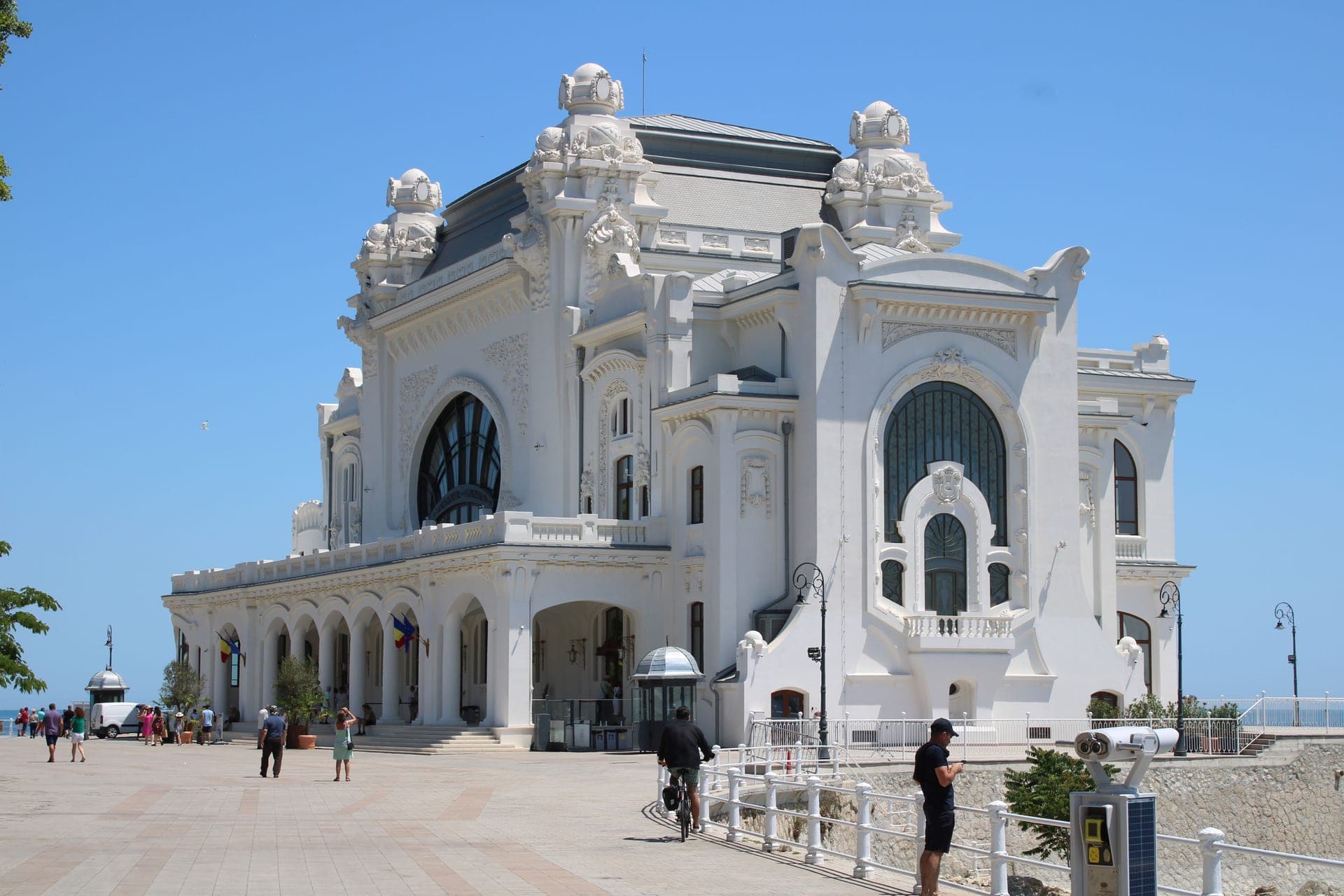
The Constanța Casino shows what the city can do with a derelict icon. The Art Nouveau building on the promontory stood empty for years until a restoration costing more than €40 million was finished in March 2025. It reopened in May 2025 as a public hall for exhibitions and concerts. It proves that EU funds, a patient client and heritage craft can bring a ruin back into use on this coast.
The Great Synagogue, a few streets away on the peninsula, is the smaller and more telling case. It spent about twenty years without a roof, and ten tenders failed before builders were found. Work began in August 2024 on a budget of €2 million, with the Jewish Community of Constanța as owner. The lesson for housing is about capacity: the money existed long before anyone could deliver.
The Mamaia beach competition, run by the Romanian Order of Architects for the national water authority, drew 19 teams in 2023. Studio 82 and the office of Vlad Sebastian Rusu won with a plan that treats the strip as tourist, urban and natural at once. It is the first large piece of the coast decided by design quality rather than by permit, as local architects had long demanded.
ANL's youth rentals remain the city's only steady supply of below-market homes. By 2018 Constanța County had 1,680 of them, the second-highest total in Romania, with a third inside the city. Tenants may later buy their flats, so each sale shrinks a stock the city can barely replace.
Habitat for Humanity Romania offers a glimpse of collective self-build. In Cumpăna, just south-west of the city, volunteers and future owners have raised 30 houses in recent years. The families put in their own labour alongside volunteers. It is small, and it is ownership again, but it is organised, shared building.
The brownfield plan by the Romanian developer IULIUS and Foster + Partners is the site where the next chapter could be written. Its designers describe the city's industrial past becoming its greatest asset, with the country's largest soil clean-up and a botanical garden of mature trees. A slice of that land given to rented and cooperative homes would answer the question the Casino and the synagogue leave open: who gets to live in the restored city.
References
Statistics14Click on any number to see the source
Housing market
Tenure & affordability
Adaptive reuse & vacancy
Population & migration
From our library7
- Tenth Overview of Housing Exclusion in Europe — Knowledge
- Housing Crisis Threatens to Fracture Central and Eastern Europe — Knowledge
- Cooperative Housing Pioneers in Central and South- Eastern Europe: Mainstreaming Alternatives through Translocal Networks — Knowledge
- MOBA: Rethinking needs and financing for affordable rent and cooperative housing in Central and South-Eastern Europe — Knowledge
- Schimb de experiență: Cooperativele de locuințe ca instrument pentru locuințe sociale și accesibile ca preț în România — Knowledge
- Understanding the housing crisis: Staff Working Document accompanying the European Affordable Housing Plan — Knowledge
- Primăria Constanța vrea să anuleze PUZ-ul stațiunii Mamaia, unde au fost construite zeci de blocuri în ultimii ani — Knowledge
Further sources24
- Decembrie 2025 pe piața chiriilor: Constanța și Iași, singurele orașe cu prețuri neschimbate — HotNews · 2025-12
- Gabriela Firea vrea să facă locuinţe cu chirie pentru tineri, în sistem ANL — Capital.ro · 2016-06
- Mai puţine locuinţe ANL finalizate în 2018 — Economica.net · 2019-01
- România are cele mai puține locuințe sociale din UE — Capital.ro · 2026
- Habitat for Humanity România atrage atenția asupra urgenței locuirii decente — Revista Biz · 2026-04
- Piața rezidențială din Mamaia trece printr-un boom al construcțiilor — Revista Biz · 2020-12
- Piața imobiliară din România în 2026 — Capital.ro · 2026
- TVA de 21% la locuințele noi — StartupCafe · 2025
- Guvernul vrea cooperative de locuinţe care lovesc în profitul dezvoltatorilor — Capital.ro · 2016-07
- Cumpăna: Habitat for Humanity construiește 4 locuințe în doar 5 zile — Radio Constanța · 2022-10
- Vergil Chițac reales la Constanța — Newsweek România · 2024-06
- Guvernul a aprobat bugetul ANL pentru 2026 — Digi24 · 2026-06
- Plan roșu activat în Constanța după un incendiu în cartierul social Henri Coandă — Euronews România · 2026-04
- Prefectul Constanței a cerut în instanță desființarea a 12 autorizații de construire în Năvodari — G4Media · 2023-02
- Un litoral sfâșiat de rechinii imobiliari — PressOne · 2024-08
- Primăriile din România cresc impozitele pentru anumite clădiri — Capital.ro · 2026
- IULIUS și Foster + Partners propun transformarea zonei contaminate din centrul Constanței — Newsweek România · 2025
- Vergil Chițac, candidat PNL: interviu — HotNews · 2020-08
- Viața din Constanța începe să devină a orașului, nu a cluburilor din Mamaia — Europa Liberă România · 2020-09
- Reabilitarea blocurilor: eșecul unui program — Europa Liberă România
- Apele Române au desemnat proiectul câștigător pentru amenajarea plajei din Mamaia — Economica.net · 2023-09
- Sinagoga Mare din Constanța, în sfârșit salvată — Euronews România
- Cazinoul din Constanța se redeschide pentru public — Revista Biz · 2025-05
- Constanța — Wikipedia