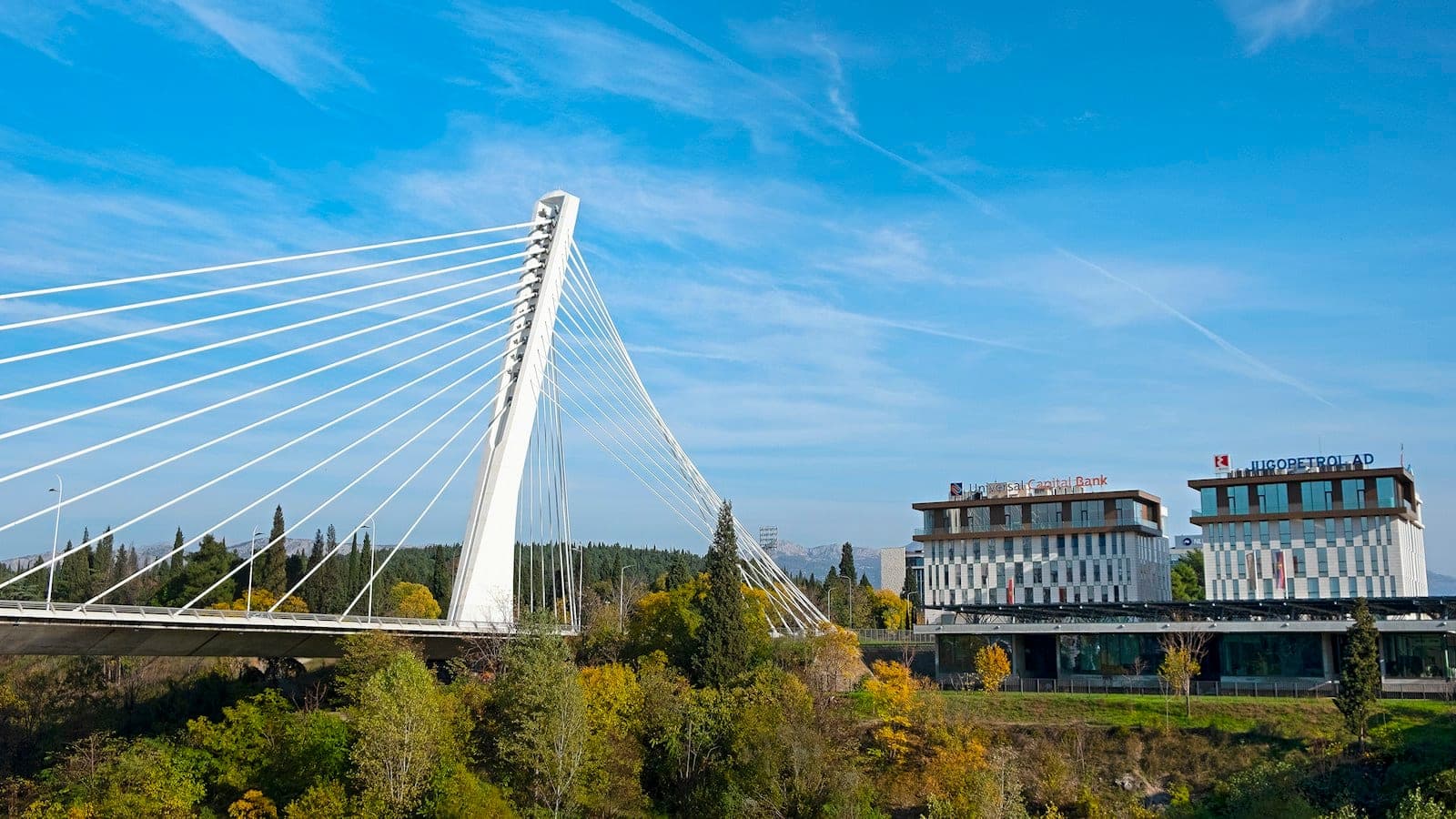
Rebuilt as Titograd, owned by its tenants, now priced by the market
Podgorica is a young capital on an old crossing of the Morača and Ribnica rivers. Allied raids almost completely destroyed the town in 1944, and when partisans liberated it only 6,207 inhabitants were left. Renamed Titograd in 1946, it grew eighteenfold by 1991, housed in blocks that workers financed through their workplaces. Those flats were later sold to the families living in them. That single decision still explains who owns what here.
The Capital City counted 179,505 residents in the 2023 census, 28.78% of Montenegro. The last census to publish tenure by municipality, in 2011, recorded 56,847 households within the boundaries of that time. Of those, 73.7% owned or co-owned their home and 12.4% rented it. Another 8.1% lived in a flat owned by parents, children or other relatives, which the census records as a tenure of its own. Cooperatives leave no trace in the table. The union-run cooperatives sell each finished flat to its member, so every cooperative home is counted as owner-occupied. Public rental is nearly as scarce: in 2011 the city held 153 of the country’s flats for socially vulnerable households, which leaves private landlords as almost the whole rental market.
- Owner / co-owner73.7%
- Renting or sub-letting12.4%
- Living in a relative’s flat8.1%
- Other2.1%
- No data3.7%
Social housing is a rule about who may live somewhere, not a separate slice of the stock. The Law on Social Housing (Zakon o socijalnom stanovanju, the 2013 framework for subsidised homes) sets that eligibility. The UN’s 2026 country profile of Montenegro counts 0.6% of the national stock, or 2,331 units across 24 municipalities, as social and affordable rental. Those homes are counted inside the tenure slices, not beside them.
Rents have moved faster than pay. The average one-bedroom went from €250 before the pandemic to about €430 by mid-2025, a 73% rise. The count comes from the Society of Statisticians and Demographers, in an interview on prices rising twice as fast as in the EU. New contracts start near €9/m². Furnished and serviced flats, priced gross with utilities and furniture, sit at €9.5/m². The top has come off since 2025. A Podgorica agent told Dan that one-bedrooms which let for about €500 a year earlier now mostly go for €400–450.
- All-stock median€8.50
- New contracts
- Furnished / serviced (gross)
- Serviced (gross, all-in)
Market tiers only. Podgorica has no cooperative rental tier and no published rent for its small municipal stock, so the ladder starts at the all-stock median of asking rents.
The city also has more homes than households. The 2023 census counted 86,886 dwellings in Podgorica, and 14,690 of the permanent ones stood temporarily unoccupied or abandoned. That is roughly 17% of the stock, before counting 7,259 flats kept for seasonal use. Offices matter less here: an estimate apportioned from national market data puts vacancy near 10%, about 0 m².
Much of the recent demand came from abroad. The census found 11,626 foreign citizens in Podgorica, 6.48% of residents, among them 2,805 Russians. Radio Free Europe reported in 2022 that the war in Ukraine had doubled asking rents. Sale prices kept climbing after rents paused: MONSTAT’s new-build average for Podgorica rose from €1,761/m² in early 2024 to €2,510/m² in the second quarter of 2026. Nationally, permits for 1,388 planned dwellings were issued in the first quarter of 2026. There is no rent cap. In 2025 renters asked the state for protection as foreign demand pushed up both prices and rents.
Renters carry the most. The Tenants’ Association (Udruženje podstanara Crne Gore, the national renters’ group) says Podgorica tenants spend almost 60% of their income on rent. Young adults wait: Montenegrins leave the parental home at 33.3 years on average. The squeeze now reaches steady earners too. The average net wage was €1,040 in July 2026, so one square metre of new build costs more than two months’ pay. The UN profile puts the national house-price-to-income ratio at 8.6. National media treat the story as chronic rather than acute. RTCG reported the 2026 rent correction as a pause, and the same wage-rent gap drives reporting on Belgrade, Pristina and Tirana.
This 10–20% fall doesn’t mean rents have become low. It is a partial correction after a period of sharp growth, when prices in some cities rose by more than 50% in a relatively short time.One form of housing still sells well below the market, and the tenure tables cannot see it: the workers’ cooperative.
Cooperatives built by teachers and nurses
Montenegro’s stambene zadruge (housing cooperatives that build homes for their members at cost) are ownership cooperatives with a short life. Members are usually public-sector employees organised through their union. The cooperative secures land and loans, builds, and then sells each flat to its member. After the sale the building becomes an ordinary block of owner-occupied flats. The price gap is large. Flats sold through solidarity housing construction, the channel the cooperatives and the union fund use, cost €674/m² in Podgorica in the first quarter of 2025, MONSTAT recorded, against €2,066/m² for all new builds. The 2010 Law on Housing Cooperatives (Zakon o stambenim zadrugama) asks the state and municipalities to help with land and waived utility-connection fees, according to a February 2026 survey of the sector.
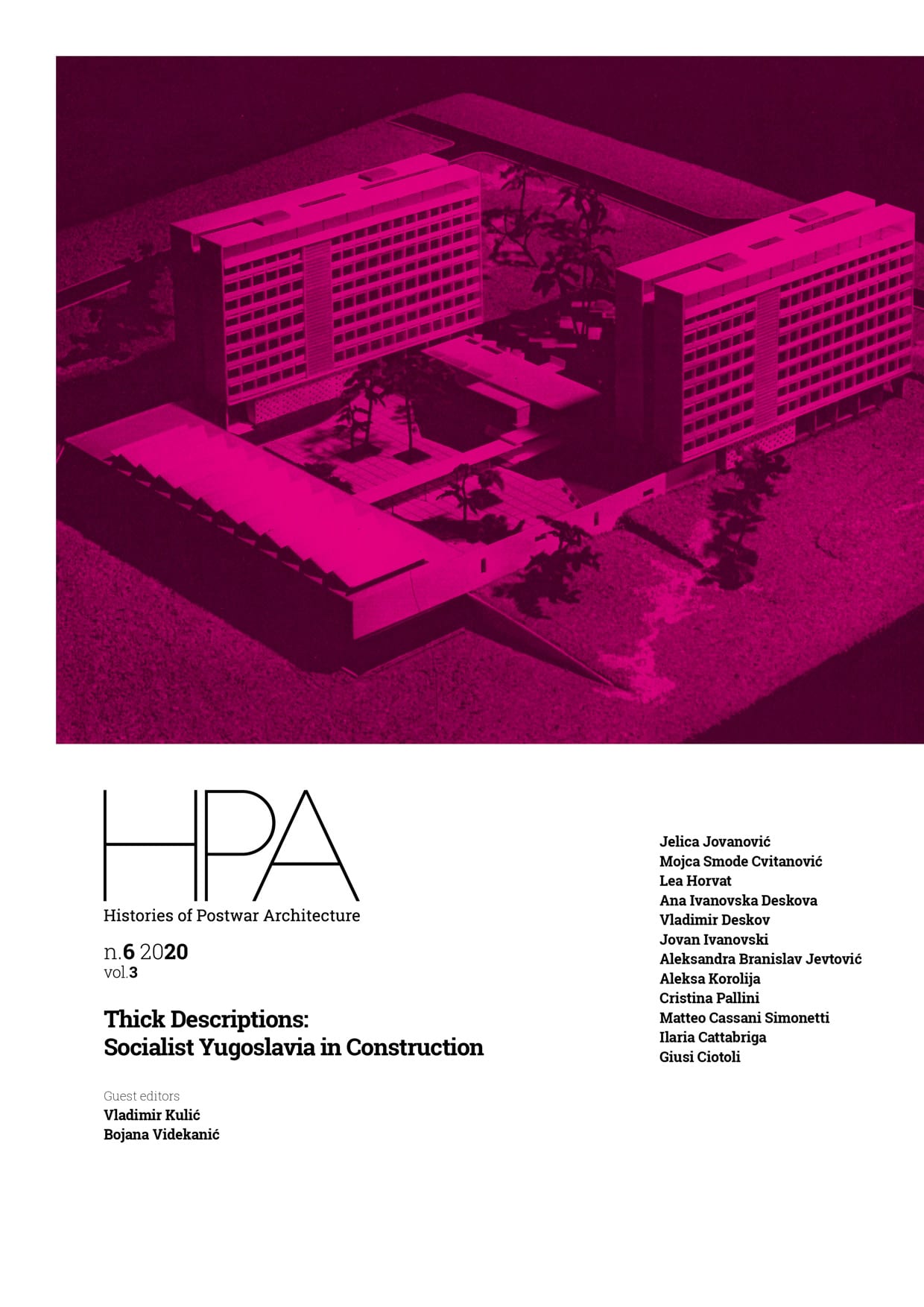
The collective habit is older than the cooperatives. In Titograd, firms and workers paid compulsory contributions (doprinos) and a voluntary levy (samodoprinos) into the city’s self-managed housing community (SIZ). That body built the estates and allocated flats through the workplace, as Lea Horvat’s history of Blok 5 shows. Tenants held a stanarsko pravo (a lifelong occupancy right in a socially owned flat) rather than a title. The 1990 Law on Housing Relations let them buy, and about 95% of units were bought within two years at deep discounts. The socialist housing fund closed at the same time. Most of the collective finance went with it.
Today’s sector has two clusters. The occupational cooperatives are the larger: Solidarno, founded in 2002 for education workers, has built 790 homes in 15 municipalities. The health workers’ cooperative Zdravstvo has built 322 since 2012, most of them in Podgorica. The second cluster is the trade-union solidarity fund CFSSI (Crnogorski fond za solidarnu stambenu izgradnju, the Montenegrin fund for solidarity housing construction). It built 365 flats in Podgorica while employer contributions were compulsory, a duty abolished in 2006. Both clusters face the same limits: land, finance and slow approvals. Zdravstvo’s director Dijana Pavličić told RTNK it sold no flats in 2025 because of a demanding procedure with the Ministry of Health. Its peers across the region are testing rental cooperatives instead, as the MOBA network and a study of cooperative pioneers in Central and South-Eastern Europe describe. Montenegro has no such model yet.
Property prices have reached unprecedented levels, out of all proportion to workers’ financial means.Government uses cooperatives as a channel for public-sector workers rather than as a tenure in their own right. The state is paying €500,000 a year from 2024 to 2026 toward Zdravstvo’s new building of more than 200 flats in Zagorič. Municipalities supply the land. Whether that channel widens beyond teachers and nurses is now a question for the national housing strategy.
Velje Brdo and the politics of the square metre
The government of Prime Minister Milojko Spajić, in office since October 2023, has staked its housing answer on one site. At Velje Brdo, on state land in the capital, it promised flats at €1,000/m² with loans at 1.2% over 30 years. The programme sits under the Housing Policy Strategy to 2034, which budgets €54.7 million for 2025–2026 and plans a National Housing Fund to build, maintain and rent flats on favourable terms. The Ministry of Spatial Planning, Urbanism and State Property (the ministry for planning and public land), led by Slaven Radunović, runs it. Radunović has said the first phase of about 600 flats should be occupied by the end of 2027.
Prices like these do not exist on the Montenegrin market.Milojko Spajić, Prime Minister of Montenegro, launching Velje Brdo in September 2024
The levers are split between the state and the Capital City. Nationally, the government adopted the Capital City’s Spatial-Urban Plan (PUP, the city-wide land-use plan) in August 2025. At the request of its Velje Brdo coordinating body, the plan reserves room for 20,000 homes there. Municipally, Mayor Saša Mujović, in office since December 2024, runs the city’s own programme, Gradski stan (City Flat). The municipality also sets property tax within the national band of 0.25% to 1.00% of market value. Earlier subsidy schemes have closed. The 1000+ programme (subsidised loans and flats for households without a home) ended in January 2024. It had housed about 4,000 people with €110 million of loans from the Council of Europe Development Bank (CEB, the Council of Europe’s social-investment bank) and commercial banks. Its closure was covered by Radio Free Europe. Cooperatives still have no dedicated national funding line of their own.
The debate turns on cost. Opposition MP Mileta Radovanić of the Civic Movement URA calculates that each square metre at Velje Brdo will cost the state €3,394. He proposes building at cost price on public land across the country instead. Architects are sceptical of the scale.
The government tells the media one thing, what it assumes people want to hear: that they will finally have a flat of their own that they can afford. Its strategic documents foresee something else.The empty flats have not yet met a policy. There is no tax on vacant homes and no office-conversion programme. The UN country profile recommends both a vacancy tax and anti-speculation measures. It also estimates that illegal construction affects up to a third of the housing stock. The government approved a new Law on Legalisation of Unlawful Buildings in July 2025, but since 2018 only 4,363 buildings have been legalised nationally.
Climate targets arrive through EU accession. Montenegro aims to close all negotiating chapters by the end of 2026, including Chapter 27 on environment and climate. A government roadmap for the EU buildings directive requires zero-emission new public buildings from 2028 and bans fossil heating in all new buildings from 2030. Public bodies must renovate 3% of their buildings a year. Households get far less: the Eko-fond (the national environmental fund) opened a 2026 call covering 30% of most efficiency measures. Velje Brdo and Gradski stan will be among the first large residential schemes built to the new rules.
- 1946[source]
Podgorica becomes Titograd
The rebuilt city takes the name it keeps until 1992.
- 1977–1984[source]
Blok 5 built
Self-managed housing finance delivers 13 buildings and about 1,800 flats.
- 1990[source]
Law on Housing Relations
Occupancy-right holders may buy their socially owned flats; about 95% do so within two years.
- 2002[source]
Solidarno founded
Education workers form the country’s most active housing cooperative.
- 2013[source]
Law on Social Housing
A national framework for subsidised homes comes into force.
- 12 December 2018[source]
Konik camp closes
The last 51 families move into Regional Housing Programme flats.
- January 2024[source]
1000+ programme ends
The subsidised-purchase scheme closes after housing about 4,000 people.
- 21 September 2024[source]
Velje Brdo launched
Flats promised at €1,000/m² with 1.2% loans.
- July 2025[source]
Legalisation law approved
The government sends a new law on unlawful buildings to parliament.
- August 2025[source]
Spatial-Urban Plan adopted
The plan reserves room for 20,000 homes at Velje Brdo.
- March 2026[source]
Gradski stan competition decided
The jury reviews 77 entries and awards no first prize.
- End of 2026[source]
EU negotiations target
Montenegro aims to close all negotiating chapters.
- End of 2027[source]
Velje Brdo first residents
Target for the first phase of about 600 flats.
- 2028[source]
Zero-emission public buildings
New public buildings must be zero-emission.
- 2030[source]
Zero-emission for all new buildings
Fossil heating is banned in new buildings.
- 2034[source]
Housing Policy Strategy ends
The horizon of the national strategy and its planned housing fund.
From socialist rebuilding to the EU-era building rules.
From Blok 5 to Gradski stan: Podgorica’s proof points
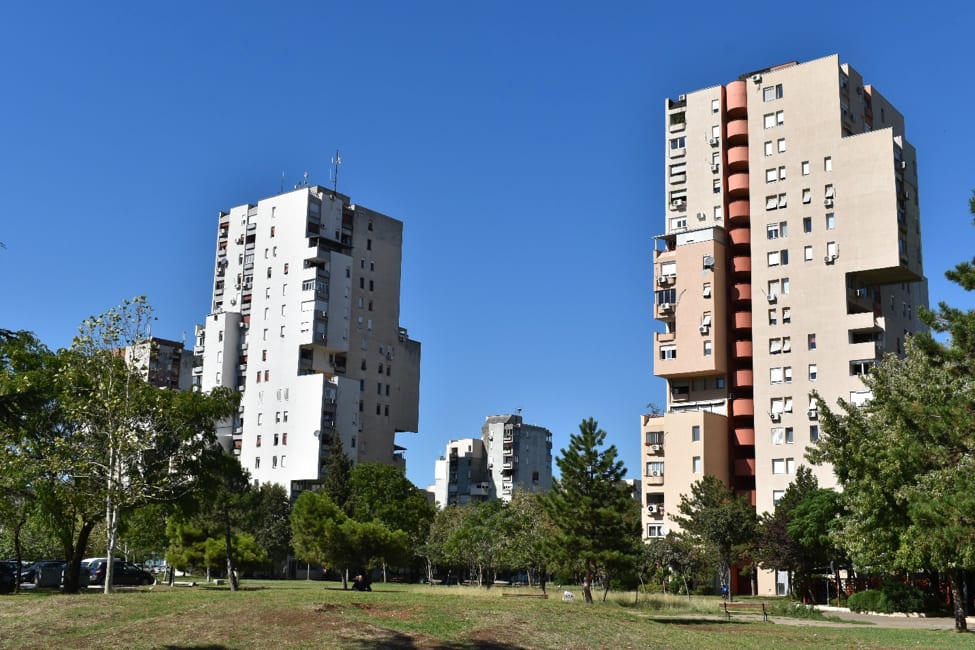
Blok 5 is still the city’s best argument for building together. Designed by Mileta Bojović and built between 1977 and 1984, it put about 1,800 flats into 13 buildings. The money came from labour organisations and institutions pooled through the housing community. Movable partition walls let families reshape their flats as they grew. A LeftEast essay on Bojović calls it the greenest quarter in Podgorica, forty years on.
Konik shows what public rental can do when finance is patient. The Regional Housing Programme (RHP, a donor-funded scheme managed by the CEB) built 17 buildings for 171 families from the camps that had sheltered refugees since 1999. The Capital City owns the flats and put €4.5 million into land and infrastructure. The camp closed on 12 December 2018. The same programme later delivered 96 flats at Vrela Ribnička for refugee families.
Solidarno and its health-sector peer Zdravstvo are the living cooperative model. Solidarno’s director Zoran Stanišić puts its members’ advantage at 30–40% below the open market. Zdravstvo’s next project is in Zagorič: more than 200 flats on 20,800 m² of floor space for health workers. Both cooperatives depend on the next municipal plot. In late 2024 Stanišić said Solidarno was waiting for the new city government to be formed before asking for another site in Podgorica. Land, not demand, sets the pace.
Gradski stan is the Capital City’s own affordable-housing programme. The site, about 18,600 m² in the Konik – Stari Aerodrom plan area, is meant for young people, families with children and older residents. The international design competition drew 77 entries. The jury gave no first, second or third prize and bought three designs instead. The city’s own brief notes that more than a quarter of households live in insecure housing.
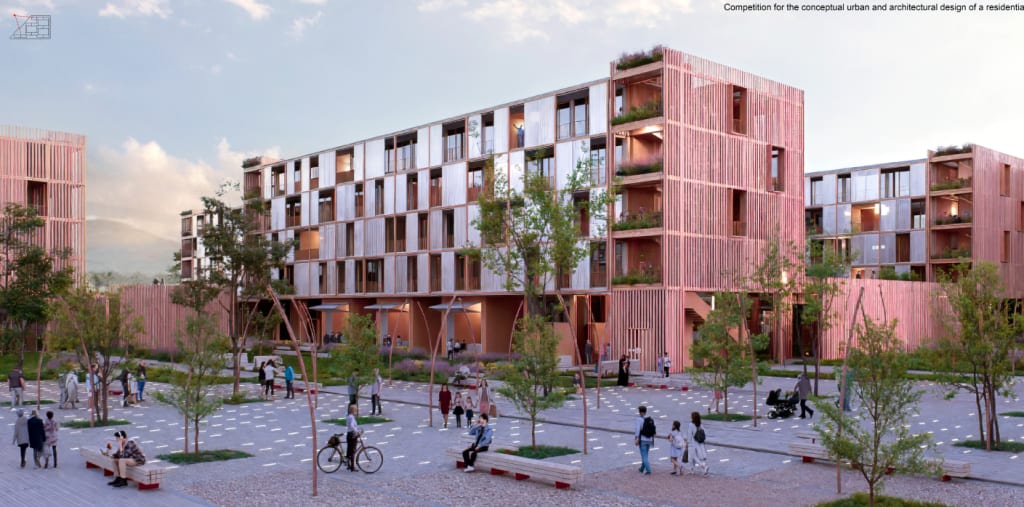
Velje Brdo will decide whether these proof points ever add up to scale. Its first phase will show whether a national programme can reach the prices that Blok 5’s pooled finance and today’s cooperatives already achieve at a smaller size.
References
Statistics5Click on any number to see the source
Housing market
Adaptive reuse & vacancy
Population & migration
From our library15
- UNECE issues recommendations to help Montenegro address urgent housing and planning challenges — Knowledge
- Radojević: Cijene stanova u Crnoj Gori rastu dvostruko brže nego u EU — Knowledge
- Odlazak stranaca uticao na korekciju cijena zakupnine stanova: kirije pale do 20 odsto — Knowledge
- Rat u Ukrajini duplirao cijene izdavanja stanova u Crnoj Gori — Knowledge
- Housing crisis in the Western Balkans: rents soar as wages stagnate — Knowledge
- Stambene zadruge nakon buma na tržištu nekretnina postaju sve privlačnije — Knowledge
- Housing Yugoslav Self-Management: Blok 5 in Titograd — Knowledge
- Stambena zadruga radnika prosvjete Crne Gore "Solidarno" — Organisation
- MOBA: Rethinking needs and financing for affordable rent and cooperative housing in Central and South-Eastern Europe — Knowledge
- Cooperative Housing Pioneers in Central and South- Eastern Europe: Mainstreaming Alternatives through Translocal Networks — Knowledge
- Strategija stambene politike do 2034. godine: planirano formiranje Nacionalnog stambenog fonda — Knowledge
- Vlada Crne Gore gasi program 1000+ stanova — Knowledge
- Bojović's Blok 5: housing self-management in Titograd — Knowledge
- Konik camp in Montenegro now officially closed: remaining 51 families move to new homes — Knowledge
- Rezultati konkursa za idejno rješenje stambeno-poslovnog kompleksa u okviru projekta Gradski stan u Podgorici — Knowledge
Further sources34
- Census 2023: population (first release) — MONSTAT · 2024-10-15
- Census 2023: population by citizenship — MONSTAT · 2024
- Census 2023: dwellings — MONSTAT · 2025-03-31
- Census 2011: households and families — MONSTAT · 2013-09-27
- New-build prices, Q2 2026 — MONSTAT · 2026-08-20
- New-build prices, Q1 2025 — MONSTAT · 2025-05-20
- Building permits, Q1 2026 — MONSTAT · 2026-05-27
- Average wage, July 2026 — Standard · 2026-08-31
- Estimated average age of young people leaving the parental household — Eurostat · 2020
- Tenants in Podgorica spend almost 60% of income on rent — Portal Analitika · 2026-07-02
- Foreigners, prices and rents rise; tenants seek state protection — RTCG · 2025-10-21
- Rents in Podgorica down 20% — RTCG · 2026-03-13
- National Housing Strategy 2011–2020 — Government of Montenegro · 2011
- Housing Yugoslav Self-Management: Blok 5 in Titograd (full text) — Histories of Postwar Architecture · 2020
- Bombing of Podgorica in World War II — Wikipedia
- Law on Social Housing — Government of Montenegro · 2013-07-23
- €1.5 million for the housing needs of health-sector employees to 2026 — Government of Montenegro · 2024-12-23
- Approval for 200+ new flats for health workers in Podgorica — TV Pljevlja · 2025-10-24
- First flats mid-2026: €1,000/m² at 1.2% — RTCG · 2024-09-21
- Radunović: Velje Brdo move-in by end of 2027 — Standard
- Government adopts the Spatial-Urban Plan of the Capital City — A+ME · 2025-08-16
- Radovanić: Housing for All instead of an overpriced Velje Brdo — Portal Analitika · 2026-09-21
- Sonja Dragović (KANA): Velje Brdo is a deception — ETV · 2026-04-24
- Property tax — Government of Montenegro
- The 1000+ programme abolished — A+ME · 2024
- Draft Law on Legalisation of Unlawful Buildings adopted — Government of Montenegro · 2025-07-11
- Since 2018 almost 90,000 applications, only 4,300 buildings legalised — Portal Analitika · 2026
- Montenegro introduces zero-emission buildings — Balkan Green Energy News · 2026-04-01
- Eko-fond 2026 call for household energy efficiency — Eko-fond · 2026-05
- Roadmap for closing all negotiating chapters by the end of 2026 — Government of Montenegro · 2026-01-31
- Mayor of Podgorica — Wikipedia
- 120 families from Konik camp move into new homes — Regional Housing Programme · 2017-11-15
- RHP: 96 refugee families get homes at Vrela Ribnička — EU Delegation to Montenegro · 2023-03-15
- Podgorica — Wikipedia
Funding & land tenure
What a housing cooperative could actually build on hereLand tenure has not been assessed for Montenegro yet — that is a gap in the research, not a finding.