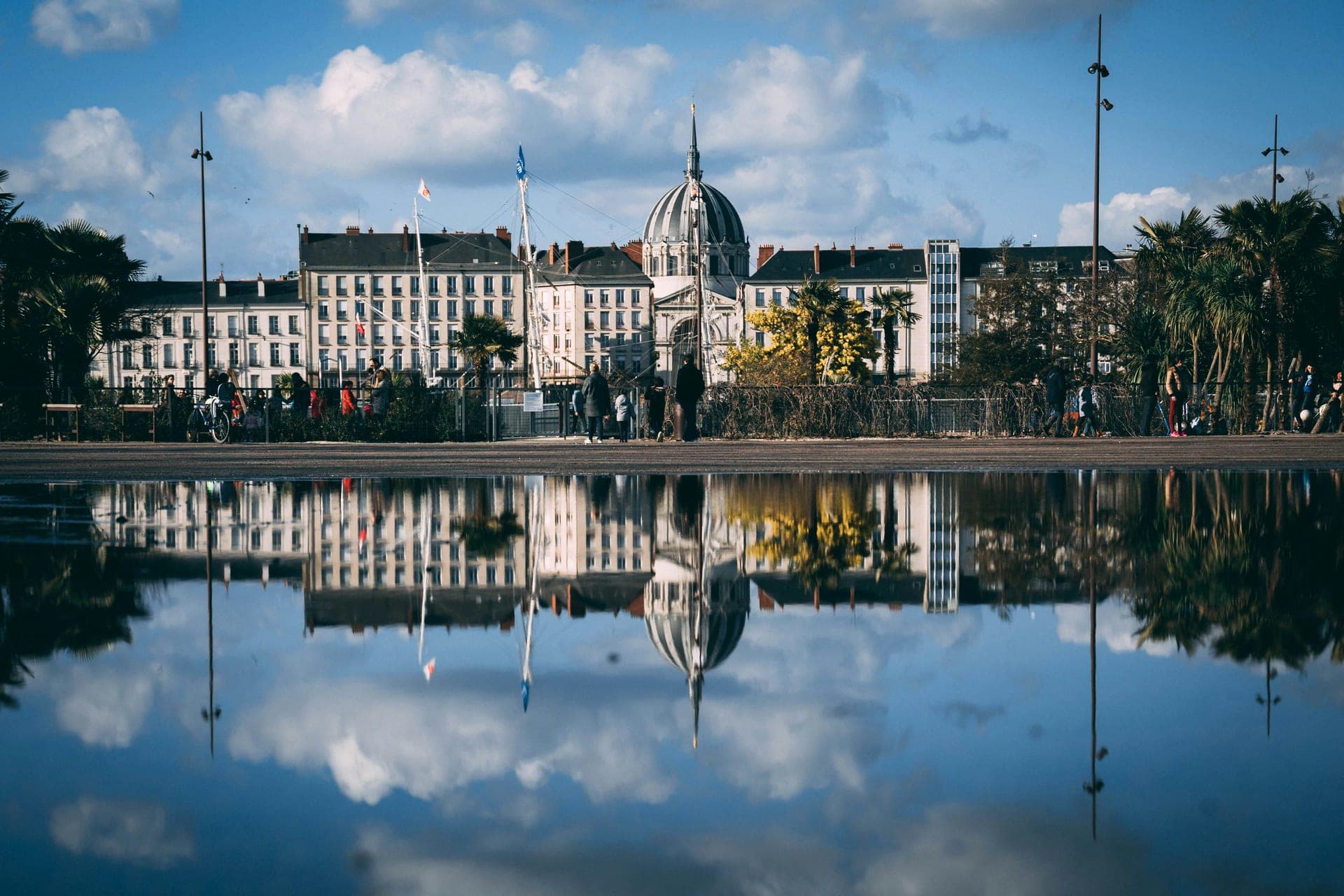
A port city that built its future and now has to house it
Nantes grew rich on the Loire. From 1707 to 1793 its merchants ran 42% of the French slave trade, and the profits paid for the merchants' mansions on the Île Feydeau, where Jules Verne was born. When the shipyards closed in the late 20th century, the city chose to reinvent itself rather than decline. It turned the old docks on the Île de Nantes into a district of culture and new homes, and it built a walking mechanical elephant where ships were once launched. That reinvention drew people in, and they now need somewhere to live.
The commune of 327,734 people counts 193,629 dwellings, and most households rent. Only 36.2% own their home, while 62.3% are tenants. Public housing is the largest single landlord. Homes let by HLM bodies (habitations à loyer modéré, France's regulated social landlords) house 19.2% of households, or 33,220 homes. Among those landlords is Nantes Métropole Habitat, the metropolitan public housing office. Private landlords house 43.1% of households. A further 1.5% are housed free of charge, a status the French census records on its own. Cooperatives have no slice of their own. Most French housing cooperatives sell the homes they build, so their members are counted as owners.
- Owners
- Owner-occupier36.2%
- Renters
- Public & non-profit rental19.2%
- Cooperative0.00%
- Private rental43.1%
- Other1.5%
- Housed free of charge1.5%
That public stock and the city's social housing are close to the same thing. In France logement social means homes let at capped rents to households under income ceilings, a rule that overlays ownership rather than forming a tenure of its own. The census puts the social share of Nantes' main residences at 19.2%, distributed across the slices above rather than added to them. The legal count is wider. Under the SRU law (the 2000 law on urban solidarity and renewal), the 21 communes of the metropolis that must reach a quota held 24.99% social homes on 1 January 2025. Eligibility is broad. Two in three residents of the metropolis meet the income rules for a social or affordable home.
Rents follow tenure closely. A social-rental home outside the Paris region averages €6.15 per m² a month, before service charges. Across the Nantes agglomeration the private median is €12, and a new lease is signed at €12.6. Furnished flats ask €14.5, which is the market most students meet. A student should budget €511 a month for a studio. A whole furnished flat taken for about six months costs an estimated €21.4 per m².
- Social rental (HLM)
- All-stock private median
- New lease
- Furnished
- Furnished, six-month stay (estimate)
Monthly rent per m², excluding service charges except for furnished lets. The social-rental figure is the average outside the Paris region; private figures cover the Nantes agglomeration; the six-month furnished figure is an estimate (new-let rent × 1.7).
Empty space sits beside the shortage. The census counts 6.1% of the housing stock as vacant, about 15,627 homes. Offices are only slightly emptier. Vacancy across the metropolitan office market stands at 6.6%, and 181,700 m² of offices were available at the end of 2025. Tourist lets take their own share. One commercial tracker counted 2,360 active Airbnb listings, renting at around €79 a night.
The pressure comes from arrivals. INSEE's latest census analysis finds that Nantes Métropole gained 7,160 residents a year between 2017 and 2023. The city alone added 3,070 a year, and 27,053 people moved into the commune from elsewhere in a single census year. Building has fallen short. The local housing programme for 2019–2025 aimed at 6,000 new homes a year. The metropolis's own review found that 4,000 were authorised in an average year. The State moved Nantes into zone A, its category for tight housing markets, in the summer of 2024.
The shortage reaches well beyond the poorest. Nantes Métropole had 38,922 registered applicants for social housing on 1 January 2025. A State study of the region ranks the large metropolises, Nantes among them, as the places where an application is least likely to succeed. Across Pays de la Loire an applicant waited 16 months on average in 2024. At the bottom, the city's social action centre helped 7,950 people in 2024, and it now sees students, isolated older people and single parents as well as people sleeping rough. In the middle, the metropolis has opened subsidised ownership to households earning up to €7,673 a month for a family of four. Housing was among the sharpest dividing lines of the March 2026 municipal campaign. The metropolis itself now describes access to housing as a problem for an ever wider public, from the young to the old.
Cooperatives absorb almost none of this pressure. Their homes are too few to show in the census, which is where their story has to be told from the ground up.
Owning without speculating: the Nantes cooperative way
French housing cooperatives mostly build homes for their members to buy, not to rent. The oldest form is the coopérative HLM (a cooperative company inside France's regulated social-housing system), which sells new homes to modest-income households. It often uses the PSLA (prêt social location-accession, a lease that converts into purchase after a trial period). The newest form separates land from building. An organisme de foncier solidaire, or OFS (a non-profit land trust), keeps the land for good. Buyers acquire only the building rights under a bail réel solidaire, or BRS (a long, renewable lease with resale prices capped). It is France's version of the community land trust model now spreading across European cities. A third, smaller strand is habitat participatif (participatory housing), in which future residents design a building together.
The Nantes tradition began with a cooperative and a famous architect. In 1949 the Maison familiale, a low-cost housing cooperative created in 1911, commissioned Le Corbusier to build in Rezé, just across the Loire. The Maison Radieuse opened in 1955 with 294 flats. Its residents were meant to acquire their homes over time under cooperative ownership, with a loan the city guaranteed. At the same moment the Castors (the "beavers", a post-war self-build movement) were raising their own houses. With help from the council, about a hundred of their homes were finished in 1954, built by their future owners in their spare time.
Today the sector falls into three groups, each facing a different constraint. The cooperative HLM builders are the oldest. MFLA (Maison Familiale de Loire-Atlantique) and its partner Demeures et Tradition have delivered nearly 5,000 homes for ownership since their origin. CIF Coopérative, a cooperative HLM company, was approved as a land trust in its own right in 2025 so it can sell under the BRS. Their output depends on buyers who can still borrow. The second group is the land trust itself. Atlantique Accession Solidaire was set up in 2019 by the département, Nantes Métropole, the Saint-Nazaire agglomeration and 14 social landlords, as a Scic (a multi-stakeholder cooperative company). Its founding plan priced BRS homes at around €2,300 per m², a little over half the open-market price the plan quoted. Its constraint is volume. The third group is the participatory builders, led locally by ICEO, a Nantes developer from the social and solidarity economy. The metropolis counts fifteen completed participatory projects and nine more under construction or in design since its first call in 2016. Their constraint is time. The Les Ruches group that co-designed Zellige formed in 2011 and moved in nine years later. Across Europe, research on collaborative housing shows the same pattern: projects take years to assemble and depend on patient public partners.
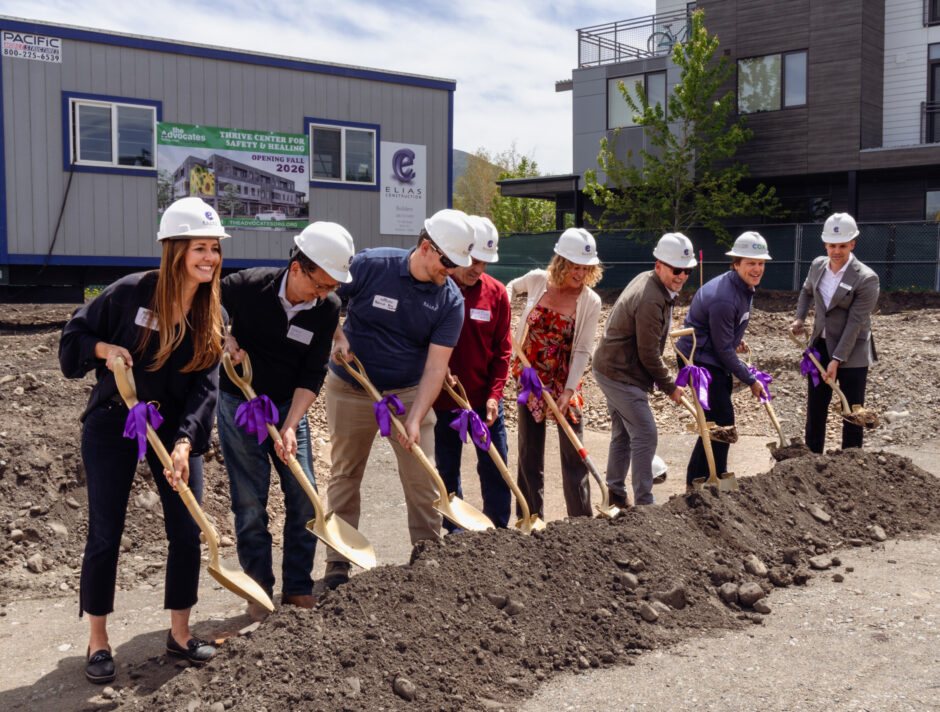
Public policy treats all three as affordable ownership. Launched as an experiment in 2019, the BRS has been open in all 24 communes of the metropolis since 2022. In 2025 the metropolis stretched it to middle incomes under the name BRS+. 920 BRS homes have been approved. The trial caps prices at €3,000 to €3,600 per m², about 25% below the market. The cooperative form is becoming the metropolis's main tool for keeping ownership within reach, and politics will decide how far it can grow.
A re-elected left, a rent-control bid and an office tower to fill
On 22 March 2026 Nantes kept its course. Johanna Rolland, the Socialist mayor since 2014, won the run-off with 52.18% against the centre-right Foulques Chombart de Lauwe. On 3 April she was re-elected president of the metropolis, with Agnès Bourgeais, mayor of Rezé, as vice-president for housing. The two camps offered opposite answers on housing. Rolland's programme promised that 40% of new homes would be social and a further fifth affordable, plus rent control and tighter rules on tourist lets. Chombart de Lauwe answered with home ownership. He promised to help residents become owners and to sell social homes to tenants who want to buy them.
We are against the idea of 40% social housing, it will never work. Better to sell social housing to those who want it or can afford it.The levers are split between three tiers. The national government sets the money and the tenancy law. On 23 January 2026 Prime Minister Sébastien Lecornu and housing minister Vincent Jeanbrun launched the Relance logement (housing recovery) plan, which aims for 2 million homes by 2030. The metropolis holds the local housing programme, the land and the rules on change of use. Its anti-crisis plan, launched in 2023 with €50 million, unlocked 7,400 stalled homes in three years. Its next programme, for 2028–2033, is due for adoption in December 2027. The city itself grants permits and asked in 2025 for rent control.
Rent control is the sharpest test. After the move to zone A, the city applied to join the national rent-control experiment, which lets a city set a reference rent and a ceiling above it. The council voted the bid on 28 March 2025. It estimated that more than 8,000 private homes were above the proposed ceilings. Local press has questioned whether the bid came too late under the experiment's rules, and it depends on the State's approval. Bordeaux, which has capped new leases since 2022, is now weighing whether to extend its own trial.
The idea is to have an upper ceiling and a lower ceiling, to give tenants a reference and, if need be, ask landlords to adjust the rent. It is a useful and effective tool.On empty space, Nantes has acted early. Since 1 January 2019, a main home may be let to tourists for at most 120 days a year, and companies that turn a home into a tourist let must create an equivalent home elsewhere. Offices are the next frontier. The Tour Bretagne, the 1970s office tower that dominates the centre, is being turned into about 200 homes and a hotel, with completion expected in 2029. Nantes Métropole Habitat is converting the former Crédit municipal, an office building of 1894 that stood empty from 2016, into 32 social homes. When the university hospital leaves the Hôtel-Dieu site for the Île de Nantes in 2027, the city intends to reuse its buildings rather than demolish them.
Climate targets push the same way. The metropolis's climate plan for 2024–2030 aims to cut greenhouse-gas emissions by almost half by 2030 and reach carbon neutrality by 2050. The 2021 Climate and Resilience Act adds zero net land take by 2050, halving the consumption of natural land over 2021–2031. Since 2022 the RE2020 standard has counted the carbon in new homes over their whole life. The Mon Projet Rénov service funds energy retrofits for low-income owners and co-owned blocks. Cooperative and social builders are the obvious vehicle. Elsewhere, cities such as Vienna, Brussels and The Hague have scaled collaborative housing with ground leases, concept tenders and loan guarantees. Nantes has so far relied on calls for projects and its land trust.
- 1955[source]
The Maison Radieuse opens in Rezé
Le Corbusier's block of 294 flats, commissioned by the Maison familiale cooperative in 1949, is inaugurated on 2 July.
- 2013[source]
European Green Capital
Nantes holds the European Commission's European Green Capital title for the year.
- 2019-01[source]
Rules on tourist lets take effect
A main home may be let to tourists for up to 120 days a year; companies must compensate with an equivalent home.
- 2019-06[source]
The Loire-Atlantique land trust is launched
The département, Nantes Métropole, the Saint-Nazaire agglomeration and 14 social landlords found an OFS aiming at 3,000 BRS homes within ten years.
- 2022[source]
BRS extended to all 24 communes
The land-trust lease, trialled since 2019, becomes available across the whole metropolis.
- 2024[source]
Nantes becomes a tight market
The State reclassifies Nantes in zone A in the summer, opening the way to a rent-control bid.
- 2025-03[source]
The council votes for rent control
The city applies to the national experiment; more than 8,000 private homes are estimated to be above the ceilings.
- 2026-03[source]
Rolland re-elected
The left alliance wins the run-off with 52.18% of the vote on a programme of 40% social housing in new production.
- 2026-06[source]
Six years of housing policy reviewed
The metropolis reports nearly 28,000 homes built since 2019 against a target of 6,000 a year.
- 2027-12[source]
Next local housing programme due
The programme for 2028–2033 is to be adopted in December 2027.
- 2029[source]
Tour Bretagne converted
The office tower is due to reopen with about 200 homes and a hotel.
- 2030[source]
Climate plan target
Greenhouse-gas emissions are to fall by 46% compared with the plan's baseline.
- 2050[source]
Carbon neutrality and zero net land take
The metropolis aims for carbon neutrality, and national law requires zero net land take.
From the cooperative Maison Radieuse to the national land-take goal: the milestones behind today's debate, with the stated targets still ahead.
Barracks, straw bales and shared terraces
Caserne Mellinet shows what a whole district of affordable homes looks like. The former army barracks east of the centre covers 13.5 hectares and will hold 1,700 homes. The plan reserves 35% for social rent, a further third for affordable ownership and the rest for the open market. The builders include the cooperative CIF, the social landlords Harmonie Habitat and Habitat 44 and the developer Quartus. Several military buildings were kept, and one of 1910 will become a cultural venue. Inside the site, the Hameau des Paladines holds 59 homes designed with their residents, 14 of them sold under the BRS.
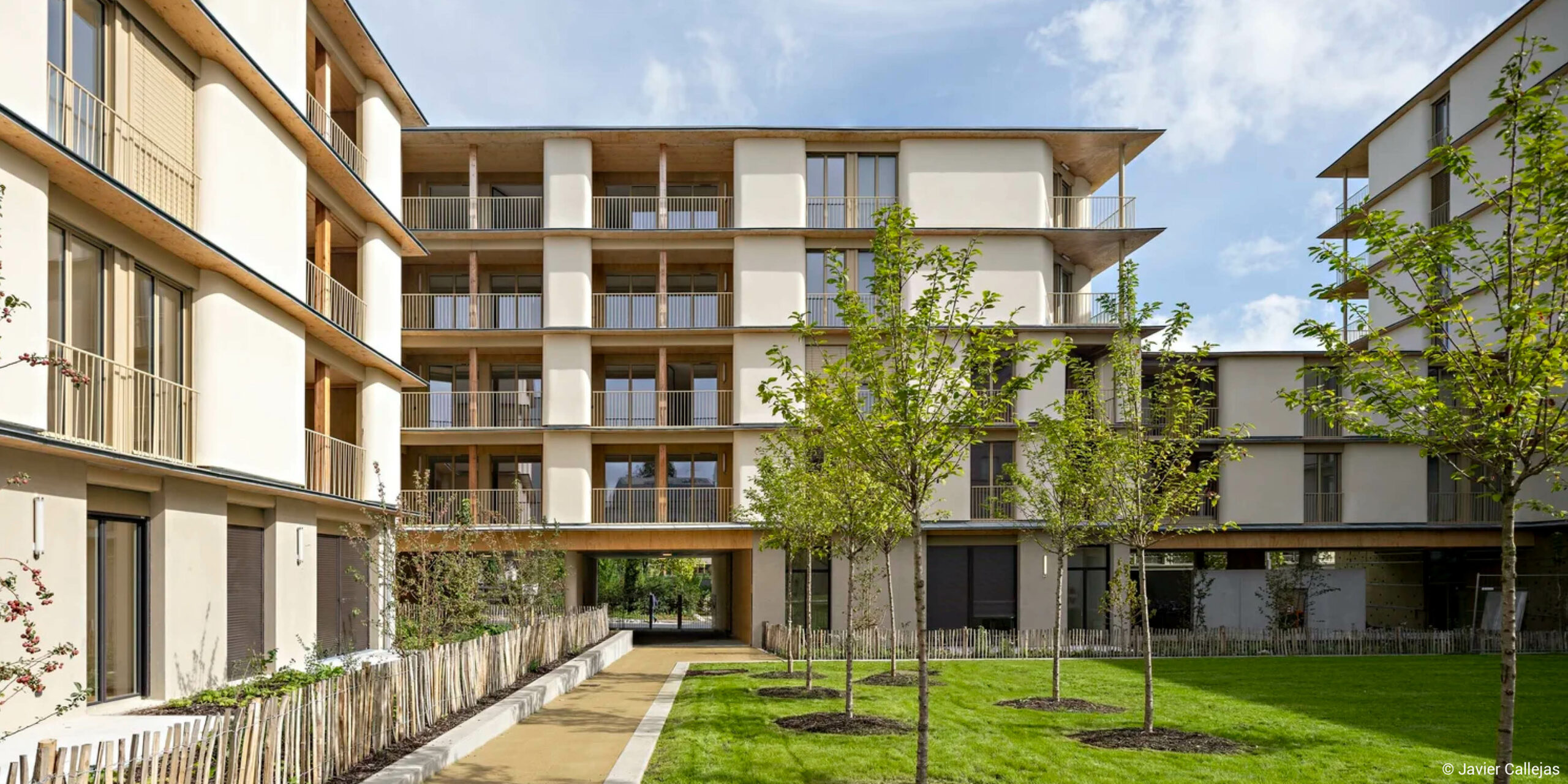
Zellige on the Île de Nantes put the participatory idea inside a large block. Tectône and Tact Architectes designed its 100 homes for CDC Habitat and the cooperative MFLA, finished in 2020. Sixty were sold as affordable ownership and forty let as social homes. Fifteen of the owners, the Les Ruches group, planned their flats together, and all residents share a large roof terrace. The island around it is still changing. Its south-west sector is planned with 33% social homes and a further fifth affordable, beside the new university hospital.
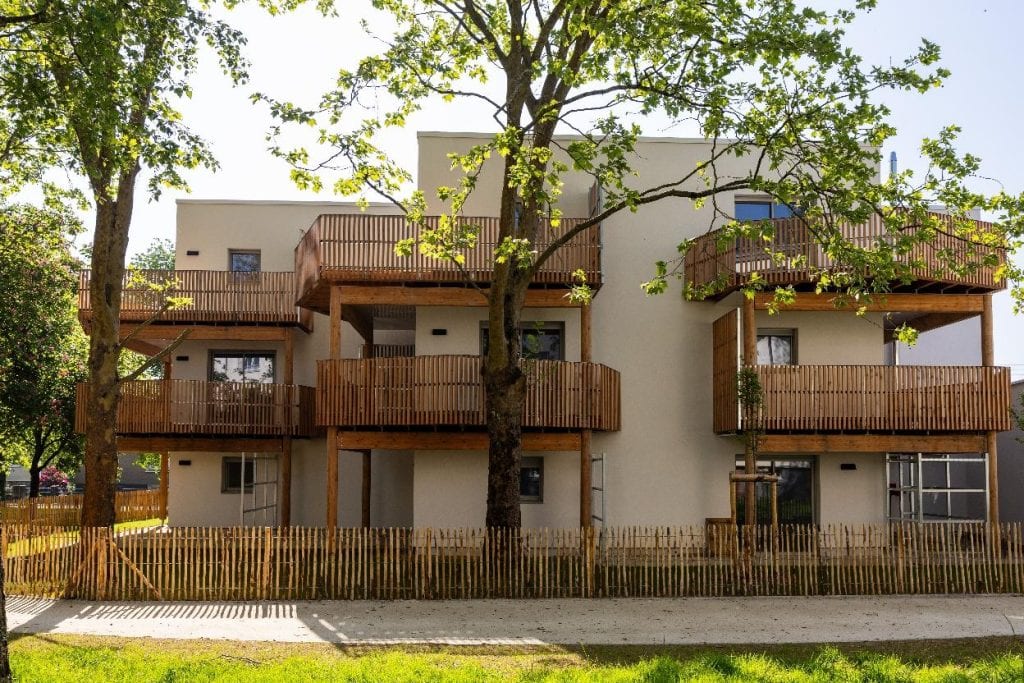
Hameau Marvingt is ICEO's answer to how participatory housing can serve every income. Its 33 homes, delivered in 2024 with Nantes Métropole Habitat and designed by Claas Architectes, mix eleven open-market homes, thirteen affordable-ownership homes and nine social rentals. It stands in the Bottière-Chénaie eco-district, built on former market gardens with the same 35/35/30 split as Mellinet. ICEO is repeating the formula in Nantes Nord. Fratera will bring 40 homes to a working-class district, up to twenty of them co-designed, with BRS homes at €2,480 per m², well below the open-market price.
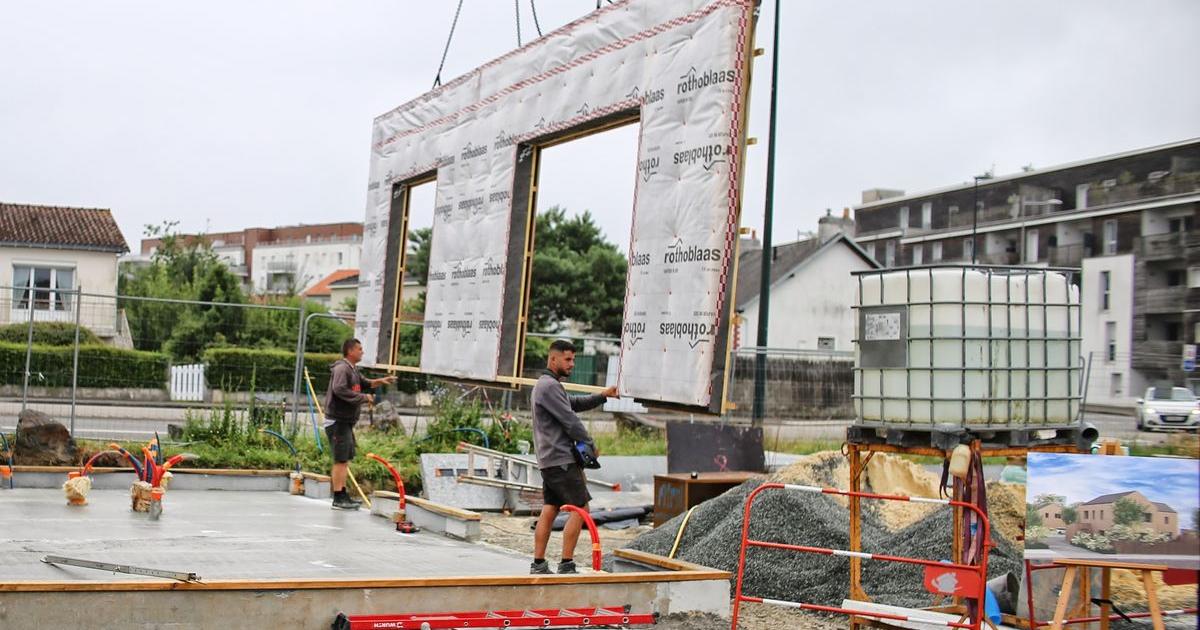
Pirmil-Les Isles tests how the next district can be built. The development zone on the south bank plans 3,300 homes in timber, hemp, straw and earth, with plaster applied straight onto straw bales. Its first homes at Basse-Île started at the end of 2025. It carries the climate plan into construction itself.
Grand Bellevue makes the case for renovating rather than rebuilding. The post-war estate on the border with Saint-Herblain houses about 17,000 people. A €350 million programme, running to 2032, is renovating 1,300 social homes by 2028, and most are already done.
Across the river stands the building where the story began. The Maison Radieuse turned 70 in 2025 and still houses about 700 people. A cooperative commissioned it to let families own their homes without speculation. The barracks, the straw walls and the co-designed blocks show that the city of Jules Verne still wants the same thing. The open question is whether that ambition can grow beyond a few hundred homes a year.
References
Statistics12Click on any number to see the source
Housing market
Adaptive reuse & vacancy
Population & migration
From our library14
- Nantes Métropole : la croissance démographique ralentit mais reste élevée (Insee Analyses Pays de la Loire) — Knowledge
- Plus de 7 400 logements débloqués grâce au plan de relance pour le logement — Knowledge
- Logement : Nantes Métropole ouvre le bail réel solidaire aux classes moyennes — Knowledge
- Urban Community Land Trust in Europe — Knowledge
- Organisme de foncier solidaire en Loire-Atlantique — dossier de presse (juin 2019) — Knowledge
- ICEO — Organisation
- L'habitat participatif à Nantes Métropole — Knowledge
- Towards Collaborative Living — Knowledge
- Municipales 2026 : Foulques Chombart de Lauwe présente son programme pour faire rayonner Nantes de nouveau — Knowledge
- Nantes se porte candidate pour expérimenter l'encadrement des loyers — Knowledge
- Encadrement des loyers : Bordeaux va-t-elle prolonger l'expérience ? — Knowledge
- Why and how cities can promote affordable and sustainable Collaborative Housing — Knowledge
- Reconversion Caserne Mellinet — Project
- Zellige — Project
Further sources41
- Nantes — Wikipedia
- Plus de 7 400 logements débloqués grâce au plan de relance pour le logement — Nantes Métropole · 2026-06-25
- Compétence habitat et logement — Nantes Métropole · 2026
- Budget étudiant : se loger à Nantes — LocService · 2025-06-16
- Figures Bureaux Nantes T4 2025 — CBRE · 2026-02
- Airbnb revenue in Nantes — AirBtics · 2025-12
- Nantes Métropole : croissance démographique (Insee Analyses Pays de la Loire) — INSEE · 2025-12
- Étude sur la tension dans le parc locatif social en 2024 — DREAL Pays de la Loire · 2026
- Quelle est la situation de la grande précarité à Nantes en 2025 ? — Ville de Nantes · 2025-01-08
- Nantes Métropole ouvre le bail réel solidaire aux classes moyennes — Nantes Métropole · 2025-10-07
- Unité d'habitation, Rezé — Fondation Le Corbusier
- Ici Corbu — 70 ans — Fondation Le Corbusier · 2025-06
- Au cœur du logement social — Crédit Mutuel
- Arrêté d'agrément OFS — CIF Coopérative — DREAL Pays de la Loire · 2025
- Organisme de foncier solidaire — dossier de presse — Habitat 44 / Nantes Métropole · 2019-06-12
- Acheter un logement abordable — Nantes Métropole · 2026-04
- Les résultats du second tour des élections municipales 2026 à Nantes — Ville de Nantes · 2026-03-22
- Découvrez votre nouvelle équipe métropolitaine — Nantes Métropole · 2026-04-03
- Les programmes détaillés des cinq candidats à Nantes — iFRAP · 2026-03-05
- Municipales 2026 : Foulques Chombart de Lauwe présente son programme — ICI Pays de la Loire · 2026-02-14
- L'électrochoc Lecornu-Jeanbrun pour sortir 2 millions de logements d'ici 2030 — Banque des Territoires · 2026-01
- L'essentiel du conseil municipal du 28 mars 2025 — Ville de Nantes · 2025-03
- La Ville de Nantes dépose une candidature pour l'encadrement des loyers — Infos-Nantes · 2025
- Nantes se porte candidate pour expérimenter l'encadrement des loyers — Ville de Nantes · 2025-04-16
- Changement d'usage d'un logement — Nantes Métropole · 2025-04-16
- Hôtel-Dieu : vers un quartier laboratoire — Nantes Métropole
- Un plan climat plus ambitieux face au changement climatique — Nantes Métropole · 2024
- Artificialisation des sols — Ministère de la Transition écologique · 2026
- Réglementation environnementale RE2020 — Ministère de la Transition écologique · 2026
- Mon Projet Rénov — Nantes Métropole · 2026-09
- La Maison Radieuse de Rezé fête ses 70 ans — Fondation Le Corbusier · 2025
- Nantes – European Green Capital 2013 — European Commission · 2013
- TOUR
- Journal de projet Mellinet n°7 — Nantes Métropole Aménagement · 2019-09
- Quoi de neuf dans l'ancienne caserne Mellinet — Nantes Métropole · 2026-06-08
- Zellige — dossier de fin de chantier — Samoa / Tectône · 2020-07
- De nouveaux urbanistes pour l'île de Nantes — Nantes Métropole · 2024-12-18
- Habitat participatif à Nantes Nord — Nantes Métropole · 2024-02-01
- Pirmil-Les Isles : Basse-Île — Nantes Métropole · 2023-11-30
- Faire du Grand Bellevue un quartier populaire, durable et actif — Nantes Métropole
- À Rezé, le Corbu souffle ses 70 bougies — Nantes Métropole · 2025-06-23