Overview of the Insee Demographic Report
The Insee analysis titled “Nantes Métropole : la croissance démographique ralentit mais reste élevée” examines population trends in the Pays de la Loire region, with a special focus on Nantes Métropole. The study is authored by Martine Barré and Perrine Bauer, researchers employed by France’s national statistics institute, Insee, which publishes authoritative demographic data. The report, released in December 2025, presents detailed figures on regional growth, inter‑communal dynamics and departmental contributions, all relevant for understanding housing demand and sustainability challenges across the area.
Regional Population and Growth Rate
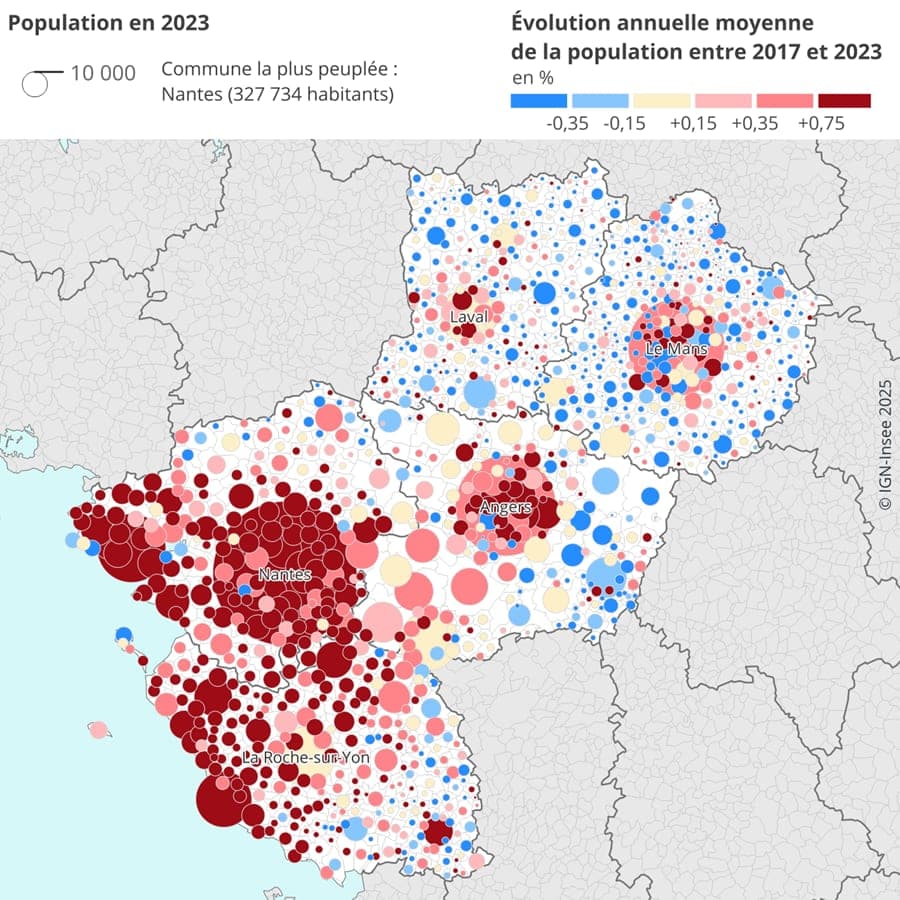
At 1 January 2023 the Pays de la Loire housed 3 907 000 residents, representing the eighth‑largest French region. Between 2017 and 2023 the region’s average annual growth was +0.7 %, outpacing the national average by 0.3 percentage points. This growth is driven mainly by net migration rather than natural increase, indicating a strong attraction of the region for newcomers, a factor that directly influences housing needs and urban planning.
Nantes Métropole’s Contribution to Growth
Nantes Métropole alone added roughly 7 160 inhabitants each year during the 2017‑2023 period, of which 3 070 settled in the city of Nantes itself. This accounts for about 29 % of the total regional population gain, confirming the metropolis as the primary engine of demographic expansion. Although the annual growth rate for Nantes Métropole (+1.1 %) has slowed compared to the earlier 2012‑2017 period (+1.4 %), it remains well above the regional average, signalling continued pressure on housing supply in the metropolitan area.
Coastal and Other Metropolitan Dynamics
The coastal inter‑communalities, especially CA Pornic Agglo Pays de Retz (+2.1 % per year) and CA Sables d’Olonne (+2.0 %), exhibit the strongest growth, highlighting the appeal of seaside locations for both residents and investors. Angers Loire Métropole, contributing 11 % of the regional gain, maintains a robust +0.9 % annual increase. In contrast, the Sarthe department shows stability, while Mayenne records a slight decline (‑0.1 % per year), underscoring divergent housing pressures across the region.
Departmental Highlights and Housing Implications
Loire‑Atlantique, home to Nantes, concentrated 62 % of the regional population gain, adding 92 660 inhabitants between 2017 and 2023 (≈15 440 per year). This translates into heightened demand for sustainable housing, energy‑efficient retrofits and new construction to accommodate growth while meeting climate targets. The Vendée department grew by 0.9 % annually, adding 6 390 residents each year, whereas Maine‑et‑Loire experienced a modest 0.4 % rise, reflecting varied intensity of housing market activity.
Key Numerical Take‑aways for Sustainable Housing Stakeholders
- Regional population (2023): 3 907 000
- Annual regional growth (2017‑2023): +0.7 %
- Nantes Métropole annual increase: +7 160 people (≈1.1 % growth)
- Loire‑Atlantique’s share of regional gain: 62 %
- Top‑growing inter‑communalities: CA Pornic Agglo Pays de Retz (+2.1 %), CA Sables d’Olonne (+2.0 %)
- Departments with notable growth: Vendée (+0.9 %), Loire‑Atlantique (+1.1 %) These figures illustrate where housing demand is intensifying and where policy interventions for energy‑efficient construction and urban densification could be most impactful. The report provides a factual foundation for pan‑European stakeholders assessing sustainable housing strategies in a region where demographic trends continue to shape the built environment.