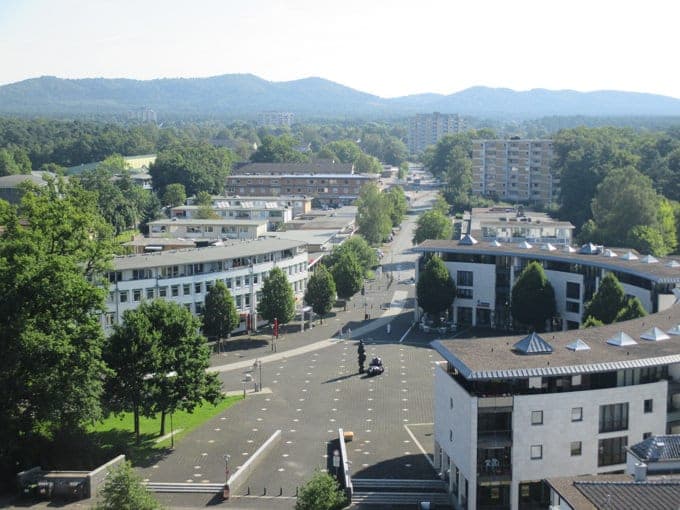
Sennestadt is a planned district about 10 km south of central Bielefeld, Germany. Developed from 1956 on the territory of the former municipality of Senne II, it was intended to ease post-war housing shortages and accommodate thousands of refugees and displaced people from Germany’s former eastern territories.1 It was an independent city from 1965 until its incorporation into Bielefeld in 1973; it has since been one of the city’s districts.1
The architect and urban planner Hans Bernhard Reichow designed the settlements and commercial areas according to his concept of “organic urban design.” Its enduring features include a green corridor running through the district, a curved street and path network, homes oriented toward the sun, and a mix of detached, semi-detached, apartment and high-rise buildings.1 The district also incorporates the older village of Dalbke and the settlements of Eckardtsheim and Heideblümchen.1
The project’s developer was Sennestadt GmbH. Founded in 1956 by the Regional Association of Westphalia-Lippe, the District of Bielefeld and the Municipality of Senne II, the non-profit municipal company was established to advance the planned new town and has carried out Sennestadt’s urban development and infrastructure work since then.2 The company’s development remit included a combination of housing and commercial uses, following Reichow’s planning principles.2