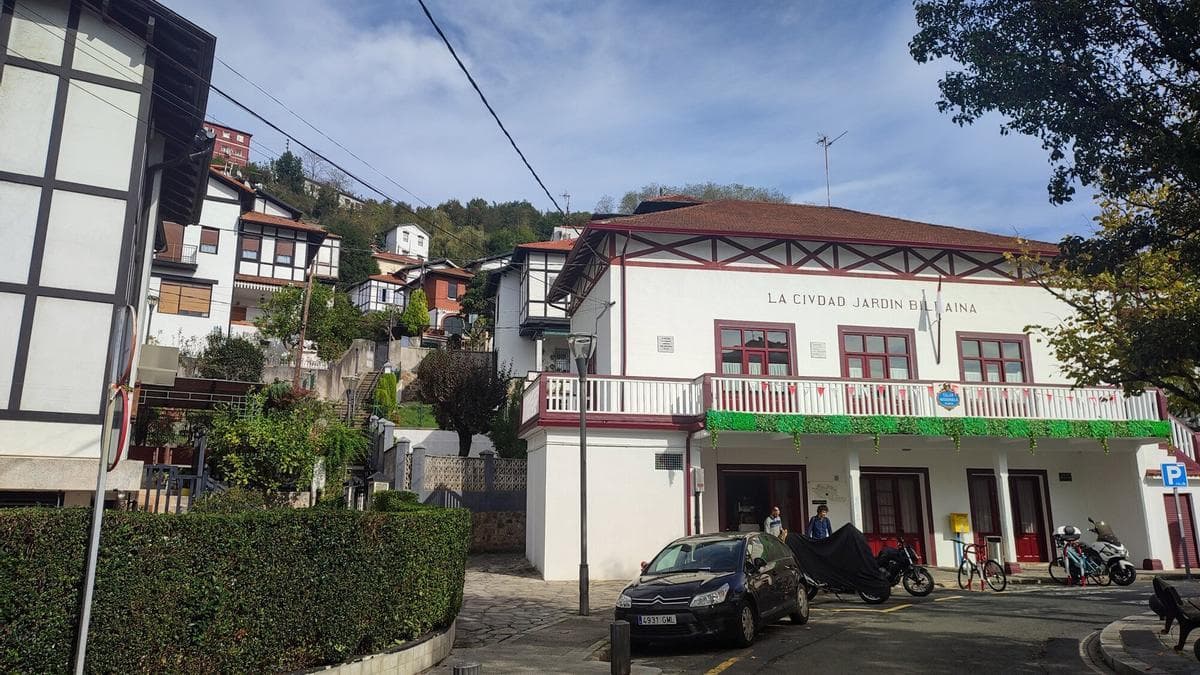
La Ciudad Jardín Bilbaína is a residential development in Bilbao, Spain, between Maurice Ravel Avenue and Mount Artxanda, in the Matiko-Ciudad Jardín neighbourhood. It forms part of the city’s Uríbarri district. The scheme placed low-rise homes among green spaces, following the garden-city approach used in European urban development. 1
The initiative emerged in 1921, when organisers proposed a cooperative to build homes on Bilbao’s outskirts. On 20 August 1922, the Sociedad Cooperativa de Empleados y Periodistas La Ciudad Jardín Bilbaína was formally established. Celso Negueruela Montes was its president and Benjamín Jubindo Pérez its secretary; both were employees of Bilbao City Council. 1 The cooperative was the project’s developer. 4
Architect Pedro Ispizua Susunaga won the municipal design competition in 1922, and the scheme was revised in 1924. The completed development comprised 56 two-family buildings, providing 112 dwellings, as well as a social centre and a network of paths. The houses had two floors, in addition to a basement and roof space, and were built in three sizes. Their predominant style was Basque regionalist, with influences from other architectural languages. 15
The project was conceived as affordable housing for workers, amid changes to Spain’s “cheap housing” legislation that made state assistance more accessible to middle-class applicants. The cooperative’s original social purpose and its built form—low-rise homes arranged with green areas—are central to the development’s history. 14