Overview of the Research Paper
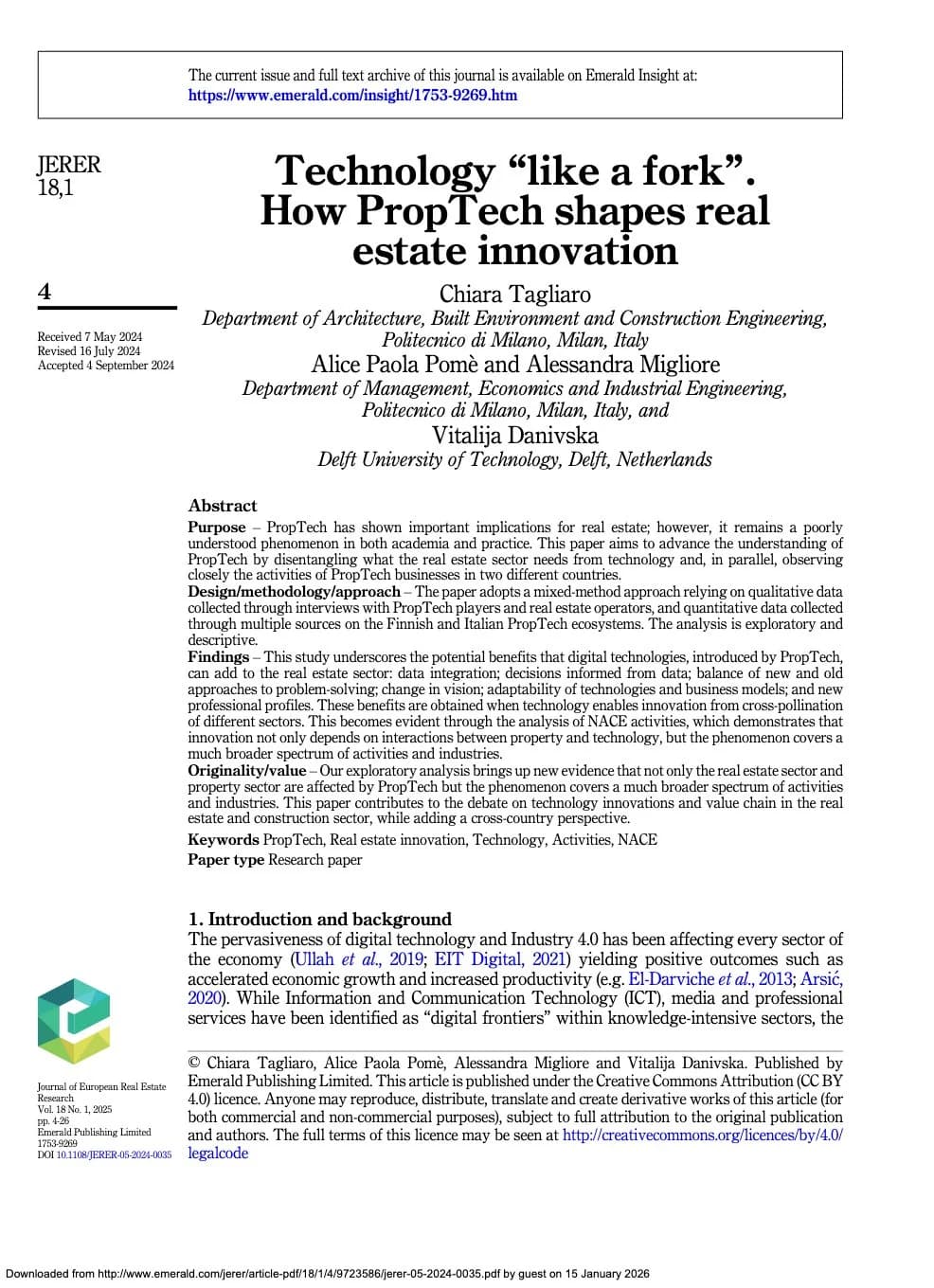
The paper “Technology ‘like a fork’. How PropTech shapes real estate innovation” is a peer‑reviewed research article published by Emerald Publishing Limited. It is authored by Chiara Tagliaro (Politecnico di Milano), Alice Paola Pomè (Politecnico di Milano), Alessandra Migliore (Politecnico di Milano) and Vitalija Danivska (Delft University of Technology). The study investigates how property‑technology (PropTech) influences the European real estate sector, with a particular focus on data integration, sustainability and cross‑border innovation.
Research Objectives and Methodology
The authors adopt a mixed‑method approach, combining qualitative interviews with PropTech practitioners and quantitative analysis of PropTech firms in Italy and Finland. Interviews (13 professionals) were conducted during a PropTech Day event in Milan, covering needs that pre‑date COVID‑19. Quantitative data were drawn from national PropTech listings, the Unissu platform and Orbis, covering 120 Finnish and 114 Italian companies active in 2020. The analysis examines company size, founding year, NACE activity codes and specific business activities.
Key Quantitative Findings
- Company distribution: 59 % of Finnish and 50 % of Italian PropTech firms operate in “Information and communication”. “Professional, scientific and technical activities” account for 27 % (Finland) and 16 % (Italy). Real‑estate activities represent 2 % (Finland) and 19 % (Italy).
- Size and age: Over 80 % of firms are small‑medium enterprises. In Finland, 59 % are small and 30 % medium; in Italy, 68 % are small and 18 % medium. Only 7 % (Finland) and 10 % (Italy) were founded before 2000, while 80 % (Finland) and 78 % (Italy) were established from 2010 onward.
- Dominant activities: “Computer programming activities” (81 firms) and “Web portals” (23 firms) are the most common. Engineering consultancy, real‑estate agency services and specialised design also feature prominently.
- Sectoral diversity: Companies are spread across 11 of the 21 NACE sections, indicating that PropTech extends beyond traditional property and ICT sectors.
Emerging Needs Identified by Interviewees
Interviewees highlighted several pre‑pandemic needs: (1) integration of heterogeneous data sources (land registry, topography, marketing); (2) robust data management for informed decision‑making; (3) balancing new digital tools with established practices; (4) a shift in organisational vision toward cross‑sectoral technology transfer; (5) adaptable business models such as “Space‑as‑a‑Service”; and (6) new professional profiles combining technical, analytical and commercial skills.
Role of Technology in Addressing Those Needs
Participants described technology as a “fork” – a tool that assists but does not replace human expertise. Key functions include: improving data reliability, enabling predictive analytics, enhancing transparency, supporting stakeholder communication, reducing transaction time and costs, and contributing to ESG objectives. However, the study notes a mismatch: despite strong demand for data management, only three firms operate in “Data processing, hosting and related activities”.
Cross‑Country Comparison: Finland vs Italy
Finland exhibits a higher concentration of firms in ICT and professional services, reflecting its status as a digital leader. Italy shows greater sectoral diversification, with notable activity in real‑estate services, construction and administrative support. PropTech per‑capita is higher in Finland, while Italy lags, suggesting differing national innovation ecosystems.
Sustainability and ESG Implications
Only one company explicitly links its digital solution to sustainability reporting, indicating an early stage of ESG integration within PropTech. Nevertheless, interviewees repeatedly associated technology with reduced resource consumption, faster project delivery and improved environmental monitoring, hinting at future potential for greener housing outcomes.
Implications for Pan‑European Sustainable Housing
The research underscores that PropTech can facilitate data‑driven decision‑making, accelerate adoption of energy‑efficient practices and support innovative service models across Europe. The concentration of ICT‑oriented firms in Finland suggests a template for scaling digital infrastructure, while Italy’s broader activity spread points to opportunities for multidisciplinary collaborations. Aligning PropTech development with sustainability goals will likely require stronger policy guidance, standardised data frameworks and increased investment in ESG‑focused digital solutions.