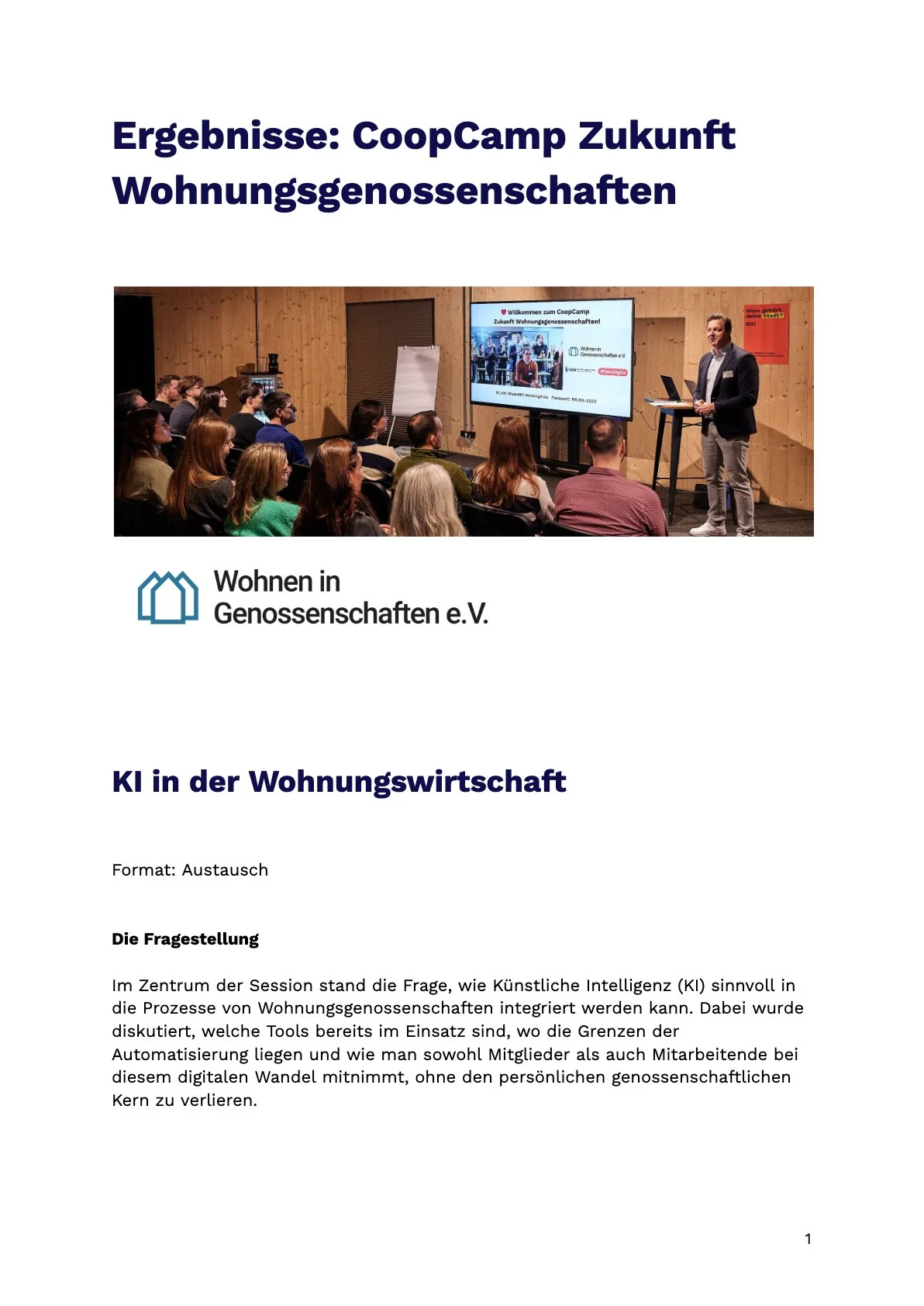
Overview of the Session Document
The document records the “GenoDigital CoopCamp mit Wogenos Jan 2026 – Session Documentation,” produced by GenoDigital. It captures a series of workshops and discussions focused on integrating artificial intelligence, financing, agile teamwork, member engagement, climate pathways, resilience, digitalisation, and serial renovation within German housing cooperatives. The material was extracted from a detailed PDF report and reflects the collective input of multiple participants, practitioners, and experts in cooperative housing.
AI Integration in Housing Cooperatives
A central theme was the practical use of AI tools such as Yuneo (chatbot/ticket system) and the telephone‑AI Ava for automating routine tenant requests like damage reporting. Participants highlighted challenges linking AI with existing ERP systems (e.g., Wodis Sigma) and noted the lack of real‑time legal updates in many AI solutions. Human acceptance emerged as a critical factor: while some staff already employ AI for simple correspondence, others remain resistant, fearing loss of personal interaction and member trust.
Financing Sustainable Housing Projects
The sessions examined how cooperatives can fund massive investments required for climate‑neutrality by 2045 without compromising affordable rent. Key financing instruments discussed included member‑direct bonds (average ten‑year terms), modest rent adjustments kept below legal maxima, and strategic dividend reductions. A proposed financing mix—one‑third public subsidies, one‑third external debt, one‑third equity—mirrored the “Freie Scholle” model from Bielefeld. Participants stressed transparent communication of cost‑benefit analyses to maintain member support.
Agile, Cross‑Departmental Teams
Workshops on agile methods showed benefits such as faster decision‑making, higher employee motivation, and better stakeholder inclusion. However, initial cycles can be longer and meet scepticism, especially among long‑tenured staff. Successful agile adoption required clear templates, defined roles, and a dedicated project‑management office to ensure visibility across initiatives. “Bridge‑builders” who connect technical and communicative domains were identified as essential for sustaining cross‑functional collaboration.
Enhancing Member Participation
A recurring issue was low member turnout in cooperative activities (e.g., only 7 participants out of 1,000 invited). The discussion highlighted the need for low‑threshold formats—like community cooking events—and targeted outreach for different age groups. Proposed measures included onboarding information packets at move‑in, a “values compass” integrated into statutes, and youth committees to involve younger members. Reward systems should shift from point‑based incentives to recognition of collective stewardship.
Developing Concrete Climate Pathways
Participants reviewed tools for climate planning, noting that while the IW2050 model offers detailed data, its complexity hampers practical use, whereas the VdW‑CO₂ tool is more user‑friendly but lacks interoperability. A key gap identified was the translation of emissions data into actionable, time‑phased renovation schedules. Recommendations called for simplified, error‑resilient software that links ecological targets with financial planning, enabling cooperatives to chart realistic pathways toward the 2045 climate goal.
Building Resilience Against Crises
The sessions addressed physical, organisational, and social resilience. Physical measures included “sponge city” concepts such as rainwater cisterns, shading devices, and reinforced basements. Organisational preparedness focused on backup power, digital registries of vulnerable residents, and partnerships with emergency services. Social resilience emphasized neighbour‑to‑neighbour help networks and educational campaigns on fraud prevention and heat‑wave safety. Standardised checklists and training programmes were identified as urgent needs.
Leveraging Digital Tools for Cooperation
Despite many existing digital solutions, participants noted a lack of awareness across cooperatives. A proposed “Coop Marketplace” would catalogue tools and services, facilitating cross‑cooperative collaborations—e.g., leasing roof space to energy cooperatives. Addressing generational digital divides required hybrid solutions that keep analog options for older members while promoting intuitive interfaces for younger users.
Serial vs. Conventional Renovation
The final workshop compared serial (factory‑produced) renovation with traditional on‑site methods. While serial approaches achieved high energy performance and aesthetic quality, they faced higher upfront costs, longer project durations (9‑12 months vs. the promised 6 months), and complex contractual negotiations. Without substantial public subsidies (up to 55 %), serial renovation remained more expensive. Participants concluded that success hinges on meticulous pre‑measurement, standardized contracts, and coordinated procurement to reduce administrative burden.
Transparency and Governance
Throughout the documentation, the importance of transparent communication was stressed. Effective channels include quarterly newsletters for representatives, digital voting tools, and clear visualisations of financial impacts. Enhancing members’ understanding of cooperative structures and decision‑making processes is essential for building trust and fostering active participation in future housing initiatives.