Resource context (publisher and author)
Deutsche Welle (DW), Germany’s international public broadcaster, published the article “Berlin building boom on the horizon?” by Helen Whittle. The piece examines Berlin’s housing shortage and the renewed political push to build housing on parts of Tempelhofer Feld, a former airfield that has been a public recreational space since 2010.
Berlin’s housing pressure and rent increases
The article describes a national and city-level affordability problem, citing a shortage of more than 800,000 apartments in Germany (Federal Statistical Office). In Berlin, the median monthly asking rent is reported to have risen by 85.2%, from €8.50 per square meter in 2015 to €15.74 in 2024, adding urgency to policy debates about accelerating construction.
Policy response and construction targets
Germany’s incoming CDU/CSU–SPD coalition is presented as pursuing a “Wohnungsbau-Turbo” (housing construction turbo) with measures such as reducing bureaucracy, cutting taxes, and offering funding programs for construction and modernization. At the city level, Berlin’s Senate Department for Urban Development, Building and Housing estimates that more than 100,000 new apartments are needed to cool the market. With an expected additional 200,000 residents by 2040, Berlin is described as needing to build around 20,000 apartments per year on average.
Delivery gap and market constraints
Despite political emphasis on building more homes, the article notes a downturn in activity: 15,965 apartments were completed in Berlin in 2023, which is attributed to weak economic conditions and higher interest rates. The piece also references previous policy attempts—such as rent controls, stricter tenancy rules, and actions against speculative vacancy or short-term furnished rentals—as having failed to resolve the shortage, according to Christian Müller of the Association of Architects and Engineers of Berlin-Brandenburg (AIV).
Tempelhofer Feld: scale, proposed development, and referendum history
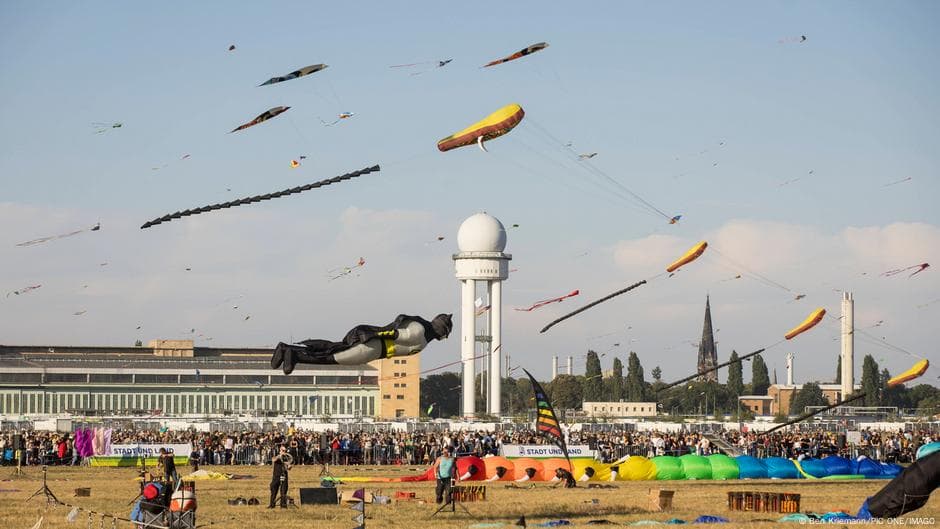
Tempelhofer Feld is portrayed as one of the world’s largest urban green spaces, covering more than 300 hectares. The Berlin government is described as considering construction of many five- to ten-story buildings and some high-rises, reducing the central inner meadow from 305 hectares to 180 hectares, with about half of the built-up area planned as commercial space. The issue is politically sensitive because a 2014 referendum rejected development plans; about two-thirds of voters (64.3%) supported protection, leading to a preservation act that prohibits new building or expansion on the site.
Political conflict, consultation process, and trust issues
The debate is framed as intensifying amid statements that elected officials may need to override local opposition to address shortages, alongside criticism from opposition parties (Greens and Left) that the approach serves investor interests more than affordability. The article reports that the CDU-SPD coalition, elected in 2023 with housing cited by 39% of voters as the top issue, has launched public consultations and an international urban-planning competition. Current proposals are described as focusing on the periphery, with Berlin’s mayor suggesting capacity for 15,000–20,000 apartments on the edges, while critics cite alternative sites identified in the City Development Plan 2040 for up to 222,000 homes.
Ecological and community functions highlighted in the article
The Feld is also presented as a nature reserve and community hub hosting projects such as experimental sustainable architecture, artist-run spaces, gardens, and repair workshops. The article mentions it as a nesting site for endangered bird species (including skylarks) and notes the relocation of Skudden sheep to support biodiversity. It also references a 2021 study by Berlin’s Environment Department emphasizing ecological roles such as supporting biodiversity, improving air quality, and cooling densely populated surrounding neighborhoods, shaping the stakes of development for climate resilience and sustainable urban planning.