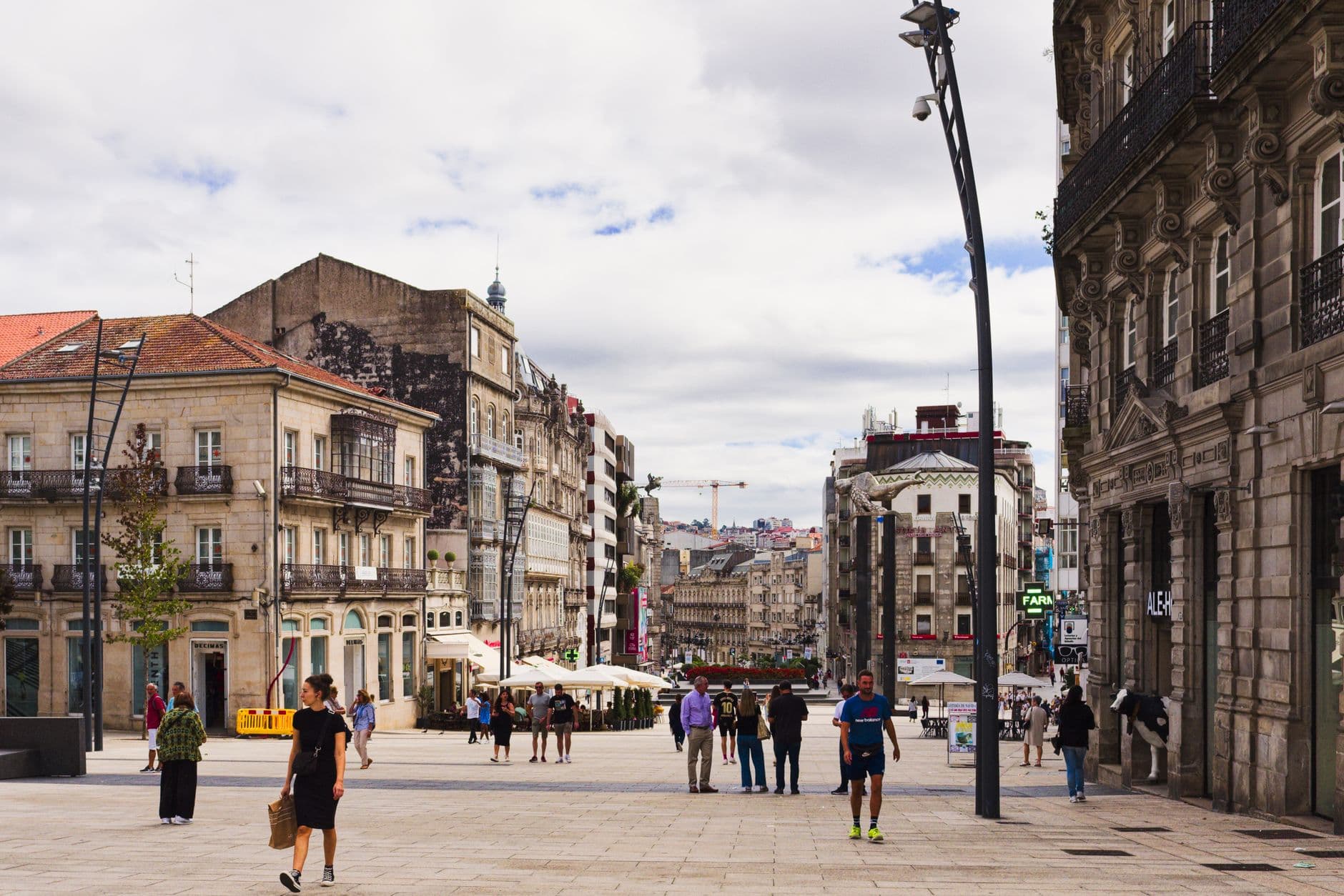
A working city priced out of its own homes
Vigo is the economic engine of Galicia: a city of 294,489 people, Europe’s leading fishing port, and a Citroën factory that has stamped out cars here since 1958. Yet by the end of 2025 the local press was calling it an "impossible" place to rent. A furnished one-bedroom flat now starts near €600 a month, and a furnished family flat around €990 a month — in a city where the price-to-income ratio has climbed to 6.32, meaning a typical home costs more than six years of a typical salary.
Demand keeps building. The city carries around 12,000 mid-term residents — Erasmus students at the Universidade de Vigo, shift-workers, maritime and fishing crews — who compete for the same flats as permanent families. And the squeeze is happening on top of a paradox: the municipality counts roughly 22,000 empty residential buildings, a figure the regional Observatorio da Vivenda flagged as evidence that the problem is not a shortage of structures but a shortage of homes people can actually live in.
The political backdrop sharpens the squeeze. Spain’s 2023 housing law lets regions designate "stressed" areas where rents can be capped, but the Xunta de Galicia has declined to do so, arguing caps shrink supply. That leaves Vigo without the rent-control tool now used in Barcelona, and leaves the pressure to be answered by building, converting, and reusing instead — exactly the terrain on which a cooperative model would be tested.
Cheap to buy, dear to rent, squeezed by holiday flats
By big-city standards Vigo still looks affordable to buy. Flats trade at about 2,128 €/m² and houses nearer 1,376 €/m², a fraction of Madrid or San Sebastián. The strain is in the rental market, where a one-bedroom in the centre runs around €773 a month against roughly €575 a month on the outskirts — a centre premium that prices the mobile workers the port and the Stellantis plant depend on out of the neighbourhoods nearest their jobs.
Short-term holiday rentals add to the pinch, concentrating whole flats around the old town and the Port of Vigo waterfront and the ferry routes out to the Cíes Islands and the wider Atlantic Islands National Park. Each whole-home holiday listing is a flat removed from the residential pool, a familiar Atlantic-coast tension in a compact, hilly city that cannot easily sprawl.
Vacancy is the paradox at the centre of the market. Residential vacancy sits around 15.1%, and the census counts some 18,588 empty dwellings across the municipality — homes that exist but do not house anyone.
- 1-bed, outskirts
- Furnished 1-bed
- 1-bed, centre
- Furnished family flat
From a one-bedroom on the outskirts to a furnished family flat in town.
A cooperative sector almost too small to measure
If Vigo has a structural weakness, it is the near-absence of non-market housing. Owner-occupation dominates at 71.86% of households, with private renting making up about 19.4%. Everything else — cooperative, public, and social housing combined — is a thin sliver, and the cooperative share specifically is small enough that the census struggles to measure it at all.
That is a Galician and Spanish pattern as much as a Vigo one: the Censo de población y viviendas shows the same thin social sector across the region. Public provision here runs through the Instituto Galego da Vivenda e Solo, the Xunta’s housing agency, alongside the Concello de Vigo’s own promotions — but the volumes are small relative to the private market.
The opportunity is equally clear. A city with this much owner-occupation, a serious vacancy problem, and an industrial workforce — the Stellantis plant alone anchors tens of thousands of livelihoods — is fertile ground for a cooperative model that competes with neither buyers nor speculators, but reuses what is already built.
- Owners
- Owner-occupier71.9%
- Renters
- Public & non-profit rental0.00%
- Cooperative0.00%
- Private rental19.4%
- Unclassified8.7%
- Unknown / Other8.7%
The empty city waiting to be reused
Vigo’s biggest housing resource may be the homes it already has and does not use. The municipality counts around 22,000 empty residential buildings and some 18,588 empty dwellings — a vacant stock large enough, in principle, to rehouse a substantial share of those priced out today.
There is slack in the commercial fabric too. Office vacancy runs near 11.8%, with roughly 0 m² of empty office space across a market of about 0 m². Office-to-housing conversion, well established elsewhere in Europe, is largely untested here but technically available — and with construction costs at 1,280 €/m², reusing existing structures often pencils out better than building new.
The regeneration tools exist locally. The Consorcio Zona Franca de Vigo assembles land and finance for mixed industrial-residential schemes, while the Concello de Vigo has been redeveloping the old town and the A Laxe waterfront for two decades. The missing ingredient is not capacity to build — it is a vehicle to turn vacant and converted floorspace into permanently affordable, non-speculative homes.
A region that said no to rent caps
Housing politics in Vigo runs along a clear fault line. Spain’s Ley 12/2023, por el derecho a la vivienda, gives autonomous communities the power to declare "zonas tensionadas" — stressed areas where rents on new and renewed contracts can be capped. The Xunta de Galicia, governed by the Partido Popular, has consistently declined to use it, framing rent caps as a brake on new supply and favouring subsidies instead.
Its alternative is help-to-rent and help-to-buy: rental vouchers and youth purchase aid channelled through the Instituto Galego da Vivenda e Solo. Critics — tenant unions and much of the Galician left — argue these measures subsidise demand in a supply-short market and do nothing to slow rents, which reached record levels in late 2025 according to the regional press.
At city level the long-serving mayor, Abel Caballero of the PSOE, has pushed municipal public-housing promotions and high-profile public works, but the Concello de Vigo cannot designate stressed areas on its own — that power sits with the Xunta. The result is a standoff: a city that wants more affordable housing inside a region that has ruled out the headline tool for delivering it.
Could Vigo become a cooperative lighthouse?
Step back from the numbers and a question forms. Here is a mid-sized Atlantic city with cheap-to-buy stock, 18,588 empty dwellings, an owner-occupation rate of 71.86%, a near-zero cooperative sector, and a young, mobile, industrial population that the rental market is steadily pushing out. Could Vigo become a lighthouse for a different, non-speculative, reuse-first way of housing a European city?
The ingredients for one are unusually legible. Adaptive reuse could turn empty buildings and vacant offices into homes rather than pouring new concrete. A cooperative could bring cultures and generations together under shared, pluralistic governance — Erasmus students from the Universidade de Vigo, returning Galician emigrants, Stellantis families, retired fishing crews — in courtyards designed for community life rather than for resale value. Cooperative temporary stays could give newcomers and visiting researchers a humane alternative to the holiday-let market that is hollowing out the centre.
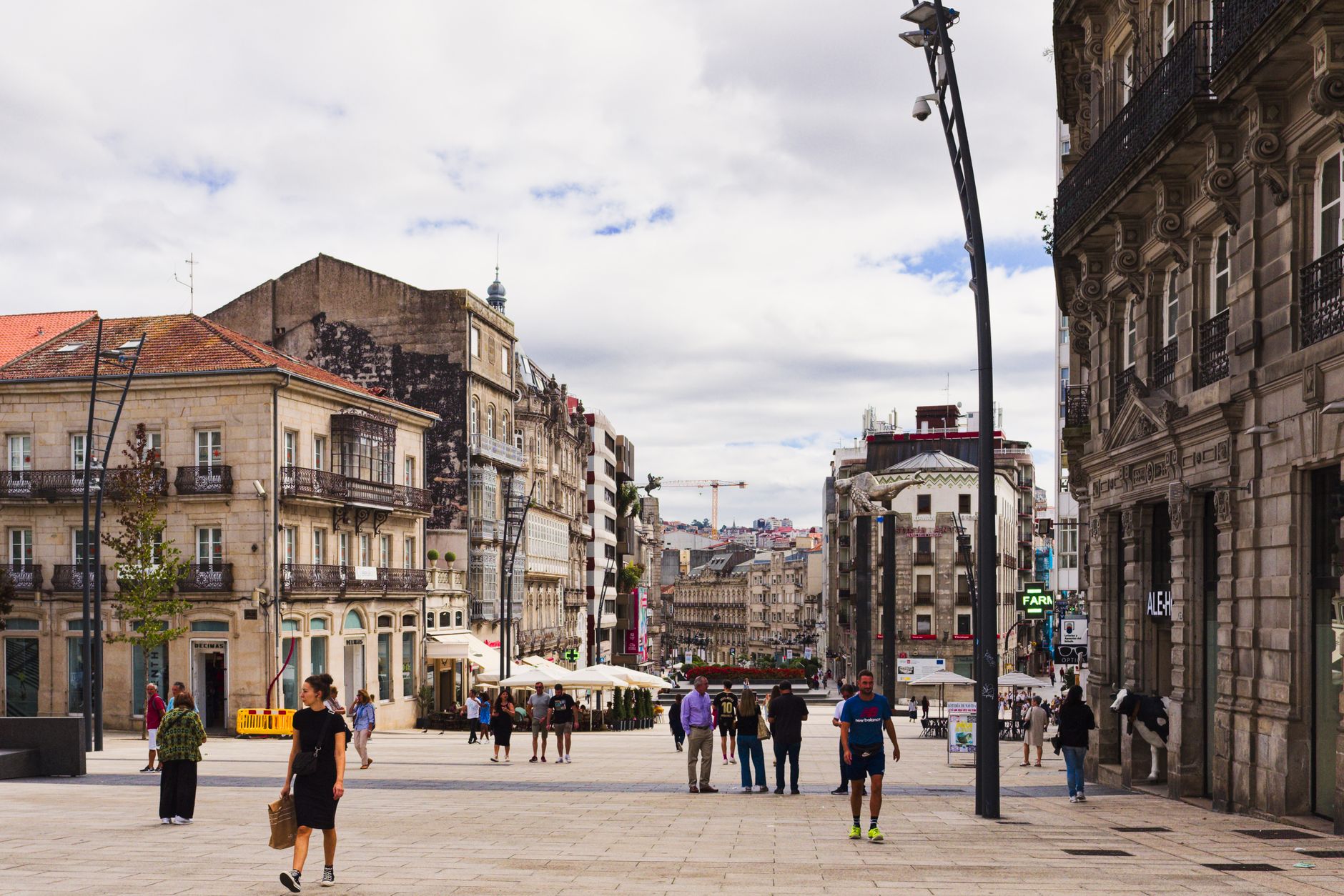
None of this asks Vigo to stop being itself — a working port, a car town, a vertical city of granite and ría. It asks whether the homes above the harbour could belong, a little more, to the people who keep it running, as part of a Europe without mental borders rallied by citizens, architects, and cooperatives. Explore the European Housing Coop vision.
References
Statistics14Click on any number to see the source
Housing market
Adaptive reuse & vacancy
Population & migration
Further sources11
- Vigo — Wikipedia
- Vigo — Wikipedia
- Port of Vigo — Wikipedia
- Cíes Islands — Wikipedia
- Atlantic Islands of Galicia National Park — Wikipedia
- PSA Vigo Plant — Wikipedia
- University of Vigo — Wikipedia
- Galicia (Spain) — Wikipedia
- Instituto Nacional de Estadística — INE
- Ley 12/2023, de 24 de mayo, por el derecho a la vivienda — Boletín Oficial del Estado
- Vigo acumula 22.000 viviendas vacías — Observatorio da Vivenda de Galicia