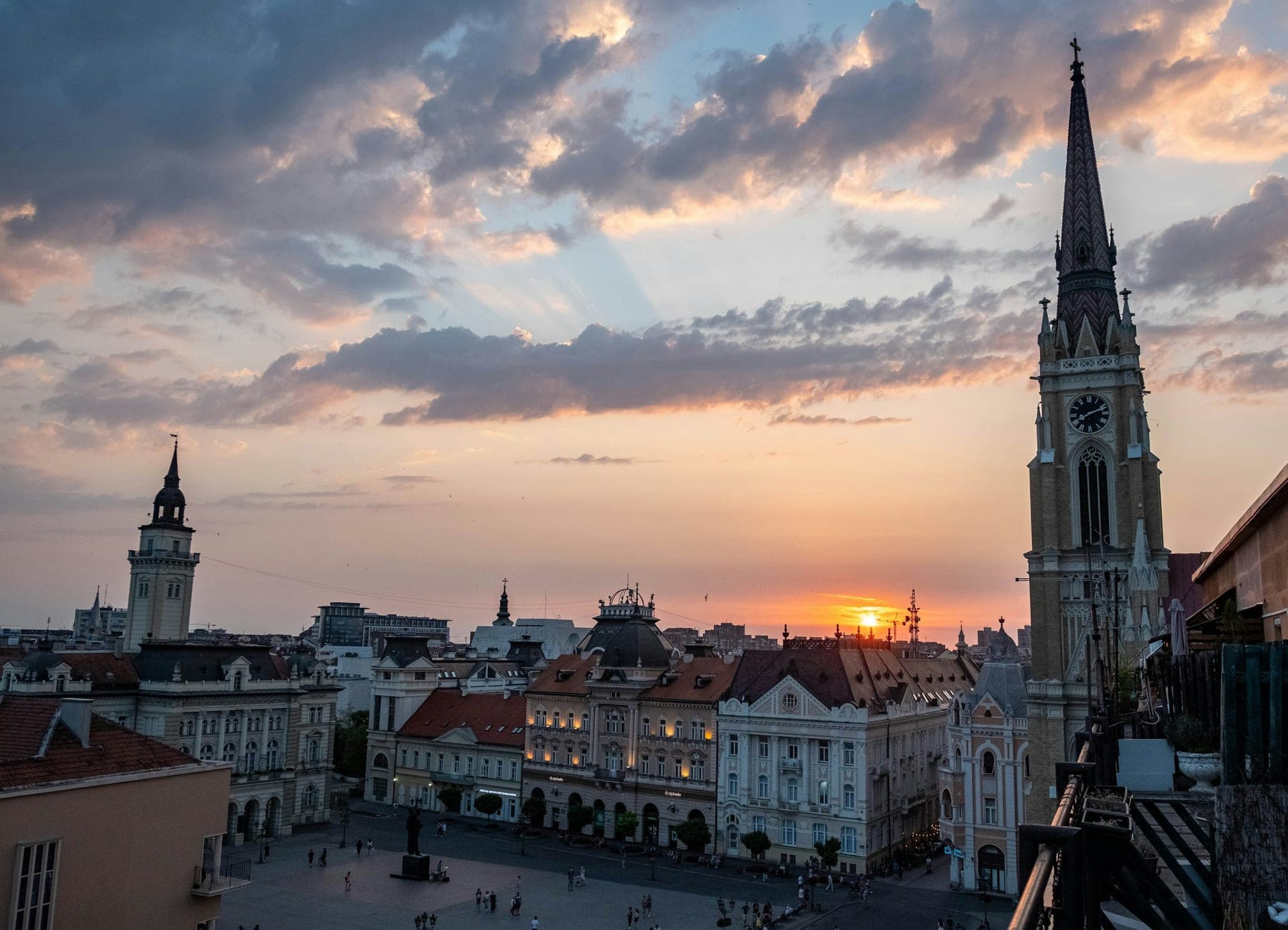
Today's pressure: a building boom under a cloud of grief
Novi Sad is two cities at once. One is a confident regional capital of roughly 369,000 people, Serbia's second economy, its construction cranes thickest over Grbavica and the Danube front, where new-build flats now change hands at around €2,256 per square metre. The other is a city in mourning and in revolt. On 1 November 2024 the freshly renovated concrete canopy of the main railway station collapsed onto the pavement, killing 16 people aged between six and seventy-four.
That disaster turned a property story into a political one. The station had been rebuilt between 2021 and 2024, and the question of who signed off on the work — and who profited — fused public anger about corruption with everyday anxieties about cost. Even as protests filled Trg Slobode, the market itself was cooling: asking rents across Serbia's big cities fell by 15% to 25% year-on-year through 2025 as supply finally outran demand. Yet for the under-thirties the relief is thin. Prices have outpaced wages for years, so even softer rents of €9.4 to €11.4 per square metre keep ownership a distant horizon. The dominant tension in Novi Sad right now is not scarcity of flats but trust: can a city that builds this fast also build safely, fairly, and for the people already living in it?
The market: cooling rents, climbing prices
Novi Sad is the country's second-most-expensive market after Belgrade, and the gap is closing fast in the new-build segment. Resale flats traded at about €2,250 per square metre in the third quarter of 2025, barely below new construction, which signals a market still in catch-up. Rents tell the opposite story. The cheaper outer estate of Novo Naselje averages around €9.4 per square metre, whilst central Podbara, Centar and Grbavica command nearer €11.4 per square metre.
- Novo Naselje (cheapest district)
- City-wide average (all stock)
- Grbavica
- Podbara / Centar (new lets)
District asking rents for ~50 m² flats. Cooperative and municipal-rent points are omitted: Serbia keeps no city-level cooperative- or public-rent register, so those segments cannot be plotted honestly.
The distinctive dynamic here is yield compression at the top of a long boom. Gross residential yields in Novi Sad sit at roughly 4.79%, well below Belgrade's 6.35%, which tells you buyers are paying for capital growth and prestige rather than rental return. Much of the recent stock has been built to sell, not to let, and a slice of it feeds the short-stay market around the fortress and the EXIT season rather than housing residents year-round. Commentators expect broad price stability into 2026 as construction slows and financing tightens — a pause, not a correction.
Cooperative, social and public housing: a thin sector with deep roots
Serbia is, on paper, a nation of owners. Mass privatisation of socially-owned flats in the 1990s left an owner-occupancy rate around 84%, among the highest in Europe, and hollowed out the rental, cooperative and public sectors that elsewhere absorb the young and the precarious. Yet the cooperative idea is not foreign to Novi Sad. Housing cooperatives — the stambene zadruge that built whole districts in the Yugoslav era — are woven into the city's twentieth-century fabric, even if today they survive mostly as a legal form rather than a living movement.
- Owner-occupied84.0%
- Cooperative1.0%
- Public / social2.0%
- Market rent13.0%
Public and social housing barely register: there is no large municipal landlord in Novi Sad on the scale of Vienna's or even Belgrade's, and social allocation runs through narrow national programmes rather than a standing stock. The City of Novi Sad and the Province of Vojvodina retain land and planning levers — through bodies such as JP Urbanizam, the city planning enterprise — that could underwrite cooperative land allocation, but they have rarely been used that way. The gap is the opportunity: a city with the legal memory of cooperatives, plenty of public land along the Danube front, and a generation priced out of ownership has the raw materials for a non-speculative middle sector that currently does not exist.
Adaptive reuse and regeneration: silk factories and a Chinese quarter reborn
If Novi Sad has a superpower, it is turning industrial ruins into civic life. The European Capital of Culture programme in 2022 built much of its identity on adaptive reuse, threading culture back into abandoned production halls. The flagship is the Svilara Cultural Station, a former silk-dyeing factory on Đorđa Rajkovića reborn as a neighbourhood arts venue — a textbook demonstration that heavy industrial shells can hold community uses without being demolished.
Around it sits a whole network of "cultural stations" created for 2022 in repurposed buildings across outlying districts and villages such as Rumenka and Bukovac, deliberately decentralising culture out of the centre. The most charged regeneration frontier, though, is the Chinese Quarter (Kineska četvrt), a derelict industrial zone east of the centre that artists and small makers colonised informally and that the city now wants to redevelop. It is the local test case for the hardest question in adaptive reuse: can a place be upgraded without expelling the very community that gave it life? The same question hangs over the Danube front, the long riverside strip slated for redevelopment in the run-up to the country's EXPO 2027 push, where the official plan promises that post-event accommodation will convert into affordable or student housing. The pipeline of empty halls is real; what is missing is a financing model that lets reuse serve residents rather than only investors.
The politics of who gets to stay
No European city's housing politics has been reshaped more abruptly by a single building than Novi Sad's. The station canopy collapse did not stay a transport scandal; it became the spark for the largest sustained protests in Serbia since the fall of Slobodan Milošević in 2000, led overwhelmingly by students demanding accountability and the release of the renovation paperwork. The built environment — who builds it, inspects it, and answers for it — moved to the centre of national debate.
- 2024-11-01[source]
Station canopy collapse kills 16
The renovated concrete canopy of Novi Sad's main railway station collapses onto the pavement, killing 16 people aged 6 to 74.
- 2024-12-30[source]
13 charged, including a former minister
Prosecutors indict 13 people over the disaster, among them former construction minister Goran Vesić and several transport officials.
- 2025-01-28[source]
Prime Minister Miloš Vučević resigns
Amid escalating protests and an assault on a student in Novi Sad, Prime Minister Miloš Vučević announces his resignation.
- 2025-10-30[source]
One year on, the city is changed but no verdict is final
A year after the collapse, no indictment has been confirmed by a final court decision, and the protest movement has reshaped civic life in Novi Sad.
- 2026-07-13[source]
Appeals court revives canopy-collapse case against ex-minister
Novi Sad's Court of Appeals confirmed the indictment against 6 people, including former construction minister Goran Vesić, overturning a ruling that ended proceedings, so the trial over the collapse that killed 16 can proceed.
The events that made construction integrity a national question.
For housing, the political lesson is double-edged. Sceptics in local media warn that the same opaque, fast-tracked procurement that endangered the station shapes the residential boom and the Danube-front and EXPO 2027 megaprojects too, and that accountability, not more cranes, is the precondition for trust. Supporters of the government counter that investment and EXPO will lift living standards. What almost no one in the city's debate yet champions is a third path between state megaproject and private speculation: resident-led, cooperative, reuse-first development that answers the protesters' core demand — a say in the places they live.
Lighthouse projects and beacons of hope
For all the grief of the past year, Novi Sad keeps proving it can make old buildings hold new life. The Svilara Cultural Station shows a silk factory becoming a commons. The cultural-station network in Rumenka, Bukovac and beyond shows regeneration that travels out to the edges instead of concentrating in the centre. The Chinese Quarter, if its makers are kept rather than cleared, could become a live demonstration of community-led reuse. And the EXPO 2027 plan's pledge to convert event accommodation into student and affordable homes shows, at least on paper, that the city can imagine housing as a legacy rather than a by-product.
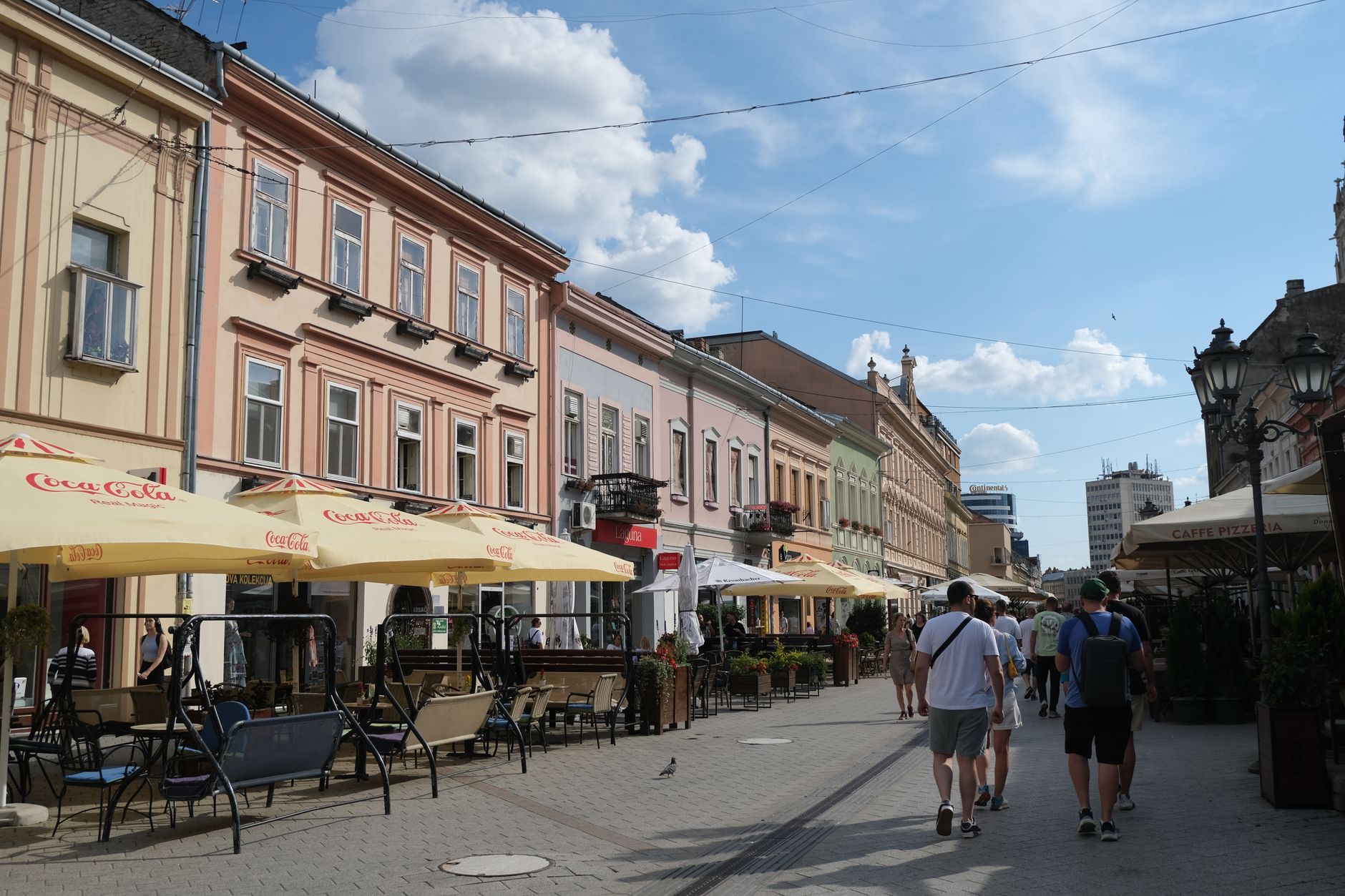
Hold these pieces together and a fifth, unbuilt lighthouse comes into view. Novi Sad has empty industrial shells crying out for adaptive reuse, public land along the Danube front, a multilingual Vojvodina habit of cultures and generations living side by side, and a student movement that has just shown how fiercely its people want a voice in their city. Those are exactly the materials a non-speculative, cooperative, reuse-first model needs: courtyards built for community life rather than yield, cooperative temporary stays for the researchers and EXIT-economy newcomers the city wants to keep, and a sense that Europe's housing answers can be shared across borders by citizens, architects and coops rather than dictated by markets or ministries. That is the open invitation behind the European Housing Coop vision. So, to return to where we began: a city of six official languages, a 16-kilometre fortress and Europe's largest summer festival has already shown it can turn ruins into shared life. The question it now gets to answer is whether it will do the same for the homes of the young people it most wants to keep.
References
Statistics4Click on any number to see the source
Housing market
Further sources10
- How much does renting an apartment cost in 2025? Updated prices in Belgrade, Novi Sad & Niš — City Expert Real Estate · 2025-11
- Serbia's Residential Property Market Analysis 2026 — Global Property Guide · 2026
- Novi Sad railway station canopy collapse — Wikipedia · 2025
- Serbia charges 13, including ex-minister, in train station roof collapse — Al Jazeera · 2024-12-30
- How the Novi Sad Station Disaster Changed a Serbian City — Balkan Insight · 2025-10-30
- Serbian protesters demand arrests after railway station canopy collapse killed 14 — Euronews · 2024-11-04
- Expo 2027 (Belgrade, Serbia) — Wikipedia · 2025
- Novi Sad: 7 things to do in this year's European Capital of Culture — Euronews Culture · 2022-10-04
- Petrovaradin Fortress — Wikipedia · 2025
- Exit (festival) — Wikipedia · 2025