A valley of renters on borrowed time
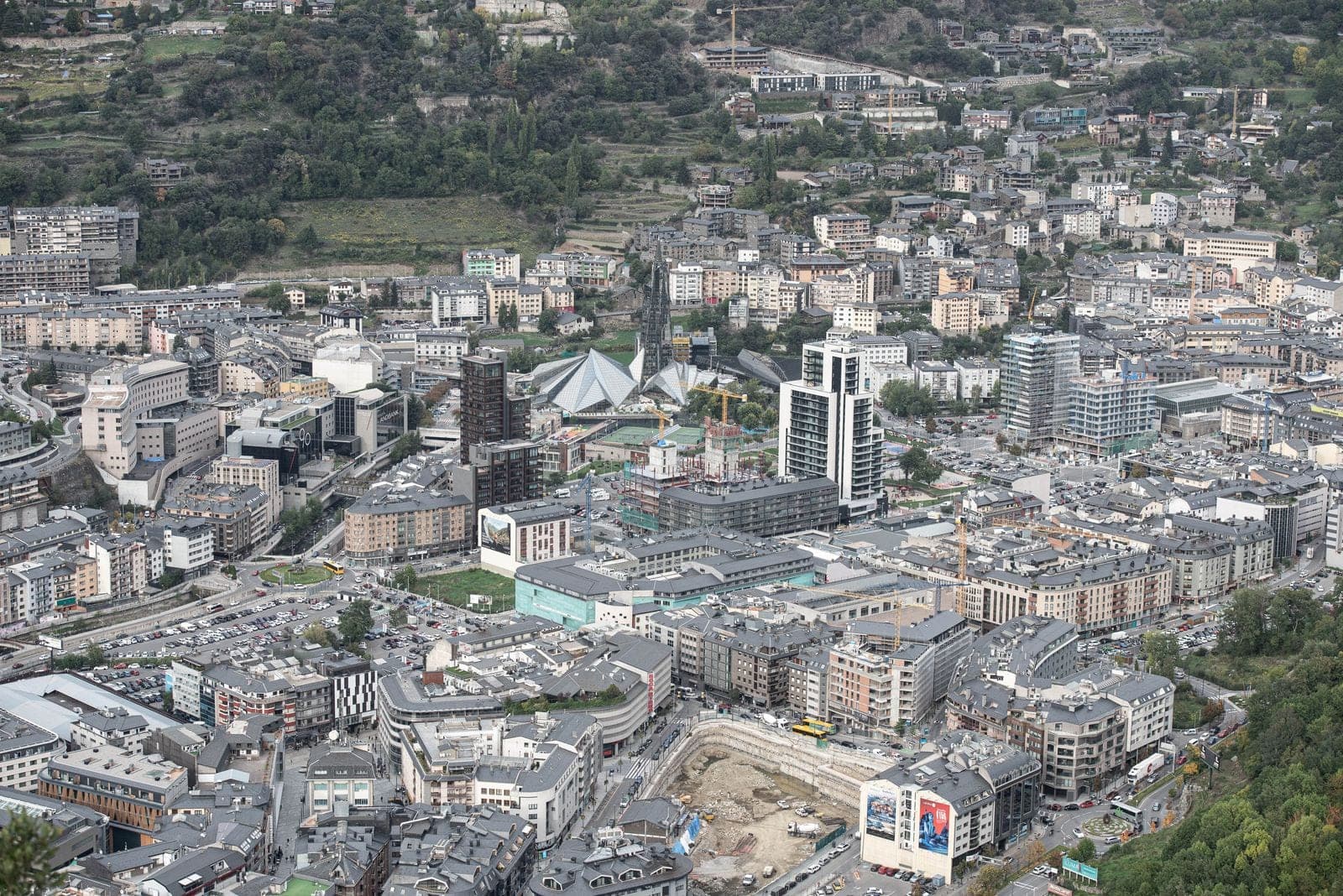
Andorra la Vella sits at the bottom of a narrow Pyrenean valley, the seat of a co-principality whose parishes have run their own land and pastures since the Middle Ages. Europe’s highest capital has always had to fit its people between steep slopes and a river. Over the past decade the pressure on that thin strip of floor has become the country’s defining political argument. The parish is home to 24,698 residents, and they share it with shoppers, skiers and a fast-growing workforce.
Renting is the norm here, which sets Andorra apart from most of southern Europe. The 2025 living-conditions survey found 38.6% of residents in homes they own and 61.4% in rented ones. A separate household budget survey counts 62.8% of residents as renters, about 55,474 people. Both surveys are national, because Andorra does not publish tenure by parish. The public tier is tiny: the Govern’s (the national government’s) rental stock reaches 266 flats in 2026, against 44,047 dwellings in the whole country. No housing cooperative exists yet, so almost every renter depends on a private landlord.
- Owner-occupied38.6%
- Rented (almost all private)61.4%
Andorra has no separate social-housing tenure. The protective layer sits on top of private tenancies instead. Since 2019 successive laws have forcibly extended existing leases and frozen most rents. A unanimous vote in November 2023 carried that regime to 2027. The newer Llei 11/2026 (the 2026 law on residential leases for 2027 to 2030) now lifts it in stages. Contracts signed in 2012 or earlier, or priced at or below €6 per square metre, are released first.
The freeze explains a very wide rent ladder. Public tenants pay an average of €9.47 per square metre a month. Sitting private tenants pay €9.9 on average, and contracts under a year old €12.1. The asking market is another world. Advertised rents in Andorra la Vella averaged €30.38 per square metre in early 2026, or €4,163.62 a month. One-bedroom flats in the centre are listed at around €1,260. Asking sale prices reached €7,178 per square metre nationally, up 24.8% in a year.
- Public rental (INH average)
- All sitting tenants (average)
- New contracts (under a year old)
- Affordable-rent cap, new private build
- Asking rent, Andorra la Vella listings
Monthly rent per square metre by tier. The first four are national averages; the top tier is the average advertised asking rent in Andorra la Vella, a thin market of a few dozen listings.
Empty space is scarce on the market but not in the stock. The statistics office, reading electricity meters, counted 6,238 empty flats in 2021, and 1,800 of them were in Andorra la Vella. No newer official count has been published. Yet in the second quarter of 2026 only 117 flats were advertised for rent in the whole country. The 2023 law raised the tax on empty homes to €50 per square metre. Tourist flats are the other drain, and the Govern has opened 235 cases against licences left inactive. No office-vacancy series exists for the parish.
Demand keeps rising. Andorra passed 90,021 residents in 2026, up 1.9% in a year, and 55.4% of them hold a foreign nationality. The capital itself grows slowly: it added only 130 residents in the first half of 2026, the smallest gain of any parish. Construction is slowing too. Architects’ approvals fell 28% in 2025, and the parishes’ building moratoria are blamed for much of the drop.
The crisis bites hardest at the bottom, but it has climbed well into the middle. An IMF paper on housing affordability in Andorra found that renters earn up to 40% less than owners. More than 42% of renters in the lowest income fifth spend over 40% of their income on housing. Across the whole population, 12.7% carry that overburden. Half of all employees earn less than €2,235.35 a month, well below the advertised rent of a flat in the capital. The public knows it: in an April 2026 survey 70.2% named housing among the most urgent issues, far ahead of traffic at 23%.
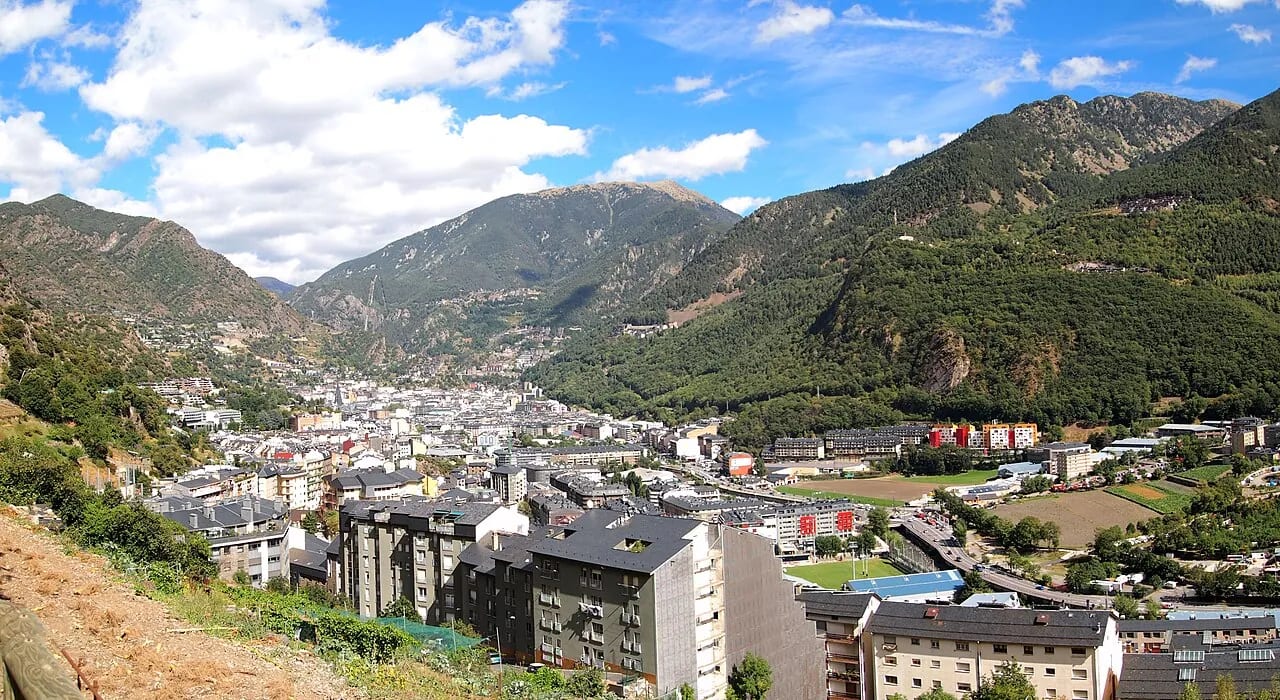
There can be no eviction without a decent alternative home. That is a red line we will not allow.Between the frozen lease and the open market there is almost nothing, and the cooperative share of the stock is still zero.
The cooperative that Andorra has not yet built
The model Andorra is debating is the cooperative in cessió d’ús (grant of use). Members pay an entry contribution and a monthly fee. The cooperative owns the building, and members hold a lifelong right to live in it but never a saleable share. Arrel’s worked example, set out in a report on the parishes’ offer of land, puts an 80 m² flat at about €1,500 a month, falling to €350 once the building loan is repaid. It assumes an initial contribution of about €75,000.
Estaló ran its own numbers for a building of 45 homes costing about €13 million. In its cost simulation, a 55 m² one-bedroom flat needs €40,160 up front and €896 a month in the base case. With the most public support, that falls to €16,730 and €670. Per square metre the fee runs from €16.3 down to €12.07, below the new-let market on either measure the group compared.
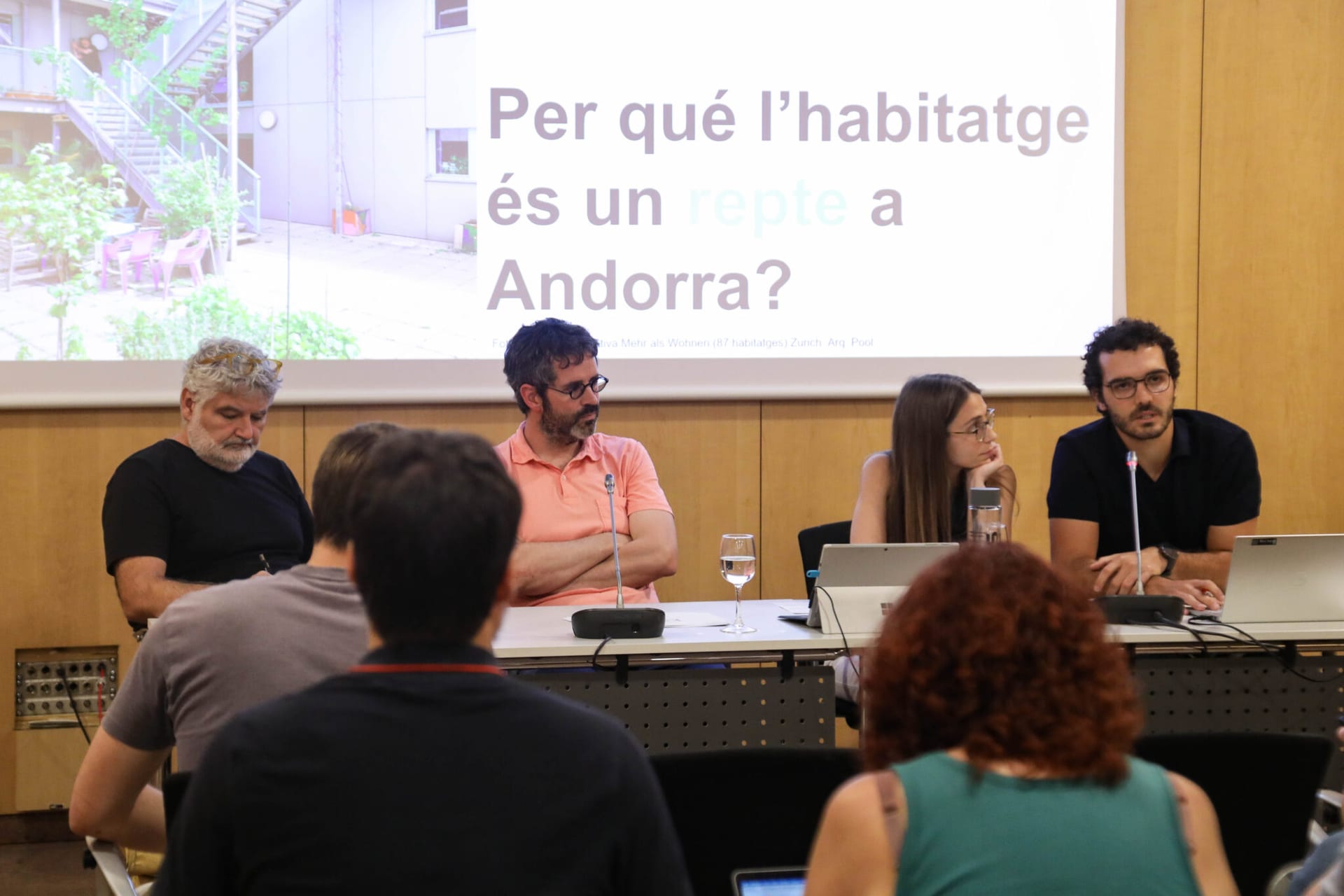
There is no modern cooperative tradition to draw on. The older inheritance is communal. From the late thirteenth century the heads of each household met in parish assemblies that managed pastures, fields and forges, and parish councils still own the plots they now offer for housing. The Llei 5/2015 (the 2015 law on cooperative societies) already lists housing among the permitted forms. Pierre Fauré of Arrel calls it a usable base that is still quite generic.
The sector today is two groups of architects and a list of names. Arrel, led by the architect-urbanists Pierre Fauré and Léa Cazaban, had signed up more than 200 interested households by May 2026. Estaló, launched in July 2026 by four architects with Andrea Doncel as president, began with about 30 interested people. Both groups compare themselves with Zurich, where cooperatives hold more than 20% of the housing stock. They face the same three obstacles: no land yet committed, no bank product for collective loans, and a law that says little about housing. Estaló is looking at sites in La Massana, while Arrel talks mainly to the parishes.

The capital is the first public body to engage. Andorra la Vella’s Comú (parish council) is looking for sites where a first project could fit, and parish sources describe a good predisposition towards the idea. The Govern is studying whether its guarantee for first-home purchases could cover a member’s entry contribution. The Institut Nacional de l’Habitatge (the national housing institute) hosted a talk on a Barcelona cooperative in its conference series, as a July 2026 overview of the debate recalls. The opposition Partit Socialdemòcrata has promised a bill to adapt the cooperative law to housing.
Unfreezing the lease, building the stock
Xavier Espot’s government, formed by Demòcrates per Andorra with Ciutadans Compromesos, treats housing as its central file. The minister in charge is Conxita Marsol, Minister of Presidency, Economy, Labour and Housing since 2023 and previously cònsol major (mayor) of Andorra la Vella. The flagship is the Llei 11/2026, passed in June 2026 by the governing majority against the whole opposition. It releases frozen leases in stages between 2027 and 2030. Rents of €2,500 a month or more are excluded from its protections.
The law comes with a cushion. A rent-aid programme worth €6 million in 2027 opens to applications on 1 November. Households qualify after 15 years of residence, once rent takes more than about 30% of their income. The public stock is the other half of the answer. The Govern aims for 650 affordable flats, expecting 500 by the end of 2027. It is putting €35 million of the 2025 surplus into public housing. The Institut Nacional de l’Habitatge has already housed 165 families and holds about 1,300 applications. A bill announced in September 2026 would pay private builders 10% of construction costs if they cap rents at €13.20 per square metre for at least 15 years.
We have begun to give the country permanent tools so that housing stops depending exclusively on the fluctuations of the market.The levers are split between two tiers. The Consell General (Andorra’s parliament) writes tenancy law and taxes, and the Govern builds and allocates through the institute. The seven Comuns (parish councils) own land and write the urban plans. Andorra la Vella’s cònsol major, Sergi González, has pushed the parish lever hardest. The capital’s new urban plan caps buildings at seven floors, down from 15, and cuts buildability by 40% on average. Developers must now cede 30% of land for green space, public housing or facilities, up from 15%. Relations are not seamless: González publicly regretted that the minister announced her builder subsidy without waiting for the Comuns.
For cooperatives there is not yet a dedicated instrument. What exists is the offer of parish land without ground rent, the capital’s search for a site, and a promise to study the purchase guarantee. The opposition bill on cooperatives is the first attempt at a legal route.
The answer to empty homes has moved from tax to requisition. After the 2023 increase in the empty-homes tax, the Llei 5/2025 (the law on sustainable growth and the right to housing) allowed empty flats to be transferred temporarily to the state for three years. It also suspended new tourist-flat licences and capped foreign buyers at one house or two flats. The Llei 3/2024 taxes foreign property investment at 6% or 10%. In August 2026 the Govern invited owners of whole buildings, aparthotels included, to lease them to the public stock for at least 30 years.
The climate rules reach housing through two instruments. The Llei 21/2018 (the law on energy transition and climate change) requires nearly zero-energy standards for new buildings licensed from 2020. It targets a 37% cut in emissions by 2030. The Renova programme subsidises building rehabilitation, with extra points for flats let at affordable rents. The public stock is where both goals meet, in passive-house and timber-framed buildings.
- Sep 2018[source]
Climate law
The Llei 21/2018 sets energy targets for 2030 and 2050 and requires new buildings licensed from 2020 to use nearly zero energy.
- Jun 2021[source]
A national housing institute
The Llei 15/2021 creates the Institut Nacional de l’Habitatge to run public housing, the register of rental contracts and housing aid.
- Nov 2023[source]
Leases extended to 2027
The Consell General extends existing leases for three years and raises the empty-homes tax to €50 per square metre.
- Dec 2023[source]
“Ja n’hi ha prou”
Organisers count between 2,000 and 3,000 people at the first large march for decent housing.
- Mar 2025[source]
Sustainable growth law
The Llei 5/2025 suspends new tourist-flat licences and caps foreign buyers at one house or two flats.
- Jun 2026[source]
Rent intervention to end
The Llei 11/2026 sets out the staged release of frozen leases between 2027 and 2030.
- Jan 2027[source]
Rent aid begins
A €6 million programme starts paying households whose rent takes more than 30% to 36% of their income.
- End 2027[source]
Public stock target
The Govern expects 500 affordable public flats and aims for 650.
- Early 2029[source]
Borda Nova II
A second building of 42 public flats is due on the Borda Nova plot in Andorra la Vella.
- 2030[source]
Climate horizon
Emissions are to fall at least 37% and national electricity production to cover at least 33% of demand.
From a climate law and a frozen rent market to a staged release of leases and a first public-housing target.
The street has become the third actor. Organisers counted between 2,000 and 3,000 people at the first large march in December 2023. In May 2026 the Sindicat d’Habitatge brought about 1,500 people through Andorra la Vella under the slogan “Neither people without homes, nor homes without people”. As reports from that march show, the union wants rents regulated and no eviction without an alternative home. The opposition says the new law will end “the Andorra we know”, while the government argues that an indefinite freeze shrinks supply.
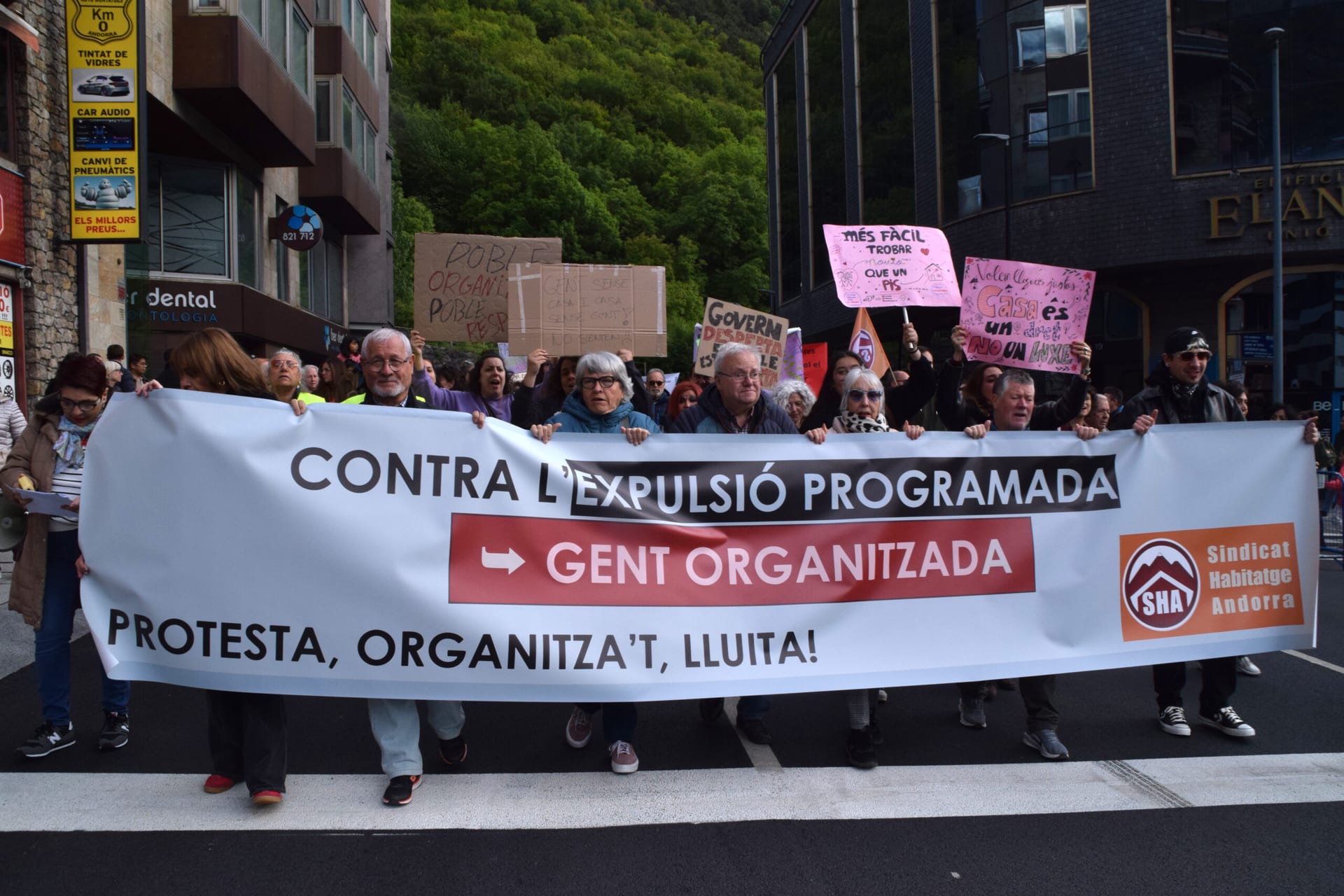
People are suffocating, people are afraid.Parish plots, passive houses and a first cooperative in waiting
Borda Nova I, on carrer Terra Vella, is the capital’s newest public building. Its 44 flats rise over nine floors on a plot the Comú gave the Govern free of charge. It is the first building in Andorra’s public stock designed to passive-house criteria. Rents run from €425 to €1,000 a month. Some two-bedroom flats were at first left unallocated, and the tenants’ union asked for the allocation rules to be revised. A second building of 42 flats, Borda Nova II, is due on the same plot in early 2029.
El Cedre, in Santa Coloma, shows what the next generation looks like. The Govern is building 30 flats there on a plot the Comú has lent for 40 years. As the award of its works sets out, the contract went for €8,267,114.34 to Construccions i edificacions les Valls. The structure will be timber, the flats range from 35 to 82 m², and the ground floor is kept for the Casa Pairal de Santa Coloma. The Govern pays 83% of the cost and the Comú the rest.
Terra Vella is the capital’s own experiment, and its hardest lesson. The Comú planned 49 flats on a 50-year concession, let at about €826 a month to residents with 15 years in the parish. The first tender attracted no valid bid, and only one company entered the negotiated round. By August 2026 the project was stalled for lack of bank finance. Sergi González still defends the route: “we continue to back public-private collaboration, because we believe the answers to the housing crisis have to be collective.”
Smaller schemes add renovated and purpose-built flats. On carrer Gravada de Tobira, the first public flats were handed over in 2025, housing 27 new families. In Roureda de Sansa, 14 renovated flats went to tenants by draw at rents between €394.04 and €717.83 a month. The Institut Nacional de l’Habitatge now manages the national stock and its waiting list.
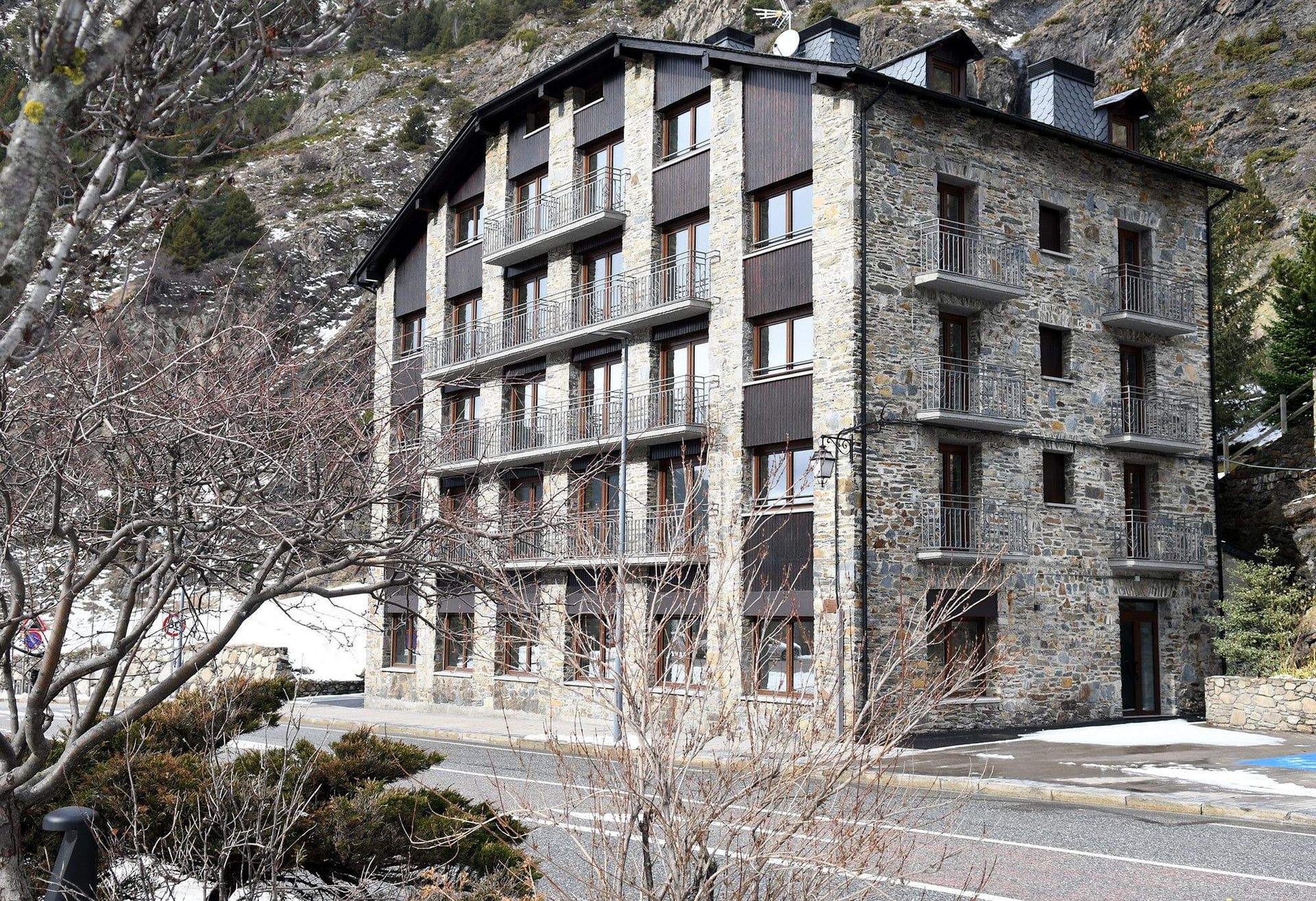
The Col·legi Oficial d’Arquitectes d’Andorra has argued for a different city rather than more of the same. Its president, Zaira Nadal, and the board proposed affordable-rent quotas in new developments and lower buildability. Without lower buildability, the college warned, the centre stays dense and congested. The parish plan has since moved in that direction.
Put together, Andorra la Vella holds pieces that rarely sit side by side. It has parish land offered free, a public builder that has learned passive-house and timber construction, a stalled concession that exposed the finance gap, and Arrel and Estaló’s would-be cooperators waiting for a first plot. What the capital does not yet have is the first building where those pieces meet.
References
Statistics4Click on any number to see the source
Housing market
Population & migration
From our library11
- El 62,8% dels residents viu de lloguer mentre el preu mitjà dels contractes puja als 9,9 euros per metre quadrat — Knowledge
- La manca d'habitatge assequible és una amenaça pel creixement econòmic d'Andorra, segons un informe de l'FMI — Knowledge
- Andorra 'descongela' i surt al carrer a defensar l'habitatge — Knowledge
- Els comuns estudien cedir terrenys per construir habitatges cooperatius — Knowledge
- Un habitatge cooperatiu podria costar des de 670 euros al mes i requerir una aportació inicial de 16.730 euros — Knowledge
- Les cooperatives es fan lloc en la batalla per l'habitatge a Andorra — Knowledge
- Arrel — Organisation
- Andorra la Vella busca espais per impulsar habitatge cooperatiu i el Govern estudia adaptar-hi les ajudes — Knowledge
- Institut Nacional de l'Habitatge d'Andorra — Organisation
- Sindicat d'Habitatge d'Andorra — Organisation
- El Govern adjudica les obres dels pisos de preu assequible del Cedre — Knowledge
Further sources46
- Govern updates public-housing rents for 2026 — Altaveu
- Govern to subsidise 10% of affordable-rental construction — Ràdio Valira
- Property portal: asking rents Q1 2026 — Altaveu
- Living conditions survey (ECV) 2025: tenure and rent overburden — El Periòdic
- Public rental stock grows with Borda Nova I (June 2026) — Govern d’Andorra
- Andorra ends 2024 with 44,047 dwellings — La Veu Lliure
- Andorra extends leases to 2027 and raises the empty-homes tax (Nov 2023) — VilaWeb
- Llei 11/2026 on residential leases 2027-2030 — Portal Jurídic d’Andorra
- Asking sale prices up 24.8% in a year (AGIA) — La Veu Lliure
- Estadística estimates 6,238 empty flats — Diari d’Andorra
- Only 117 flats advertised for rent, Q2 2026 — El Periòdic
- 235 cases opened against inactive tourist flats — Bondia
- Andorra passes 90,000 residents — Viure als Pirineus
- Population at 30 June 2026 by parish — Ràdio Valira
- Building approvals fall 28% in 2025 — Altaveu
- Half of employees earn less than €2,235 — Altaveu
- AR+I opinion survey, April 2026: housing the top concern — Bondia
- Llei 5/2015 de societats cooperatives — Portal Jurídic d’Andorra
- Estaló launched to promote cooperative housing in Andorra — Diari d’Andorra
- PS bill on housing cooperatives due in September 2026 — Diari d’Andorra
- Llei 21/2018 on energy transition and climate change — Portal Jurídic d’Andorra
- Llei 15/2021 creating the Institut Nacional de l’Habitatge — Portal Jurídic d’Andorra
- Manifestació per a un habitatge digne a Andorra (2023) — Viquipèdia
- Llei 5/2025 per al creixement sostenible i el dret a l’habitatge — Portal Jurídic d’Andorra
- Andorra approves the law ending the rent intervention — Aldia
- New rent aid: €6 million for 2027 — El Periòdic
- €21.6 million to buy buildings; 650-flat target — Aldia
- Conxita Marsol — Wikipedia
- €35 million of the surplus for public housing — El Periòdic
- INH has allocated 165 homes; about 1,300 applications — El Periòdic
- Espot at the Debat d’Orientació Política, June 2026 — El Periòdic
- New Andorra la Vella urban plan caps buildings at seven floors — Diari d’Andorra
- González regrets measures presented without the Comuns — El Periòdic
- Llei 3/2024 on the foreign real-estate investment tax — Portal Jurídic d’Andorra
- Govern call to lease whole buildings for the public stock — Diari d’Andorra
- Renova building-rehabilitation programme regulation — Portal Jurídic d’Andorra
- More affordable flats; Borda Nova I allocations — Bondia
- Terra Vella: 49 flats at €826 a month — Altaveu
- Only one company bids for Terra Vella — Altaveu
- Terra Vella stalled for lack of finance — Diari d’Andorra
- First tenants of the Tobira public flats — Govern d’Andorra
- Roureda de Sansa flats allocated — Diari d’Andorra
- COAA proposals on affordable rental — Diari d’Andorra
- Andorra la Vella — Wikipedia
- A house with history — Casa de la Vall
- Madriu-Perafita-Claror valley — Madriu-Perafita-Claror
Funding & land tenure
What a housing cooperative could actually build on hereLand tenure has not been assessed for Andorra yet — that is a gap in the research, not a finding.