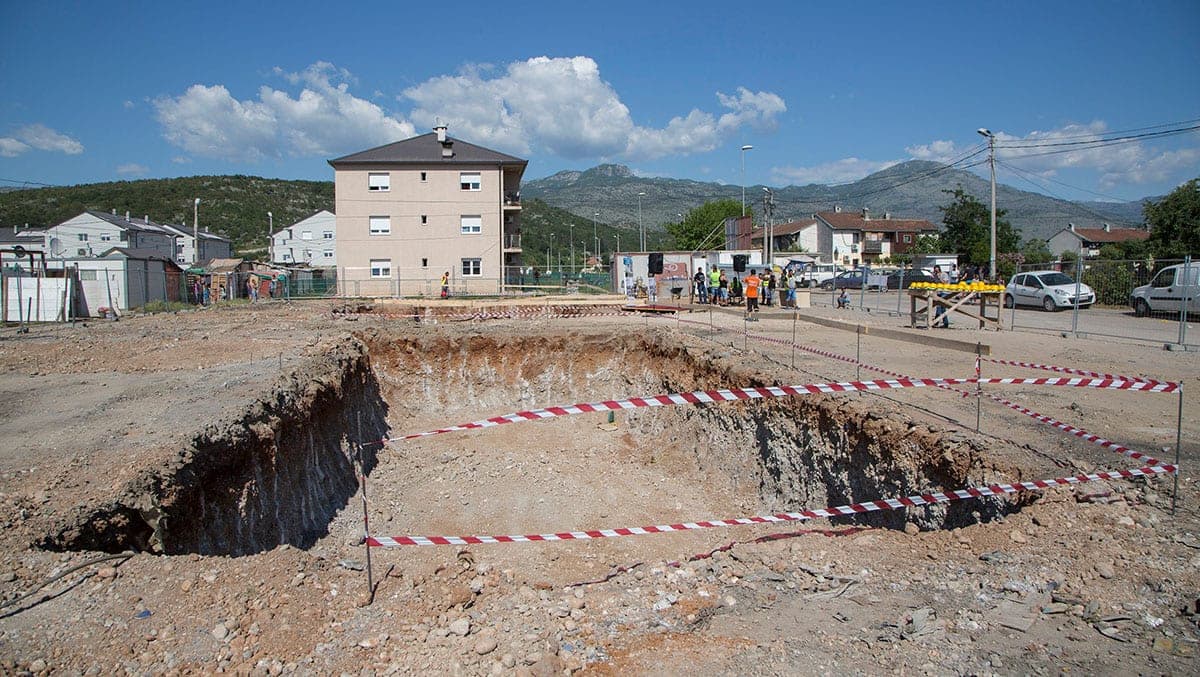
Konik social housing is part of Montenegro’s Country Housing Project under the Regional Housing Programme (RHP), a joint initiative launched in 2012 by Montenegro, Bosnia and Herzegovina, Croatia and Serbia. Its purpose was to provide durable housing for vulnerable refugees, internally displaced people and returnees, either where they had sought refuge or in their places of origin.1
The project addresses the continuing housing needs of people displaced by conflicts in the former Yugoslavia. Montenegro had provided shelter to displaced people from Bosnia and Herzegovina and Croatia, and to internally displaced people from Kosovo; despite the construction of about 1,500 homes with donor support, many remained without durable housing. In 2011, the government adopted a strategy for durable solutions, with particular attention to the Konik area.1
The Konik sub-project, MNE2, provided housing for 171 of the most vulnerable families from Camp Konik 1 and nearby areas. It did so through construction of 17 buildings in Podgorica.1 It was one of several housing activities in Montenegro, alongside projects including apartments, individual houses and residential facilities for older people and people with disabilities in other municipalities.1
The Ministry of Labour and Social Welfare was the lead institution, responsible for the country programme’s management framework, beneficiary selection and development of sub-projects, among other duties. The Capital Projects Administration served as the Project Implementation Unit, handling procurement and contract management, among other tasks.1 The source names Budimirka Đukanović as National RHP Coordinator for Montenegro.1
The regional programme concluded in 2023. Across Montenegro, it provided secure homes to 646 families—more than 2,000 people.1