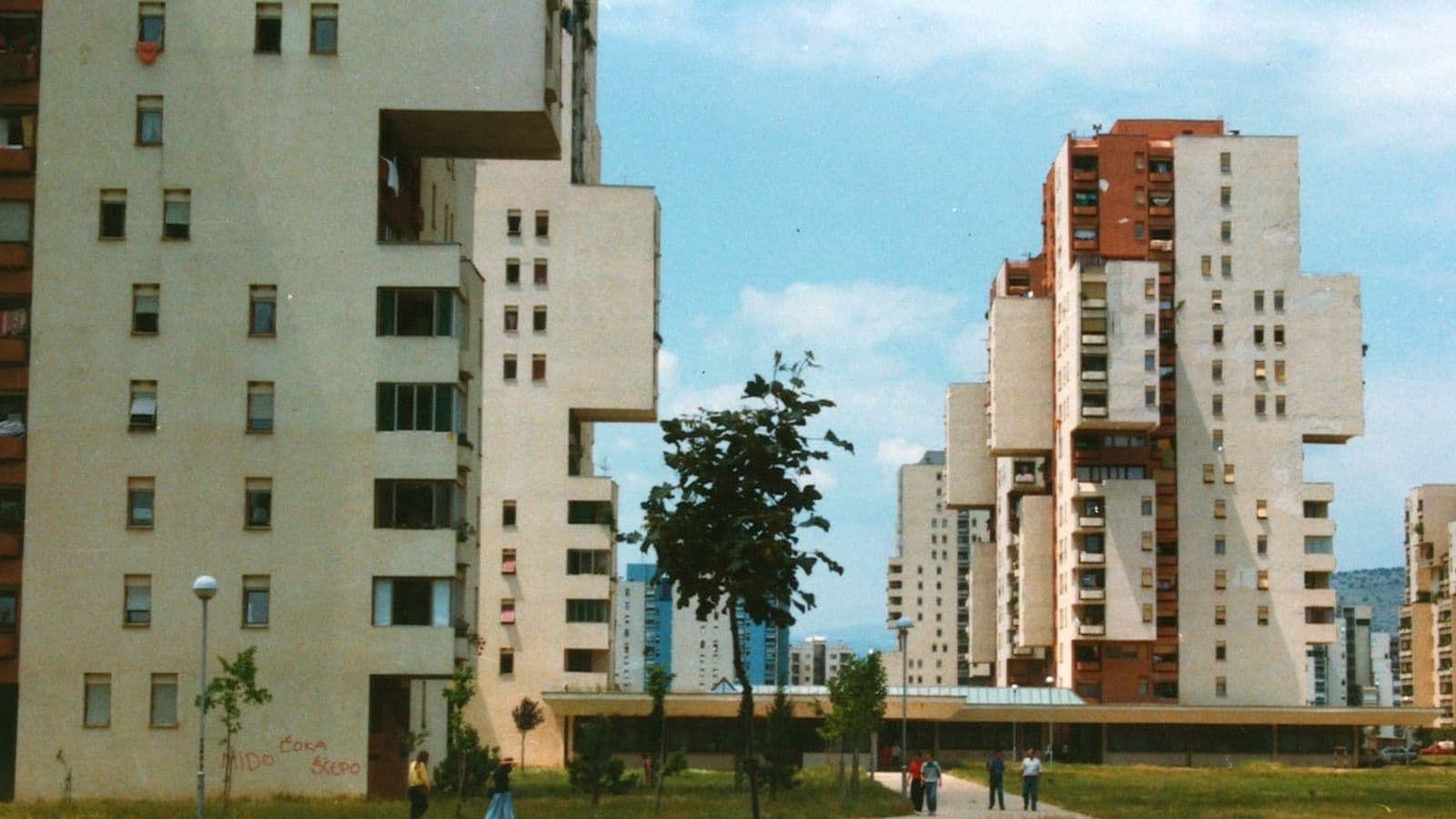
Blok 5 is a mass-housing neighbourhood in Titograd, now Podgorica, Montenegro, built between 1977 and 1984. The project’s architectural design was by Mileta Bojović; its urbanist blueprint was by Vukota Tupa Vukotić. 13 The development comprised thirteen residential buildings and around 1,800 apartments, making it Montenegro’s capital’s largest mass-housing project to that point. 35
The project was organised through Yugoslavia’s housing self-management system. The Self-Managed Interest Group for Housing in Titograd (SIZ Titograd) pooled resources from labour organisations and managed the competition and construction process. 3 In the article’s account, self-management shaped the project at several levels, from planning and the proposal to flexible apartment layouts and building façades. 1 The scheme’s design sought to allow variation in how residents used their homes, although the intended consultation between future residents and architects was not consistently supported by the project’s administrative arrangements. 11
Blok 5 is the subject of Lea Horvat’s article “Housing Yugoslav Self-Management: Blok 5 in Titograd,” published in Histories of Postwar Architecture in 2020. 1 Horvat’s study examines how the principles of self-management were translated into the built environment, the tensions among participants in the construction process, and the neighbourhood’s changing legacy after socialism. 1 The article identifies Blok 5 as a significant case for understanding the relationship between mass housing and Yugoslav self-management. 1