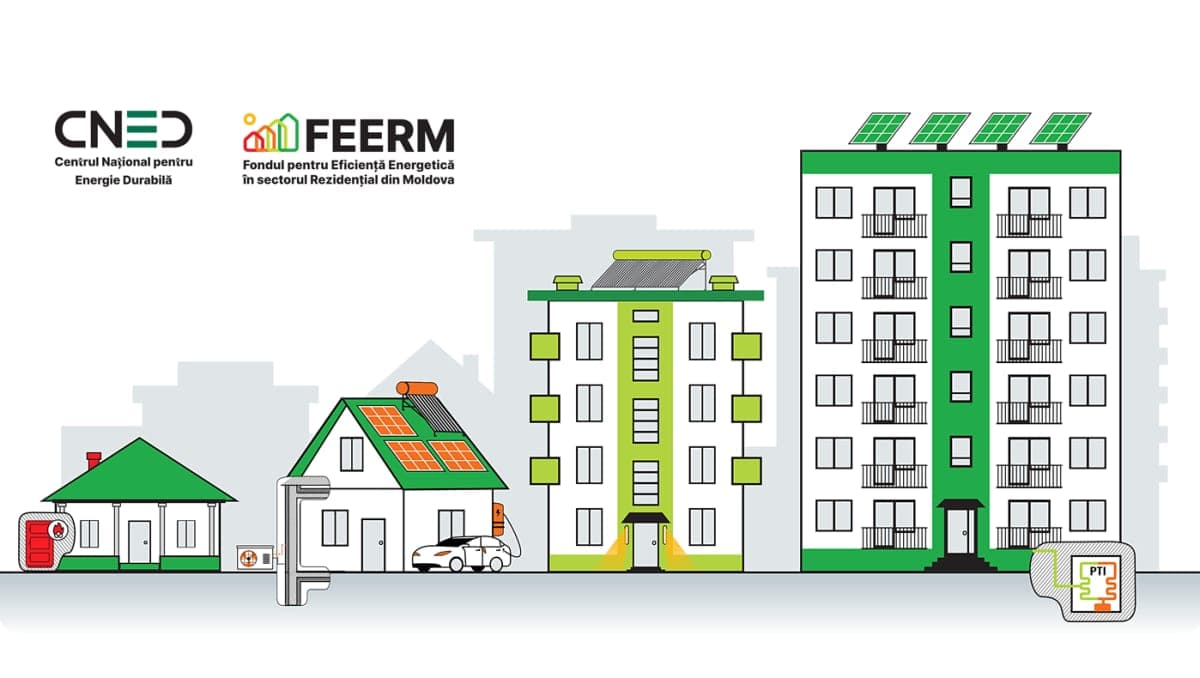
The Residential Energy Efficiency Fund (FEERM) is a Moldovan government funding programme administered by the National Center for Sustainable Energy (CNED), a public institution under the Ministry of Energy. CNED coordinates implementation of state policy on energy efficiency, renewable energy and financial support for related projects. 111
The Government approved FEERM on 10 April 2024. The programme was designed to mobilise an estimated 1.4 billion Moldovan lei over 2024–2027, with funding from energy-efficiency obligation mechanisms, development-partner and international-organisation grants and donations, and resources allocated through the Energy Vulnerability Reduction Fund. 1
FEERM’s purpose is to provide grants and other financial support to improve energy performance in residential buildings and reduce household energy use and costs. Its beneficiaries include condominium-owner associations undertaking apartment-block renovations and households improving individual homes. For apartment blocks, the programme provides grants of up to 70% of eligible investment; for individual houses, grants can cover up to 50%. Additional support may be available to households experiencing energy vulnerability. 1314
One funding product, Casa Verde, supports energy-efficiency measures and renewable-energy installations in individual homes, including homes under construction, subject to eligibility requirements. Applications are submitted online through the FEERM platform and assessed by CNED. 12
CNED was created through the reorganisation of the former Energy Efficiency Agency and began operating on 1 January 2024. Its headquarters are in Chișinău, Moldova; the published contact page identifies Ion Muntean as director. 8312 FEERM’s stated reach is national, covering residential projects across the Republic of Moldova. 15