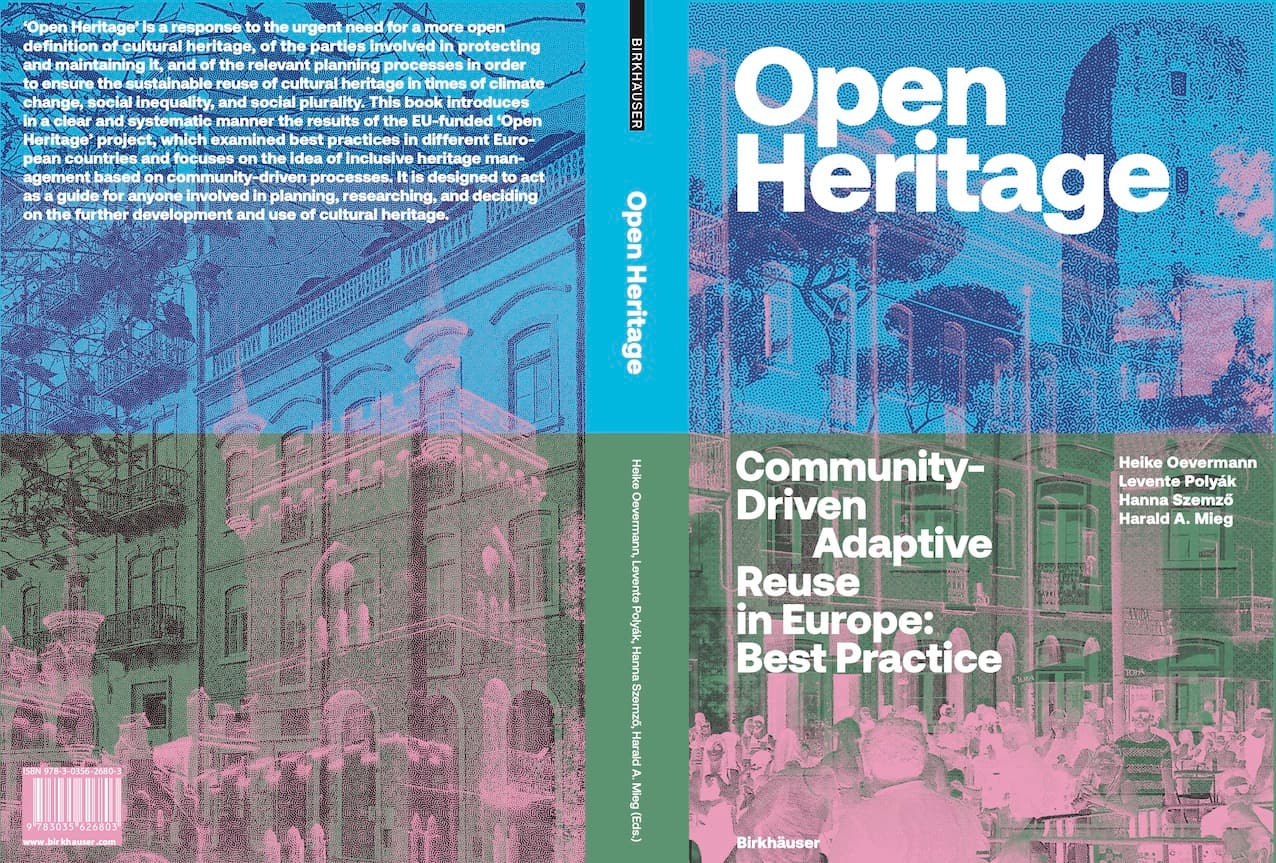

Overview of the Open Heritage Publication
Open Heritage – “Community‑Driven Adaptive Reuse in Europe: Best Practice” is a scholarly volume published by Birkhäuser. It is authored by Heike Oevermann, Hanna Szemző, Levente Polyák, and Harald A. Mieg, who are researchers and practitioners involved in the OpenHeritage Horizon 2020 project (Grant No. 776766). The book presents the results of a four‑year European research programme that examined community‑driven adaptive reuse of heritage sites across 11 countries, exploring policies, financing, governance and regional integration.
Core Themes and Case Studies
The work is organised around three thematic sections: (A) Policies and Governance, (B) Financing Projects, and (C) Supporting Regional Integration. It showcases nine detailed case studies, including Cascina Roccafranca (Turin, Italy), High Street West (Sunderland, UK), London Community Land Trust, Färgfabriken (Stockholm, Sweden), Stará Tržnica (Bratislava, Slovakia), Jam Factory (Lviv, Ukraine), Largo Residências (Lisbon, Portugal), Praga Lab (Warsaw, Poland) and Broei (Ghent, Belgium). Each case illustrates how local communities, municipal authorities and private actors co‑manage heritage assets to create socially and financially sustainable outcomes.
Funding Models and Financial Insights
The publication details a variety of financing instruments used across the projects. Public grants (e.g., EU Horizon 2020, national heritage funds), private sponsorship (e.g., Lindéngruppen for Färgfabriken), crowdfunding, community share offers, and rent‑to‑invest schemes (as in Stará Tržnica) are described. For instance, the Old Market Hall Alliance in Bratislava invested €200 k–€400 k in fire safety upgrades and secured a €200 k low‑interest loan from Erste Bank, repaying it within three years. Färgfabriken’s annual budget combines €285 k from its main sponsor, €80 k from Swedish cultural grants and €93 k from regional funding, illustrating a mixed public‑private model.
Governance Structures and Community Involvement
A recurring finding is the importance of inclusive governance. Projects often use “Pact of Collaboration” agreements, joint boards with municipal and civil society representatives, and resident committees. The Cascina Roccafranca model features a foundation board comprising three municipal nominees and two civil‑society members, overseeing both strategic decisions and day‑to‑day operations. In Sunderland, the Heritage Action Zone framework enabled a symbolic £1 transfer of property to a preservation trust, fostering cooperative management between the council, the trust and local cultural groups.
Regional Integration and Policy Context
The book links adaptive reuse to broader European policy frameworks such as the European Green Deal, the New European Bauhaus, and the Horizon 2020 programme. It highlights how the Urban II programme contributed €10.7 million to the regeneration of Turin’s Mirafiori Nord district, including Cascina Roccafranca. The authors argue that aligning heritage projects with EU sustainability goals can unlock additional funding streams and facilitate cross‑border knowledge exchange through the OpenHeritage “Cooperative Heritage Labs”.
Impact Metrics and Social Benefits
Quantitative outcomes are provided for several sites. Cascina Roccafranca recorded 656 activities in 2019, attracting over 165 000 entries and mobilising 324 volunteers for more than 11 000 hours of work. The Old Market Hall in Bratislava generated approximately €16 k–€20 k of additional revenue by operating on a commercial basis, while also delivering €50 k–€60 k of social subsidies through rent reductions for community programmes. Jam Factory in Lviv, despite wartime disruptions, continued to host international residencies and provided shelter for displaced artists, illustrating resilience of community‑driven heritage initiatives.
Lessons for Sustainable Housing
For a pan‑European audience interested in sustainable housing, the volume offers actionable insights: (1) adaptive reuse can extend the life‑cycle of existing built assets, reducing material consumption; (2) mixed‑financing models enhance financial resilience; (3) participatory governance ensures that housing and community spaces meet local needs; and (4) embedding projects within EU sustainability policies can amplify impact. The authors conclude that community‑driven adaptive reuse is a viable pathway to create affordable, inclusive and environmentally responsible housing solutions across Europe.