Overview of the Report and Its Contributors
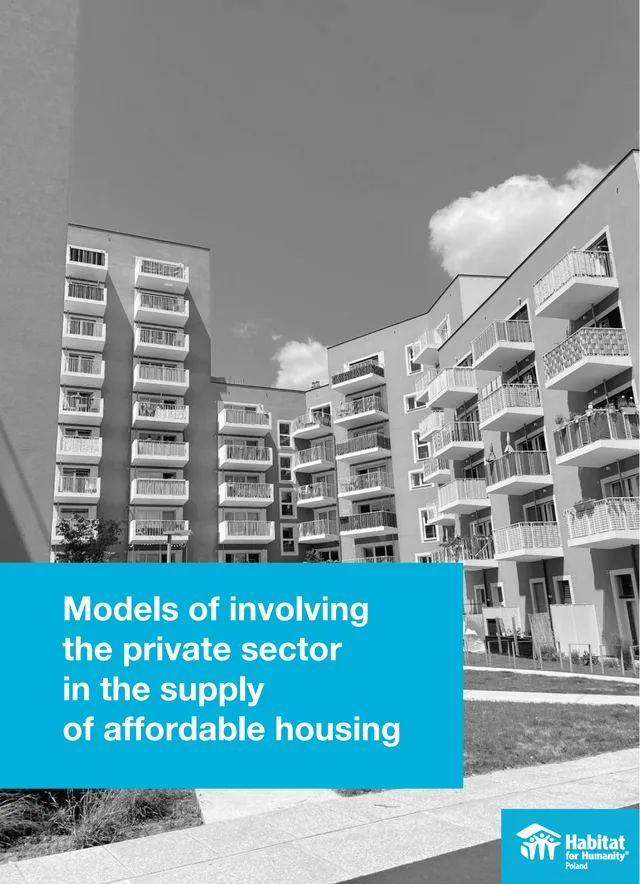
The report “Models of involving the private sector in the supply of affordable housing” is published by Habitat for Humanity Poland, a non‑governmental organisation active in promoting decent housing across Europe. It is authored by a multidisciplinary team: architect and urban planner Agata Twardoch (professor at the Silesian University of Technology), lawyer Jakub Szlachetko (head of the Metropolitan Institute think‑tank), economist Adam Czerniak (chief economist at Polityka Insight), urban planner and political scientist Łukasz Drozda (assistant professor at the University of Warsaw), cultural anthropologist Mikołaj Łątkowski, and architect Wojciech Lesiak who also designed the cover. Their combined expertise spans architecture, law, economics, urban policy and anthropology, providing a comprehensive perspective on housing challenges.
Context of Poland’s Housing Market
In 2022 Poland completed a record 240 000 apartments, yet prices continued to rise, reducing affordability. Despite a surplus of dwellings—approximately 1.3 million more apartments than households—only 0.263 % of new units were municipal, and social‑rental stock remains low (11.1 % of the population lives in social housing, placing Poland 17th among EU states). The report highlights that housing functions simultaneously as a consumer good and an investment asset, creating market imbalances that the private sector could help mitigate.
Existing Public‑Private Models in Poland
The study reviews current Polish mechanisms for private‑sector involvement, including Social Rental Agencies (SRAs), various Public‑Private Partnership (PPP) schemes such as “premises for land”, “premises for renovation”, and housing cooperatives. These models illustrate how public authorities can leverage private capital and expertise to deliver affordable units, yet they also reveal barriers such as limited legal flexibility and fragmented funding streams.
International Practices and Lessons Learned
Comparative analysis covers examples from the United Kingdom and France, showing how different institutional frameworks support affordable housing. The report notes that in the UK, strong social‑rental agencies and clear PPP regulations have facilitated larger private‑sector contributions, while French models combine tax incentives with strict affordability criteria. These cases inform the Polish context, suggesting that adaptable legal instruments and sustained public oversight are crucial.
Key Findings from Focus Group Research
Twelve stakeholders—including policymakers, market analysts and developers—participated in focus groups conducted in August 2023. Consensus emerged on the need for clearer risk‑sharing mechanisms, streamlined land‑use procedures, and incentives for private investors to target low‑income segments. Participants also stressed the importance of integrating sustainability criteria, such as energy‑efficiency standards, into any new financing model.
Proposed Models for Future Private‑Sector Engagement
Four primary models are outlined:
- Social Commissions – public bodies allocate land or subsidies to private developers under strict affordability contracts.
- Housing Grants – direct financial support to developers for constructing affordable units, with repayment tied to long‑term rent caps.
- Urban Recycling – cross‑sector cooperation to renovate vacant buildings and repurpose under‑used public assets.
- Lodging in Social Rental Agencies – hybrid arrangements where SRAs manage private‑sector‑built units under public‑sector oversight. Each model varies in required legal changes, from minimal adjustments (model 1) to substantial reforms of property and tenancy law (model 3a).
Sustainability and Environmental Considerations
The authors stress that any expansion of affordable housing must align with sustainable development goals. They advocate for low‑carbon construction methods, reuse of existing structures, and the incorporation of renewable energy solutions. By reducing the emissions intensity of new builds and revitalising dormant buildings, the proposed models aim to lower the sector’s overall environmental footprint.
Implications for Pan‑European Housing Policy
For a European audience, the report demonstrates that Poland’s housing shortage is not purely quantitative but structural. Effective private‑sector participation, guided by robust public policy and sustainability standards, could serve as a template for other EU nations facing similar affordability crises. The research underscores the necessity of coordinated legal frameworks, financial incentives and stakeholder dialogue to achieve scalable, affordable and environmentally responsible housing solutions.