Overview of the Submission
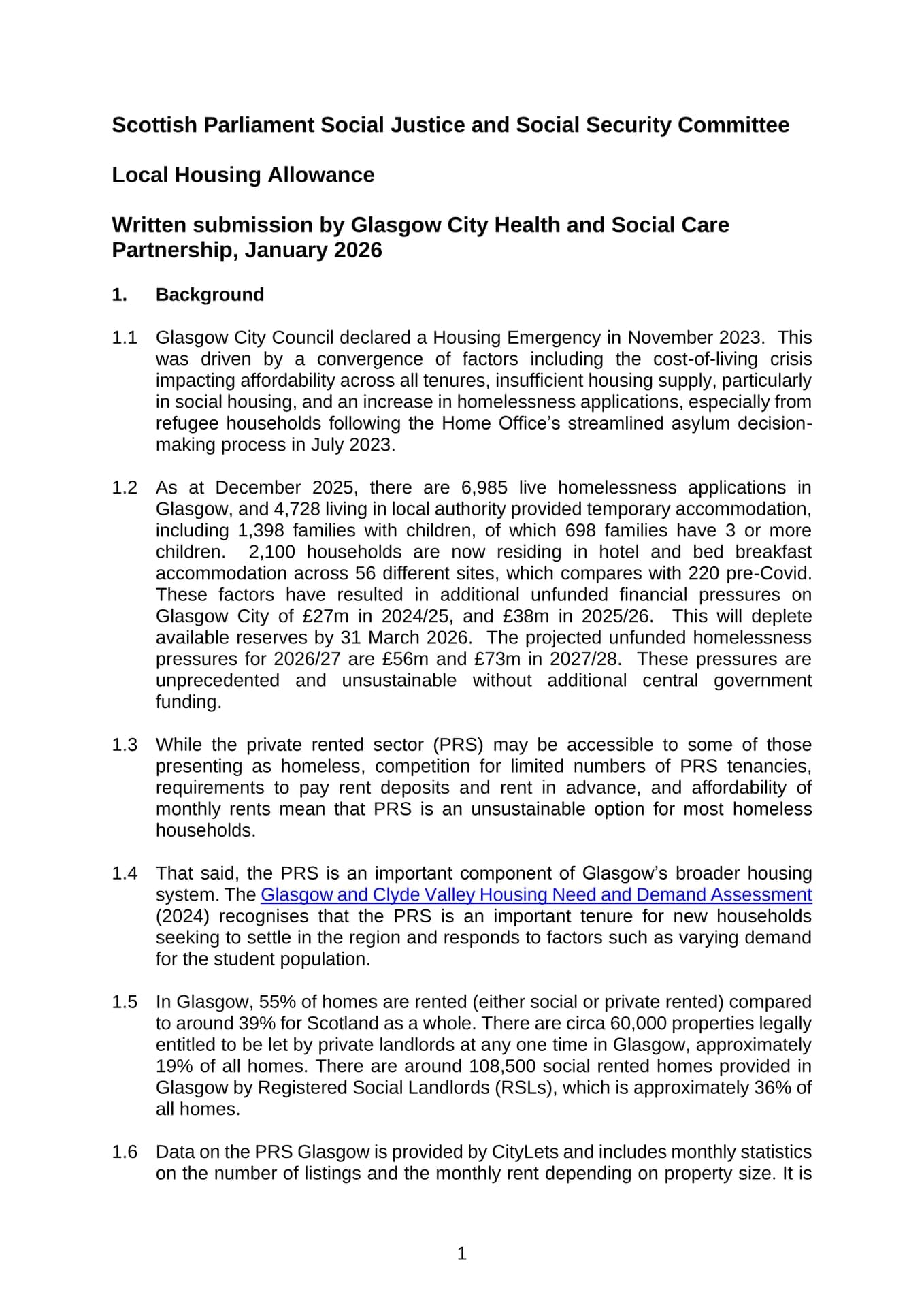
The document is a written submission to the Scottish Parliament’s Social Justice and Social Security Committee, prepared by the Glasgow City Health and Care Partnership. It presents evidence on the housing emergency in Glasgow, focusing on the impact of the Local Housing Allowance (LHA) freeze and the private‑rented sector (PRS) on homelessness and affordability. The partnership, a statutory health and social care body, aims to inform policy‑makers about the scale of unmet housing need and to propose reforms that support sustainable, affordable housing for vulnerable households.
Scale of Homelessness and Unfunded Pressures
As of December 2025, Glasgow recorded 6,985 live homelessness applications, with 4,728 households in temporary local‑authority accommodation, including 1,398 families with children (698 of whom have three or more children). An additional 2,100 households were placed in hotels or B&Bs, a sharp rise from pre‑COVID levels. These pressures have generated unfunded costs of £27 million in 2024/25 and £38 million in 2025/26, depleting council reserves and projecting further shortfalls of £56 million for 2026/27 and £73 million for 2027/28.
Private‑Rented Sector Dynamics
Glasgow’s housing market is heavily weighted towards rented homes: 55 % of dwellings are rented, compared with 39 % across Scotland. Approximately 60 000 properties are in the private sector (19 % of all homes) and 108 500 are social‑rented (36 %). Average private rent stands at £1 229 per month, having risen 2.2 % in the past year, 46.1 % over five years, and 79.7 % over ten years. Listings have fallen, and only a small share of properties are offered at or below the LHA rate – 10.8 % for one‑bedroom units and just 3.8 % for four‑plus‑bedroom homes.
Impact of the LHA Freeze
LHA is set at the 30th percentile of the Broad Rental Market Area, meaning 70 % of properties command higher rents. The freeze, in place since 2024/25, widens the gap between LHA rates and market rents, limiting affordable options for benefit claimants. Weekly LHA rates for a shared room are £68‑£103, while a four‑plus‑bedroom allowance is £223‑£414, far below prevailing market rents of up to £2 705 for larger units. The freeze disproportionately affects single adults under 35 and families requiring larger homes, exacerbating homelessness risk.
Discretionary Housing Payments (DHP)
DHPs bridge the shortfall between LHA and actual rent, covering deposits, advance rent, or removal costs. In 2025/26, non‑social‑rented DHP spending reached £1.331 million, a 1.9 % increase on the previous year. Glasgow received an additional £169 000 for 2025/26 and £620 000 for 2026/27 to support moves from homelessness into the PRS. However, administrative burdens associated with DHPs, especially the Spare Room Subsidy, are rising, outpacing central funding.
Proposed Reforms to LHA and BRMAs
Key recommendations include restoring LHA to the 30th percentile annually, reviewing and potentially redrawing Broad Rental Market Areas to reflect current market conditions, and removing the shared‑room cap for single adults under 35. These changes aim to improve PRS affordability, increase the pool of eligible properties, and reduce reliance on emergency accommodation.
Implications for Sustainable Housing
The submission highlights how unaffordable private rents and rigid LHA thresholds undermine sustainable housing outcomes. By aligning LHA with market trends and simplifying DHP administration, Glasgow could reduce the carbon and financial costs of temporary accommodation, promote longer‑term tenancy stability, and support healthier communities. The data underscore the urgency of coordinated policy action to address the housing emergency while advancing broader sustainability goals.