Overview of the Glasgow Housing Emergency Report
Glasgow City Council submitted this policy document to the Scottish Parliament in 2025 to detail the city’s housing emergency and the actions being taken. The submission, produced by the Council’s integration joint board and health‑social care partnership, reflects a coordinated response to rising homelessness, cost‑of‑living pressures and a surge in temporary accommodation needs. Published under the auspices of the Scottish Parliament, the material draws on council‑generated data and recent strategic plans, offering a comprehensive picture of the housing landscape in Glasgow for a pan‑European audience interested in sustainable housing solutions.
Declaration of a Housing Emergency
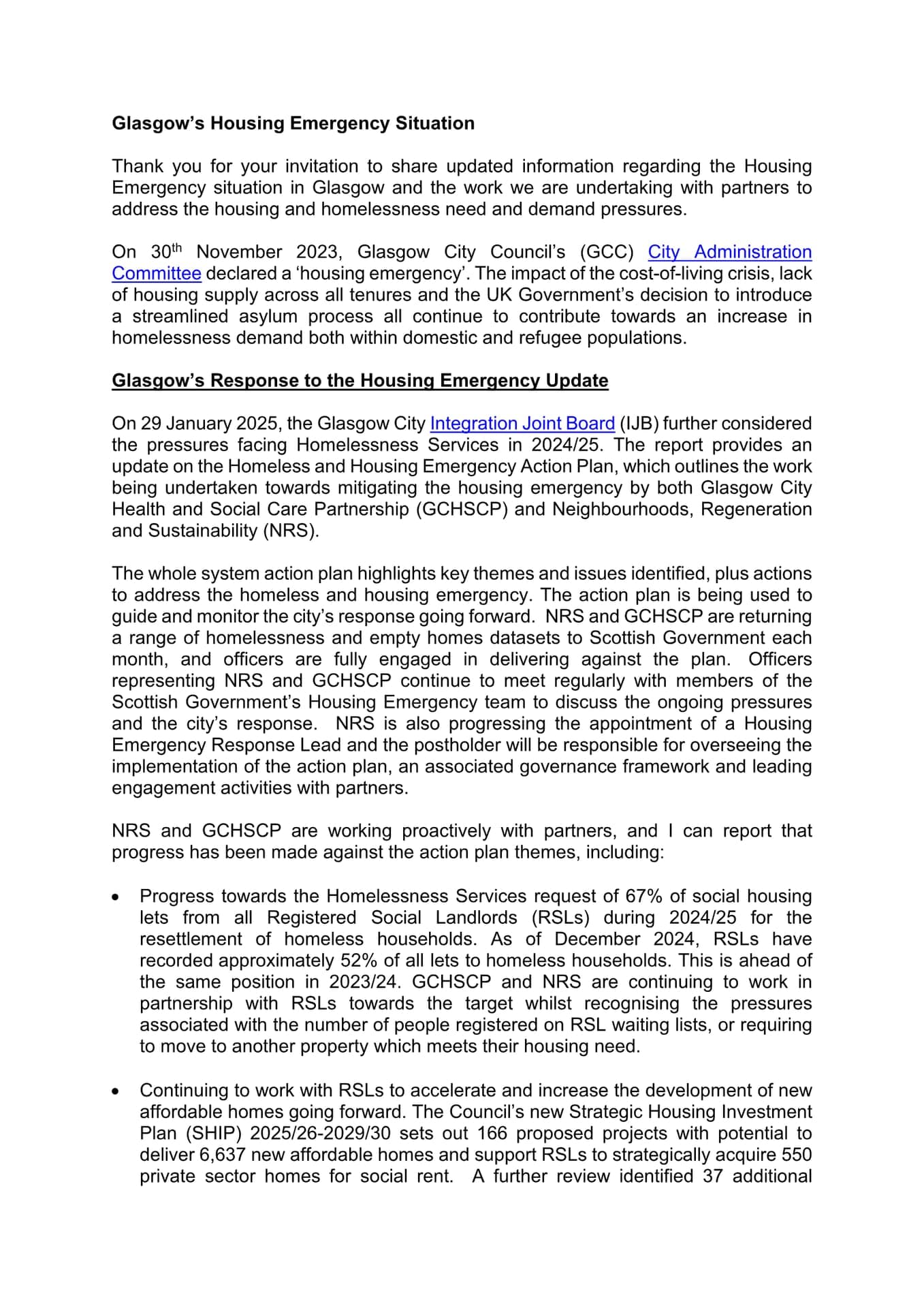
In November 2023 Glasgow’s City Administration Committee formally declared a housing emergency, citing the combined impact of the cost‑of‑living crisis, limited housing supply across tenure types and new asylum procedures that increased demand for temporary accommodation. The emergency status underpins the city’s Homeless and Housing Emergency Action Plan, which sets out targets and actions for 2024‑25 and beyond, and guides monitoring by both local and national authorities.
Progress on Social‑Housing Lettings
The council aims for 67 % of social‑housing lets from registered social landlords (RSLs) to be allocated to homeless households in 2024‑25. By December 2024, RSLs had recorded roughly 52 % of such lets, indicating progress above the previous year’s levels. This increase is part of a broader effort to accelerate the resettlement of homeless families into stable, long‑term homes.
Strategic Housing Investment Plan (SHIP) Figures
Glasgow’s SHIP 2025‑30 outlines 166 projects that could deliver 6,637 new affordable homes and facilitate the acquisition of 550 private‑sector properties for social rent. An additional review identified 37 opportunities capable of adding 4,321 homes. However, development costs have risen sharply – a 56 % increase per unit between 2017/18 and 2023/24, and a further 6 % rise in the most recent year. The average development cost per new RSL property in 2023/24 was £245,476, with grant approval averaging £180,936, representing a 52 % premium over Scottish Government benchmarks.
New Build and Adaptable Units
During 2024‑25, 847 new‑build units are expected, including five larger family homes (4+ bedrooms), 43 three‑bedroom units and 67 wheelchair‑adaptable homes. Funding cuts to the Affordable Housing Supply Programme (AHSP) have reduced the number of units likely to receive approval to fewer than 350 for the financial year, though restoration of funding for 2025‑26 is planned.
Private‑Sector Acquisitions and Funding
In September 2024 the Scottish Government confirmed an extra £11.544 million for 2024‑25 to support RSLs in acquiring private‑sector properties for temporary accommodation or long‑term void reuse. By February 2025, 37 units had been settled at a cost of £4.2 million, with a further £5.1 million earmarked, and 64 void properties slated for reuse at a grant cost of £2.2 million.
Housing Transfer Incentive Scheme
A transfer incentive scheme encourages households occupying larger homes to move to appropriately sized properties, freeing up larger units for homeless families. As of February 2025, three transfers were completed and 18 potential transfers awaited offers.
Empty‑Home Reuse Progress
Efforts to bring empty homes back into use have yielded 475 private‑sector homes reclaimed in 2024‑25, with a target of around 600 homes by March 2025. Workshops and policy discussions focus on compulsory purchase orders and legislative reforms to accelerate this process.
Homelessness Statistics Snapshot
- Live homeless applications: 6,600 (up 3 % since June 2024)
- Households in temporary accommodation: 4,100 (up 9 %)
- Households in B&B or hotel accommodation: 1,570 (up 14 %)
- Homeless households with children: 1,309 (up 10 %)
- Children in temporary accommodation: 3,503 (up 13 %)
Sustainable Housing Outlook
The report highlights the scale of Glasgow’s housing crisis while outlining concrete, data‑driven initiatives aimed at expanding affordable stock, improving the efficiency of existing housing assets and reducing reliance on temporary accommodation. The rising construction costs and funding constraints underscore the need for sustained investment and innovative policy solutions to achieve long‑term, sustainable housing outcomes for the city’s most vulnerable populations.