
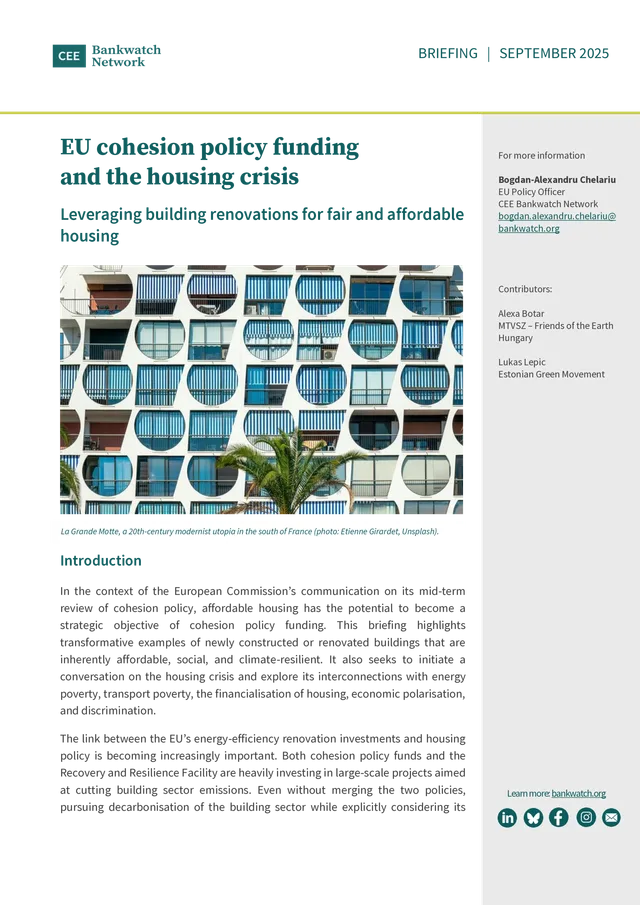
Overview of the Resource
This briefing, authored by Bogdan‑Alexandru Chelariu, Alexa Botar and Lukas Lepic and published by the CEE Bankwatch Network, examines how EU cohesion policy funding can be leveraged to address the housing crisis through building renovations. It highlights the links between affordable housing, energy‑efficiency upgrades, and broader climate goals, drawing on case studies from the Czech Republic, Estonia, Slovakia and Hungary.
EU Policy Context
The European Commission’s mid‑term review of cohesion policy positions affordable housing as a potential strategic objective. Cohesion funds and the Recovery and Resilience Facility are already investing heavily in large‑scale renovation projects aimed at cutting emissions from the building sector. However, the briefing notes that housing‑related considerations remain under‑integrated in many national energy and climate plans.
Findings on National Plans
- Czech Republic: Acknowledges rising housing costs and includes limited support for low‑income households, but lacks concrete strategies and impact assessments.
- Estonia: Highlights maintenance grants for low‑income residents, region‑targeted aid where property values are low, and a municipal housing fund, yet offers few mitigation measures for climate‑vulnerable stock.
- Hungary: Provides special grants for families, especially with children, and mandates energy audits for apartment blocks, but does not fully analyse housing‑crisis mitigation.
- Slovakia: Uses census data to identify homes lacking insulation and outlines renovation schemes, but provides no comprehensive emissions analysis or dedicated housing chapter.
Positive Examples from the Field
- Powerpoor (Estonia): Empowers energy‑poor citizens through joint energy initiatives, training apartment‑association mentors and linking renovation financing with community‑based energy projects.
- SOFTacademy (Estonia): A neighbourhood‑level renovation of the Mustamäe district combines building upgrades, public‑space improvement and a “right to stay” approach to curb displacement and price pressure.
- URBACT Good Practice (Slovakia): Revitalises residential courtyards in Trnava with community gardens and public spaces, generating social cohesion and reducing housing pressure in adjacent districts.
- Housing First (Czech Republic, Brno): Provides immediate housing to homeless families, achieving 96 % retention after one year; suggests future standards should embed high energy‑efficiency requirements.
Key Data and Facts
- Cohesion policy and the Recovery and Resilience Facility together target large‑scale building sector decarbonisation, but specific housing outcomes remain unclear.
- Estonia’s home‑ownership rate is around 80 %, with limited affordable rental options, underscoring the need for renovation‑driven affordability.
- The European Investment Bank aims to deliver one million affordable, sustainable homes across the EU by 2030, with Estonia highlighted as a priority.
- Studies cited show short‑term gas consumption drops of 7 % in the first year of insulation, falling to 2.7 % in the second, with rebound effects limiting long‑term savings.
- In France, renovation costs range from €19 to €46 per square metre, yet only 66 000 homes were renovated in 2022, far below the target of 370 000 per year.
Recommendations for Policymakers
- Develop renovation projects in partnership with citizens, turning apartment‑building associations into energy communities and expanding interventions to neighbourhood scales.
- Use renovation programmes to promote housing equity, stabilising living conditions and reducing speculative market pressures.
- Align deep‑renovation standards with heat‑pump readiness and decarbonised electricity to maximise emissions cuts.
- Implement robust monitoring and independent evaluation mechanisms, involving universities and state agencies to track social and climate outcomes.
Implications for a Pan‑European Audience
The briefing underscores that while EU funding streams are substantial, their impact on affordable, sustainable housing hinges on integrating housing criteria into national plans and designing renovation projects that simultaneously address climate, social equity and community resilience. By learning from the highlighted case studies and adopting the outlined recommendations, European stakeholders can better harness cohesion policy to mitigate the housing crisis and advance the continent’s climate objectives.