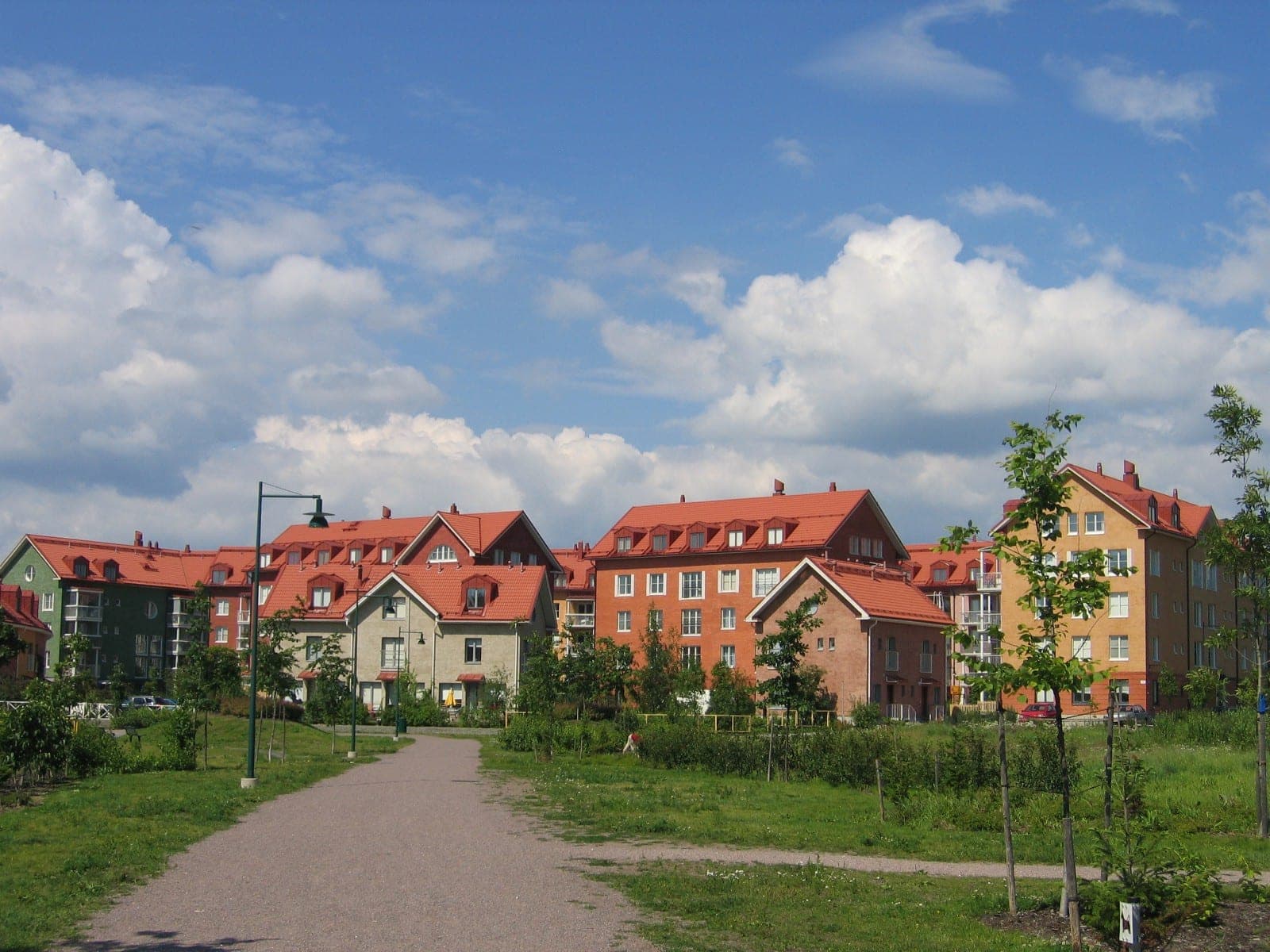
A city of arrivals, and a building site gone quiet
Most people who arrive in Finland by air land in Vantaa. Helsinki Airport sits inside the city boundary, and the suburbs around it have become among the most international in the country. 29.9% of residents now speak a mother tongue other than Finnish or Swedish, and for six years in a row the population has grown only because of them. Vantaa was a rural parish until the 1970s. Its housing question is therefore less about heritage than about arrival: where newcomers land, and at what price.
Ownership and renting are almost evenly matched. 50% of households own their home, usually as shares in a housing company, and 47% rent. The public and non-profit tier holds 9.8% of dwellings, about 11,200 homes. Its core is VAV, the city's own rental company. Private landlords let 37.2% of the stock. The remaining 3% sits outside the two main census categories, mostly right-of-occupancy homes, Finland's nearest thing to a cooperative, plus a few other arrangements. Vantaa has no conventional cooperative sector to add.
- Owners
- Owner-occupier50.0%
- Renters
- Public & non-profit rental9.8%
- Cooperative0.00%
- Private rental37.2%
- Other3.0%
- Right-of-occupancy / other3.0%
In Finland, social housing is a condition attached to a loan rather than a landlord. Homes built with state interest-subsidy loans from ARA (the Housing Finance and Development Centre of Finland, merged into the Varke centre in 2025) keep cost-based rents and means-tested allocation. In Vantaa 22.5% of dwellings carry that covenant. The share is more than twice the public tier because it also covers flats owned by national non-profits such as the Y-Foundation. Eligibility is broad: 48% of households would qualify on income. The way in is narrow. Varke's 2025 review of rental markets lists 9,298 applicants for subsidised flats in Vantaa, 23% of them in very urgent need. Only 62 new subsidised flats were completed in the city in 2024.

The rent ladder is short. A tenant in the city's own stock pays about €13.80 per square metre a month. Right-of-occupancy residents pay a use-charge of €14.80, some 15% below comparable market rents. The median across all tenancies is €16.65, and a newly signed private lease asks €17.44. Only furnished mid-stay flats break away, at €29.60 gross with bills included. The top of the ladder is also coming down. Rents on newly let free-market flats fell by nearly 6% in 2025, according to the city's own accounts.
- Public/municipal housing
- Right-of-occupancy (use-charge)
- All-stock median
- New contracts
- Furnished / serviced (gross)
Monthly rent per square metre by tier, net of bills except the furnished tier (gross, all-in). The regulated floor and the market median sit less than €3 apart; only furnished mid-stay lets break away.
There is more empty space in offices than in homes. 18.2% of office floor space is vacant, about 188,155 square metres, and 71 office buildings stand wholly empty. Across the capital region, office vacancy reached a record 18% at the end of 2025. Housing is fuller. Census data put dwelling vacancy at 3%, or 11,557 empty dwellings, and the rental vacancy rate at 4.5%. The subsidised stock is almost full: only 1.3% of it stood empty.
People keep coming. The city records about 14,500 people moving in each year, and roughly 15,000 mid-term residents staying three to twelve months. Building has not kept pace. Only 474 homes were completed in 2025, down from 975 a year earlier and an average of 3,116 a year in 2020–2023. The city's 2025 accounts headline the section with the words "housebuilding has completely stalled". Starts picked up only to 651. Private rents are set freely, so the regulated tier is the only brake on price.
The crisis here is narrow and deep rather than broad. Across Finland, 4.5% of people spend more than 40% of disposable income on housing. That share rises to 14.8% in the lowest income fifth, and renting households spend 25.8% of their income on housing on average. Applicants to VAV earn an average of about €1,650 a month. Middle-income renters have had some relief as market rents fall. The strain sits at the bottom. The number of homeless people in Vantaa rose from 269 in 2024 to 384 in 2025, while single homelessness nationally grew by 20%. Yle's February 2026 report on the rise described it as a reversal of Finland's best-known social success. European research on the deteriorating position of market renters and on racial discrimination in rental housing suggests who is most exposed in a city this international. City hall frames the issue chiefly as segregation between districts.
Finland managed to eliminate homelessness caused by income poverty, but now the tide has turned.Between the city landlord and the open market lies a thin middle layer, and it is the closest Vantaa comes to cooperative housing.
Right-of-occupancy: the co-op Vantaa has instead
The Finnish default is not a cooperative. Most flats are held through the asunto-osakeyhtiö, the limited housing company that owns a block while each household owns shares tied to one flat. That is ownership in all but name. The form closest to a cooperative is asumisoikeus, or right-of-occupancy. A resident pays a deposit of 15% of the flat's index-linked price, then a monthly use-charge set at cost. In return they get an indefinite right to stay, and the deposit comes back, index-linked, when they leave. Nobody can sell the flat on at a profit. Varke's 2025 review of the tenure counts 5,819 such homes in Vantaa. Member-owned housing cooperatives (asunto-osuuskunta) barely exist.

That absence has a history. Vantaa grew out of the parish of Helsinge and became a market town in 1972 and a city in 1974, swelling on estates built for families moving to the capital region. Myyrmäki began to rise in the 1960s and central Hakunila's tower blocks in the 1970s, in the era of the Arava state housing loans introduced in 1949. Finland did build state-backed housing cooperatives in those decades. As a study by Pellervo Economic Research notes, they were later converted into ordinary housing companies. Right-of-occupancy arrived in the early 1990s as a publicly financed middle tenure, not as a member movement. Vantaa's other contribution was civic: in 1985 it co-founded the Y-Foundation with Helsinki, Espoo, Tampere and Turku.
Today the sector falls into three groups with different problems. The largest is the institutional right-of-occupancy owners. TA-Asumisoikeus holds 30% of the national stock, Asuntosäätiö (the Housing Foundation, founded in 1951) 29% and Avain Asumisoikeus 15%. TA-Yhtiöt builds both right-of-occupancy and rental homes in the new district of Kivistö. All of them allocate through a national queue-number register, with 45,000 valid numbers in 2025. Their problem is money: the government stopped financing new right-of-occupancy homes after 2025. The second group is the non-profit specialists, led by the Y-Foundation, whose group owns 19,135 homes across Finland. The third, self-organised housing, is close to empty. When Vantaa offered six group-building plots in 2012, it received no applications at all. Helsinki's state-backed cooperative pilot of 2016 found, in a study of its three projects, that municipal land policy judged co-ops not social enough, not long-term enough and not lucrative enough.
The state therefore treats these tenures as instruments of the subsidy system, not as member institutions. Their fate is set by loan authorisations and budget lines rather than by residents. An international typology of affordable cooperative housing links the form's growth to supportive institutions and public policy. In Finland both of those now run through a tighter national budget.
Loans, a tram and a city that wants to steer
The national government of Petteri Orpo, a centre-right coalition in office since 2023, has kept subsidised building going while pruning the system around it. For 2025 it authorised €1.75 billion in interest-subsidy loans, including €680 million for right-of-occupancy homes. ARA stopped being an independent agency on 1 March 2025. Its work moved to Varke (the Centre for State-Supported Housing Construction), which sits inside the Ministry of the Environment. From January 2026 the off-budget State Housing Fund was abolished, and a 0.5% one-off guarantee fee now applies to new loans. The 2027 budget proposal lowers the loan authorisation again. The general housing allowance was cut in April 2024, when the share of costs it reimburses fell from 80% to 70%. Kai Mykkänen, the minister for climate and the environment, argued in January 2025 that with construction still weak, "it is important to get planned building projects moving".
Each level of government holds a different lever. The state sets the loans, the allowance and tenancy law. The Helsinki region negotiates with the state through the MAL agreement, a land-use, housing and transport pact signed for 2024–2035 in December 2024. Its long-term aim is 16,500 new homes a year across the region, with about 10,000 a year expected in 2024–2027, and state-supported homes made up 35% of regional completions in 2024. The city owns land, plans districts and runs VAV. Its mayor, Pekka Timonen, launched a new strategy in January 2026 promising "an investment model in Vantaa with which we will proactively dictate the city's growth, planning, and new construction" (Vantaa's 2026 city strategy). The strategy names the light-rail corridor through Hakunila, Tikkurila and Aviapolis as the main site for future homes and jobs.
There is no Vantaa programme for cooperatives. The instruments that exist are national: interest-subsidy loans for rental and right-of-occupancy building, and the cost-rent covenant that comes with them. With right-of-occupancy funding closed to new projects, that middle rung is no longer growing. Providers of affordable housing object to the direction of travel. KOVA, the federation of Finnish affordable housing companies, called the closure of ARA and the State Housing Fund "hasty decisions". It warned that folding the fund into the state budget removes a tool future governments could use to revive construction.

Office vacancy has not yet produced a conversion policy. Office building has stopped instead: 44,192 square metres of offices were completed in 2024, against just 1,125 in 2025. Where empty commercial land meets housing, the city's answer so far is rezoning for demolition and new building rather than conversion. At Kielotie 7 in Tikkurila, the owner has asked to rezone an office and retail block so that 8- to 12-storey apartment buildings can replace it. European work on reclaiming vacant spaces for housing shows what a deliberate conversion route would look like. Vantaa has not taken it.
The climate targets run through the same estates. Vantaa aims to be carbon neutral by 2030, defined as an 80% cut in emissions on 1990 levels. Emissions in 2024 were a provisional 776 kilotonnes of CO2 equivalent, 8% lower than a year earlier. The EU's recast buildings directive requires the average primary energy use of homes to fall by 16% by 2030. Much of that saving has to come from the concrete blocks of the 1960s and 1970s, where VAV and the non-profits are the landlords. Research on climate adaptation in public, cooperative and social housing treats such landlords as the natural channel for retrofit money.
The argument is less over whether the state should subsidise housing than over the machinery it uses. Jouni Parkkonen, executive director of KOVA, sees the dismantling of ARA as a mistake without precedent. Mykkänen's case is that the loans still flow and that projects need to start. Vantaa sits between them, with a stalled private market and a waiting list of thousands.
This may be the first time that state administration has gone against the current in this way: abolishing a significant agency and folding its functions into the work of a ministry.- 1949[source]
Arava state housing loans
Finland passes the Arava legislation, the state loan system that financed much of the post-war suburban stock and later became ARA.
- 1972–1974[source]
From parish to city
The rural municipality of Helsinge becomes the market town of Vantaa in 1972 and a city in 1974.
- 1985[source]
Y-Foundation founded
Vantaa co-founds the Y-Foundation with Helsinki, Espoo, Tampere and Turku, the body behind much of Finland’s Housing First stock.
- 2015[source]
Ring Rail Line and the Kivistö fair
The Ring Rail Line opens with a station at Kivistö on 1 July, and the national housing fair is held in the new district.
- April 2024[source]
Housing allowance cut
The general housing allowance reimburses 70% of eligible costs instead of 80%, and the basic self-contribution rises.
- December 2024[source]
MAL agreement 2024–2035 signed
The state and the Helsinki region sign a land-use, housing and transport pact naming the Vantaa tram as the region’s top project.
- March 2025[source]
ARA becomes Varke
The state housing agency is wound up and its work moves to a new centre inside the Ministry of the Environment.
- June 2025[source]
Tram construction begins
Work starts on the 19 km light-rail line from Mellunmäki via Tikkurila to the airport.
- 2025[source]
Housebuilding at a record low
Only 474 homes are completed in Vantaa, against an average of 3,116 a year in 2020–2023.
- 2029[source]
Tram due to open
Passenger service on the Vantaa light rail is scheduled to begin, opening the corridor the city strategy plans its new housing around.
- 2030[source]
Carbon-neutral target
Vantaa aims to cut emissions by 80% from 1990 levels, the city’s definition of carbon neutrality.
From the Arava state loans that built the suburbs to the tram and the climate target the city is now planning around.
The places where these choices will become buildings are strung along a tramline that does not yet run.
Along the tramline, from Kivistö to Hakunila
The Vantaa light rail is the city's bet on its own future. The 19 km line will run from Mellunmäki metro station through Hakunila and Tikkurila to the airport. Construction began in June 2025 and passenger service is due in 2029. In February 2026 the council approved a €110 million loan guarantee for the depot, by 45 votes to 22. The strategy expects most new homes to follow the tracks. None of the projects below is a finished answer. Together they show what the city has to build with.
Kivistö is the precedent. The district grew around a Ring Rail Line station that opened in July 2015, the same year it hosted the national housing fair, which drew 138,756 visitors. TA-Yhtiöt offers right-of-occupancy and rental homes there, alongside private blocks. By the end of 2032 the wider Kivistö area is expected to house close to 30,000 residents. It proved that rail can pull a new district out of fields within a decade. It also shows the limit: most of its growth depended on the private market that has now stalled.
VAV is the institution that keeps building when others stop. The city's own landlord owns nearly 12,000 rental homes, and one in ten Vantaa residents lives in one. In April 2026 it signed a €17 million design-and-build contract for two apartment blocks of about 110 rental homes in Aviapolis, the business district around the airport. Work is due to begin in the third quarter of the year. Its chief executive, Mirka Saarholma, puts the case simply: "even amid the changes, there is still strong demand for affordable housing in Vantaa". VAV's constraint is the state loan line it builds with, which is shrinking.
Hakunila is where the city is testing whether investment can undo segregation. Its 1970s towers stand on the eastern stretch of the new tramline. Since early 2025 an anti-segregation action programme has steered investment towards Hakunila, Koivukylä and Myyrmäki. Tero Anttila, deputy mayor for the urban environment, has said that "it is important for Vantaa as a city that all our areas are vibrant and pleasant to live in". In Martinlaakso, in the west, the city is planning to replace existing rental buildings at Raappavuorenrinne with seven blocks of 7 to 13 storeys. Renewal of this kind adds homes. It also carries the familiar risk of displacing the tenants it is meant to serve.

Pähkinärinne in west Vantaa opened in 2013 as the city's first Housing First unit, built on the principle that a home comes before treatment rather than after it. It belongs to the model the Y-Foundation carried nationwide and that the European Housing First guide now teaches. In 2024 Vantaa had about 250 places in supported housing units, centred on the Koisotie campus. The rising count of homeless people shows that the model needs a steady supply of ordinary flats to work.
Asuntosäätiö and its peers form the patient layer beneath all of this. Asuntosäätiö owns about 18,000 homes in more than 30 municipalities, most of them right-of-occupancy. KOVA speaks for the affordable landlords, and ARA, now Varke, has financed the cost-rent stock since the Arava era. A comparative review of cost-based social rental housing in Europe places Finland's model among the durable ones, and the Tenth Overview of Housing Exclusion in Europe shows how rare its homelessness record has been. For a city built by and for arrivals, these are the pieces it can build on, provided the money that holds them together keeps flowing.
References
Statistics15Click on any number to see the source
Housing market
Tenure & affordability
Adaptive reuse & vacancy
Population & migration
From our library18
- Y-Foundation (Y-Säätiö) — Organisation
- Asuntomarkkinakatsaus 1/2025: Vuokra-asuntojen markkinat (Varke) — Knowledge
- Housing affordability and poverty in Europe: on the deteriorating position of market renters — Knowledge
- Double punishment: the racial discrimination in Europe’s rental housing market — Knowledge
- Asunto-osakeyhtiö (General Finnish Housing Cooperative Model) — Organisation
- Asuntomarkkinakatsaus 2/2025: Asumisoikeusasunnot (Varke) — Knowledge
- TA-Yhtiöt (TA-Yhtymä Oy) — Organisation
- Housing cooperatives and the contradictions of Finnish land and housing policies — Knowledge
- Affordable Cooperative Housing: An International Typology, Supportive Institutions and Public Policies — Knowledge
- The future lives in Vantaa: Vantaa's city strategy (City of Vantaa, 2026) — Knowledge
- KOVA (Finnish Affordable Housing Companies' Federation) — Organisation
- Reclaiming Vacant Spaces to Tackle Housing and Homelessness Crises in Europe — Knowledge
- Climate adaptation in public, cooperative, and social housing in Europe — Knowledge
- Vantaa acts to prevent segregation in Hakunila, Koivukylä and Myyrmäki (City of Vantaa, 2025) — Knowledge
- Housing first guide Europe — Knowledge
- ARA (Housing Finance and Development Centre of Finland) — Organisation
- Cost-based Social Rental Housing In Europe — Knowledge
- Tenth Overview of Housing Exclusion in Europe — Knowledge
Further sources39
- Vantaa interim report 1/2026 — City of Vantaa
- Asuntomarkkinakatsaus 1/2025: vuokra-asuntojen markkinat — Varke
- Asuntomarkkinakatsaus 2/2025: asumisoikeusasunnot — Varke
- Vantaa financial statements 2025 — City of Vantaa
- Office vacancy in the capital region at a record level (2025) — City of Helsinki
- Housing-cost burden, income distribution statistics 2024 — Statistics Finland
- VAV statement on government proposal VN/5542/2026 — VAV
- Homeless people 2024 — Varke
- Asunnottomat 2025 — Varke
- Asunnottomina nyt myös nuoret ja vanhukset (18 Feb 2026) — Yle
- History of Vantaa — City of Vantaa
- Hakunila — Wikipedia
- Arava — Wikipedia
- PTT Report 254 (Forsström-Tuominen, 2016) — Pellervo Economic Research PTT
- Y-Säätiö — Wikipedia
- Our holdings — Y-Säätiö
- Group-building plots in Vantaa draw no applicants (9 Mar 2012) — Yle
- State-supported housing production keeps construction going (16 Jan 2025) — Finnish Government
- Year-end changes in the Ministry of the Environment’s branch (22 Dec 2025) — Finnish Government
- Ministry of the Environment budget proposal for 2027 — Finnish Government
- General housing allowance cut in 2024 — Kela
- MAL agreements signed (13 Dec 2024) — Finnish Government
- MAL monitoring review 2025 — HSY
- KOVA: closing Ara and the State Housing Fund are hasty decisions (24 Jun 2024) — KOVA / STT Info
- Kielotie 7 zoning change 002611, participation and assessment plan (6 Mar 2026) — City of Vantaa
- Vantaa environmental responsibility report 2024–2025 — City of Vantaa
- Energy Performance of Buildings Directive (recast) now in force — Matheson
- Vantaa tram construction begins (23 Jun 2025) — Yle
- Council backs tram depot loan guarantee (Feb 2026) — Yle
- Kivistö railway station — Wikipedia
- Asuntomessut — Wikipedia
- Kivistö — TA-Yhtiöt
- Toivo signs €17m design-and-build contract for VAV in Aviapolis (16 Apr 2026) — Inderes
- About VAV — VAV
- Current zoning projects — City of Vantaa
- Yksi kerrostalo muiden joukossa — Vantaa and Kerava wellbeing services county
- Homelessness in Vantaa (17 Oct 2024) — Yle
- About Asuntosäätiö — Asuntosäätiö
- Statistics 2025 — Finavia