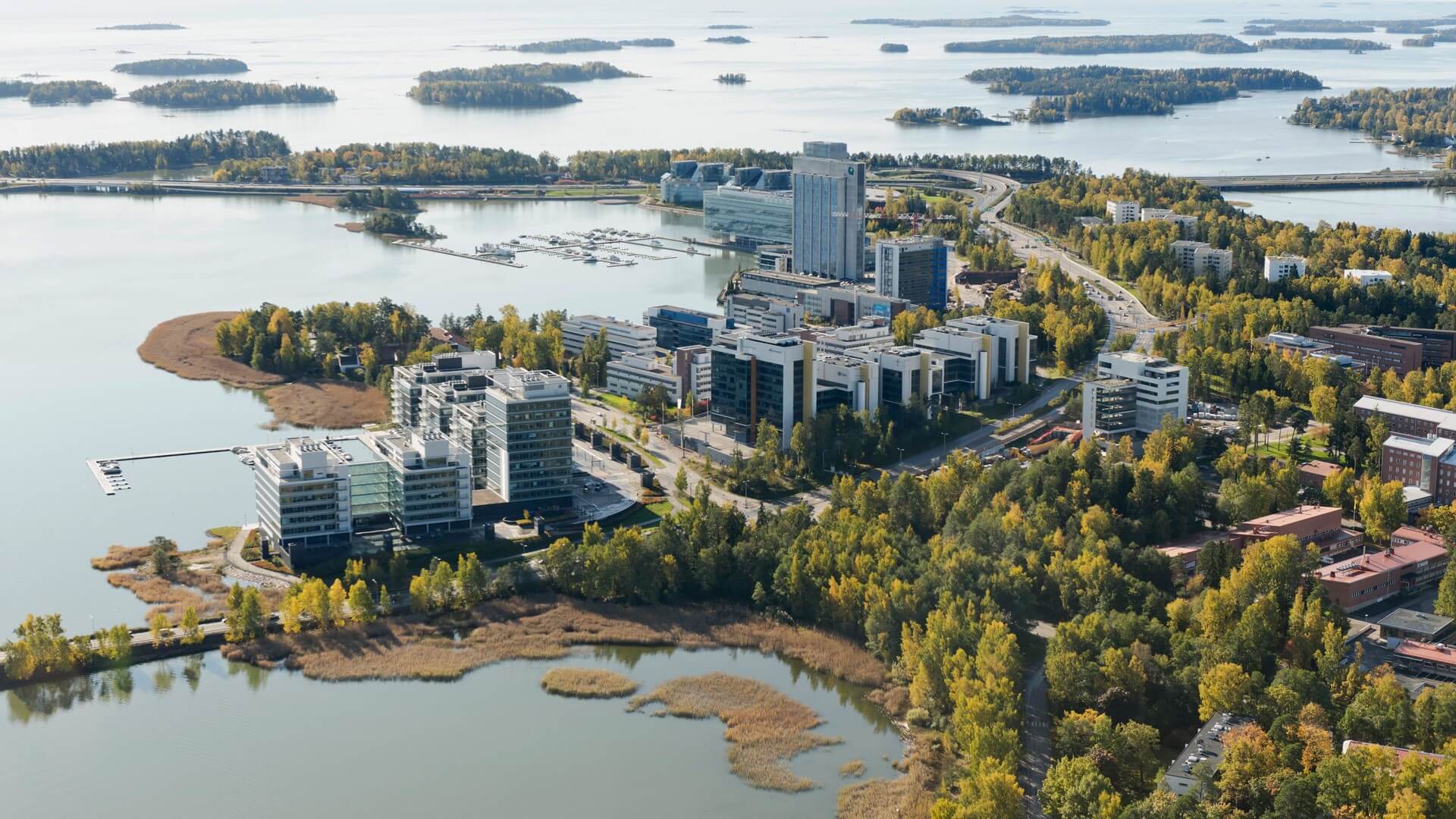
A garden city grown into a metropolis
Espoo grew from a rural parish into Finland's second-largest city within living memory, and it never acquired one dense old centre. It is a coastal city of forests, research campuses and company headquarters, organised around several urban hubs along the metro and the coastal railway. That loose shape began as a housing idea. In the 1950s a non-profit foundation built Tapiola here as a model of a socially mixed garden city, and mixing tenures has stayed the city's instinct. Today 325,716 people live in Espoo, and 25.9% of them have a first language other than Finnish, Swedish or Sámi.
Ownership is the majority tenure, but not by much. 56% of households own their home, most of them as shareholders in an asunto-osakeyhtiö (a limited housing company in which each flat is a block of shares). 41% rent. The largest landlord is the city itself. Espoon Asunnot, its wholly owned rental company, held about 16,200 homes in 2023, or 11.2% of the stock. Private landlords and investors own roughly 29.8% of homes. Finnish statistics have no separate cooperative tenure. The closest form, the right-of-occupancy flat, sits in the small remaining slice of about 3%.
- Owners
- Owner-occupier56.0%
- Renters
- Public & non-profit rental11.2%
- Cooperative0.00%
- Private rental29.8%
- Other3.0%
- Right-of-occupancy / other3.0%
Social housing in Finland is a set of rules rather than a type of landlord. About 18.5% of Espoo's dwellings were built with state subsidy and still carry its conditions: rents that only cover costs, and tenants chosen by need. The loans were granted by ARA (the state housing finance agency), whose role now sits with Varke (the Centre for State-Subsidised Housing Construction). This layer runs across tenures rather than forming one. It covers Espoon Asunnot's homes, subsidised rentals owned by nationwide non-profits and most right-of-occupancy flats. The cost-rent principle behind it is one of the models compared in a study of cost-based social rental housing in Europe. The income limits reach far up the scale: an estimated 42% of households would qualify.
Rents climb in shallow steps. The city company charged an average of €14.8 per m² a month in 2023. The median across all private leases is €17.52, and a newly signed private lease costs €18.51. The top step is steeper. A furnished flat let for a few months runs to an estimated €31.5 per m², and a furnished one-bedroom flat to about €1,450 a month. Buying costs about €4,034 per m² for a flat in an apartment block.
- Public & non-profit (Espoon Asunnot)
- All-stock median (private)
- New-let (private)
- Mid-stay serviced (estimate)
Monthly rent per square metre by tier. The city landlord sits about €3.7 below a new private lease, a narrow gap by European standards. Short furnished lets are the only tier far above the rest.
Homes are rarely empty in Espoo; offices often are. Only 2.8% of dwellings stood vacant in 2023, and the rental vacancy rate was 4.2%. Eurostat's census count of 12,497 dwellings without a usual resident is wider, because it includes flats between tenants and second homes. Commercial space tells a different story. 18.2% of office floor space was vacant in 2025, about 0 m². Short-term letting is a small factor, with an entire one-bedroom flat averaging €95 a night.
Demand keeps arriving from abroad and from Aalto University's campus in Otaniemi. Espoo grew by 4,785 people in 2025. About 17,800 people move in each year, and some 22,000 stay for between three and twelve months. Construction has not kept pace. Completions fell from 3,268 homes in 2024 to 2,426 in 2025, and only 1,867 homes were started. Plans approved in 2024 contained just 17,300 m² of new residential floor space, against a yearly average of 310,000 m² since 2016. The city still expects about 4,400 completions a year over the decade to 2034.
The crisis here is real but uneven. Private rents have gone flat: non-subsidised rents across Finland rose just 0.2% in 2025, while subsidised rents in Greater Helsinki rose 3.9%. Espoon Asunnot lifted its own rents by an average of 4.75% that year. The strain is concentrated among low earners and people living alone, the groups that the homelessness count and the waiting list capture. Homelessness is small but stubborn: 404 people living alone were homeless in Espoo in 2024, the third-highest count in Finland. Europe-wide reviews such as the Tenth Overview of Housing Exclusion in Europe set figures like these in context. The waiting list is lengthening against the national trend. Applications for state-subsidised rentals fell 22% across Finland, yet Espoon Asunnot's list grew 10.5% to 9,608 households by July 2026. The company now has more than 17,000 homes and about 35,000 residents.
The need for affordable homes has not disappeared. We have many applicants, and we cannot offer a home to everyone.Between owning and renting sits a Finnish middle way, and the foundation that built Tapiola is still one of its main providers.
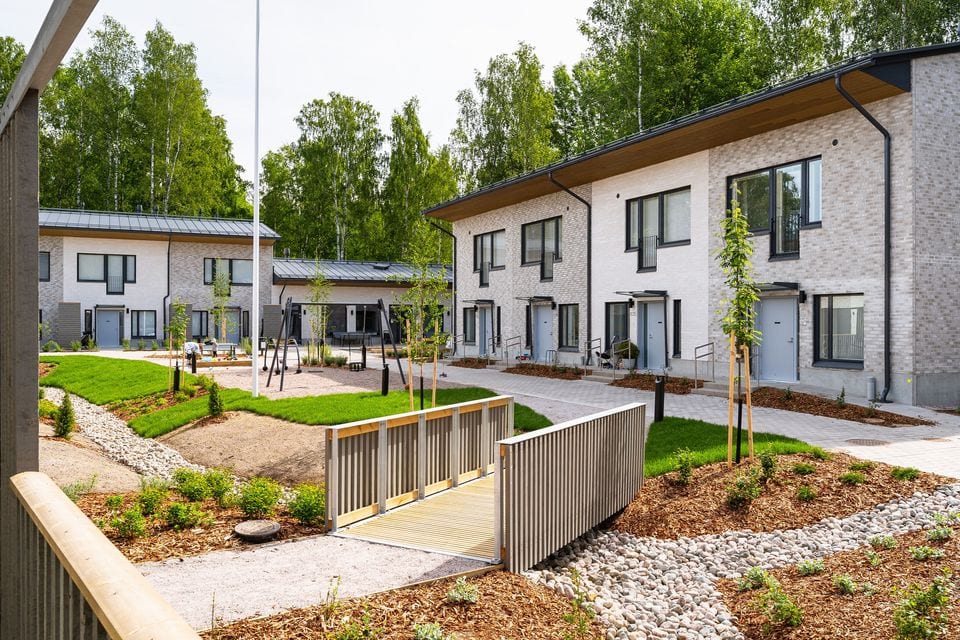
Right of occupancy: the Finnish middle way
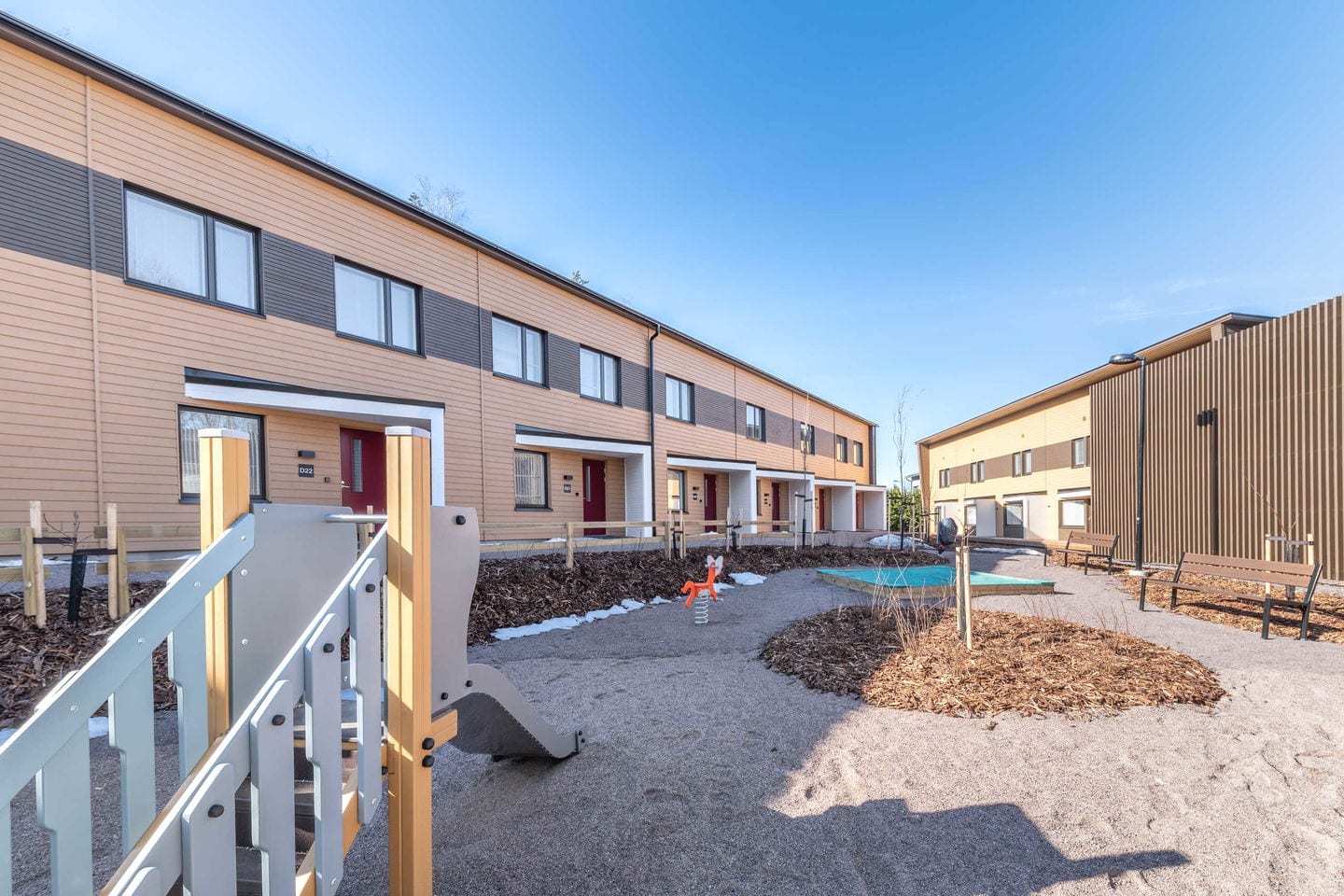
Finnish cooperative housing is a hybrid. Nearly every block of flats is run as a limited housing company whose shareholders are its residents, so self-management is routine for owners. The form closest to a non-profit cooperative is asumisoikeus (right-of-occupancy housing). A household pays a one-off right-of-occupancy fee of 15% of the flat's price, then a monthly charge, the käyttövastike (a cost-based user charge set by the non-profit owner). The fee is returned when the household moves out, and the owner cannot end the contract. The model is one of the limited-equity forms set out in an international typology of affordable cooperative housing.
The local story starts with Asuntosäätiö (the Housing Foundation). Six civic organisations, including the trade-union confederation and the tenants' central organisation, founded it in 1951. Its director, the lawyer Heikki von Hertzen, bought forest land west of Helsinki and set out to build a garden city for every social class. Building began in 1953. The foundation kept and managed homes instead of selling them, and when Finland created right-of-occupancy tenure it became one of the largest providers. A study of housing cooperatives and the contradictions of Finnish land and housing policies places that arc in its national setting.
The sector today falls into three clusters. The first is the large non-profit providers. TA-Yhtiöt is headquartered in Espoo's Nihtisilta and owns more than 20,000 homes in 48 locations across Finland, and Asuntosäätiö offers right-of-occupancy homes in more than 30 locations. Both belong to KOVA (the federation of affordable rental and right-of-occupancy landlords), alongside municipal companies such as Espoon Asunnot. The second cluster is the thousands of self-managed housing companies in which owner-occupiers hold shares. The third is small resident-led housing cooperatives, which are rare in Espoo; neighbouring Helsinki has a handful, such as Koskelan Lehmus. Their problems diverge. The right-of-occupancy providers face the end of state support for new production after 2025, a national stock of about 65,000 homes and state loan and guarantee liabilities of about €6bn. The government names empty right-of-occupancy flats as its largest risk, because use restrictions stop owners converting them. The housing companies, by contrast, carry the renovation and energy-retrofit bills of an ageing stock alone.
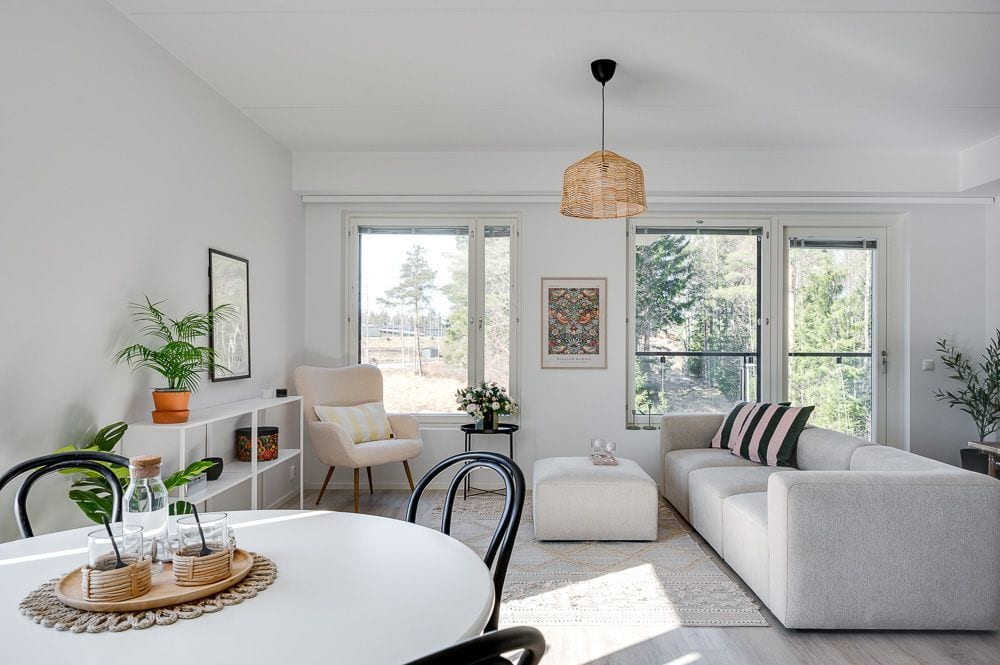

Espoo slots these providers into a mixing rule. Its housing and land-use principles of June 2023 ask for about 20% of new homes to be state-subsidised, counting right-of-occupancy, with at most 15% as long-term subsidised rentals. Plots are allocated so that no block or neighbourhood becomes a concentration of subsidised homes. That rule now sits at the centre of the city's politics.
Who the new homes are for
National policy under Prime Minister Petteri Orpo has swung twice. In February 2024 the government raised the state's interest-subsidy lending authority to €2.25bn for that year, to keep builders working while private construction froze. It set €1.75bn for 2025 and a lower €2bn in total for 2026 and 2027. Support for new right-of-occupancy projects was wound down. For 2026 the authority stands at €1.135bn, aimed mainly at ordinary rental and student housing. The September 2025 budget talks then cut it by a further €365m from 2027.
The government is temporarily speeding up state-subsidised production at a time when non-subsidised housing production is frozen and employment in the sector is weakening. If housing construction stalls completely, the growth centres could soon face a housing shortage. State-subsidised production should be timed to even out the business cycle.Each tier of government holds a different tool. Parliament and the Ministry of the Environment set subsidy law and budgets, and Varke grants the loans. The MAL agreement (a land-use, housing and transport deal between the state and the Helsinki region's municipalities) links state money for rail to local housing targets. Espoo holds the land and the plans. Under the 2020–2023 agreement it promised 3,300 homes a year, 30% of them state-subsidised. It built 20,724 homes in those four years, but only 18% were subsidised. In 2024 and 2025 the balance flipped: 39% of 5,694 completions were subsidised, because private developers pulled back while state-backed schemes kept building.
Espoo's council is divided over what that means. In February 2026 councillor Mikko Laakso and 25 colleagues asked why more than 45% of the homes finished in 2025 were state-subsidised, over double the council's target. The City Board's reply, presented by Olli Isotalo (head of the urban environment department), blamed the downturn and plans signed years earlier. It promised that plots would not be allocated in ways that create concentrations. Mayor Kai Mykkänen's administration works to the Espoo Story 2025–2029, the council's strategy, which aims to add owner-occupied homes. Unions and non-profit landlords see the opposite danger. Päivi Inberg is President of SuPer (the Finnish union of practical nurses). After the 2025 budget talks she warned that the cut "especially undermines the opportunities of low-income earners, such as practical nurses and childcare workers, to access reasonably priced rental housing".
The city's own instruments are land and contracts. It leases or sells plots to non-profit builders and writes the tenure mix into each maankäyttösopimus (a land-use agreement signed with a private landowner before rezoning). It also sets targets for its own landlord. Espoon Asunnot was meant to start 300 homes a year, but it now expects about 180 a year in 2026–2028. A comparative review of land policy instruments for social and affordable housing sets these tools against those of other European cities.
Offices are the clearest surplus, and Espoo answers it by rezoning. Between 2015 and 2024 the city's zoned reserve of business premises shrank by about a fifth as plan changes turned workplace areas over to housing. In 2023, 82% of the building stock that was removed was office, industrial or commercial space. Kera, a former logistics district beside the coastal railway, is the largest such switch. Research on the adaptive reuse of existing buildings in urban Europe describes the multi-phase management that such conversions demand.
Climate rules now shape every new block. Espoo aims to be carbon neutral by 2030. Since January 2026 Finland's Building Act has capped the carbon footprint of new blocks of flats at the permit stage, and the limits tighten in 2029. Espoon Asunnot holds each new project to 16 kgCO2e per m² a year over a 50-year life. The city adopted a nature roadmap, Luontoviisas Espoo (Nature-wise Espoo), in 2025. Non-market landlords are where these duties land first, a task set in a wider frame by a review of climate adaptation in public, cooperative and social housing in Europe.
- 1951[source]
Asuntosäätiö founded
Six civic organisations found the Housing Foundation, which buys forest land in Espoo for a garden city.
- 1953[source]
Tapiola begins
Construction starts on Tapiola, planned as a mix of social groups and housing types.
- Nov 2017[source]
The metro reaches Tapiola
The western metro extension opens, linking Tapiola and southern Espoo to Helsinki by rail.
- 2019[source]
Kera logistics centre empties
The Inex logistics centre moves out of Kera, freeing 27.3 hectares for a new district.
- Jun 2023[source]
Housing and land-use principles
The council asks for about 20% of new homes to be state-subsidised and bars concentrations of subsidised housing.
- Feb 2024[source]
State lending boosted
The government lifts interest-subsidy authority to €2.25bn for 2024 to counter the construction slump.
- Feb 2025[source]
Kai Mykkänen becomes mayor
The former climate and environment minister takes office for a seven-year term.
- End 2025[source]
Right-of-occupancy support ends
State production support for new right-of-occupancy homes stops, leaving a national stock of about 65,000.
- Jan 2026[source]
Carbon limits for new buildings
Carbon-footprint limit values apply to permit applications for new blocks of flats.
- Feb 2026[source]
Council question on subsidised share
Councillors challenge a 2025 output in which more than 45% of completed homes were state-subsidised.
- 2027[source]
Deeper subsidy cut
Interest-subsidy authority for state-supported housing falls by €365m.
- 2029[source]
Carbon limits tighten
The building carbon-footprint limits become stricter.
- 2030[source]
Carbon-neutral Espoo
The city's target year for carbon neutrality.
- 2034[source]
Supply horizon
The city forecasts about 4,400 completions a year through 2034.
From the foundation that built Tapiola to the subsidy debate of 2026 and the targets ahead.
From Tapiola to Kera: seventy years of mixing
Tapiola Garden City is still the reference point. Asuntosäätiö began building it in 1953 with the architects Aarne Ervi, Viljo Revell, Aulis Blomstedt and Markus Tavio, and later Alvar Aalto and Kaija Siren designed parts of it too. The brief was a microcosm of Finnish society. Detached houses, terraces and towers stood side by side, for families with children and for single people. The district covers about 3.5 km². Finland's heritage agency has called it the largest and most valuable example of 1960s building ideals in the country. Espoo's present rule against subsidised-housing concentrations echoes it.
TA-Yhtiöt carries the same non-profit idea at national scale from its Espoo base. It builds, owns and manages rental and right-of-occupancy homes. Its 88 right-of-occupancy flats on Likusterikatu in Suurpelto were finished in early 2024, and Suurpelto was again among the districts where most homes were finished in 2025. Together with Asuntosäätiö it shows what the right-of-occupancy model built: mixed buildings where residents hold a stake without buying the flat.
Suvela shows the city landlord at its most ambitious. For more than a decade Espoon Asunnot and the city have replaced outdated rental blocks in this neighbourhood of Espoon keskus with energy-efficient homes, including the Kirstinharju block. In 2023 ARA gave the work its Housing Pioneer award. Its director general, Hannu Rossilahti, said the renewal "can be used as an example for eliminating or alleviating segregation in other areas as well".
Espoon Asunnot also works at the sharpest end of the market. It offered 274 homes to homeless applicants in the first half of 2025 alone. That work follows Finland's Housing First model, championed nationally by the Y-Foundation (Y-Säätiö) and set out for other countries in the Housing First Guide Europe. A permanent flat with its own lease comes first, and support follows.

Kera turns an emptied logistics hub into a neighbourhood. The Inex distribution centre left for Sipoo in 2019. For six years its halls were let for temporary use, from events to small businesses, by the landowner, the retail cooperative S Group. Construction began in 2023, and the district is planned for about 16,000 residents. The city wants Kera to become an internationally interesting model area for the circular economy, built on low-carbon solutions and nature-positive design.
References
Statistics16Click on any number to see the source
Housing market
Tenure & affordability
Adaptive reuse & vacancy
Population & migration
From our library15
- Asunto-osakeyhtiö (General Finnish Housing Cooperative Model) — Organisation
- Espoon Asunnot Oy — Organisation
- Cost-based Social Rental Housing In Europe — Knowledge
- ARA (Housing Finance and Development Centre of Finland) — Organisation
- Tenth Overview of Housing Exclusion in Europe — Knowledge
- Asuntosäätiö (The Housing Foundation) — Organisation
- Affordable Cooperative Housing: An International Typology, Supportive Institutions and Public Policies — Knowledge
- Housing cooperatives and the contradictions of Finnish land and housing policies — Knowledge
- TA-Yhtiöt (TA-Yhtymä Oy) — Organisation
- KOVA (Finnish Affordable Housing Companies' Federation) — Organisation
- Land Policy Instruments for the Provision of Social and Affordable Housing — Knowledge
- Adaptive Reuse: A Multiphase Management Analysis of Existing Buildings in Urban Europe — Knowledge
- Climate adaptation in public, cooperative, and social housing in Europe — Knowledge
- Housing first guide Europe — Knowledge
- Y-Foundation (Y-Säätiö) — Organisation
Further sources27
- Espoo population at the end of 2025 — City of Espoo · 2026
- About Varke — Varke
- Toimintaympäristön tila Espoossa 2025: maankäyttö, rakentaminen ja asunnot — City of Espoo · 2025-09-18
- Slightly over 2,400 new dwellings built in Espoo last year — City of Espoo · 2026-01
- Homeless people 2024 — Varke · 2025
- Espoon Asuntojen tyhjien asuntojen määrä puolittui — Espoon Asunnot Oy / STT Info · 2026-09-14
- Konserniraportti Espoon merkittävimmistä yhteisöistä, tammi–kesäkuu 2025 — City of Espoo · 2025
- Non-subsidised rents rose by 0.2 per cent in 2025 — Statistics Finland · 2026
- Right-of-occupancy housing — Ministry of the Environment
- The advantages of right-of-occupancy — Asuntosäätiö
- Tapiola Garden City — Docomomo Finland
- Selvitys asumisoikeuskannan taloudellisesta tilanteesta on valmistunut — Finnish Government
- TA-Yhtiöt — TA-Yhtiöt
- Valtuustokysymys Espoon asuntotuotannosta ja korjaavista toimenpiteistä (City Board 11.5.2026 § 159) — City of Espoo · 2026-05-11
- Government begins budget talks amid rising inter-party tensions — Yle News · 2025-09-01
- Statligt stöd särskilt för byggande av studentbostäder år 2026 — Finnish Government · 2026-01-15
- Talouspoliittinen ministerivaliokunta linjasi valtion tukeman asuntorakentamisen vauhdittamisesta — Finnish Government · 2024-02-20
- SuPer's Inberg on the government budget session — SuPer · 2025-09-03
- Kai Mykkänen takes office as Mayor of Espoo 1 February 2025 — City of Espoo · 2025-01
- Kera to become an ecological district along the railway line — City of Espoo · 2021-08
- Limit values for the carbon footprint of buildings in force from 9 January — Confederation of Finnish Construction Industries RT · 2026-01
- Tapiola — Wikipedia
- Asumisoikeusasunnot, Likusterikatu 3, Suurpelto, Espoo — TA-Yhtiöt
- Housing development efforts by City of Espoo and Espoon Asunnot Oy recognised with ARA award — City of Espoo · 2023-05
- Sustainable Kera — City of Espoo
- Adventures in Finland’s second-largest city: day trip to Espoo — MyHelsinki
- Nuuksio National Park — Wikipedia