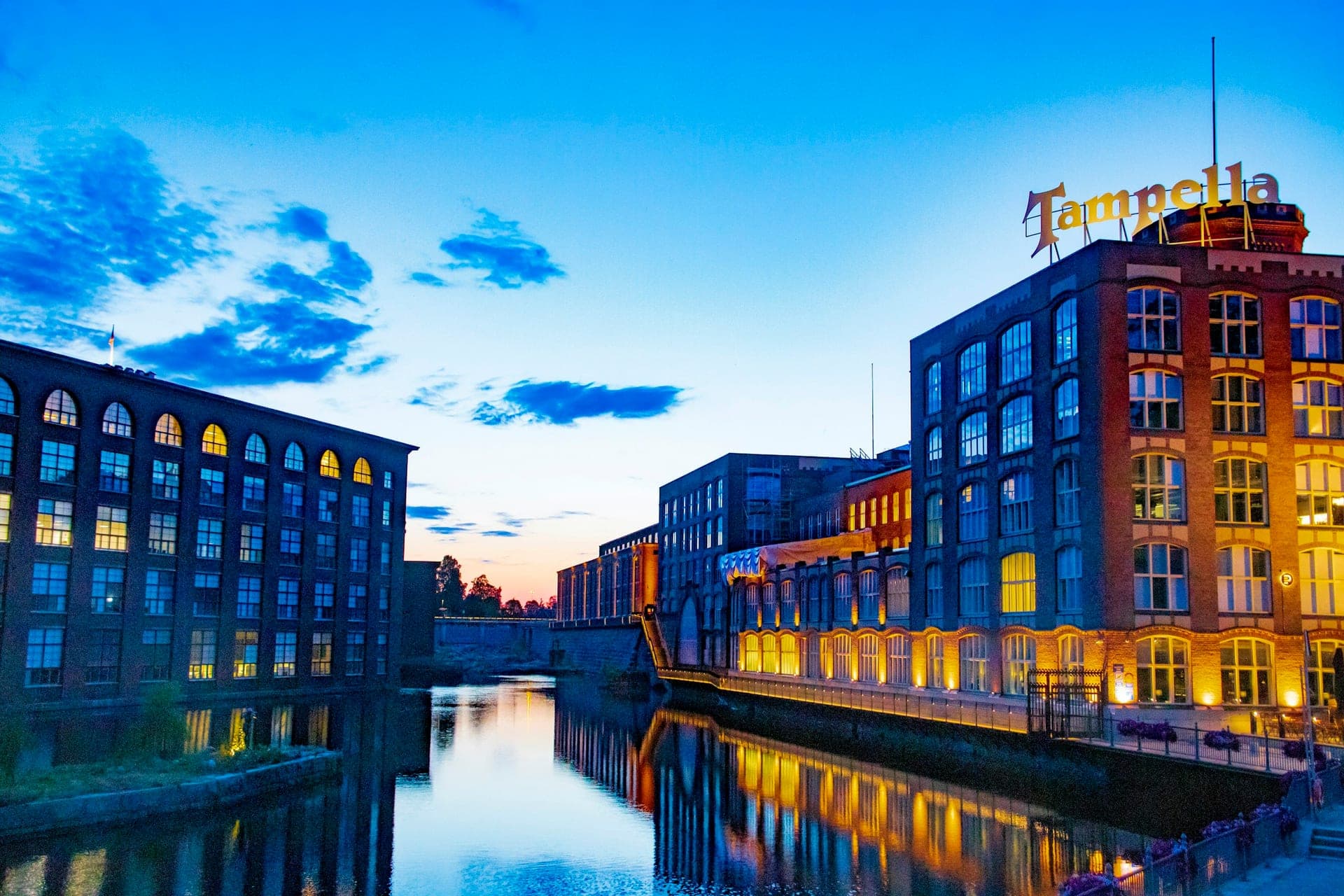
Mill town, studio capital
Tampere grew up on the Tammerkoski rapids, where water falling from one lake to another drove the cotton mills that made it Finland's industrial city. Mill hands needed homes, and on the Pispala ridge many built their own. That mix of lake, factory and self-reliance still frames the housing question. Today the question is less whether the city builds than what kind of homes a fast-growing university and technology city has been building.
Tampere is a renters' city by Finnish standards. About 49% of households rent, while 48% own their home, almost always as shares in an asunto-osakeyhtiö (a limited-liability housing company that owns the block). The city's rental group counted about 10,800 homes, or 8.9% of the stock. Private landlords let the largest rented slice, around 40.1%. The remaining 3% is mostly asumisoikeus, the right-of-occupancy tenure that is Finland's closest relative of a housing cooperative. Tampere had 4,254 right-of-occupancy homes in 2025, the fourth-largest stock of any Finnish municipality.
- Owners
- Owner-occupier48.0%
- Renters
- Public & non-profit rental8.9%
- Cooperative0.00%
- Private rental40.1%
- Other3.0%
- Right-of-occupancy / other3.0%
Social housing in Finland is a financing rule, not a tenure. About 21% of Tampere's dwellings were built with state-backed loans that tie rents to costs and set rules on who may move in. That layer reaches across the city's own flats, the student homes of TOAS, right-of-occupancy blocks and non-profit rental from national landlords. It is therefore more than twice the public-tenure share. On income, around 55% of households would qualify. A comparison of cost-based rental in Austria, Denmark and Finland explains how these rents follow a building's costs rather than the market.
The price ladder is short at the bottom and steep at the top. The city's own landlord charges around €12.90 per square metre a month. The median across all tenancies is €15.89, and a newly signed private lease asks €17.07. A furnished flat let for about six months is estimated at €29 gross. Size matters more than tier here: studios let for a median €22.9 per square metre at the end of 2025.
- Public/municipal housing
- All-stock median
- New contracts
- Furnished mid-stay (serviced, gross)
Monthly rent per square metre by tier: net of utilities except the furnished mid-stay tier, which is gross and an EHC estimate (new-let rent × 1.7). The regulated city stock sits a little below the market median; the steep step is to furnished short lets.
Empty space is modest in homes and larger in offices. Residential vacancy stood at 3.2%, and Eurostat counts 12,246 empty dwellings, many of them between tenants or awaiting sale. Among rental flats the vacancy rate was 3.5% in 2024. Offices are emptier: 13.9% of office floor space stood vacant, about 143,944 square metres. Holiday letting barely registers, with about 607 active listings on the two main platforms.
Demand has come from people. The city gained 5,308 residents in 2024, and about 15,200 people move in every year. Builders answered with a boom. Nearly 5,500 homes were started in 2021, 42% of them studios. Then interest rates rose and starts fell to about 1,900 in 2025. The boom's flats are now on the market, and Finland sets no cap on private rents. In January 2026 a 40-square-metre flat in the centre asked €590 a month, about €70 less than a year earlier.
Tampere has the dubious honour of being Finland’s studio-flat capital.Cheaper studios have not ended the squeeze; they have shifted it. Across Finland, tenants spend a median 25.8% of income on housing, owners 13.2%. In the lowest income fifth, 14.8% of people carry an excessive housing-cost burden. Among tenants paying market rent, 12.3% spend more than 40% of disposable income on housing, while the middle of the income scale is largely spared. The hardest edge is visible on the street: Tampere counted 468 single homeless people in 2025, up from 259 in 2021. Worry runs wider than hardship. 34% of Finns say they are greatly worried about rising housing costs. Eurofound's study of unaffordable housing finds the same insecurity among Europe's private renters, and the 2025 pulse survey of Europe's mayors shows housing climbing their list of concerns.
Between the private market and the city's own flats, the tier that offers security without speculation is small. Right-of-occupancy homes make up roughly one home in thirty, and Tampere has almost none of the member-owned cooperatives found in Zurich or Copenhagen.
A cooperative tier without cooperatives
Finland's cooperative impulse lives in two forms, and neither is a classic co-op. The dominant one is the asunto-osakeyhtiö. Residents buy shares in the company that owns their block and run it together, but the shares trade at market prices. The second is asumisoikeus. A resident pays a right-of-occupancy fee of 15% of the home's index-linked price, then a monthly käyttövastike (a use charge set at cost). In return they gain a secure right to stay, but they cannot sell at a profit. Charges in Tampere rose 4.6% in a year, yet still ran slightly below the rents of state-subsidised flats.
The local history is one of workers building for themselves. On the Pispala ridge, factory and construction workers put up wooden houses without a unified plan, before the area joined Tampere in 1937. The poet Lauri Viita, who grew up there, remembered them going up “lengthwise, crosswise, diagonally”. Finland had housing cooperatives as early as the 1800s, but they stayed small once the housing company became the normal way to own a flat. Right-of-occupancy arrived around 1990 as a state-financed middle tenure. A historical study of cooperatives, housing systems and the state reads the wider Nordic story as a drift towards commodification once regulation loosened.
Today the tier falls into three clusters. The largest is institutional. Six right-of-occupancy companies operate in Tampere, among them TA-Asumisoikeus, Asuntosäätiö and Avain, the three biggest nationally. They share one problem: state loans for new right-of-occupancy blocks end after 2025, and a 2026 government bill would replace the national queue with first-come allocation. The second cluster is cost-rent student and non-profit housing. TOAS, the regional student-housing foundation, lets 7,234 homes with 10,802 bed-places at an average €13.9 per square metre. National non-profits such as Y-Säätiö and A-Kruunu build in the new districts. The third cluster barely exists: resident-led groups. No asumisosuuskunta (a member-owned housing cooperative) is known to operate in the city. Their obstacle is different, namely land and finance for groups with no developer behind them. A study of Finnish housing cooperatives traces how unclear eligibility and time-limited affordability rules have kept such pilots rare.
City policy towards that third group is ambivalent. Its 2026 plot offer promises concept calls for community-oriented housing and names group self-build and cooperative housing as goals. Yet the new housing guidelines give plot sales to cooperatives and group-build projects less weight than before. Resident-led housing appears in the city's plans, but not yet at the centre of its affordability programme.
Studios, subsidies and a shrinking state
Tampere's council has been led since June 2025 by Mayor Ilmari Nurminen of the Social Democrats, with deputy mayors from the Greens, the National Coalition Party and his own party. Housing sits with Deputy Mayor Jaakko Mustakallio of the Greens, who chairs the housing and real-estate committee. The city's housing and land guidelines for 2026–2029 aim to enable at least 10,000 homes, about 2,500 a year. At least 30% are to be affordable, meaning state-subsidised or built by the city's own housing companies. Draft rules would cap any single flat type at 40% of a new building, a direct reply to the studio boom.
The money and the law come from Helsinki, the land and the plans from city hall. ARA, the agency that financed Finnish social housing for decades, was wound up on 1 March 2025. Its tasks moved to Varke (the State-Subsidised Housing Construction Centre) inside the Ministry of the Environment. The ceiling for new interest-subsidy loans falls from €1,135 million in 2026 to €500 million in 2027. Housing allowance was cut in April 2024 to cover 70% of eligible costs instead of 80%, and recipient households fell to about 382,000 by December 2024. Between state and city sits the regional MAL agreement on land use, housing and transport, running to 2035. It commits the Tampere region to at least 13,400 homes in 2024–2027.
For cooperative-style housing the instruments are narrowing. The state stops approving subsidised loans for new right-of-occupancy blocks after 2025, so the tier can now grow only on the city's terms. The city's remaining levers are its land: leasing plots on affordability conditions, running concept tenders scored on quality rather than price, and steering its own companies' building. A comparative analysis of approved-housing-body models places Finland's non-profit providers among Europe's more developed. That is why a change in how they are financed matters well beyond one programme.
The empty offices have one worked answer so far. A draft local plan would let the former office of the Lapinniemi cotton mill, a 1924 building by Birger Federley, become housing throughout. Office vacancy in the city rose from 10% to over 15% in 2023–2024. There is no city-wide conversion programme and no tax on empty homes. So far the lesson of the glut has gone into flat-mix rules rather than into reuse policy.
Climate goals set a second test. Tampere aims to be carbon neutral by 2030, cutting emissions 80% from 1990 levels and offsetting the rest. From 2026 the city applies a life-cycle carbon limit when it sells or leases plots for blocks of flats. It also wants wooden frames in 30% of new blocks of flats by 2030, up from 14% in 2020. Non-profit and city landlords build most of the demonstrators, as a systematic review of circular social-housing design would predict.
The public argument turns on the studios. Mustakallio accepts that the market overshot. From the rental trade, the broker Vesa Rinne of Vuokraturva told Yle that landlords had seen “the marvel of rents actually having to be cut”. Tenants gain from that, investors less so. The city's answer is to diversify what gets built, and its clearest examples stand on former mill and lakeside land.
These studios were built for that demand. But it is true that we perhaps went a little too far in investor-led building during the years of low interest rates.- 1820[source]
Finlayson cotton mill founded
A Scottish industrialist, James Finlayson, founds the mill on the Tammerkoski rapids that turns Tampere into Finland’s factory city.
- 1937[source]
Pispala joins Tampere
The self-built workers’ ridge, grown without a unified plan, becomes part of the city.
- 1970[source]
City founds its rental foundation
The City of Tampere establishes Tampereen Vuokratalosäätiö (today VTS-kodit) to let homes at the lowest possible rent.
- 2021[source]
Record housing starts; tram opens
Nearly 5,500 homes are started, 42% of them studios. The first tram lines begin running in August.
- Sep 2023[source]
National right-of-occupancy queue
The reformed Right-of-Occupancy Act brings a single national queue for asumisoikeus homes.
- Dec 2024[source]
Regional MAL agreement signed
The state and the Tampere city-region agree on at least 13,400 homes in 2024–2027, with the agreement running to 2035.
- Mar 2025[source]
ARA wound up
The Housing Finance and Development Centre’s tasks move to Varke inside the Ministry of the Environment. State loans for new right-of-occupancy blocks end after 2025.
- Jun 2025[source]
New mayor
Ilmari Nurminen (Social Democrats) is elected Mayor of Tampere by the new council.
- 2026[source]
Housing guidelines 2026–2029
Target of at least 10,000 homes over four years, about 2,500 a year, at least 30% of them affordable.
- 2027[source]
Right-of-occupancy reform
A government bill would take effect, abolishing queue numbers in favour of first-come allocation from 2029.
- 2030[source]
Carbon-neutral target
Emissions are to fall 80% from 1990 levels, with the remainder compensated.
- 2035[source]
MAL horizon
The regional agreement aims for about 33,500 homes in the region and the end of homelessness.
From the mill town to the studio boom, the end of ARA and the regional targets that run to 2035.
Pulp mill, cotton mill, canal and timber
Hiedanranta, the former Lielahti pulp-mill site on Lake Näsijärvi, is the city's largest bet. The district is now planned to house 18,500 people. Its first building is a seven-storey block of 40 right-of-occupancy homes by TA-Asumisoikeus. It reuses concrete pillars, beams and hollow-core slabs taken from a Tampere building demolished in 2023, and its first residents move in during 2026. A review of circular industrialised construction treats this kind of component reuse as the next step for affordable building.
The Finlayson area, the cotton mill that gave Tampere its first industrial century, shows the slower kind of reuse. Textile production ended in the early 1990s, and the red-brick halls now hold companies, schools and museums. New buildings of some 30 thousand square metres, with about 800 residents, have filled the gaps between them. Europe's community-driven adaptive-reuse projects show how such mill quarters can carry homes as well as culture.
Ranta-Tampella, beside the old Tampella engineering works, is a canal district for 4,000 residents on the Näsijärvi shore. Building began in 2016 with YIT as developer, and the master plan, “Horisontti”, came from B&M Architects. It is mostly market housing, and it shows what the city can extract from a waterfront plot it controls.
Vuores Kuusikko carries the timber argument. Its 195 homes in four- to six-storey wooden blocks were completed in 2022 for A-Kruunu and TA-Asumisoikeus, designed by Arkworks. The surrounding Isokuusi area requires wooden façades, and Vuores as a whole is planned as a small town for 13,000 residents. It is proof that non-profit rental and right-of-occupancy can lead a building technology rather than follow it.
VTS-kodit, the foundation the city set up in 1970, remains the anchor of the affordable stock. It houses about 15,000 people in over 8,000 rental homes, let on a cost basis. Its weight grows as the state steps back, because the city's own companies count towards the city's 30% affordable target. Student housing is the other quiet success. TOAS plans 100 new homes in 2026, and in June 2026 the Hippos block opened 586 student homes, billed as Finland's largest student-housing project.
The Tampere tram, opened in 2021, links these districts together. A VTT study found land use along the line becoming denser than expected, as low commercial buildings gave way to housing. At the western end, a 2025 plan for Lentävänniemi adds about 1,540 residents as infill around 1970s blocks due for renovation. Hervanta, the concrete suburb of over 26,000 residents once known for its reputation, was named District of the Year in 2026.
ASUTUT, the sustainable-housing design group at Tampere University led by Sofie Pelsmakers, gathers more than 20 researchers on everyday homes and the energy they use. The materials for a different housing mix are on the table: mill land in public hands, a cost-rent city landlord, a tram and timber know-how. What the sauna capital still lacks is the resident-led layer that would let people build and hold homes together.
References
Statistics14Click on any number to see the source
Housing market
Tenure & affordability
Adaptive reuse & vacancy
Population & migration
From our library9
- Cost-based Social Rental Housing In Europe — Knowledge
- Unaffordable and inadequate housing in Europe — Knowledge
- Eurocities Pulse Mayors Survey 2025 — Knowledge
- Housing cooperatives, housing systems and the state. Historical lessons from Europe, Australia and Latin America — Knowledge
- Housing cooperatives and the contradictions of Finnish land and housing policies — Knowledge
- Unlocking Potential - A Comparative Analysis of Approved Housing Body Models in the European Union — Knowledge
- Circular economy strategies for the design of a social housing system: a PRISMA-based systematic review — Knowledge
- A review of circular industrialised construction for sustainable and affordable housing: Towards a process-driven framework — Knowledge
- Open Heritage - Community-Driven Adaptive Reuse in Europe: Best Practice — Knowledge
Further sources42
- Varke — right-of-occupancy housing market review 2025
- RAKLI / KTI — Tampere region property market 2026
- BnBCalc market data (Airbnb + Vrbo)
- Tampere region population review 12/2024
- City of Tampere — housing and land policy 2026–2029, annex 1 (operating environment)
- Yle, 16 January 2026
- Statistics Finland — income distribution statistics 2024
- Eurostat via Trading Economics — overburden rate, tenants at market rent
- Yle, 26 January 2026
- Danske Bank / YouGov — Financial Peace of Mind 2025
- pispala
- yle_pispala
- ksl
- aso_owners
- he156
- TOAS — annual report 2025
- tontti2026
- mayor
- committee
- City of Tampere — housing and land policy guidelines 2026–2029, annex 4
- Yle, 14 January 2026
- ara_varke
- Varke — 2026 application guide for interest-subsidy loans
- Kela — general housing allowance cuts 2024
- Kela — housing allowance recipients 2024–2025
- Tampere city-region MAL agreement 2024–2027
- lapinniemi
- City of Tampere — Climate-neutral Tampere 2030
- Finnish Government — wood construction award to Tampere, 2021
- Yle, 25 May 2025
- finlayson
- Finlayson industrial area
- Finnish Architecture — Ranta-Tampella
- Puuinfo — Vuores Kuusikko
- Wood Architecture — Vuores
- VTS-kodit
- Hippos student housing press release, June 2026
- tram
- vtt_tram
- City of Tampere — Lentävänniemi infill plan 2025
- Hervanta
- Tampere University, 9 June 2023