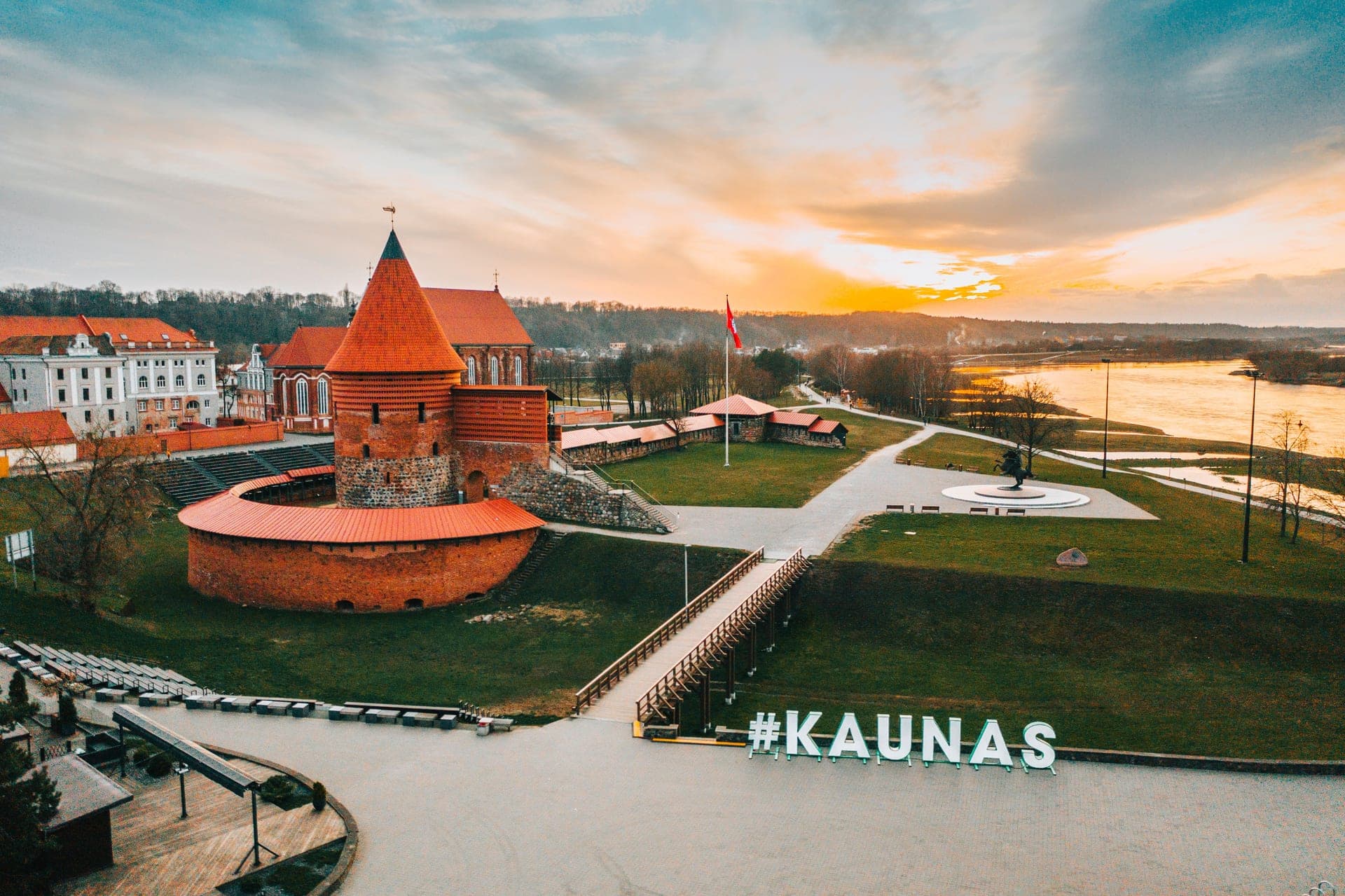
A capital's architecture, an owner-occupier's market
Kaunas spent two decades as Lithuania's stand-in capital, and it built like one. Between the wars it raised ministries, banks and apartment houses at speed, and more than 6,000 buildings in that modernist spirit still stand. The same streets now pose a quieter question. How does a city of 305,120 people, where the flats were sold to their tenants in the 1990s, house the people who arrive without the money to buy?
Owning is the norm. 84% of households own their home and 16% rent. The city is a small landlord, with about 2,500 municipal flats, or 1.7% of the stock. No cooperative tenure exists, so the whole non-market sector is that municipal slice, 1.7%. Private landlords let the other 14.3%, much of it through informal arrangements between families. The pattern is regional. A study of the housing crisis in Central and Eastern Europe places Lithuania at 88.8% home ownership, and warns that high averages hide scarcity in the cities where the jobs are.

- Owners
- Owner-occupier84.0%
- Renters
- Public & non-profit rental1.7%
- Cooperative0.00%
- Private rental14.3%
Social housing here is a way of allocating a flat, not a separate landlord. A municipal flat becomes social when it is let at a regulated rent to a household on the waiting list. That layer covers 1.7% of Kaunas dwellings and sits inside the municipal slice of the chart, not beside it. Not every municipal flat qualifies. The city let 1,219 social homes in 2023, and about 500 residents were waiting for one. Across Lithuania the average wait was 5.74 years.
Leaving that small sector means a steep climb. Municipal tenants pay about €1.1 per m² a month. The median across all rented stock is €9.1, and an advertised new contract cost about €12.1 in 2025. Furnished flats on stays of a few months, bills included, run to an estimated €20.6 per m². Buying is the bigger stretch. Flats averaged €2,071 per m² at the end of 2025, after a 13.8% rise that outpaced every other large Lithuanian city.
- Public/municipal housing
- All-stock median
- New contracts
- Furnished / serviced (gross)
Net cold rents from the municipal floor to new contracts, with the furnished mid-term segment (gross, bills and furniture included) at the top. Kaunas has no cooperative rent tier.
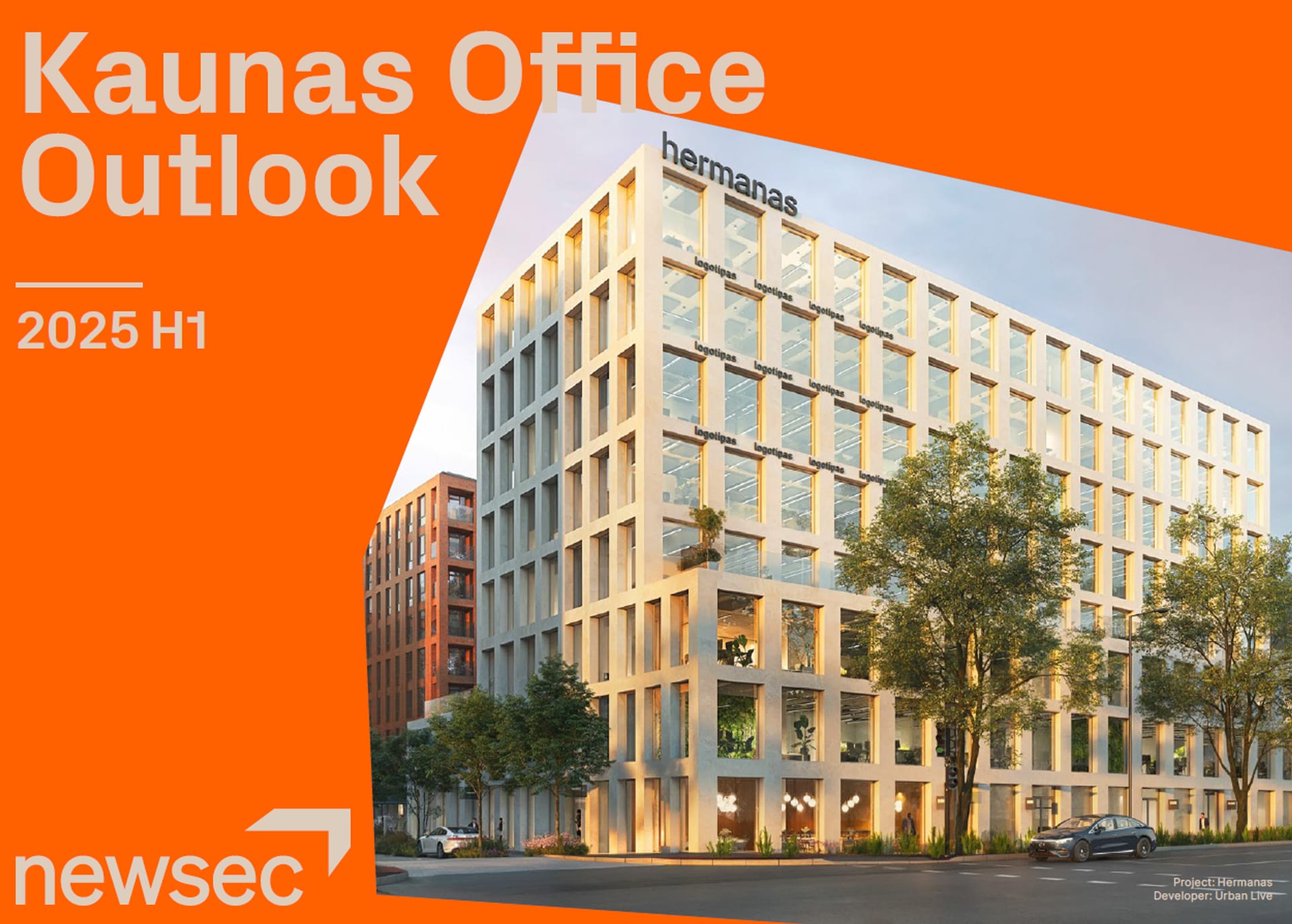
Kaunas is short of good homes more than of buildings. The 2021 census found 9% of dwellings empty, some 19,683 homes. Many are inherited Soviet-era flats or houses at the edge of town. Offices are tight by comparison. Newsec's Kaunas office outlook recorded 2.3% vacancy across 277,300 m² of office space in mid-2025, with a forecast of 5-6% as new blocks open. Spare office floors are not yet a housing reserve.
Demand has returned after decades of decline. About 5,800 people move to the city each year, and an estimated 12,000 students, trainees and contract workers stay for three to twelve months. New supply has lagged. Ober-Haus reports that completions of flats fell two years running, and many families build instead in Kaunas District, where land is cheaper. There is no rent cap and no licensing of holiday lets. A whole one-bedroom flat on a short-stay platform fetches a median €65 a night.
The burden falls hardest on people renting at market prices. In 2025, 27.4% of Lithuanian tenants paying market rent spent over 40% of disposable income on housing, far above the rate for owners. Their numbers are growing. Renting households more than doubled between 2010 and 2024, from 86,000 to 181,500, and households on state housing support rose from 5,200 to 20,600. Middle earners who want to buy now feel it too. Kaunas flat prices rose 16.4% in the year to August 2026, and the Bank of Lithuania's repeat-sales index shows a rise of more than 20%. An average Kaunas income still buys about 79 m², more than in the capital, but the margin is shrinking. Cold homes are a quieter strain. An EU open-data review of housing trends found that nearly 20% of people in Lithuania could not keep their home warm in 2024.
If housing prices keep rising faster than residents' incomes, affordability in the big cities will keep falling, and alternatives outside the city will look ever more attractive.What Kaunas lacks is a middle rung between the municipal list and the open market. In Vienna or Zürich cooperatives fill that space. In Kaunas their share of the tenure count is zero.
From the Butas house to the bendrija
Lithuania has no cooperative housing tenure today. The nearest form is the daugiabučių namų savininkų bendrija (DNSB, an association of the owners of one apartment block). It looks after the roof, the heating plant and the renovation loan. Yet every flat inside is owned outright and resold at market price. There is no member share, no resale limit and no shared asset to protect. The first Kaunas cooperatives worked the other way round: members pooled savings to build a house and then kept it together.
That idea arrived early. In 1932 judges of the Supreme Tribunal formed a cooperative to build the Butas house on Trakų street, a modernist block of nine flats by the architect Jonas Kriščiukaitis that now carries the European Heritage Label. Poorer families were housed in municipal cheap-flat colonies at fixed rents, as a history of Kaunas's cheap-flat colonies of the 1920s and 1930s records. Under Soviet rule, home-building cooperatives returned in 1962. They let employees who could save skip the state queue and build in brick, as histories of Soviet Lithuanian housing describe. The Law on the Privatisation of Flats of 1991 closed that chapter. From 1995 the building cooperatives were converted into owners' associations, according to the national encyclopaedia. Housing Europe's country review of Lithuania describes the outcome: public flats passed to sitting tenants at symbolic prices, and over 90% of dwellings were private by the end of the decade.
The collective actors of today fall into three clusters, and none is a cooperative in the European sense. The largest is the owners' associations, which run a share of the Soviet-era blocks. A second is the municipal administrators appointed where no association formed; they maintain buildings but hold no mandate to invest. The third is a small group of architects and planners pressing for non-speculative models, among them the urbanist Ignas Kazlauskas of the Vilnius agency BLUMA. Their problems differ. Associations struggle to win agreement among dozens of owners and to borrow for works. Administrators have no capital. Reformers have no legal form, no land and no lender. Research on cooperative housing pioneers in Central and South-Eastern Europe finds that finance is the hardest barrier across the region's semi-periphery, and that regulation and institutions are missing too.
The government has now named the gap. At a Ministry of Environment conference in June 2026, Kazlauskas set out a cooperative pilot: a municipality would lease land or a building on favourable terms, and the state or the city would guarantee part of the bank loan. Residents would pay a monthly charge covering the loan and upkeep, while the building stayed with a non-profit cooperative. Zürich, where cooperatives hold 18% of the housing stock, served as the model. It resembles the land-lease partnerships analysed in research on public-cooperative policy mechanisms. The idea now waits on a national affordability strategy that has yet to decide who builds the rented homes.
Renovation first, a rental tier still on paper
That strategy is due by the end of 2026. The Ministry of Environment leads on housing affordability, and its assessment published in June 2026 is the starting point. The government of Prime Minister Mindaugas Sinkevičius, approved by the Seimas (Lithuania's parliament) in July 2026, pledges more money for first-home loans and faster renovation of apartment blocks. Its implementation plan aims to renovate more than 1,100 blocks by 2028. Ownership support remains the main lever. In 2025 the previous government backed a proposal to raise the state's share of a young family's first-home loan from 10% to 15%, and to let the subsidy cover building as well as buying.
Housing powers are split between the state and the city, with no regional tier in between. The state writes the Law on Support for the Acquisition or Rental of Housing, sets subsidy rates and funds renovation through APVA (the Environmental Projects Management Agency). The Ministry of Social Security and Labour oversees the social-housing queue and rent compensation. The City of Kaunas, under Mayor Visvaldas Matijošaitis, owns the social flats and runs renovation locally. It bought 148 flats for €6.7m between 2016 and 2023, most of it with EU regional funds. In June 2026 the council adopted incentives covering up to 100% of costs for the best-scoring block renovations. The need is plain: only 7.8% of Kaunas apartment blocks, 332 of 4,263, have been renovated.
No instrument yet funds cooperative housing. There is no concept-led land tender, no ground-lease pact and no cooperative federation to deliver one. The tools closest to it are a density bonus for developers who give floor space to social housing, noted in Housing Europe's review, and the ministry's proposed pilot on leased municipal land. Speakers at the June conference also floated a municipal-housing tier between the social list and the market, and shared-ownership models.
Empty property is handled through tax rather than conversion rules. Each year the council lists neglected buildings whose owners pay a higher property tax. The 2025 list named 173 properties taxed at 3%, and national amendments now let the city charge 5%. Office-to-housing conversion is not yet on the agenda, since office vacancy is low. The reusable land is industrial and military, which is where the city's best conversions stand. European work on reclaiming vacant spaces for housing treats such buildings as a supply source rather than a nuisance.
Climate policy reaches housing mainly through heat. Nationally, 4,110 apartment blocks had been renovated by early 2025, about 14% of those eligible, and more than 30,000 still wait. The owners' associations are the delivery channel. Owners vote, the association takes the loan, and state support covers part of the works. The heat itself is being cleaned up too. The European Investment Bank lent €35m to AB Kauno energija, the municipal heating company, which aims for carbon-free heat by 2050.
- 1932[source]
The Butas cooperative house
Judges of the Supreme Tribunal complete one of the first apartment-building cooperatives in the temporary capital.
- 1962[source]
Soviet home-building cooperatives
Cooperative apartment blocks reappear, letting members who could save bypass the state queue.
- 1991[source]
Flats privatised
The Law on the Privatisation of Flats lets tenants buy their homes with cash or vouchers.
- 1995[source]
Owners' associations
Associations of apartment owners are introduced; the building cooperatives are converted into them.
- 2014[source]
Housing-support law
The Law on Support for the Acquisition or Rental of Housing sets the frame for social housing and rent compensation from 2015.
- 2016–2023[source]
Kaunas buys social flats
The city adds 148 flats to its social-housing fund with a €6.7m budget, mostly EU regional money.
- September 2023[source]
Modernist Kaunas on the World Heritage List
UNESCO inscribes the interwar city centre, putting heritage rules on thousands of homes.
- June 2026[source]
Affordability assessment published
The Ministry of Environment presents its housing-affordability assessment and a proposed cooperative pilot.
- June 2026[source]
Kaunas modernisation incentives
The council adopts a programme paying up to 100% of costs for the best-scoring block renovations.
- End of 2026[source]
National affordability strategy due
The ministry is drafting a long-term policy on access to quality housing.
- 2028[source]
Renovation target
The government aims to renovate more than 1,100 apartment blocks over 2026–2028.
- 2050[source]
Carbon-free heat
AB Kauno energija, the city heating company, aims to produce heat without CO2 emissions.
Milestones for housing in Kaunas and Lithuania, with stated targets ahead.
The debate turns on whether to help people own or to give them something decent to rent. Ministers have favoured ownership. Lawyers and planners at the June conference argued for a rental tier. Market voices, such as Svajūnas Šarauskas of Ober-Haus, point instead to a shortage of new two- and three-room flats in convenient locations.
Until now we had an indecently small sum, about €6 million, which we spread across many families, and sizeable queues formed. They still form, because the need to buy housing in the regions is really great.Social housing is intended for the most vulnerable people, but alongside it municipal housing is also needed, which could be rented to a wider group of residents who do not meet the social-housing criteria but still struggle to secure housing on market terms.Evaldas Klimas, partner at the law firm WALLESS, at the Ministry of Environment housing conference (June 2026)
While that argument runs, the working examples in Kaunas are about repair: of façades, barracks, riverbanks and Soviet courtyards.
Façades, barracks and courtyards: Kaunas mends its own
The Heritage Management Programme is the city's steadiest investment in its homes, although heritage officers run it. Since 2015 it has co-financed owners who restore the façades and roofs of listed buildings, mostly interwar apartment houses. By 2024, 197 owners had used it and the city had spent about €4.7m. That year set a record, with 62 buildings and nearly €2m. Restoration on one street tends to spread, as neighbours apply the next year. The pressure grew after UNESCO listed Modernist Kaunas in 2023, because most of the protected buildings are still lived in.
Modernism for the Future, part of the Kaunas 2022 European Capital of Culture programme, gave those residents a voice. Its "360/365" strand set out to bring 360 buildings to life in a year and recorded the stories of the people living in them. It treated owners and tenants as custodians of the heritage, not obstacles to it. That shift matters in a city where the heritage is mostly private flats.
The Šančiai barracks conversion shows what the city's military land can become. The architects G. Natkevičius ir partneriai turned a 19th-century tsarist artillery barracks into a housing quarter with a school, a kindergarten and shops. Brick vaults and high ceilings were kept rather than cleared. The final phase adds 84 flats, sold at €2,800–3,200 per m². It is market housing, so it proves the form rather than the price.
Nemunaičiai applies the same logic to a whole riverbank. The developer SBA Urban is turning an industrial strip facing the Old Town into a mixed district, with a masterplan by Schmidt Hammer Lassen due to take shape by 2031. Its first mixed-use building, Tvistas by MVRDV, reuses the old water tower as a public stair to a roof terrace. Like Šančiai, it keeps what stood on the site. Like Šančiai, it sells at market prices.
The Kaunas Housing Modernisation Agency carries the effort into the Soviet estates where most people live. Under its "warm homes, cosy courtyards" scheme, the city renews a whole courtyard, including paths, lighting, play areas and pipes, once residents vote to renovate their blocks. Planners have drawn 40 quarter schemes, starting in Vilijampolė, and a transformation strategy has been prepared for Eiguliai. The national quarter-renovation study cites that work as a model for other cities. Renovating a street at a time is slower to organise than one block, but it gives owners a reason to join.
What links these projects is repair. Kaunas is restoring façades, barracks, riverbanks and courtyards with public money and patient persuasion. The Butas house of 1932 is a reminder that the city once added a second ingredient, collective ownership, and could do so again.
References
Statistics11Click on any number to see the source
Housing market
Adaptive reuse & vacancy
Population & migration
From our library7
- Housing Crisis Threatens to Fracture Central and Eastern Europe — Knowledge
- Kaunas Office Outlook 2025 H1 — Knowledge
- Exploring housing trends with open data | data.europa.eu — Knowledge
- The State of Housing in Europe: Lithuania — Knowledge
- Cooperative Housing Pioneers in Central and South- Eastern Europe: Mainstreaming Alternatives through Translocal Networks — Knowledge
- Public-cooperative policy mechanisms for housing commons — Knowledge
- Reclaiming Vacant Spaces to Tackle Housing and Homelessness Crises in Europe — Knowledge
Further sources25
- Ministry of Environment conference on housing supply, June 2026
- Visuotinė lietuvių enciklopedija
- Ministry of Environment quarter-renovation study, February 2025
- Ober-Haus, Kaunas housing market 2025
- SA.lt, final phase of the Šančiai barracks conversion
- LRT English, September 2023
- City of Kaunas, neglected-property list 2025
- LRT on the Ministry of Environment housing-affordability assessment, June 2026
- Eurostat ilc_lvho07c, housing cost overburden by tenure, Lithuania 2025
- LRT, July 2026
- Modern Art Centre, Lithuanian cultural history
- Seimas, Law on the Privatisation of Flats (I-1374)
- Kas vyksta Kaune, July 2025
- 15min, August 2026
- ELTA via jp.lt, government implementation plan, September 2026
- BNS via jp.lt, Kaunas modernisation programme, June 2026
- European Investment Bank, September 2024
- City of Kaunas, social-housing fund project 2016-2023
- City of Kaunas, December 2023
- MVRDV, Tvistas
- Kauno istorijos metraštis, 2012
- Swedbank housing-affordability index via LRT, September 2026
- LRT / BNS, January 2024
- Seimas, Law on Support for the Acquisition or Rental of Housing (XII-1215)
- Ober-Haus apartment price index, August 2026