Overview of the Data Story
The European Data Portal presents an interactive data story titled “Exploring housing trends with open data”. It analyses recent housing developments across the EU, focusing on price dynamics, affordability, ownership patterns and energy‑efficiency improvements. The resource combines statistics from Eurostat, the European Central Bank and the European Data Portal, offering a pan‑European perspective for those interested in sustainable housing.
Rising House Prices Across the EU
Between 2015 and 2024, average house prices in the EU increased by 58 %. The growth was uneven: eight Member States saw prices more than double, while in Hungary they more than tripled. Conversely, Cyprus, Italy and Finland experienced modest or negligible price changes. Most of the surge occurred before 2021, with recent years showing stabilisation or slight declines in several countries.
Affordability and Cost‑Overburden Rates
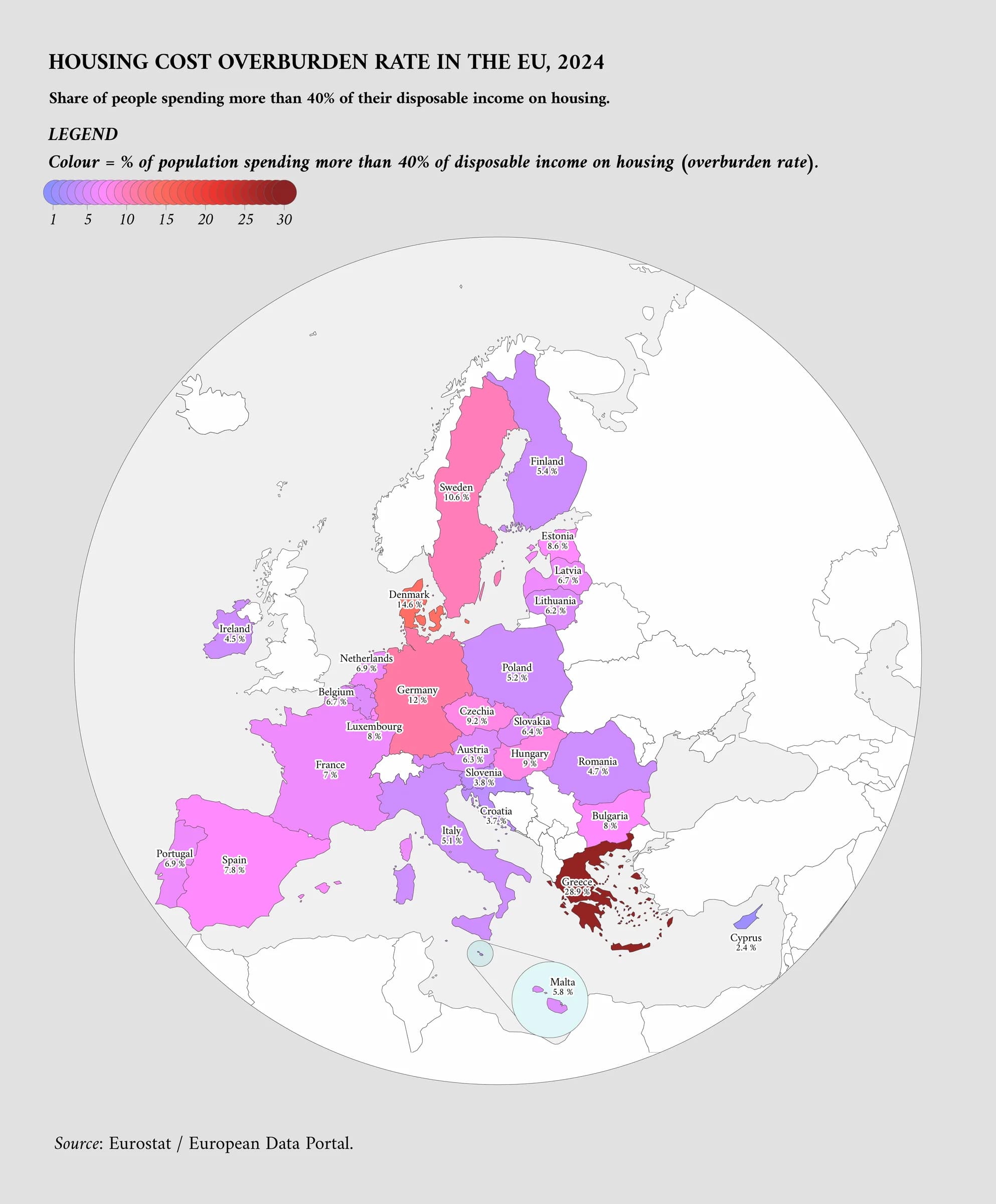
Affordability is measured by the share of households spending over 40 % of disposable income on housing. The EU average stands at 8 %, but national differences are stark. Greece records the highest burden at 29 %, and Denmark follows with 14.6 %. The lowest rates are found in Slovenia (3.8 %), Croatia (3.7 %) and Cyprus (2.4 %). Urban areas generally exhibit higher overburden rates than rural regions.
Ownership vs. Renting Trends
Homeownership remains dominant, yet varies widely. Germany (47 % owners) and Austria (55 %) have the lowest ownership shares, reflecting strong rental markets and tenant protections. In contrast, Romania, Slovakia, Hungary and Croatia exceed 90 % homeownership, a legacy of 1990s privatisation. From 2014 to 2024, tenancy grew in most Member States, with Malta and Luxembourg seeing the largest rises (≈12 and 9 percentage points). Conversely, nine countries, notably Poland and Hungary, experienced modest ownership gains (3.6 and 3.4 points).
Energy‑Efficiency Progress and Challenges
Energy efficiency is a key sustainability indicator. In 2024, 9 % of EU residents reported being unable to afford adequate heating; the figure jumps to nearly 20 % in Bulgaria, Greece and Lithuania. Renovations that improve energy performance reached 18 % of people at risk of poverty versus 28 % of those not at risk. The Netherlands leads with 59 % of dwellings upgraded, followed by Estonia at 47 %. Malta (8 %), Greece (12 %) and Spain (15 %) lag behind, partly due to milder climates. Generally, wealthier households benefit more from efficiency upgrades, with Estonia and Luxembourg as rare exceptions where low‑income groups see slightly higher improvement rates.
Policy Context and the European Affordable Housing Plan
The European affordable housing plan, announced by President Ursula von der Leyen in the 2025 State of the Union, aims to increase accessibility, improve quality and promote renovation across the EU. The data story underscores the plan’s relevance by highlighting persistent price pressures, uneven affordability and the need for targeted energy‑efficiency measures to protect vulnerable households.
Implications for Sustainable Housing
The combined evidence shows that while some Member States have made notable strides in price stabilisation, ownership balance and energy upgrades, many still face pronounced disparities. Sustainable housing policy must address both the financial burden of housing costs and the environmental impact of energy‑inefficient homes. Coordinated investment, social‑focused renovation programmes and continued open‑data monitoring are essential to achieve a more equitable and climate‑resilient European housing market.