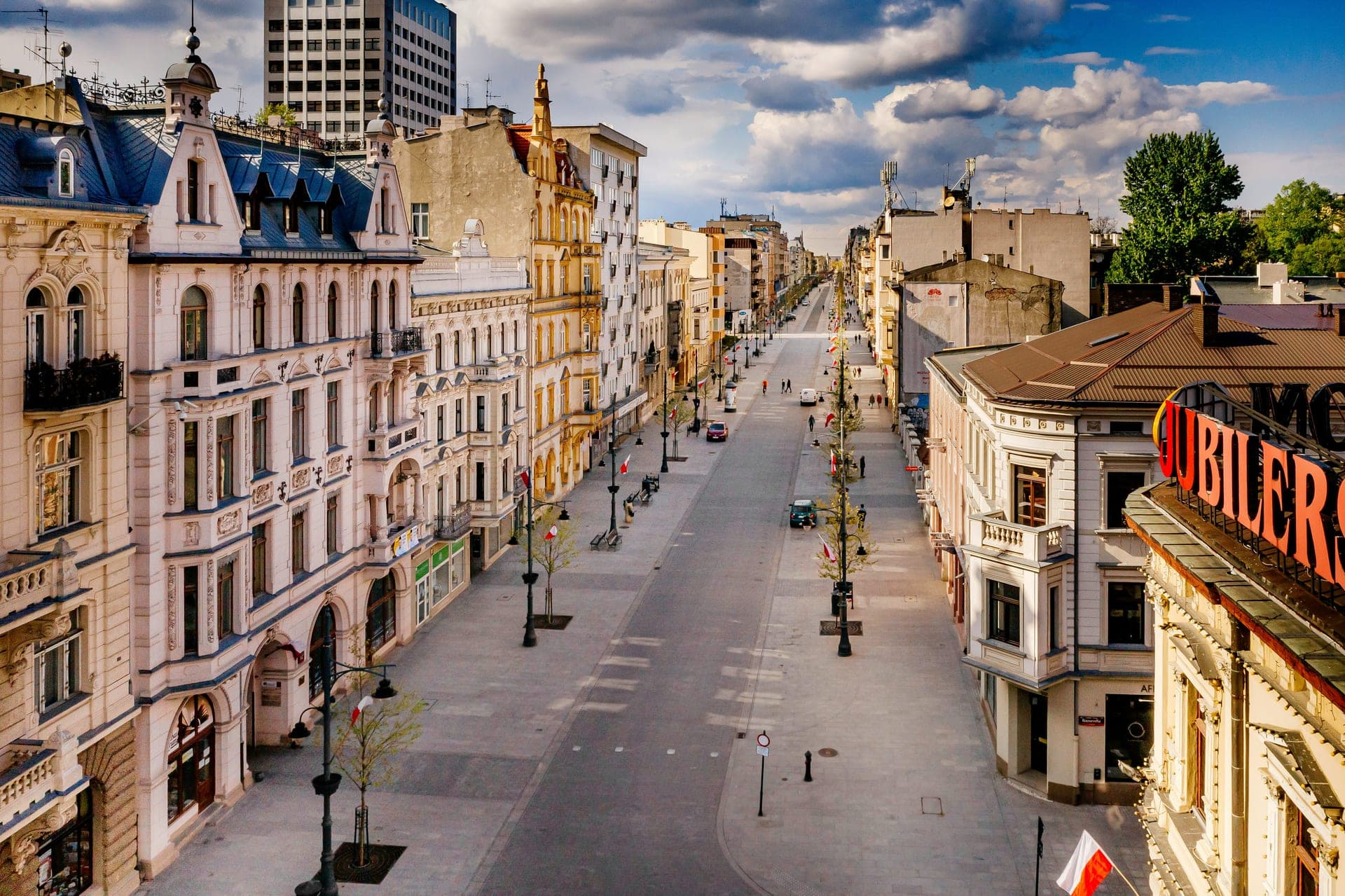
A city with empty flats and a waiting list
Łódź was invented for industry. In 1820 the government of the Congress Kingdom of Poland set the village aside for planned textile development, and it grew from 13,000 people in 1840 to over 500,000 by 1913. Mill owners housed their workers in brick rows beside the spinning halls, and tenements filled the grid around Piotrkowska Street. That inheritance now runs in reverse. From a peak of about 854,000 in 1988, the city has shrunk to 639,890 residents at the end of 2025, and the housing question has turned from shortage to condition.
Most Łódź households own their home. The Eurocities survey of 20 European cities puts owner-occupation at 62%, a figure that includes the cooperative ownership right most Polish statistics count as ownership. The municipality holds the largest block of the rest. At the end of 2024 its stock held 37,251 flats, about 9.6% of the city's 386,614 dwellings. Cooperatives have no current published city-wide share. They are spread across 48 housing cooperatives, none of which publishes a city-wide total. Private renting fills most of the remainder, beside a thin layer of TBS flats (towarzystwa budownictwa społecznego, non-profit rental companies built with state loans).
- Owners
- Owner-occupier44.9%
- Cooperative13.2%
- Renters
- Public & non-profit rental6.2%
- Private rental35.7%
Share of dwellings by tenure, resolved live from the geographic catalogue.
Social housing in Poland is a rent rule inside the municipal stock, not a tenure beside it. A lokal socjalny (a social flat reserved for the poorest households) is let at 2.80 zł a square metre (about €0.66) from January 2026. Other council tenants now pay a base rent of 14 zł (about €3.29), up from 12.50 zł. The city publishes no separate count of social flats, so the layer cannot be sized against the stock.
The private market starts far above that floor. Advertised rents in May 2026 averaged 53 zł a square metre (about €12.47) across 7,617 listings. A studio still advertised for less than 1,800 zł a month in January 2026. Council tenants in new or revitalised buildings pay a surcharge that lifts them to 16.80 zł (about €3.95). A newly let private flat therefore costs close to 4 times a council one per square metre. Buying is cheap by national standards, at 9,708 zł per square metre for a new flat in late 2025, a price level Warsaw, Kraków, Wrocław, Gdańsk and Poznań left behind long ago.
- Social flat (lokal socjalny)
- Public/municipal housing
- Municipal, new or revitalised building
- New contracts
Monthly rent per square metre by tier, net of utilities. Converted at 4.25 zł per euro.
Łódź's defining housing number is an empty one. At the end of 2024, 27% of the municipal stock, 10,222 flats, stood unoccupied, according to GUS returns analysed in Filip Springer's column on the city's empty council flats. Only 338 were simply waiting for tenants. The city hall says 5,600 of about 10,100 empty flats sit in buildings marked for demolition. In 2015 the city owned 10,000 more council flats and had half today's vacancy rate: it has been selling and demolishing faster than it renovates.
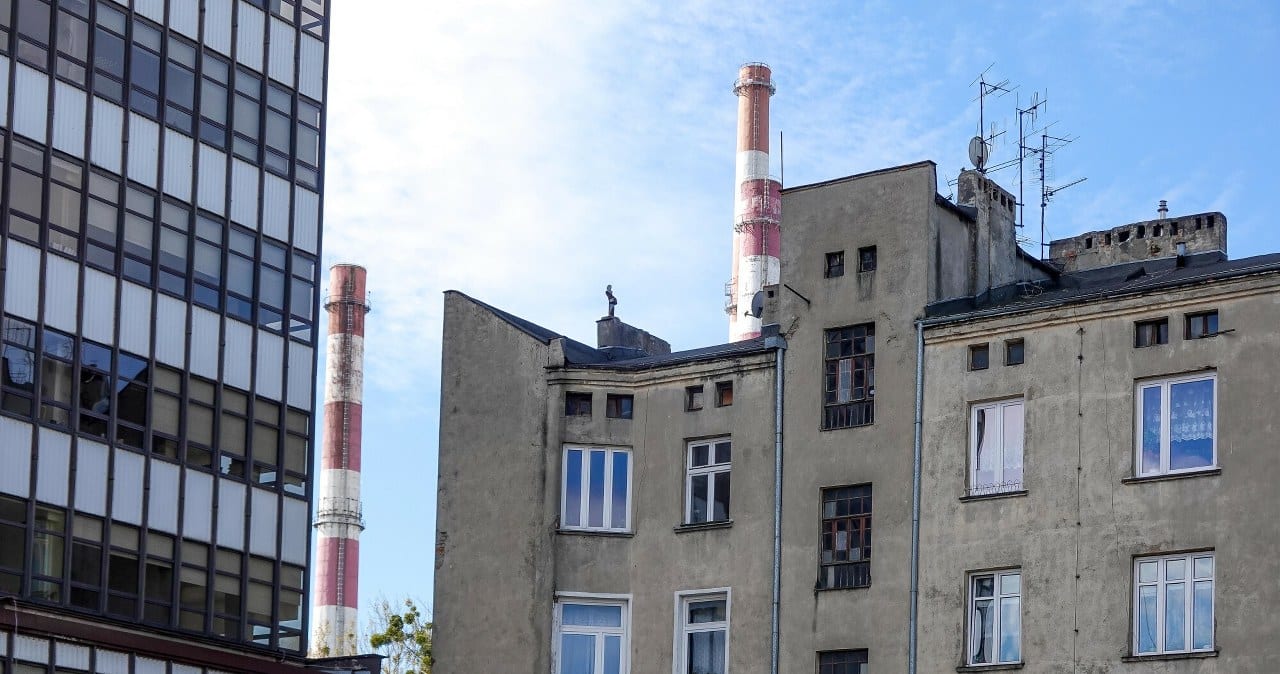
Łódź's statistics show a painful truth: you cannot recover flats that were allowed to turn into ruins over decades.Building has not slowed with the population. Developers completed 5,489 dwellings in 2024, or 8.46 per 1,000 residents, well above the national rate. In the same year the city lost 1,437 residents to internal migration, only partly offset by a foreign-migration balance of +209. Eurocities records the paradox directly: Łódź lost about 4% of its population in 5 years while average property prices rose 81% between 2019 and 2024.
The squeeze falls hardest on households who depend on the city. Eurocities puts waiting times for social housing at more than 60 months and notes rising demand from vulnerable groups, refugees among them. Nationally, 33.7% of Poles lived in an overcrowded home in 2024, double the EU rate of 16.9%. Cheap square metres can still mean cramped homes. Łódź is one of the ten case-study cities in ESPON's harmonised housing-affordability database, which sets rents against local incomes. Tenants have started to protest too. In December 2025 dozens of council tenants demonstrated outside the city hall against the rent rise, pointing to flats in poor repair. Interia's headline for Springer's column called Łódź the city that concentrates Europe's housing challenges.

Between the owners and the council sits a cooperative sector that built much of post-war Łódź and today builds very little.
The cooperative estates that outlived the mills
A Polish housing cooperative, the spółdzielnia mieszkaniowa, gives its members one of two rights. The spółdzielcze lokatorskie prawo (a tenant-right: the member occupies the flat but cannot sell it) was the post-war norm. The spółdzielcze własnościowe prawo (an ownership right that can be sold, mortgaged and inherited) took over after 1990, and many members have since converted to full title. That is why statistics file most cooperative households as owners. In practice the cooperative often survives as the manager of the estate rather than its landlord.
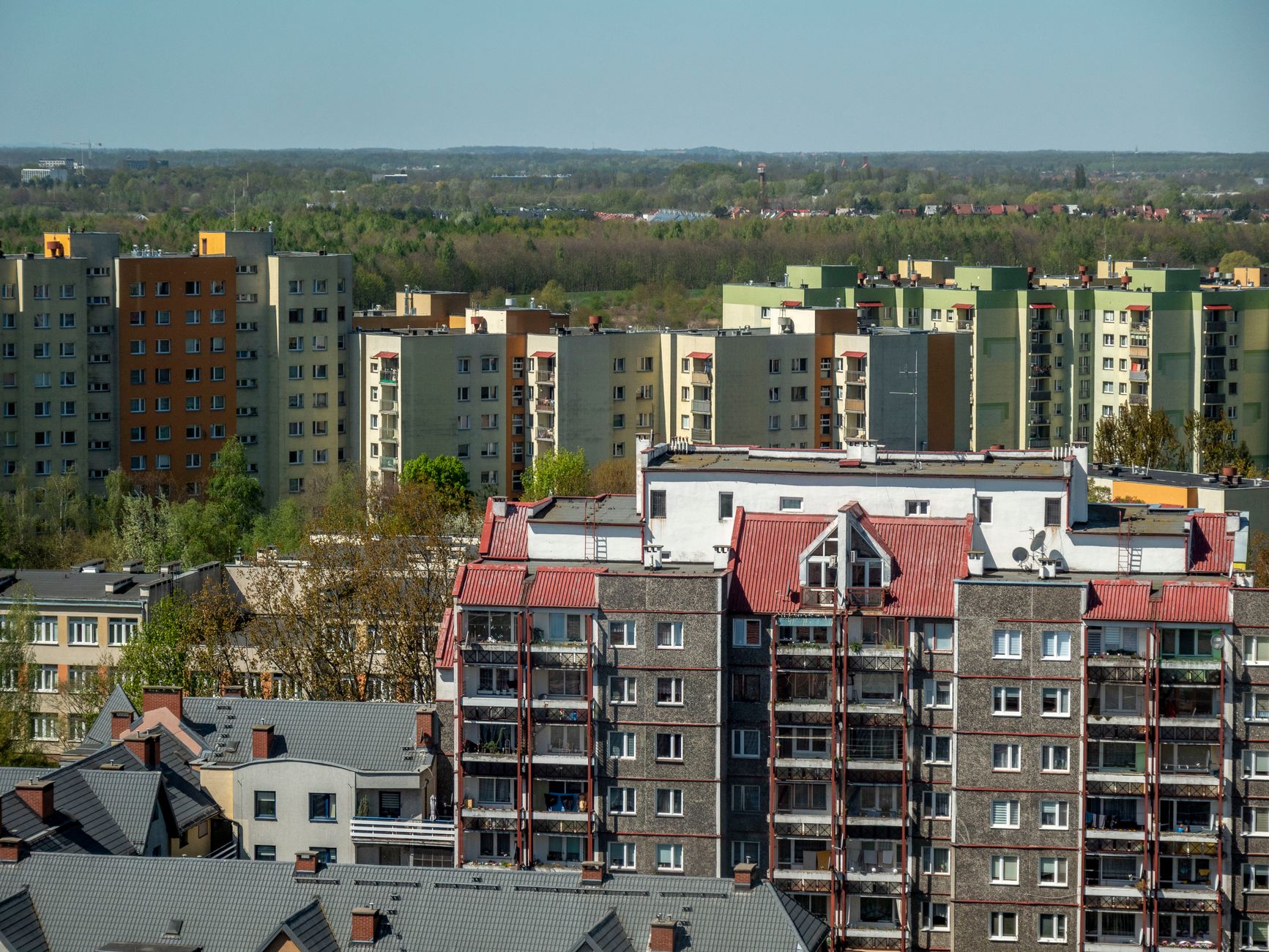
Łódź's cooperative era was an industrial one. The Robotnicza Spółdzielnia Mieszkaniowa „Polesie” (the Polesie workers' housing cooperative, called „Przyszłość” until 1971) built the large-panel district of Retkinia from 1972, on a plan by Krystyna Krygier and Tadeusz Sumień. Villagers were moved off the land to make room for the blocks. Today Retkinia, Karolew and Smulsko together house nearly 71,000 people. Other textile-era cooperatives followed, and RSM Bawełna (bawełna means cotton) grew into one of the largest in the voivodeship.
Those giants have since broken apart. In 1990 RSM Polesie split into smaller cooperatives, among them SM „Botanik”, SM „Piaski” and SM „Zagrodniki”, each running a single estate. RSM Bawełna spun off SM „Zarzew” in 1980 and SM „Czerwony Rynek” in 1981, and it still manages 8,261 flats for 10,244 members. Of those cooperatives, only 2 were building in 2024: SM Budowlanych „Kielnia” and SM Radogoszcz-Wschód. Their new flats sell quickly, and they sell rather than let. The rest administer, maintain and repair estates from the 1970s and 1980s. The two clusters face different problems. The estate managers carry the cost of retrofitting large-panel blocks. The two builders compete with private developers for land and finance. A 2023 Studia BAS paper on the barriers and opportunities facing Polish housing cooperatives sets both in a national frame.
City hall treats cooperatives as neighbours rather than partners. National housing money reaches Łódź through the municipality and its own companies, and the city's programmes are written for its own stock, its tenants and private developers. The OECD's 2025 review of housing reforms in Czechia and Poland examines the same national toolkit from outside, including the place of not-for-profit providers in it.
Demolish, rebuild, re-let
Mayor Hanna Zdanowska's administration (KO, the Civic Coalition) set out its answer in September 2025. The city council adopted a municipal housing programme for 2025 to 2030 with 1,500 new flats and 2,200 renovated ones. It will modernise 125 municipal buildings and demolish 149 in the worst condition. It also plans to shrink the municipal stock from 37,579 flats to 30,000 by merging, selling and demolishing. In February 2026 the city restated its goal as about 4,500 renovated flats by the end of 2030, alongside more than 1,500 new municipal flats.
New building begins where tenements come down. At Młynarska 20 in Bałuty, a prefabricated five-storey block replaces a demolished tenement with 28 two- and three-room flats. Across that quarter, Okopowa Street and Zgierska Street, the city plans 300 new municipal flats within 5 years.
Most of the money is national. For 2026 the government has set aside a record 6.7 billion zł (about €1.58 billion) for housing, according to the Ministry of Development and Technology (MRiT), which runs housing policy. Of that, 4.02 billion zł flows through the Fundusz Dopłat (the housing subsidy fund) at BGK (Bank Gospodarstwa Krajowego, the state development bank). It pays for council flats, rental schemes and student housing, with a target of more than 18,000 affordable homes. The Łódzkie voivodeship holds the air-quality rules and the EU regional funds. The city holds land, stock and rents. Eurocities notes that Łódź leans on limited public funding and short-term project grants, and that inflation made its pre-approved budgets obsolete within a year.
Łódź's own instruments target people and plots more than organisations. The city trades municipal plots to developers for middle-income flats. Its STRYCH programme turns underused attics into flats with rent reductions of up to 80%, and a City of Students scheme houses students and recent graduates. Since 2025, Mieszkanie za remont (a flat for renovation) lets a tenant refurbish an empty council flat at their own cost in return for a secure lease below market rent.
On vacancy, the city's reply is demolition first. The deputy mayor, Adam Wieczorek, said in February 2026 that most empty flats sit in buildings long prepared for demolition, and that 38 buildings came down last year, with 150 more to follow. Renovated buildings then carry a rent surcharge of up to 20%. The independent councillor Kosma Nykiel warned that the change would reach tens of thousands of tenants, including families moved out for renovation who now pay more to return. At European level, the 'Right to Housing! Now and Forever' citizens' initiative asks for rules on vacant homes and easier conversion of empty buildings. FEANTSA's study of repurposing vacant spaces into homes makes the case in detail.
Climate policy reaches Łódź through its stoves. The Łódzkie voivodeship's anti-smog resolution, in force since 2018, required unclassified solid-fuel boilers to go by 1 January 2025. The Mia100 kamienic programme (100 tenements renovated by the city) pairs thermal upgrades with courtyard redevelopment, and the Green Trails project ties new housing to green infrastructure. The stakes rise with the EU's second carbon market. A Bertelsmann Stiftung study of ETS2's effect on European housing finds Polish households among the most exposed to dearer heating. The city's green showcase is the International Horticultural Expo, moved from 2024 to 2029 after the pandemic.
- 1820[source]
Łódź designated for industry
The government of the Congress Kingdom sets Łódź aside for centrally planned textile development.
- 1870[source]
Scheibler buys Księży Młyn
Karol Scheibler acquires the burnt-out mill estate and builds spinning halls, services and workers' family houses around it.
- 1928–1931[source]
Montwiłł-Mirecki estate
The city magistrate builds a modern workers' estate with electricity, running water and sewers.
- 1972[source]
Retkinia's first block
The Polesie workers' housing cooperative hands over the first block of the large-panel Retkinia estate.
- 1988[source]
Population peaks
Łódź reaches about 854,000 residents, before the textile industry collapses in 1990 and 1991.
- 1990[source]
The cooperative giants split
Members of RSM Polesie vote to divide it into smaller cooperatives, one per estate.
- 2010[source]
Lofty u Scheiblera open
The Scheibler spinning mill reopens as 421 lofts after a 250 million zł conversion.
- 2017–2024[source]
Area revitalisation of the centre
Eight EU co-financed projects renew about 180 tenements and add 1,006 flats.
- 2025[source]
Smoky boilers banned
The regional anti-smog resolution's deadline for replacing unclassified solid-fuel boilers passes on 1 January.
- Sept 2025[source]
Housing programme to 2030 adopted
The council votes for 1,500 new and 2,200 renovated flats and a stock cut to 30,000.
- Jan 2026[source]
Council rents rise
The base rent climbs from 12.50 zł to 14 zł per square metre, and to 16.80 zł in new and revitalised buildings.
- 2029[source]
Horticultural Expo
Łódź hosts the International Horticultural Expo, rescheduled from 2024.
- 2030[source]
Programme target year
About 4,500 renovated and more than 1,500 new municipal flats are due by the end of 2030.
Milestones in how Łódź was housed, and the goals the city and the region have set.
The quarrel in the council chamber is about credibility as much as targets. The administration argues that some buildings are beyond saving and that new flats on their plots serve tenants better.
Our strategy is to renovate where possible, and to build new where revitalisation is technically or economically unjustified.The opposition doubts the city can deliver even routine repairs to the stock it already has.
We will be watching you closely, because you have put together a fine programme, but there are people in Łódź who have been waiting since 2013 for their front door to be replaced.Neither side disputes that the council stock must shrink. They differ on whether a city still demolishing can be trusted with building.
Mills, famuły and a model estate
Księży Młyn is where Łódź first housed its workers on purpose. Karol Scheibler bought the burnt-out mill estate in 1870. Around his spinning halls he built a school, a fire station, a factory shop and rows of brick family houses, the famuły. The ensemble was declared a national historic monument in 2015. It is the city's original argument that homes, work and services belong within one walk.
Lofty u Scheiblera gave the district's biggest mill a second life. Opal Property Developments turned the spinning hall into 421 lofts of 40 to 200 m², investing 250 million zł. The conversion opened in May 2010 to designs by Gary Wolff with the Łódź practice Marciniak & Witasiak. It showed that a listed mill could hold homes. A University of Łódź study of how the neighbours see the lofts asks the next question: whom the conversion was for.
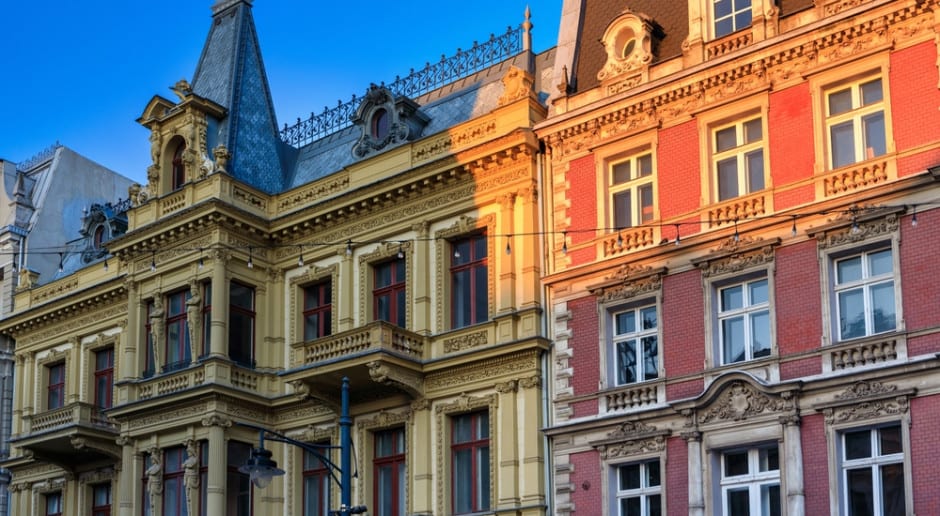
The Area Revitalisation of the City Centre (Rewitalizacja Obszarowa Centrum Łodzi) is the largest programme of its kind in Poland. Its eight EU co-financed projects renewed about 180 tenements and produced 1,006 new flats, 270 commercial units and 36 artists' studios. It is both the lighthouse and the argument, since tenants moved out during the works now face a surcharge to live in the result.
The Montwiłł-Mirecki estate shows that the city once built well for itself. The magistrate raised it between 1928 and 1931 on a competition-winning plan by Stefan Manasterski and Remigiusz Ostoja-Chodkowski. Its flats had electricity, running water and sewers when few Łódź homes did, and about 5,000 people lived there by 1939. It is still in good repair, which cannot be said of much that was built later.
Retkinia's cooperatives carry the post-war layer forward. SM „Botanik”, SM „Piaski” and SM „Zagrodniki” each run one slice of the estate their predecessor built. Many members now hold saleable or full ownership titles, but blocks, courtyards and maintenance are still run in common. That shared management of whole districts is the part of Łódź's cooperative tradition that still works every day.
Few European cities hold this set of materials: a municipal stock large enough to have empty flats in it, mills that have already been converted once, and cooperatives with half a century of estate management behind them. What Łódź has not yet shown is who will turn them into homes that stay affordable.
References
Statistics2Click on any number to see the source
Housing market
Population & migration
From our library9
- Cities addressing the housing crisis: Innovative and integrated approaches — Knowledge
- 10 tysięcy pustych mieszkań czy raczej ruin do wyburzenia? Łódź skupia wyzwania mieszkaniowe Europy — Knowledge
- Unequal housing affordability across European cities. The ESPON Housing Database, Insights on Affordability in Selected Cities in Europe — Knowledge
- Spółdzielnie mieszkaniowe na rynku nieruchomości w Polsce w XXI w.: Bariery i szanse rozwoju — Knowledge
- Housing Reforms in Czechia and Poland — Knowledge
- Łódź: radni uchwalili nową strategię mieszkaniową na lata 2025-2030 — Knowledge
- Reclaiming Vacant Spaces to Tackle Housing and Homelessness Crises in Europe — Knowledge
- Heating Up Inequality? Socio-spatial impacts of ETS2 on European housing and cohesion — Knowledge
- Lofty „U Scheiblera” w Łodzi z perspektywy mieszkańców najbliższego otoczenia — Knowledge
Further sources20
- Łódź — Wikipedia
- Łódź in numbers (GUS data) — Polska w liczbach
- Rent index, Łódź, May 2026 — Znajdź Najem
- Housing and rental prices in Łódź run against the tide — Bankier.pl
- Record sum for municipal flat repairs in Łódź, and rent rises — TuŁódź
- Council raises rents; tenants take to the streets — Portal Samorządowy (PAP)
- Living conditions in Europe – housing — Eurostat
- Housing cooperatives in Łódź are building — Łódź.pl
- RSM Bawełna — RSM Bawełna
- Retkinia — Wikipedia
- Łódź will build more municipal flats and tackle vacant ones — Radio Łódź
- Łódź will demolish tenements to build municipal flats — Bankier.pl
- Billions of złoty for housing: 4 bn zł into BGK's Fundusz Dopłat — Portal Samorządowy (PAP)
- The 'Mieszkanie za remont' programme starts in Łódź — Łódź.pl
- Anti-smog resolution of the Łódzkie voivodeship — Łódzkie voivodeship
- Księży Młyn — Wikipedia
- Montwiłł-Mirecki estate in Łódź — Wikipedia
- Lofty 'u Scheiblera' in Łódź officially open — Muratorplus
- Lofty u Scheiblera finished — Bryła
- Revitalisation in Łódź in numbers — Łódź.pl